
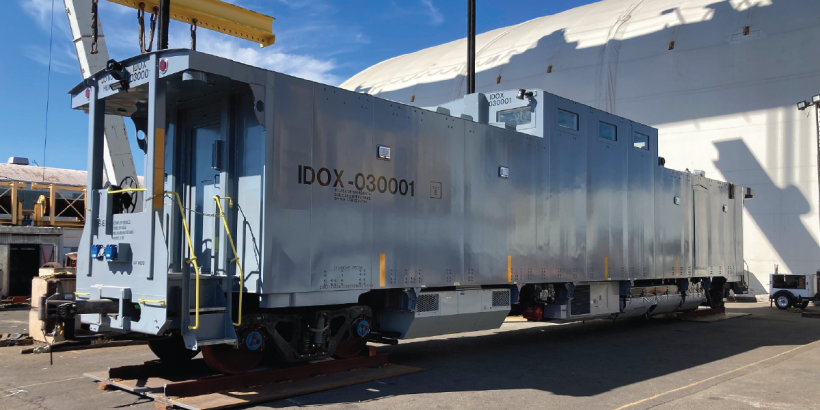
At first glance, the phrase “armored caboose” sounds like something a model-train enthusiast invented after drinking too much coffee near a hardware aisle. But the U.S. Navy and the Department of Energy are not building this railcar for decoration, nostalgia, or Instagram-worthy railroad vibes. They are building it because moving spent nuclear fuel is one of those jobs where “pretty good” is not a standard anyone wants to explain at a town hall meeting.
The Navy’s new Rail Escort Vehicle, or REV, is a modern security railcar designed to travel with shipments of spent nuclear fuel and high-level radioactive waste. Think of it as a rolling command post, security cabin, surveillance platform, and protective buffer of human judgment all packed into a heavy-duty railcar. It is not the old caboose from children’s books, where someone waves from the back while sipping coffee. This caboose has cameras, communications systems, rugged engineering, and a very serious job: helping protect nuclear material as it moves across America’s rail network.
The story matters because the United States has a large inventory of spent nuclear fuel from commercial reactors, research programs, and naval nuclear propulsion. That material must be stored, monitored, and, when necessary, transported safely. The Navy’s new armored caboose is part of a bigger modernization effort centered on the Department of Energy’s Atlas railcar system, a specialized train set designed to carry heavy spent-fuel containers under strict safety and security standards.
What Is the Navy’s New Armored Caboose?
The so-called armored caboose is officially known as the Rail Escort Vehicle. It was developed through cooperation between the U.S. Navy’s Naval Nuclear Propulsion Program and the Department of Energy. Its purpose is simple to describe and complex to execute: carry trained security personnel during rail shipments of spent nuclear fuel and high-level radioactive waste.
Unlike a normal passenger or service car, the REV is built around mission needs. Security teams need a place to work, rest, communicate, observe, and coordinate during long trips. Nuclear shipments do not move like ordinary freight. They require careful planning, regulatory compliance, route coordination, inspection, emergency preparedness, and constant attention. The REV gives personnel a dedicated space to manage those responsibilities without turning the locomotive cab into a crowded control room with worse legroom than an economy flight.
The vehicle is equipped with surveillance and communications capabilities. Public information describes features such as cameras and communications equipment, but it does not reveal sensitive operational details. That is exactly how it should be. A good security system is like a good magician: the audience may understand the theme, but nobody needs the full trick explained on a napkin.
Why Nuclear Waste Moves by Rail
Spent nuclear fuel is not green goo in a cartoon barrel. It is solid fuel material that has already been used in a reactor and is no longer efficient for power generation. It remains radioactive and thermally hot, so it must be shielded, contained, cooled, and monitored. When transported, it is sealed inside heavily engineered casks that are designed to protect people and the environment under both normal and severe accident conditions.
Rail is especially useful because spent-fuel casks can be extremely heavy. Some loaded transport packages are far beyond what typical highway trucking can comfortably handle. Railroads are built for heavy loads, long distances, and controlled logistics. That makes rail a logical option for large-scale future movement of spent nuclear fuel from reactor sites to storage or disposal facilities.
The Atlas system is designed for this world of heavyweight responsibility. The main Atlas railcar is a 12-axle car built to carry massive spent-fuel containers. Two buffer railcars provide spacing within the train, and the Rail Escort Vehicle carries the escort team. Together, the system is less like “a train car” and more like a coordinated safety architecture on wheels.
Atlas: The Heavy Lifter Behind the Caboose
The Rail Escort Vehicle gets attention because “armored caboose” is a headline with a handlebar mustache. But the Atlas railcar is the muscle of the system. Atlas was developed by the Department of Energy to transport commercial spent nuclear fuel and high-level radioactive waste safely and securely. It was designed to handle some of the heaviest shipments in the national nuclear waste program.
Atlas is not just a flatcar with a fancy name. It includes specialized structural features, advanced monitoring systems, and engineering built around the demands of heavy radioactive-material transport. The system completed extensive testing, including a long-distance test run between Colorado and Idaho. In 2024, the Association of American Railroads certified the Atlas railcar system for operation on major U.S. freight railroads under the S-2043 standard, which applies to railcars carrying high-level radioactive material.
That certification is a big deal. Railroads are not in the habit of saying, “Sure, bring your 480,000-pound nuclear-material shipment aboard; we’ll figure it out after lunch.” AAR standards exist to make sure special railcars behave safely in the real freight environment, including curves, braking, couplings, track interactions, and the complicated physics of very heavy objects moving at speed.
Why the Rail Escort Vehicle Matters
A nuclear shipment is protected by layers. The first layer is the fuel form itself. The second is the shipping cask, which provides shielding, containment, heat removal, and criticality prevention. The third is the railcar system, designed to carry the cask safely. The fourth is the operational plan, including inspections, routing, communications, and trained personnel. The Rail Escort Vehicle strengthens that fourth layer.
The REV gives escort personnel visibility and connectivity. During a shipment, they can monitor conditions, communicate with relevant authorities, and support quick decision-making if something unusual happens. That could mean a mechanical issue, a weather disruption, a blocked route, a public-safety concern, or any number of ordinary rail problems that become more interesting when the cargo is nuclear waste.
In other words, the REV is not there because the casks are weak. The casks are built to be tough. The REV is there because high-consequence transportation deserves redundancy. If your phone has a password, facial recognition, two-factor authentication, and still asks whether you are really trying to buy socks at midnight, then yes, a nuclear shipment can have multiple layers too.
How Safe Are Spent Nuclear Fuel Shipments?
The Nuclear Regulatory Commission requires spent-fuel transport packages to prevent release of radioactive contents, provide shielding, remove heat, and prevent nuclear criticality. To qualify, package designs must demonstrate performance under normal transport conditions and severe accident tests, including impact, puncture, fire, and immersion scenarios.
These tests are intentionally harsh. A shipping package must be able to withstand conditions such as a drop, a puncture test, a fully engulfing high-temperature fire, and water immersion. The point is not to make nuclear transport sound dramatic; the point is to design containers so that real-world drama does not become a radiological emergency.
The United States has transported spent nuclear fuel for decades. Most shipments are rare compared with ordinary hazardous-material movements, but the regulatory framework is extensive. The Department of Transportation oversees hazardous-material shipping rules and rail safety, the Federal Railroad Administration enforces rail-safety responsibilities, and the NRC certifies the most hazardous radioactive-material packages and regulates physical protection for commercial spent fuel in transit.
The Security Side: Serious, But Not Hollywood
When people hear “nuclear waste train,” the imagination sometimes grabs a movie camera and starts running. The real world is less cinematic and more procedural. Security is about planning, deterrence, monitoring, communication, and disciplined response. The Rail Escort Vehicle supports those basics.
It is important not to confuse public safety with secrecy theater. The public should know that spent nuclear fuel is transported in certified containers, that railcars are tested, that agencies coordinate oversight, and that security personnel accompany certain shipments. At the same time, the public does not need sensitive details about routes, tactics, or exact security procedures. Good transparency explains the safety case without handing out the instruction manual to bad ideas.
The Navy’s involvement makes sense because the Naval Nuclear Propulsion Program has long experience moving naval spent fuel and related components by rail. The new REV helps replace older escort vehicles and creates a design that can support both Navy needs and DOE’s broader spent-fuel transportation program. That kind of shared development saves money, reduces duplication, and avoids the classic government problem of building two separate expensive solutions that both somehow need a third solution later.
Why Communities Should Pay Attention
Nuclear waste transportation is not only an engineering issue. It is also a public-trust issue. Rail routes pass through real communities with real emergency responders, local officials, schools, hospitals, farms, businesses, and people who would very much like to know that the train rolling by has been planned carefully.
Public concern is understandable. Radiation is invisible, nuclear history is complicated, and the phrase “high-level radioactive waste” does not exactly sound like a county fair attraction. But fear is not a substitute for information. Communities benefit when federal agencies coordinate with states, tribes, local responders, and rail operators before shipments occur.
Training matters. Emergency responders need to know who to call, how to identify shipment documents, how to establish safe perimeters, and how to coordinate with federal teams. Most transportation incidents are not radiological catastrophes; they are practical problems first. Is someone injured? Is the track blocked? Is there a fire unrelated to the cask? Are communications working? The REV helps escort teams stay connected and aware during those practical moments.
What Makes This Caboose “Armored” in Spirit?
The word “armored” can suggest steel plates and action-movie bravado, but the better meaning here is resilience. The Rail Escort Vehicle is built for a protective mission. Its value comes from hardened purpose, secure communications, surveillance capability, onboard personnel support, and integration into a rail system designed for unusually demanding cargo.
The REV protects nuclear shipments by improving human control around the shipment. It helps trained personnel stay with the train, maintain awareness, and respond to changing conditions. It is a reminder that safety is not only about thick metal; it is about systems thinking. A cask without trained oversight is less complete. A railcar without communications is less capable. A route without coordination is less trustworthy. The REV ties these pieces together.
In plain English, the armored caboose is not the superhero. It is part of the superhero team. Atlas carries the load. The cask contains and shields the material. Buffer cars add spacing. Regulations set the rules. Inspectors, railroads, and emergency planners keep the operation disciplined. The REV brings the escort team along for the ride with the tools they need.
Specific Example: A Complete Nuclear Waste Train
A typical Atlas consist is designed around several railcars working together. The main Atlas cask-carrying railcar holds the transport container. Buffer railcars sit between critical parts of the train to provide spacing and operational separation. The Rail Escort Vehicle travels with the shipment and supports security personnel. Locomotives provide power, while rail operators manage movement under the established routing and safety framework.
During testing, the system was evaluated as a full train rather than as isolated equipment. That matters because railcars behave differently when connected. Coupler forces, braking responses, curves, track geometry, vibration, and weight distribution all interact. Testing a single car tells engineers one thing. Testing the complete consist tells them whether the system can behave properly in the real railroad environment.
This is why the final testing and certification process took years. Nuclear transport equipment must be boring in the best possible way. Exciting trains are for theme parks. A spent-fuel train should be predictable, monitored, compliant, and dull enough to make an accountant nod approvingly.
The Bigger Nuclear Waste Problem
The armored caboose solves one part of a much larger issue: the United States still needs long-term solutions for spent nuclear fuel and high-level radioactive waste. Commercial spent fuel is stored at reactor sites across the country, usually in pools first and then in dry storage systems. A permanent geologic repository has been debated for decades, and interim storage remains a policy challenge.
Transportation will become more important when the country decides where that material should go. Without safe transport, storage policy is stuck in place. Without public trust, even technically sound transport can become politically difficult. The Atlas system and REV do not answer every policy question, but they build necessary infrastructure for the day when shipments must scale up.
That is why this railcar story deserves more attention than it will probably get. It is not flashy like a new fighter jet, and it will not star in a recruitment commercial with dramatic music. But infrastructure often matters most when nobody notices it. Bridges, railcars, inspection programs, casks, communications networks, and emergency plans are the quiet machinery of national safety.
Experience-Based Lessons From Nuclear Waste Transport
The most useful experience around nuclear waste transportation comes from one repeated lesson: people trust systems they can understand. They do not need every technical diagram, but they do need clear explanations. When communities hear “nuclear waste train” with no context, anxiety fills the empty space. When they learn that the material is solid, sealed in certified casks, moved under federal rules, and escorted by trained personnel, the conversation becomes more grounded.
Another lesson is that logistics are not glamorous, but they are everything. A successful shipment begins long before a train moves. Equipment must be inspected. Railcars must be tested. Routes must be reviewed. Communications must be checked. Responders must know their roles. The best day in nuclear transport is one where nothing exciting happens because everyone did the unexciting work correctly beforehand.
Experience also shows that emergency preparedness should be practical rather than theatrical. Local responders do not need panic; they need procedures. In any rail incident, the first priorities are life safety, scene control, communication, and hazard identification. With nuclear material, radiological assessment becomes part of the response, but it does not erase the basics. The Rail Escort Vehicle supports those basics by keeping knowledgeable personnel with the shipment.
There is also a public-communication lesson. Officials should avoid two mistakes: overselling safety as if risk is zero, and describing risk so vaguely that it sounds mysterious. The honest message is stronger: spent fuel transport involves risk, but the risk is managed through engineered containers, tested railcars, strict rules, trained escorts, and coordinated oversight. That is more credible than “trust us,” which is historically the least comforting sentence in government communication.
Finally, the armored caboose teaches a broader infrastructure lesson. Modern safety is rarely one big invention. It is usually a stack of smaller improvements that work together. Better railcars. Better sensors. Better communications. Better testing. Better coordination. Better training. The REV may look like a caboose with a serious gym membership, but its real value is integration. It connects people, equipment, procedures, and information during a mission where gaps are not welcome.
Conclusion: A Caboose With a Mission
The Navy’s new armored caboose is more than a quirky rail story. It is a practical response to a national challenge: how to move spent nuclear fuel and high-level radioactive waste safely, securely, and credibly. The Rail Escort Vehicle gives security personnel a purpose-built platform for monitoring and coordination. The Atlas railcar provides the heavy-lift backbone. Certified casks provide containment and shielding. Federal rules and rail standards provide the framework.
No single railcar can solve America’s nuclear waste policy puzzle. But the REV and Atlas system show that the country is preparing the transportation tools it will need. That preparation matters. When the future finally calls for large-scale movement of spent nuclear fuel, the answer cannot be “we have a clipboard and good intentions.” It needs to be tested equipment, trained people, clear procedures, and public confidence.
So yes, the Navy has helped build a new armored caboose. It will not wave cheerfully from the end of a storybook train. It will work quietly, watch carefully, communicate constantly, and help protect some of the most sensitive cargo in America. For a caboose, that is quite a career upgrade.













