
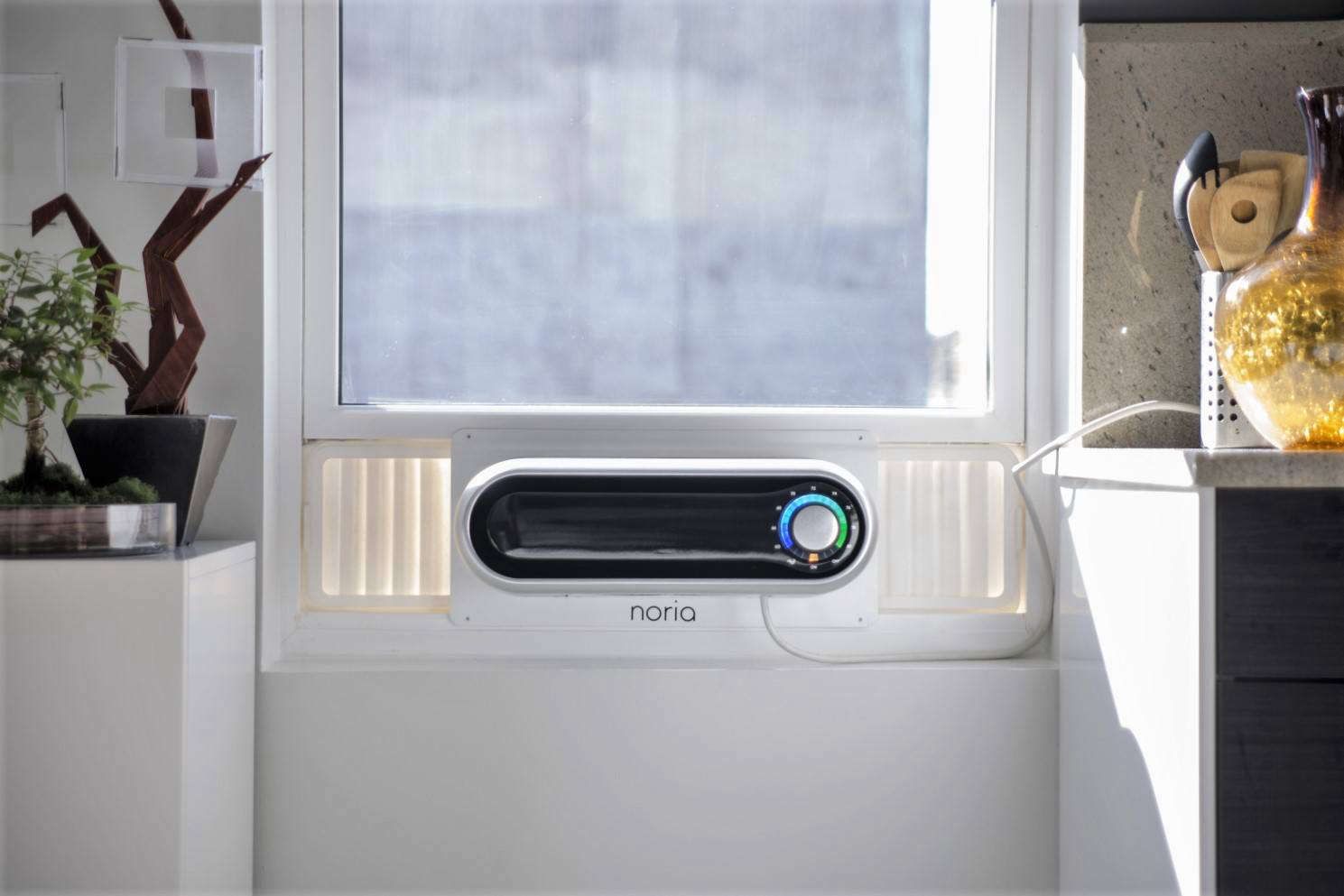
The Noria Smart Air Conditioner arrived with a wonderfully simple question: Why did window air conditioners still look and feel like appliances designed to punish anyone with a window?<d long been bulky, awkward to install, noisy enough to join the conversation, and large enough to turn a pleasant view into a close-up of beige sheet metal. Noria proposed something radically different: a slim, attractive, connected window air conditioner designed around the person using it rather than merely around the refrigeration hardware hiding inside.
Unveiled as a crowdfunding project in 2016, Noria quickly attracted attention for its low-profile body, smartphone controls, upward-directed airflow, simplified installation system, and compact 5,000-BTU cooling capacity. The idea resonated so strongly that the campaign raised far more than its original goal. Yet the story that followed became more complicated. Noria was later renamed Kapsul, production suffered years of delays, specifications evolved, some units eventually reached customers, and the company later encountered severe financial trouble.
That history makes Noria more than an interesting air conditioner. It is also a revealing case study in smart-home design, hardware manufacturing, crowdfunding, and the surprisingly difficult business of making a genuinely better window AC.
What Was the Noria Smart Air Conditioner?
Noria was conceived as a complete rethink of the conventional window air conditioner. Instead of beginning with the familiar giant metal box and adding Wi-Fi as an afterthought, the design team focused on several everyday complaints: blocked windows, difficult installation, poor aesthetics, uneven airflow, confusing controls, and inconvenient seasonal storage.
The original concept stood less than six inches tall and offered approximately 5,000 BTU of cooling capacity. Early specifications described a body roughly 5.8 inches high, 18.25 inches wide, and 15 inches deep. The prototype was promoted as weighing about 30 pounds, significantly lighter than many conventional units of the period.
Those numbers mattered because Noria was not trying to cool an entire open-plan house. Its natural habitat was the small bedroom, studio, dorm room, apartment office, or other compact space where a traditional 5,000-BTU window unit would normally be used.
The concept was reportedly intended for a room of roughly 160 square feet. Current room-air-conditioner sizing guidance generally places a 5,000-BTU unit in approximately the 100-to-150-square-foot range under typical conditions, with adjustments needed for strong sunlight, unusual ceiling height, kitchens, or additional occupants. In other words, Noria’s cooling capacity was firmly in the small-room category, no matter how futuristic the exterior looked.
The Design That Made Noria Famous
A Window AC That Did Not Eat the Entire Window
The most obvious Noria feature was its height. Conventional window units often occupy a substantial portion of the lower window opening. Noria’s slim horizontal profile attempted to preserve more glass, more daylight, and more of the outside view.
That sounds cosmetic until you live in a small apartment. In a compact room, a window may be the main source of natural light. Covering half of it with an appliance can make the entire space feel smaller. Noria treated the window as part of the room instead of free real estate waiting to be conquered by a compressor.
This design-first philosophy anticipated a broader change in the air-conditioner market. Modern U-shaped and saddle-style window ACs now compete partly on the same qualities: reduced indoor noise, better window usability, improved sealing, and a less intrusive appearance. Noria was early in recognizing that cooling performance was only one part of the user experience.
An Installation System Designed for One Person
Installing a traditional window AC can feel like participating in a very short, very dangerous strongman competition. You lift a heavy metal box, balance it near an open window, attempt to understand tiny diagrams in the manual, and briefly consider whether your security deposit covers accidental air-conditioner flight.
Noria’s answer was a dedicated window frame adapter. The idea was to install and secure the frame first, then slide the air conditioner into the prepared opening. A front handle and more manageable form factor were intended to make installation and removal easier for one person.
This was arguably one of Noria’s strongest ideas. Smart controls are convenient, but they do not help much when an appliance is physically miserable to install. Hardware design begins before the power button is pressed.
Upward-Directed Airflow
Noria was also designed to send cooled air upward rather than simply blasting it horizontally across the room. Because cooler air tends to sink while warmer air rises, the concept aimed to encourage better circulation and reduce hot and cold pockets.
In practice, room comfort depends on far more than vent direction. Insulation, window exposure, humidity, ceiling height, furniture placement, and room geometry all matter. Still, directing airflow toward the upper part of the room was a thoughtful attempt to address air distribution rather than merely producing the coldest possible breeze three feet in front of the machine.
What Made Noria a “Smart” Air Conditioner?
The original Noria concept included connected control through a smartphone. Early promotional material described Bluetooth connectivity, temperature adjustment, and scheduling from a mobile app.
At the time, that felt unusually modern for a window AC. Today, remote control and scheduling are common among connected room air conditioners, but the practical benefits remain useful.
A smart air conditioner can allow a user to create a cooling schedule instead of running the unit continuously. For example, a bedroom AC might cool the room shortly before bedtime and reduce its activity later at night. An office unit might remain off during the weekend. Remote access can also prevent the classic summer mystery: “Did I leave the AC running, or am I currently air-conditioning an empty apartment for my houseplants?”
The later Kapsul version moved toward Wi-Fi connectivity. Product information also discussed onboard sensing and future smart-home integrations. As with many connected appliances, however, buyers must remember that software support matters almost as much as the compressor. An ordinary mechanical control can work for years. An app-dependent feature is only useful while the app, servers, account system, and company remain functional.
Fresh-Air Mode Was Another Interesting Idea
The original Noria concept also promoted a fresh-air mode that could bring cooler outdoor air inside when conditions were suitable. The basic logic was attractive: if the outdoor temperature drops below the indoor temperature in the evening, why run refrigeration at full power when cooler outside air may help?
Natural ventilation can be useful under appropriate temperature, humidity, air-quality, and weather conditions. It is not automatically a good idea during wildfire smoke, heavy pollution, extreme humidity, or high outdoor temperatures. Still, the concept showed that Noria’s designers were thinking beyond the standard binary choice of “compressor on” or “compressor off.”
Noria Specifications: Concept Versus Production Reality
One source of confusion around the Noria Smart Air Conditioner is that the early concept and the later Kapsul production version did not have identical specifications.
The original Noria was promoted as an exceptionally slim, approximately 30-pound 5,000-BTU air conditioner. After the product evolved into the Kapsul W5, published specifications described a unit approximately seven inches tall, 20 inches wide, and 22 inches deep. Listed weight figures also varied in company materials, with approximately 40 pounds appearing in technical specifications and a higher figure appearing elsewhere on the product page.
The later W5 specifications included:
- 5,000 BTU cooling capacity
- Approximately 7 inches tall
- About 20 inches wide and 22 inches deep
- Compatibility with qualifying single- and double-hung windows
- 120-volt household power
- Approximately 480 watts of listed power use
- An EER rating listed as 11
- Wi-Fi connectivity
This evolution illustrates a basic truth about physical products: a beautiful prototype is the beginning of engineering, not the end. Certification, durability, manufacturing tolerances, heat exchange, noise control, shipping, serviceability, and cost can all force changes before a design reaches production.
Was the Noria Air Conditioner Energy Efficient?
Noria’s compact dimensions and smart controls made it look efficient, but visual minimalism should never be confused with measured energy efficiency.
For room air conditioners, shoppers should examine recognized efficiency measurements such as CEER, or Combined Energy Efficiency Ratio, and look for current ENERGY STAR certification when available. Higher efficiency means producing more useful cooling for the electricity consumed.
The later Kapsul W5 was listed with an EER of 11. The room-AC market has continued to advance since Noria’s original 2016 campaign, especially through variable-speed compressor technology. Modern inverter and variable-speed designs can adjust output instead of repeatedly operating at full power and switching completely off. That can improve temperature stability, reduce unnecessary cycling, save energy, and lower perceived noise.
This is an important consideration for anyone comparing the Noria idea with newer products. The Noria concept was futuristic in industrial design and usability, but today’s best window ACs benefit from a decade of additional development in compressors, control systems, sealing, efficiency standards, and smart-home integration.
The Crowdfunding Success and the Long Road to Kapsul
Noria was a crowdfunding sensation. Its Kickstarter campaign attracted thousands of supporters and raised roughly $1.5 million, dramatically exceeding its original goal. Additional crowdfunding reportedly added hundreds of thousands of dollars more.
Unfortunately, demand is not the same thing as manufacturing readiness.
Backers were originally expecting delivery much sooner than many ultimately received it. Years of delays followed. Manufacturing challenges, tariffs, supply-chain problems, and other difficulties were cited over time. The Noria name was eventually changed to Kapsul following a naming dispute.
By 2021, some production units had reached customers, but public reporting showed that many original backers were still waiting. The situation became especially controversial when units were offered to retail customers while some early crowdfunding supporters remained unfulfilled.
By May 2023, public reporting based on comments from the company’s interim leadership described an extremely difficult financial situation. The company was said to have run out of money, with liquidation considered likely, while many original supporters still had not received products.
That history should not erase the engineering ideas behind Noria, but it should absolutely shape how the product is discussed. Noria was not a simple story of “invent clever AC, launch clever AC, everybody lives happily and comfortably at 72 degrees.” It became a cautionary tale about the enormous distance between a successful prototype and a sustainable consumer-hardware company.
What Noria Got Right
It Focused on Real Human Problems
Noria’s greatest strength was not Bluetooth. It was empathy.
The product asked what people actually disliked about window air conditioners: lifting them, storing them, looking at them, listening to them, controlling them, and losing a large portion of the window.
That approach is still relevant. A product can perform its technical function perfectly and remain unpleasant to own. The best appliance design considers the entire experience, from carrying the box through the front door to cleaning the filter years later.
It Proved Consumers Wanted Better-Looking Cooling
The enthusiasm surrounding Noria demonstrated genuine demand for room air conditioners that did not resemble industrial equipment borrowed from the back of a grocery store.
Since then, the category has become considerably more design-conscious. Sleeker front panels, improved controls, U-shaped architectures, quieter inverter compressors, and connected apps are far more common.
Noria did not single-handedly create that trend, but it clearly represented the same consumer frustration that helped drive it.
It Made Installation Part of Product Design
Many appliance companies historically treated installation as the customer’s problem. Noria treated it as a design challenge.
That remains one of the project’s most valuable lessons. A window AC that performs beautifully after installation but requires two people, a support bracket, three towels, a screwdriver, and emotional counseling to mount is not delivering a completely polished experience.
Where the Noria Concept Faced Limitations
5,000 BTU Is Still 5,000 BTU
A slim cabinet does not repeal thermodynamics. A 5,000-BTU room air conditioner is best suited to a relatively small space.
A sunny 300-square-foot living room, a kitchen, or a poorly insulated top-floor apartment could easily demand more cooling capacity. Buyers who focus on appearance while ignoring room size may end up with an attractive machine working desperately and continuously without creating comfortable conditions.
The Final Product Was Less Featherweight Than the Concept
The original approximately 30-pound vision was particularly appealing. Later Kapsul specifications described a heavier production unit. It may still have been easier to handle because of its shape and integrated handles, but the finished appliance was not quite the tiny lightweight miracle suggested by some early impressions.
Connected Features Create Long-Term Dependencies
Smart-home functionality is wonderful when everything works. It is less wonderful when an app disappears, a server shuts down, or a manufacturer no longer supports the product.
For major appliances, the best smart features should enhance basic functionality rather than become mandatory for basic operation. A good AC should still cool the room even if the cloud service has wandered off to that great server farm in the sky.
How the Noria Idea Compares With Modern Window Air Conditioners
The window-AC market now offers several technologies that address problems Noria identified a decade ago.
Variable-speed compressors can provide quieter, steadier, and more efficient cooling. U-shaped designs can place more of the noisy hardware outside while preserving greater control over the window. Smart connectivity commonly provides scheduling, remote control, energy information, and voice-assistant integration.
Modern buyers should therefore avoid choosing a room air conditioner on design alone. Compare:
- Cooling capacity for the actual room size
- Current ENERGY STAR certification
- CEER or other recognized efficiency ratings
- Variable-speed or inverter technology
- Measured noise performance
- Window compatibility and sealing
- Drainage requirements
- Filter access and cleaning
- Warranty and replacement-part availability
- The manufacturer’s history of software and customer support
Noria helped popularize the idea that a window AC could be beautiful and pleasant to use. Today’s shopper can demand those qualities while also insisting on proven efficiency, reliable support, and real-world availability.
Experience: What Living With a Noria-Style Smart Air Conditioner Would Feel Like
The most useful way to understand the appeal of the Noria Smart Air Conditioner is to imagine the everyday experience it was designed to improve.
Consider a small bedroom in a city apartment. The room has one good double-hung window, limited storage space, and no central air conditioning. Every June, the resident retrieves a conventional window AC from a closet. The machine weighs enough to make the annual installation feel like a minor home-improvement project. Once installed, it blocks much of the lower window and introduces a steady mechanical soundtrack to every video call, movie, and attempt at sleep.
A Noria-style experience begins differently. Instead of balancing the entire air conditioner in an open window from the beginning, the user prepares the installation system and then positions the unit into the secured adapter. A wide body and accessible handles can make the appliance feel less like a dense cube of machinery. Even when the final production unit is not genuinely lightweight, better ergonomics can make a major difference.
Once running, the low-profile body leaves more of the window visible. That may sound like a small benefit until the room is narrow and the window provides most of the daylight. Preserving a few additional inches of glass can make the room feel less boxed in.
The upward airflow also changes the sensation of cooling. A traditional unit may create one aggressively cold zone directly in front of the vent while the opposite side of the room remains warm. A design intended to distribute air upward can create a gentler circulation pattern. The result, in the ideal room, is less “arctic blast to the left shoulder” and more general comfort.
Smart scheduling becomes valuable after the novelty wears off. The best connected appliance experience is not constantly opening an app and admiring a temperature graph. It is needing the app less because the appliance follows a useful routine.
Imagine setting the AC to begin cooling a bedroom before sleep rather than turning it on hours earlier. On a mild evening, a fresh-air function could potentially reduce the need for compressor cooling when outdoor conditions are favorable. In the morning, a schedule could raise the target temperature or shut the system down automatically.
The experience also reveals why sizing is crucial. Put a 5,000-BTU unit in a compact bedroom and the capacity may be appropriate. Put the same unit in a large sun-baked living room with tall ceilings, and the elegant design suddenly matters much less. The compressor may run continuously while the user wonders why the “smart” air conditioner has not developed the intelligence to create another 5,000 BTUs.
Noise is equally personal. Promotional language such as “quiet” or “whisper quiet” is useful only up to a point. A light sleeper may notice compressor tones that another person ignores completely. The location of the bed, window construction, fan speed, and vibration through the frame can all affect the experience. This is why standardized or independently measured sound data is preferable to adjectives wearing tiny marketing hats.
Seasonal storage is another area where the Noria philosophy makes sense. A lower-profile appliance is easier to place under a bed or on a storage shelf than a tall conventional window box. For renters who install and remove an AC every year, storage dimensions can be almost as important as operating dimensions.
Then there is the less glamorous part of ownership: maintenance and support. Filters need cleaning. Window seals must remain tight. Drainage must work correctly. Connected features may need software support. If something fails, access to warranty service and replacement parts becomes more important than the beauty of the control dial.
That is perhaps the most important experience-related lesson from Noria’s history. A great appliance is not merely a great object. It is a long chain of experiences: purchasing, delivery, installation, daily operation, cleaning, software updates, troubleshooting, repairs, and eventual replacement.
Noria’s original vision understood the first half of that chain remarkably well. It made people imagine a window air conditioner that could be attractive, intuitive, compact, connected, and easier to live with. The difficult commercial history of Noria and Kapsul showed how challenging it is to deliver the second half consistently.
For consumers today, the ideal Noria experience is therefore not necessarily buying an old Noria or Kapsul unit. It is applying the project’s best ideas to a modern purchase: choose an AC that fits the room correctly, preserves as much window function as possible, installs securely, operates quietly, offers useful rather than gimmicky smart controls, and comes from a manufacturer capable of supporting the product after the first heat wave.
Conclusion: Noria’s Real Legacy Is Bigger Than One Air Conditioner
The Noria Smart Air Conditioner remains a fascinating product story because the original concept identified genuine problems that the room-AC industry needed to solve. Its slim profile, simplified installation system, upward airflow, connected controls, and attention to appearance made the ordinary window air conditioner feel like a category ready for reinvention.
At the same time, the long development delays, transition to the Kapsul name, incomplete fulfillment history, and later financial difficulties demonstrate why innovative hardware is extraordinarily difficult to bring from a compelling campaign video to thousands of reliable homes.
Noria should therefore be remembered neither as a perfect lost masterpiece nor merely as another troubled crowdfunding campaign. Its ideas were meaningful. Its execution history was complicated. And many of the qualities that made the concept excitingquieter operation, smarter controls, easier installation, better window access, and more thoughtful designhave become increasingly important across today’s room-air-conditioner market.
The smartest lesson from Noria may be this: consumers do not simply want a machine that produces cold air. They want a cooling system that respects the room, the window, the electricity bill, and the person who has to lift the thing.
Note: Noria was later renamed Kapsul, and historical product pages may still appear online. Those older pages should not be treated as proof of current inventory, warranty coverage, app support, or an active retail operation. Buyers considering a used unit should independently verify condition, parts availability, connectivity, and service options before purchasing.













