
Shopping for an infant toy can feel strangely high-stakes. One package promises to build a baby’s brain, another claims to encourage six developmental skills before breakfast, and a third flashes brightly enough to direct traffic. Fortunately, babies are much easier to impress th. Child development experts consistently favor toys that encourage reaching, grasping, kicking, rolling, babbling, problem-solving, and interaction with caregivers. Parents tend to agreeespecially when a toy is washable, portable, durable, and capable of occupying a baby long enough for someone to drink half a cup of coffee while it is still warm.
This guide covers the best baby toys for the first year, including tummy-time toys, sensory toys, teethers, stacking toys, books, and early mobility toys. It also explains what each type supports, how to shop safely, and what experienced parents learn after living with a miniature toy tester who considers the packaging equally fascinating.
What Makes an Infant Toy Truly “Developmental”?
A developmental toy does not need a battery, an app, or a voice that cheerfully announces the color blue 47 times. It simply needs to give a baby an age-appropriate opportunity to practice a skill.
During the first year, infants learn through sensory exploration and repeated movement. They look at objects, follow them with their eyes, reach, grab, shake, mouth, drop, bang, transfer, hide, find, stack, and knock down. These ordinary-looking actions help build visual tracking, hand-eye coordination, fine motor control, body awareness, early language, and an understanding of cause and effect.
The adult involved in play matters just as much as the object. When a baby shakes a rattle and a parent says, “You made a sound!” the toy becomes part of a back-and-forth learning experience. Smiles, words, gestures, imitation, and responsive attention give simple toys far more developmental value than a complicated electronic toy used alone.
Best Infant Toys by Age and Developmental Stage
Age ranges are helpful starting points, not competitive deadlines. Babies develop at different rates, and premature infants may follow an adjusted developmental timeline. Always follow the manufacturer’s age and safety instructions while also watching what your baby can comfortably do.
1. High-Contrast Cards and Books
Best for: Newborns to 4 months
Young babies are drawn to bold contrast because their vision is still developing. Black-and-white cards, simple geometric patterns, and high-contrast cloth books are easy for newborns to focus on during supervised floor play.
Place a card approximately within your baby’s comfortable viewing distance and slowly move it from side to side. This encourages visual tracking without overwhelming the baby. High-contrast images can also make tummy time more interesting, which is no small accomplishment considering many newborns initially treat tummy time like an unreasonable workplace assignment.
Choose sturdy cards with rounded corners or washable fabric pages. Avoid hanging cards or toys from cords within the baby’s reach.
2. A Padded Play Gym or Activity Mat
Best for: Birth to approximately 9 months
A well-designed play gym is one of the most versatile infant toys. Newborns can look at hanging shapes while lying on their backs. Older babies can bat, kick, reach, roll, and explore different textures during supervised floor time.
Good activity mats offer several play positions without crowding the baby with constant noise and flashing lights. Look for removable toys, washable fabric, a nonslip base, and enough open space for free movement. A mat with a few thoughtfully placed objects is often more useful than one that resembles an infant-sized casino.
Parent favorites frequently include piano-style play gyms, minimalist wooden-frame gyms, and mats with detachable rattles or sensory fabrics. The best choice is the one that fits your space, cleans easily, and lets your baby move freely.
3. An Unbreakable Tummy-Time Mirror
Best for: Birth to 9 months
Babies are naturally interested in faceseven when the fascinating stranger in the mirror is themselves. An infant-safe mirror can encourage a baby to lift and turn the head during tummy time, supporting neck, shoulder, and upper-body strength.
Select a mirror specifically designed for infant play. It should be shatter-resistant, lightweight, stable, and free from sharp edges. Floor mirrors that stand upright or attach securely to a play mat are especially convenient.
Talk about what your baby sees: “There are your eyes,” or “That baby is smiling.” Your baby will not understand every word, but hearing language connected to an interesting object supports early communication.
4. Lightweight Rattles and Grasping Toys
Best for: Approximately 3 to 7 months
As babies begin opening their hands, reaching deliberately, and transferring objects, a lightweight rattle becomes a tiny laboratory for cause and effect. Shake toy, hear sound. Drop toy, watch parent retrieve it. Repeat until parent questions the meaning of time.
Choose a rattle with an easy-to-grip shape, gentle sound, smooth construction, and no detachable pieces. Flexible loop-style grasping toys and open-frame balls are popular because small hands can hold them from several angles.
The toy should be light enough that an accidental forehead bonk does not end playtime dramatically. Check it regularly for cracks, loose beads, exposed fasteners, or weakened seams.
5. Cloth, Crinkle, and Board Books
Best for: Birth through the entire first year
Books are among the best educational toys for infants because they combine pictures, language, touch, repetition, and caregiver interaction. Newborns may stare at one bold image. A 6-month-old may grab the pages. A 10-month-old may lift a flap, point, babble, and then attempt a literary taste test.
Cloth and crinkle books work well for younger infants because they are soft and washable. Thick board books are easier for older babies to handle. Look for simple photographs, faces, animals, everyday objects, rhymes, textures, or sturdy flaps.
Reading to a baby does not require finishing the story. Name pictures, imitate sounds, ask simple questions, and follow your baby’s attention. Three enthusiastic minutes can be more valuable than completing a book while your audience is crawling toward the laundry basket.
6. One-Piece Teethers
Best for: Approximately 3 months and older
Infants explore with their mouths long before they can politely examine an object with their hands. A properly designed teether can provide sensory input and something appropriate to chew when gums feel uncomfortable.
Choose teethers made as one sturdy piece whenever possible. They should be large enough not to become a choking hazard, easy to wash, and free from detachable decorations. Follow cleaning instructions carefully and inspect the surface for splits, punctures, or trapped moisture.
Avoid homemade teething jewelry, amber necklaces, and any item worn around an infant’s neck. Also avoid freezing a teether until it becomes rock-hard; a cool teether is usually gentler on sensitive gums.
7. Textured Sensory Balls
Best for: Approximately 5 to 12 months
A large, lightweight sensory ball can support grasping, two-handed play, visual tracking, crawling, and early turn-taking. Babies can squeeze it, roll it, mouth it, or chase it across the floor with the determined speed of someone pursuing an important business opportunity.
Choose a ball too large to fit into the baby’s mouth. Soft fabric balls, open-frame balls, and securely sealed textured balls are good options. Avoid small rubber balls, foam pieces that can be bitten off, and squishy gel toys that may leak if punctured.
Roll the ball slowly between you and your baby. Narrate the action using words such as “roll,” “stop,” “fast,” and “under.” This simple game combines movement, anticipation, language, and social engagement.
8. Nesting and Stacking Cups
Best for: Approximately 6 to 12 months and beyond
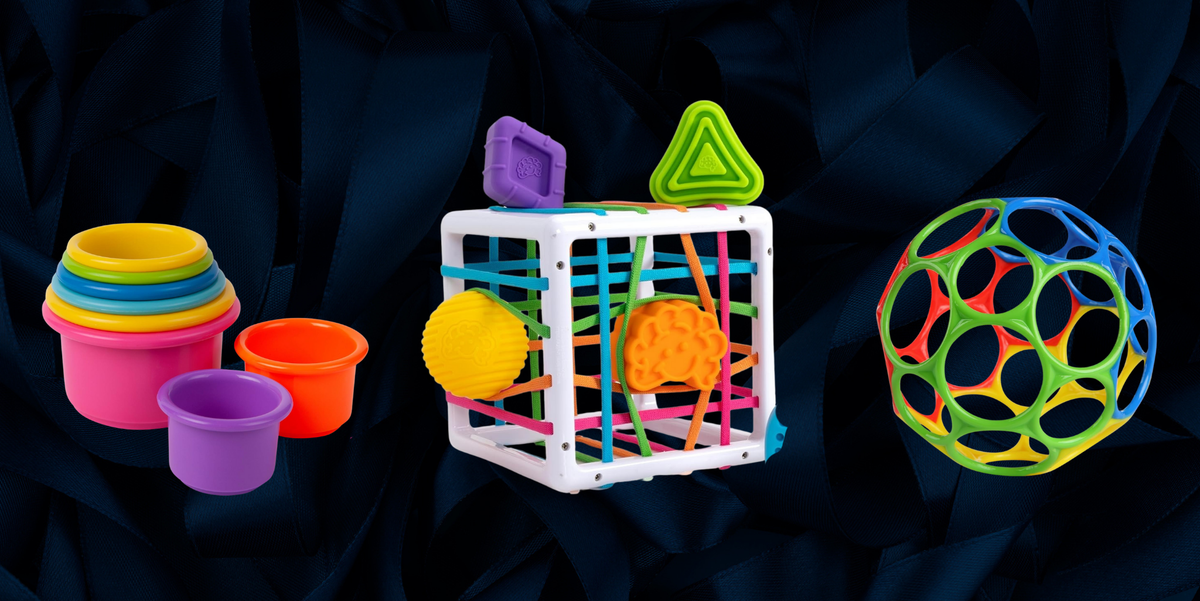
Nesting cups are inexpensive, portable, and surprisingly powerful learning toys. Babies can bang them together, knock down a tower, place one inside another, hide objects beneath them, or use them during supervised bath play.
These activities introduce size relationships, spatial awareness, object permanence, and problem-solving. Cups also remain useful into toddlerhood, making them an excellent value compared with toys a baby outgrows before the receipt reaches the recycling bin.
Look for smooth edges, sturdy construction, drainage holes for bath use, and pieces large enough for infant safety. Wash and dry them thoroughly, particularly after water play.
9. Soft Blocks
Best for: Approximately 6 to 12 months
Before babies become architects, they become demolition specialists. Soft blocks let them practice grasping, transferring, stacking, throwing, and knocking things down without turning the living room into a hard-hat zone.
Fabric, foam, or soft rubber blocks may include simple pictures, numbers, textures, or gentle sounds. Choose blocks without small inserts or coverings that can peel away. They should be washable and firm enough to hold their shape.
Build a two- or three-block tower, then let your baby knock it over. Repetition teaches prediction and cause and effect. It also teaches parents that rebuilding is apparently their new full-time position.
10. Simple Object-Permanence Toys
Best for: Approximately 7 to 12 months
As babies begin understanding that objects continue to exist when hidden, they often become delighted by drop boxes, pop-up toys, scarves pulled from containers, and classic peekaboo games.
A simple object-permanence box allows a baby to drop a large ball through an opening and watch it reappear. The activity supports hand-eye coordination, memory, attention, and problem-solving. However, an expensive wooden box is not mandatory. A clean container and a few large, safe objects can provide similar practice under supervision.
Start by partially hiding a toy beneath a cloth. Once your baby finds it easily, cover it completely. Expect dramatic surprise every time, even though your baby has personally conducted this experiment 19 times.
11. Stacking Rings
Best for: Approximately 7 to 12 months and beyond
Stacking rings are a classic for good reason. Younger infants may hold, shake, bang, and mouth the rings. Older babies can remove them from the post, compare sizes, and eventually attempt to replace them.
Early play does not need to be “correct.” A baby who places every ring on the floor is still exploring shape, weight, texture, and movement. Avoid constantly correcting the order. Demonstrate occasionally, then let the baby investigate.
Choose a stable base and large rings without holes or parts that could trap tiny fingers. Soft or flexible versions may be easier for younger babies.
12. Simple Musical Toys
Best for: Approximately 6 to 12 months
Egg-shaped shakers made specifically for babies, soft bells enclosed inside fabric, and small hand drums can encourage rhythm, listening, imitation, and coordinated movement. Musical play becomes even more valuable when a caregiver copies the baby’s sounds or takes turns making noise.
Keep the volume gentle. A toy held close to a baby’s ears can sound much louder than it does from across the room. Test noisy toys yourself, avoid products with harsh amplification, and make sure every sound-producing component is securely enclosed.
13. Large Activity Cubes and Cause-and-Effect Toys
Best for: Approximately 7 to 12 months
Activity cubes with large spinning pieces, sliders, flaps, rollers, or securely attached gears can keep a sitting baby engaged while encouraging finger control and problem-solving. Simple pop-up or push-and-release toys also help babies connect an action with a result.
The most useful versions do not perform the entire activity for the child. Look for toys that respond to pushing, turning, opening, or moving rather than toys that launch a long electronic performance after one button press.
14. A Stable Push Toy
Best for: Babies who are already pulling to stand and cruising
A sturdy push toy can provide movement practice for a baby developing balance and walking skills. This category is different from a seated baby walker, which child safety experts generally do not recommend.
The push toy should have a broad base, controlled wheel movement, a stable handle, and enough weight that it does not shoot forward when the baby leans on it. Use it only on a flat, hazard-free floor and remain within arm’s reach, especially near stairs or changes in floor level.
How to Choose Safe Baby Toys
Follow the Age Label
A toy’s recommended age is partly about developmental fit, but it is also a safety guide. Do not assume an advanced baby can safely use a toy designed for older children. Age warnings may reflect small parts, stronger hand skills, battery access, or the way a toy is expected to be used.
Think Bigger Than the Baby’s Mouth
Infants investigate nearly everything orally. Avoid small balls, marbles, loose beads, detachable eyes, coins, balloons, and pieces that can break off. Be particularly careful when older siblings have building sets, craft supplies, doll accessories, or other small objects.
Avoid Water Beads and Loose High-Powered Magnets
Water beads can expand after ingestion and cause serious internal obstruction. Loose high-powered magnets can also cause severe internal injuries if more than one is swallowed. These products do not belong in an infant’s play area, even when they are intended for an older child.
Inspect Battery Compartments
Button and coin batteries must never be accessible to infants. Battery compartments should require a screwdriver, coin, or tool to open. Stop using a toy immediately if the compartment is loose, cracked, or missing a screw.
Check Strings, Seams, and Sound
Avoid long cords, loose ribbons, elastic loops, and necklaces. Check stuffed and fabric toys for strong seams and securely attached parts. Test sound levels before handing over a musical toy, especially because babies may hold it directly against an ear.
Keep Toys Out of the Crib
Playtime and sleep time require different environments. Toys, pillows, blankets, stuffed animals, and other soft objects should not be left in an infant’s sleep space. Move the baby to a safe, clear sleep area whenever playtime ends or drowsiness begins.
How Many Toys Does an Infant Need?
Usually fewer than adults are tempted to purchase. A small collection covering several types of play is more useful than a crowded toy bin. Consider keeping a play gym, books, grasping toy, teether, cups, blocks, ball, and one or two cause-and-effect toys available.
Rotate toys every week or two instead of presenting everything at once. A familiar toy that disappears temporarily may feel exciting when it returns. Rotation also reduces clutter and makes it easier to notice which developmental skills and play styles currently interest your baby.
Real-World Parent Experiences: What Babies Actually Play With
One of the most common parent experiences is discovering that price has little relationship to popularity. A beautifully designed developmental kit may receive a polite glance before the baby spends 20 minutes investigating a clean silicone spatula. This does not mean the purchased toy was a mistake. It means infants are attracted to objects they can easily understand, manipulate, and explore with several senses.
Play gyms often earn their floor space because they evolve with the baby. In the newborn stage, the hanging pieces provide something to look at. A few weeks later, accidental arm movements become intentional batting. Eventually, babies grab the toys, roll toward them, and sit beside the mat while examining detachable pieces. Parents frequently appreciate products that support several stages rather than solving one narrowly defined developmental task.
Tummy-time mirrors are another item many caregivers initially underestimate. A baby who protests while staring at the floor may remain engaged longer when a face appears nearby. Parents often place themselves beside the mirror, copy expressions, sing songs, or move a rattle slowly across the reflected view. The mirror is useful, but the parent’s participation is what turns two quiet minutes into a richer language and social experience.
Teethers produce more divided opinions because babies have strong personal preferences. One infant may adore a textured silicone ring, while another rejects it in favor of a cool washcloth. Families often learn not to buy six versions before testing one. The winning teether is usually easy for the individual baby to hold, comfortable to mouth, simple to clean, and conveniently located when drool reaches weather-system proportions.
By the middle of the first year, stacking cups often become unlikely household champions. Babies bang them, throw them, hide snacks beneath them, and chase them across the kitchen. Parents use them during floor play, bath time, and travel. Unlike a toy that offers one scripted activity, cups invite experimentation. They also reveal a valuable truth about infant play: using a toy “incorrectly” is often exactly how learning happens.
Families with older children report a different lessoninfant toy safety depends on the entire room, not merely the baby’s toy basket. A carefully selected rattle offers little protection when a tiny building piece is under the sofa. Many parents create separate play zones, perform quick floor checks, and teach siblings to keep small-part toys at a table or in another room.
Toy rotation is another practical strategy that becomes more appealing after the living room begins resembling a warehouse. Parents commonly keep only a few toys accessible and store the rest in a closet or bin. The baby gets a calmer play area, adults spend less time cleaning, and previously ignored toys often regain attention when reintroduced.
Finally, experienced caregivers repeatedly notice that the longest-lasting “toy” is interaction. A parent imitating a baby’s rattle shake, hiding a cup beneath a cloth, naming pictures in a book, or rolling a ball back and forth can extend play far longer than extra features can. Babies do not need every award-winning product. They need safe opportunities to explore and someone willing to respond when they proudly discover, once again, that gravity still works.
Conclusion
The best infant toys match a baby’s abilities, invite active exploration, and make it easy for caregivers to join the fun. High-contrast books, play gyms, mirrors, rattles, teethers, sensory balls, stacking cups, soft blocks, and sturdy push toys can each support valuable skills when introduced at an appropriate stage.
Choose quality over quantity, inspect toys frequently, and do not be distracted by dramatic educational claims. A toy does not need to teach the alphabet in three languages. It needs to be safe, interesting, and open-ended enough for a baby to discover what happens next.
Note: Developmental timelines vary. Discuss concerns about your baby’s movement, vision, hearing, feeding, communication, or play skills with a pediatrician. Always check current product recalls and follow the manufacturer’s safety and age instructions.













