
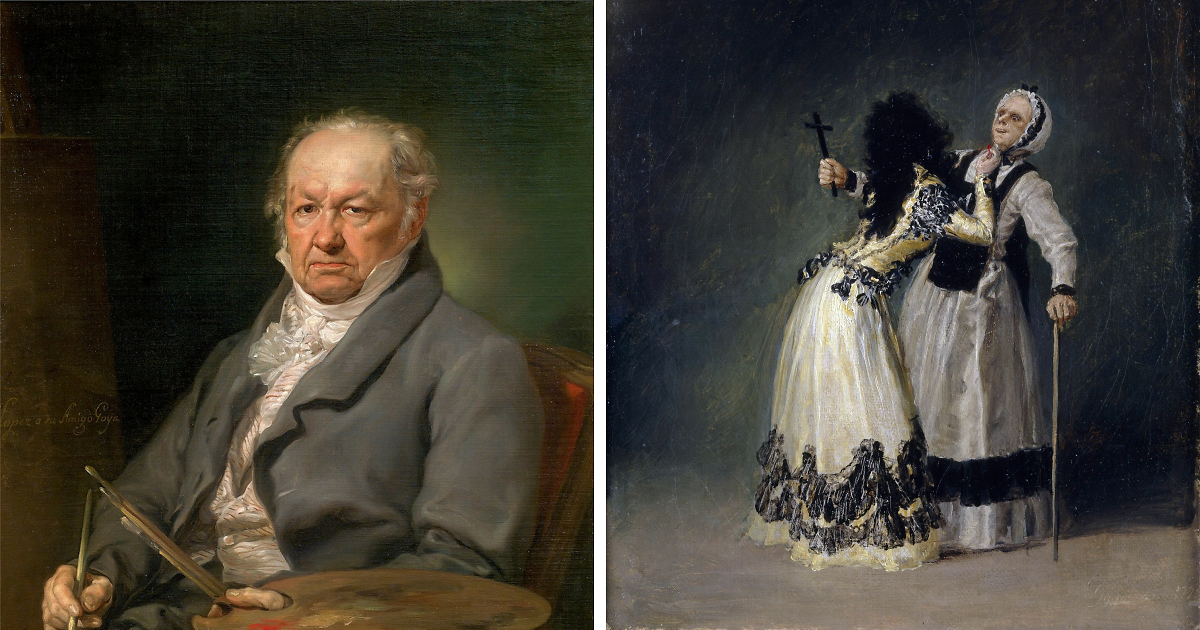
There are bad days, and then there are Francisco Goya days. The coffee is cold, the news is horrifying, your inbox has reproduced overnight, and somewhere in the mental basement a giant is chewing on the furniture. At moments like these, a pastel sunset with the words “Choose Joy” can feel less like encouragement and more like a personal attack.
Enter Francisco Goya, the Spanish painter and printmaker who looked at fear, violence, stupidity, superstition, political chaos, and the general human tendency to make everything worse and apparently thought, “Yes. That. Put it on the wall.”
Goya’s darkness remains strangely magnetic because it does not demand that viewers pretend life is tidy. His demons do not arrive with a five-step morning routine. His victims are not promised that everything happens for a reason. His most disturbing works acknowledge something many people quietly discover during difficult periods: sometimes solace begins not with cheerfulness, but with recognition.
That is the peculiar comfort of Goya’s dark art. It looks into the cellar, finds the monster, and turns on a lamp.
Goya Did Not Start Out as the Patron Saint of Bad Vibes
It is tempting to imagine Goya emerging from the womb holding a piece of charcoal and muttering about the collapse of civilization. His career was considerably more complicated.
Born in 1746, Francisco José de Goya y Lucientes became a highly successful artist. He designed tapestry cartoons, painted aristocrats, and eventually served the Spanish court. He could produce elegant portraits and polished official work. He understood status, fashion, and the delicate art of painting wealthy people without making them ask for their money back.
Then life became less decorative.
Illness, deafness, and a turn inward
In the early 1790s, Goya suffered a severe illness that left him deaf. Historians have debated the exact medical cause, and retrospective diagnosis is a dangerous parlor game. What is clear is that profound deafness altered the circumstances of his life. His work increasingly opened into sharper satire, fantasy, private observation, and disturbing imagery.
In 1799, he published Los Caprichos, a series of 80 prints attacking ignorance, hypocrisy, superstition, social pretension, and assorted human nonsense. The most famous image, The Sleep of Reason Produces Monsters, shows a slumped figure surrounded by owls, bats, and shadowy creatures.
The image is often reduced to a tidy slogan: abandon reason and monsters appear. Goya, predictably, is less tidy. The print belongs to a series where imagination, irrationality, social criticism, and nightmare constantly overlap. Reason matters, but imagination is not simply the enemy. The disturbing part is the unstable relationship between them.
In other words, the human mind is complicated. Stunning news from 1799.
Goya’s Darkness Had Receipts
Goya was not manufacturing gloom because black paint looked dramatic above the sofa. He lived through immense political upheaval.
Napoleon’s intervention in Spain and the Peninsular War produced occupation, resistance, executions, famine, and atrocities. Goya responded with The Disasters of War, a series of 80 prints whose very lack of heroic polish remains brutal.
Traditional war art often knows where to place the trumpet. There are flags, horses, noble commanders, strategic clouds, and men dying with suspiciously excellent posture. Goya largely removes the comfortable distance. Bodies hang from trees. Prisoners face rifles. Civilians suffer. Hunger reduces people to desperation.
The captions are frequently blunt, bitter, or weary. The images do not transform suffering into a pageant of national greatness. They ask what violence does to actual bodies and actual minds.
The Third of May 1808 refuses cinematic glory
Goya’s famous 1814 painting The Third of May 1808 takes the execution scene and makes it terrifyingly immediate. A firing squad becomes a repeating machine of uniforms and rifles. The soldiers’ faces are hidden from the viewer. Opposite them, condemned Spaniards react individually: terror, prayer, disbelief, collapse.
At the center, a man in a light shirt raises his arms. The pose carries echoes of Christian martyr imagery, but Goya does not wrap the execution in heavenly reassurance. Blood is already on the earth. Bodies are already piled in the foreground. Another group waits.
This is one reason Goya’s treatment of war influenced later artists. His visual language helped shape subsequent images of political violence, including works associated with Édouard Manet and Pablo Picasso. Goya understood a grim truth about modern horror: repetition is part of the nightmare.
The machine does not need to hate you personally. It only needs to continue.
The Black Paintings: When Your Interior Design Theme Is Existential Dread
Late in life, Goya moved to a property outside Madrid commonly known as the Quinta del Sordo, or Villa of the Deaf Man. Between roughly 1819 and 1823, he created the works now called the Black Paintings.
There are 14 paintings in the group. They were made directly on the walls of his home and were not conventional commissioned pictures designed to flatter a royal patron, satisfy a church committee, or impress someone choosing curtains.
The works were later transferred to canvas. Today, their isolation in museum frames can make us forget their original strangeness. These visions once inhabited rooms.
Imagine walking downstairs for a glass of water and passing Saturn Devouring His Son.
Suddenly the refrigerator light seems wonderfully optimistic.
Saturn is afraid, and that may be the worst part
In the myth, Saturn consumes his children to prevent a prophecy that one of them will overthrow him. Other artists had painted the subject before Goya. His version feels unusually raw.
The figure grips a mutilated body in darkness. His eyes are wide. His posture is frantic. This is not an elegant god calmly conducting mythological business. He appears consumed by the very fear driving his violence.
That makes the image difficult to dismiss as a simple picture of a monster. Goya gives us something more uncomfortable: a being becoming monstrous through terror, appetite, and desperate attempts at control.
It is possible to interpret Saturn politically, psychologically, mythologically, or personally. Goya left no handy podcast episode explaining the painting. The uncertainty is part of its power.
The lonely dog and the art of almost disappearing
Then there is The Dog, one of the Black Paintings’ quieter images. A small dog’s head appears above a sloping area of color, surrounded by an enormous, nearly empty space.
Compared with cannibal gods and witches, a dog sounds like emotional relief. It is not exactly a golden retriever calendar.
The animal appears isolated, overwhelmed, perhaps sinking or perhaps simply looking upward. Much of the painting offers no narrative answer. Viewers bring their own loneliness to that emptiness.
This is one of Goya’s remarkable abilities. He can make horror loud, but he can also make absence loud.
Why Dark Art Can Feel Comforting
Here is the apparent contradiction: why would anyone seek comfort in Goya’s darkness? When life already hurts, why voluntarily spend time with demons, executions, and a giant eating a relative?
Because comfort and happiness are not identical.
Research on viewing art and participating in creative activity suggests that artistic experiences can interact with emotion, stress, attention, empathy, and psychological well-being. Clinical art therapy goes much further and involves a trained professional, specific goals, and a therapeutic relationship. Looking at a Goya print in your bedroom is not automatically therapy.
Still, ordinary encounters with art can give difficult feelings somewhere to land.
“Someone else saw it too” is a powerful sentence
Distress often becomes heavier when it feels private and linguistically awkward. You may know something is wrong without having a polished explanation for it. Fear can be vague. Grief can be contradictory. Anger may arrive wearing sadness’s coat.
Art can externalize emotional complexity. Goya does not explain your specific bad day, of course. He does something broader. He confirms that dread, irrationality, cruelty, isolation, and confusion belong to the long record of human experience.
The monster is not proof that you failed at positive thinking.
The monster has historical colleagues.
Goya offers darkness without a motivational mug
Modern wellness culture can become aggressively bright. Real strategies such as healthy routines, social support, sleep, exercise, and professional care matter. The problem comes when every painful feeling is treated like a branding error.
Goya provides no compulsory silver lining.
He does not tell the executed man to manifest a better firing squad. He does not give Saturn a productivity planner. He lets terror remain terror.
Paradoxically, this honesty can reduce the loneliness of difficult emotions. A person can stand before an upsetting image and think, “Yes, not literally this, obviously, but emotionally… Tuesday.”
Do Not Forget That Goya Could Be Funny
Calling Goya a painter of darkness is useful, but incomplete. Scholarship on his drawings and prints also emphasizes his satire, tenderness, observation, and attraction to absurdity.
Los Caprichos is packed with grotesque humor. Goya mocks vanity, foolish customs, corrupt authority, bad education, superstition, and people behaving like donkeys. Literally, in some cases.
His humor matters because laughter and dread are not opposites. Anyone who has survived a catastrophic family dinner, a bureaucratic nightmare, or a group project knows this.
Sometimes reality becomes so ridiculous that humor is the only chair left in the room.
Goya’s comic cruelty rarely lets viewers feel completely superior, however. We may laugh at the fool and then recognize the fool’s shoes. His satire keeps rotating the mirror.
How to Look at Goya When You Are Having a Terrible Week
You do not need an art history degree, a black turtleneck, or the ability to pronounce every Spanish title with operatic confidence. Try slowing down with one work.
Describe before you interpret
Choose The Dog, The Sleep of Reason Produces Monsters, or one plate from The Disasters of War. Before Googling an explanation, describe what is physically present.
Where is the light? What occupies the most space? Where does your eye move first? Which face do you avoid? What seems unfinished, exaggerated, or strangely empty?
This basic act of looking creates a little distance between immediate reaction and interpretation. Instead of “This painting is depressing,” you may notice, “The figure occupies very little of the space, and I keep waiting for something to appear above it.”
That is a more interesting conversation.
Name the emotional friction
Ask why the work bothers or attracts you. Is it disgust? Pity? Fear? Curiosity? Recognition? Dark amusement?
You are not trying to solve Goya. Scholars have been arguing about him for generations, and they have libraries. You have a snack and perhaps 20 minutes.
The point is to notice your response.
Make something deliberately imperfect
Goya’s work can also inspire an ordinary creative response. Draw the mood of your week as a ridiculous creature. Give your anxiety six elbows. Paint bureaucracy as an enormous chicken wearing a crown. Write a caption in the spirit of a bitter old printmaker.
The goal is not to create museum-quality art. Making art for reflection is different from clinical art therapy, and neither requires becoming the next Goya before dinner.
The simple creative decisionthis fear gets claws, this frustration gets purple bootscan turn an invisible feeling into an object you can examine.
When life gives you lemons, paint a demon. Then give the demon an embarrassing hat. You are still in charge of accessories.
Goya’s Darkness Feels Uncomfortably Modern
Goya lived before smartphones, social media, 24-hour news alerts, and the phrase “per my previous email.” Yet his work feels astonishingly contemporary.
He was interested in corrupted reason, crowds, superstition, institutional brutality, political violence, fear, spectacle, and the ease with which human beings surrender judgment. None of those subjects have exactly retired to Florida.
The Sleep of Reason Produces Monsters feels relevant in an age when misinformation can travel globally before a responsible person finishes saying, “Hang on, is that account actually a veterinarian?”
The Disasters of War remains relevant because images of conflict continue to raise painful questions about witnessing. How much should we look at? When does documentation create understanding? When does repeated exposure numb us? What do we owe the people represented?
Goya cannot provide a modern media diet. He does, however, remind us that looking should be an active moral experience rather than passive visual consumption.
Finding Solace Without Romanticizing Suffering
There is a trap in discussing artists and darkness. We can start treating suffering as artistic fertilizer, as though deafness, war, illness, and political instability were generous career coaches.
They were not.
We should also resist diagnosing Goya from a distance based solely on unsettling paintings. Dark imagery is not a psychiatric chart. Artists invent, exaggerate, satirize, observe, remember, and transform.
The value of Goya’s work is not that misery automatically creates genius. It is that he found visual forms capable of holding experiences that polite language often fails to contain.
That distinction matters.
Art does not have to cure pain to accompany a person through it. A painting can be a witness rather than a prescription. For serious or persistent mental health concerns, professional support remains important. Saturn is memorable, but he is an appalling therapist.
An Experiential Reflection: A Bad Week, a Quiet Room, and Goya
Consider an experience that many art viewers may recognize. The week has been objectively ordinary and subjectively awful. Nothing has exploded. No invading army has crossed the parking lot. Yet deadlines have stacked up, sleep has become unreliable, and every minor inconvenience appears personally authored by a committee.
You open an image of Goya’s The Dog.
Your first response is disappointing: “That’s it?”
A small head. A slope. A huge field of emptiness.
You wait.
The waiting changes the painting.
After a minute, the empty space starts feeling less empty. It has weight. The dog’s position becomes uncertain. Is it trapped? Is it watching something? Is it emerging? The painting refuses to complete the story, and your mindan unpaid intern with terrible boundariesimmediately volunteers.
You notice that you want to rescue the dog. Then you notice you are not sure the dog needs rescuing. Then, slightly annoyingly, you realize the last few days have felt similar: a lot of emotional space with no obvious object inside it.
Nothing magical happens.
The dishes remain in the sink.
The difficult email has not written itself out of respect for Spanish Romanticism.
But a vague feeling has acquired an image.
Later, you look at The Sleep of Reason Produces Monsters. The bats and owls circling the collapsed figure initially seem theatrical. Then you think about 2:13 a.m., when the reasonable brain clocks out and every small concern applies for senior management.
You laugh.
Not because the image is harmless, but because recognition has a comic edge. Goya’s nightmare is grand, winged, and beautifully etched. Yours is worried that a three-word text message contained an invisible tone.
You take a sheet of paper and sketch the week’s anxiety as a creature. It resembles a nervous potato with twelve eyes. One eye is labeled “money.” Another is “deadline.” Three appear to be dedicated to an awkward conversation from 2017 that no living person remembers.
The drawing is bad.
That is part of the relief.
For ten minutes, the goal is not improvement, optimization, healing, networking, monetization, or becoming “the best version of yourself.” The goal is to decide whether the nervous potato needs teeth.
It absolutely needs teeth.
This kind of encounter with Goya can offer a modest form of solace. Not an escape from darkness, and not a claim that looking at art fixes psychological distress. The experience is smaller and perhaps more believable. A troubling feeling becomes observable. A private fear joins a much older conversation. Humor enters without demanding that sadness leave first.
Before closing the image, you return to The Dog.
The enormous space remains.
The dog’s head remains.
But you are looking differently now. You no longer demand that the painting explain whether the animal is doomed. You let uncertainty stay in the room without immediately wrestling it into a motivational quote.
For one quiet minute, that is enough.
Conclusion: Paint the Demon, Then Look at It
Francisco Goya’s darkness offers no cheerful formula for surviving a difficult life. That may be precisely why his art continues to matter.
From the satirical monsters of Los Caprichos to the unheroic violence of The Disasters of War and the private nightmares of the Black Paintings, Goya made room for fear, absurdity, cruelty, isolation, and doubt. He did not always resolve them. He gave them shape.
Sometimes that is what we need from art.
We do not always require a sunny landscape telling us the storm will pass. Occasionally, we need an old Spanish painter to acknowledge that the storm is weird, people are irrational, authority can be terrifying, and the bats are definitely getting closer.
Then we can breathe, laugh nervously, and pick up a pencil.
Life gave you lemons.
Fine.
Paint a demon.
Just remember: you choose the hat.
Note: Viewing or making art may support reflection and healthy coping for some people, but it is not a substitute for professional mental health care when serious or persistent distress requires treatment.













