
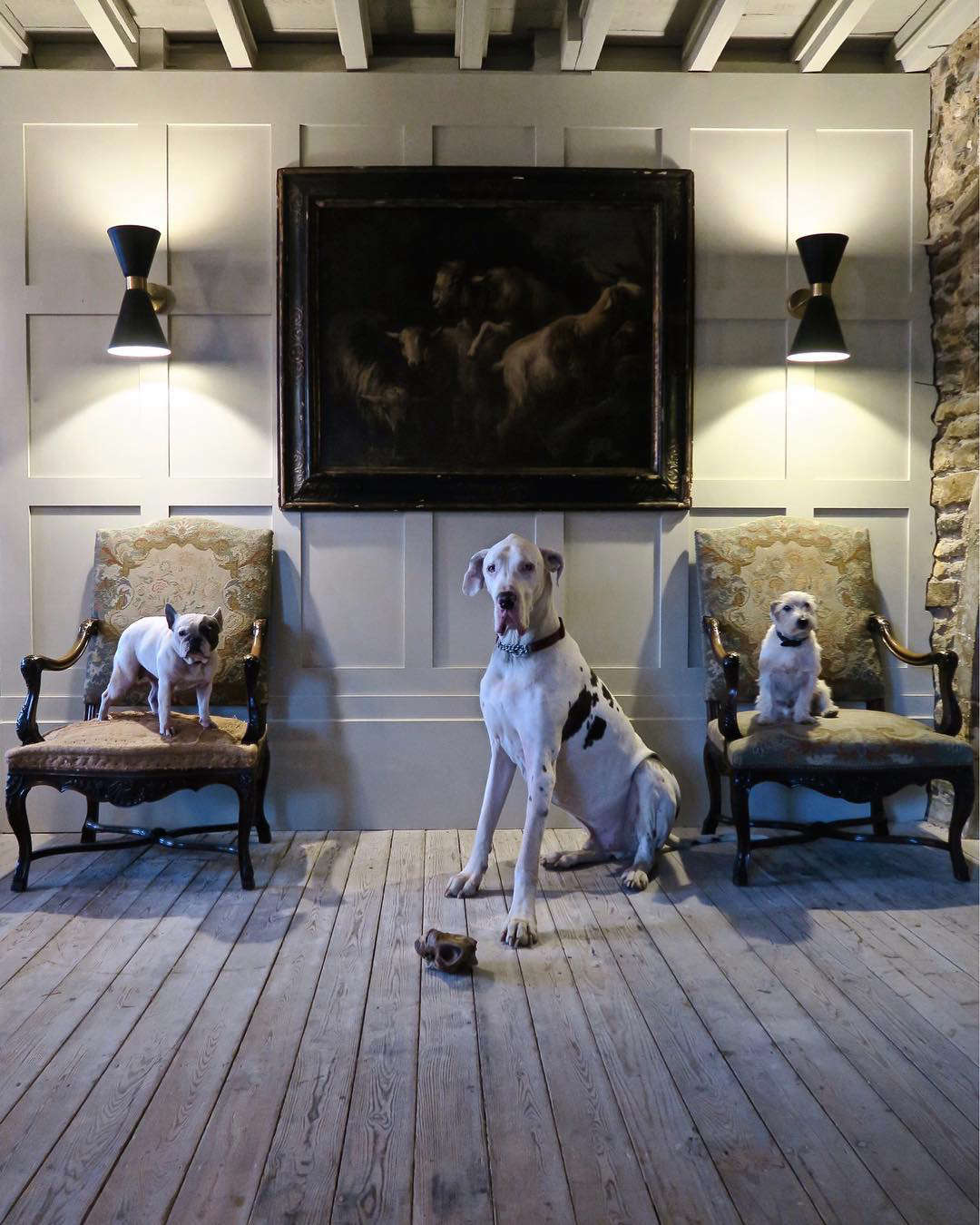
Most antiques showrooms ask visitors to admire a cabinet, test a chair, and keep a respectful distance from the porcelain. Alex MacArthur’s showroom in Rye, East Sussex, offers something more cinematic: step off a cobbled hill, enter a medieval religious building, look toward a soaring roof, and try not to be upstaged by a chandelier the size of a small weather system.
First introduced to design audiences as MacArthur’s new showroom after his move from Brighton, the space occupies the surviving chapel of an Augustinian friary established on this site around 1380. MacArthur discovered the derelict property in 2014 and bought it in 2015, beginning a demanding restoration alongside his antiques business. The result is not a conventional shop inserted into an old shell. It is a conversation between sacred architecture, industrial intervention, decorative antiques, modern design, and one dealer’s appetite for objects with serious presence.
A Showroom That Refuses to Behave Like One
MacArthur had already spent decades in the antiques trade, including early experience assisting a furniture restorer, working around London antiques markets, exhibiting at fairs, and building a business in Brighton. Quarterly open houses turned his Regency townhouse into an evolving domestic showroom. Clients enjoyed seeing pieces in a lived-in setting, but sharing a home with constantly changing inventory eventually became exhausting. A favorite chair could be part of the family on Monday and heading to a buyer by Friday.
He began searching for a live-work property with ecclesiastical character, industrial scale, architectural interest, broad lateral space, several entrances, and a walled garden for his dogs. That sounds less like a property brief and more like a request for a unicorn with planning permission, yet the former Austin Friars chapel in Rye checked nearly every box.
The building was in severe disrepair. The chapel had stood unused for years, while the attached Georgian cottage had been abandoned since the 1950s and occupied by pigeons with a strong sense of tenancy. Damp, decay, water intrusion, and the volume of the structure made the project intimidating. MacArthur nevertheless saw a future home, gallery, antiques showroom, event venue, and creative laboratory under one ancient roof.
The Monastery’s Long, Complicated Life
From Medieval Friary to Industrial Workspace
Augustinian friars moved to the Conduit Hill site around 1380 after losing an earlier location. The friary was dissolved in 1538 during the English Reformation, but the chapel survived while related monastic buildings disappeared. It later served practical uses that included a barracks, community space, malthouse, and pottery workshop.
Those changes remain visible. Medieval stone rubble walls, buttresses, pointed openings, and surviving tracery sit beside large industrial windows installed in the early 20th century. Some 14th-century windows were bricked in, but their elegant outlines can still be read. The later glazing pours daylight into the interior, producing a striking tension between sacred enclosure and factory openness.
A Protected Building, Not a Blank Canvas
The chapel is both Grade II listed and a scheduled monument. Renovation therefore cannot mean sanding away every inconvenient sign of age and manufacturing a smooth luxury finish. Conservation asks owners to understand significant historic fabric, stabilize what is vulnerable, and let old materials retain evidence of time.
MacArthur’s showroom works because rough masonry, worn brick, old timber, patched surfaces, and industrial additions remain part of the design. Restoration brings function and light without cosmetic amnesia. The building is still allowed to look as though it knows several stories and may reveal them only after dinner.
Why Alex MacArthur’s Antiques Look at Home Here
Scale Meets Scale
MacArthur’s collection ranges from 17th-century ecclesiastical and European pieces to 20th-century industrial design, midcentury furniture, garden objects, lighting, and contemporary art. The unifying idea is not a strict date or geography. It is impact.
That approach suits the monastery. Tall salvaged chateau doors echo the chapel’s vertical pull. Monumental chandeliers occupy the air rather than merely illuminating it. Stone planters feel almost archaeological. Large paintings and sculptural furniture create destinations within the open volume, helping visitors understand the building’s dimensions through objects.
Photographs from the showroom’s early Rye chapter captured a 19th-century Italian chandelier, enormous ironwork doors, vintage movie lighting, midcentury seating, and a chandelier MacArthur assembled using 1960s Paris streetlights. Contemporary marine paintings by British artist Andrew Viner appeared beside antique and industrial pieces. The combinations were not arranged as a historical reenactment. They were built for tension, surprise, and atmosphere.
Old and New Without Awkward Small Talk
Mixing periods succeeds when objects share visual qualities even if they do not share birthdays. A clean-lined modern chair can sit beside a carved cabinet when both have strong silhouettes. Industrial metal keeps gilt from becoming overly polite. Contemporary art sharpens old color, while patina gives modern forms warmth. Designers frequently use these contrasts to keep antique-filled rooms feeling personal and current rather than museum-like.
The architecture also acts as part of the collection. Stone, brick, aged timber, tall windows, and shifting daylight form a complex neutral palette. Against it, brass glows, leather deepens, painted surfaces become more mysterious, and sculptural forms read clearly from across the room. The monastery performs some of the curatorial work before a price tag appears.
A Retail Experience Built Around Discovery
The showroom generally operates by appointment for private buyers, interior designers, hotel owners, stylists, and fellow dealers. Visitors are not rushing through fluorescent aisles with a cart and a coupon. They are discussing scale, provenance, placement, condition, transport, and the practical question behind every enormous antique: how exactly is this getting through the front door?
Rooms, mezzanines, annexes, and the former factory floor unfold gradually. A chandelier first appears as a distant glint; a sculpture gains drama against an old opening; a chair becomes more convincing when it is not stranded beneath retail lighting beside seven identical chairs.
Because inventory changes, the showroom never feels entirely fixed. Pieces leave, new finds arrive, art installations shift, and groupings are recomposed. It behaves less like a static period room and more like a three-dimensional sketchbook guided by MacArthur’s evolving eye.
More Than Antiques: The Monastery as a Cultural Venue
The property has grown beyond its showroom role. Its chapel, galleries, and private courtyard have hosted photography, filming, performances, exhibitions, dinners, weddings, and other events. The antiques help shape each occasion, and objects can be rearranged or supplemented to create a tailored atmosphere.
The attached Georgian cottage provides an intimate contrast to the chapel’s scale. MacArthur renovated it with expressive lime-painted surfaces, Moroccan tiles, religious art, a chinoiserie cabinet, midcentury seating, and sculptural lighting. Outside, an Italianate courtyard with tall cypress trees and antique olive pots feels secluded even though the property is close to Rye’s High Street.
This evolution feels natural. Medieval religious buildings were made for gathering, movement, sound, and shared attention. The present program is secular and flexible, but it returns people to the space. A structure threatened by vacancy gains purpose, income, visibility, and a community invested in its survival. Adaptive reuse is widely recognized as a practical preservation strategy because meaningful new functions can help historic buildings remain active rather than abandoned.
Five Design Lessons Hidden in the Monastery
1. Buy for Emotional Staying Power
MacArthur’s collecting is led by attraction rather than profit alone. Condition, authenticity, value, and practicality still matter, but memorable rooms rarely come from choosing only the safest option. One remarkable object can carry more personality than a coordinated suite of agreeable furniture.
2. Respect Scale, but Do Not Fear It
A substantial mirror, tall cabinet, generous table, or dramatic light can make a room feel calmer by creating a clear anchor. The monastery takes this idea to a theatrical extreme, yet the domestic lesson is simple: fewer, stronger forms often reduce visual clutter.
3. Let Patina Remain Visible
Scratches, oxidation, faded paint, old repairs, and uneven surfaces can add depth when an object is stable and usable. Over-restoration may remove the evidence that gives an antique its character. The building reinforces that point by wearing time openly. Preservation specialists and antiques experts similarly emphasize retaining significant original materials, finishes, proportions, and craftsmanship whenever possible.
4. Mix Eras Through Shape and Material
Instead of asking whether two objects come from the same period, compare their proportions, lines, colors, and materials. Curved metal can echo carved wood. A modern lamp may repeat the geometry of a medieval opening. Good rooms are conversations, not attendance sheets.
5. Treat Lighting as Architecture
In a tall historic interior, light defines zones and returns human scale to a vast room. The same principle works at home: combine overhead fixtures with lamps, wall lights, and focused illumination for art. A room should not have to choose between interrogation brightness and atmospheric darkness.
Planning a Visit to Alex MacArthur Interiors in Rye
The Monastery stands at 1 Conduit Hill in central Rye, an East Sussex town of cobbled streets, historic houses, galleries, independent shops, and steep inclines. Viewing is generally by appointment, while events and selected public openings may offer additional access. Because inventory, schedules, accessibility arrangements, and private bookings change, visitors should confirm details directly before traveling.
Allow time for Rye itself. The monastery’s position just off the High Street makes it easy to combine a viewing with antiques shops, cafés, and a slow walk through the old town. Think of the outing less as a quick retail stop and more as a design pilgrimage with lunch.
The Experience: Entering the Converted Monastery
Imagine leaving Rye’s High Street and turning onto Conduit Hill. The town already feels arranged for a period drama: old brick, uneven paving, sudden views, and buildings leaning toward one another as though exchanging local gossip. Then the monastery appears, discreet rather than loudly commercial. There is no glass storefront crammed with product and no sale banner flapping against medieval stone. Crossing the threshold feels like gaining access to a private world.
Inside, the first sensation is vertical. Your eyes rise before settling on any object. The height of the former chapel changes your posture and pace. Industrial windows pull cool daylight across rugged masonry, while older openings and bricked tracery hold shadows. The room feels ecclesiastical and factory-like at once: solemn, raw, practical, and unexpectedly glamorous.
Then the antiques separate themselves from the architecture. A chandelier occupies the air as an event, not a finishing touch. Iron doors stand like fragments from a vanished estate. Brass catches the light, old leather absorbs it, and weathered wood looks warmer because so much surrounding material is mineral. The display rewards both distant viewing and close inspection of tool marks, repairs, wear, and irregularities.
The absence of conventional retail grouping may be the most liberating detail. A contemporary painting can hang near an old railway rack; a sculptural planter may sit below lighting made from salvaged street fixtures; an aristocratic fragment may face a modern chair. Each arrangement suggests a possible room without dictating one. Visitors are encouraged to imagine rather than merely compare.
Movement through mezzanines and adjoining spaces changes the collection again. From above, large pieces become part of a composition. From below, they feel monumental. An object missed on the first pass may suddenly make sense against a different wall or under altered light. Context changes value: a chair photographed against white paper can look handsome; beneath a medieval roof, it acquires a plot.
The courtyard creates another shift. After the density indoors, cypress trees, antique pots, open air, and inward-facing architecture form a quieter sanctuary. The town remains nearby, yet the enclosure feels protected. It becomes easy to understand why the monastery works for dinners, performances, celebrations, and photo shoots. Guests are not simply renting square footage; they are entering a ready-made atmosphere.
A visit also makes the restoration labor difficult to ignore. This beauty did not result from a weekend makeover and several brave cans of paint. Roofs, drainage, glazing, damp, historic fabric, and constant maintenance remain part of the story. Every calm, illuminated corner represents persistence, technical problem-solving, financial risk, and a willingness to live with imperfection.
Leaving may deliver the most useful lesson. The monastery does not ask visitors to copy its look object by object. Few homes need chateau doors in the breakfast nook, and fewer have the ceiling clearance. Instead, it encourages bolder thinking: choose with conviction, let periods collide, honor old materials, use scale deliberately, and create rooms that reveal themselves gradually. Your house may not be a 14th-century friary, but it is still allowed to have a personality.
Conclusion: A New Chapter Written in Old Stone
Alex MacArthur’s converted monastery showroom succeeds because neither the antiques nor the architecture is passive scenery. The medieval chapel gives the collection scale, gravity, and mystery. The collection brings people, art, commerce, light, and contemporary life back into a building that endured long periods of neglect.
It is also a persuasive case for adaptive reuse. Preservation becomes more resilient when historic places are given meaningful work. In Rye, an ancient friary chapel supports an antiques business, creative events, private celebrations, and cultural experimentation without hiding the marks of its past. That combination of reverence and nerve makes the showroom unforgettable.
Note: The word “new” in the title refers to the showroom’s widely published relocation and unveiling after MacArthur acquired the Rye property in 2015. The monastery continues to evolve through restoration, changing inventory, exhibitions, and events. Verify current appointment and opening details before visiting.













