
Mention the Cold Press Gallery in Norfolk and someone may picture a trendy juice bar where kale is squeezed until it confesses. The real Cold Press is far more interesting: an art gallery, print studio, and artist-residency project shaped by quiet architecture, skilled craftsmanship, natural materials, and the belief that art benefits from having room to breathe.
One geographical clarification is essential for American readers. This is not a gallery in Norfolk, Virginia. The Cold Press began in Norfolk, England, with important roots in Holt, a Georgian market town near the North Norfolk coast. Its best-known gallery occupied a former Methodist meeting hall, while its rural studio and accommodation gave visiting artists time away from the crowded London art scene. Today, The Cold Press continues to work between a Norfolk studio and a project space in Spitalfields, London.
What Is the Cold Press Gallery?
Founded by Kate and Ben Lawrence, The Cold Press developed as something more ambitious than a conventional room for selling art. The couple had experience in the London art world but wanted to create a calmer, more collaborative environment. Their Norfolk project combined an intaglio print studio, accommodations for visiting artists, exhibition spaces, and a carefully edited collection of paintings, prints, ceramics, sculpture, furniture, and functional objects.
The model was refreshingly logical. Artists were first offered a studio in which to work and a cottage in which to stay. Once the residency program began producing new work, the need for an exhibition space became obvious. After all, making art without showing it is a little like baking an excellent pie and placing it in a locked cabinet. The Holt gallery allowed residency work to appear beside pieces by invited artists and makers, creating conversations between disciplines rather than dividing everything into rigid categories.
A Gallery Built Around Collaboration
Collaboration has remained central to The Cold Press identity. The gallery did not simply line up unrelated objects and hope visitors admired each one independently. Paintings, ceramics, wooden vessels, textiles, furniture, metalwork, and sculpture were positioned so that materials, shapes, textures, and colors responded to one another.
That curatorial approach made the space feel closer to a thoughtfully furnished home than a commercial showroom. A ceramic bowl might be displayed on a handcrafted table. A small sculpture could hover above a group of rough-glazed vessels. A brass object might echo the warm tone of a nearby wood piece. The result was not visually loud, but it rewarded slow lookingthe artistic equivalent of speaking softly and making everyone lean closer.
The Historic Gallery in Holt, Norfolk
In 2012, The Cold Press moved its gallery into an early-19th-century former Methodist meeting hall in Holt. Historical accounts describe a building that had originally been designed to resemble a townhouse from the street, reflecting the difficult social position of the religious group that once used it. Its restrained proportions, tall openings, and simple rooms later proved remarkably suitable for contemporary art and craft.
The ground floor contained two principal gallery rooms, along with an office and kitchen. Upstairs was a residential apartment. This mixed-use arrangement blurred the boundary between displaying art and living with it. Rather than isolating objects beneath theatrical spotlights, the building demonstrated how a sculpture, vessel, photograph, or piece of furniture could behave in an everyday interior.
Architecture That Did Not Compete With the Art
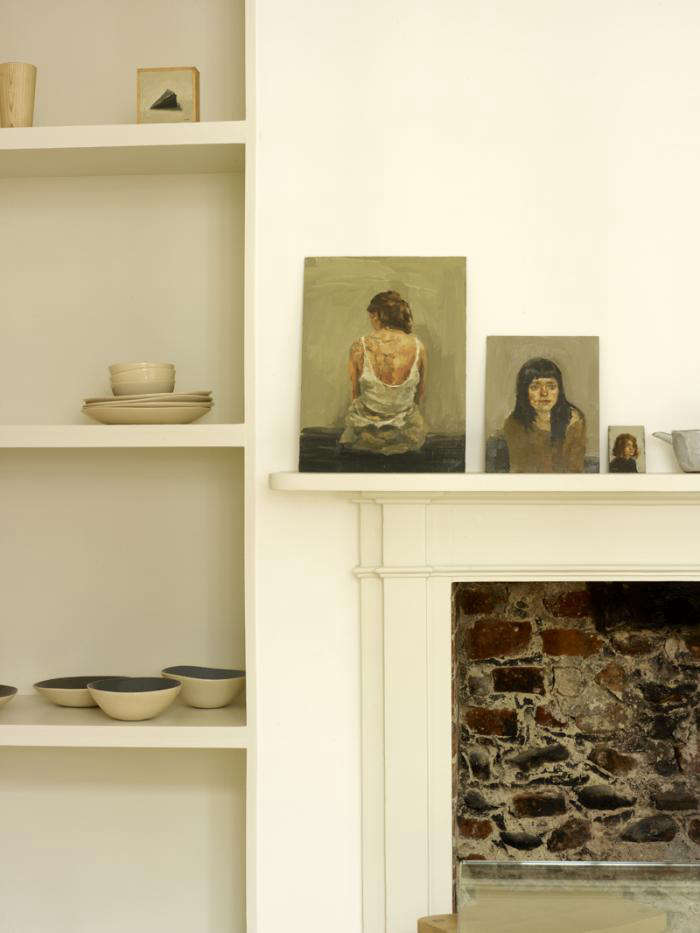
The Holt gallery was defined by cream and white walls, understated shelving, generous natural light, wood furniture, and minimally dressed windows. These choices created a neutral background without making the rooms feel sterile. The architecture remained visible, but it knew better than to interrupt.
White gallery walls are sometimes criticized as predictable, yet here they supported the collection’s subtle surfaces. Pale ceramics, blackened timber, fine wire, delicate prints, and small metal objects require careful viewing. A louder interior could easily overpower them. Comparable gallery-style interiors use restrained backgrounds for the same reason: they allow differences in texture, silhouette, and material to become more legible.
Built-in shelves held ceramics without turning them into ordinary kitchenware. Tables and vitrines brought objects closer to domestic height. Some artwork rested against walls or sat low in the room rather than being ceremoniously elevated. That relaxed presentation helped dissolve the invisible barrier that often makes gallery visitors stand three feet away with their hands folded as though attending a very tasteful court hearing.
Why Printmaking Matters to The Cold Press Story
The word “Press” is not decorative branding. The Norfolk studio was established around intaglio printmaking, a family of techniques that includes etching, engraving, drypoint, aquatint, and mezzotint. In intaglio printing, ink sits in recessed lines or textures below the surface of a metal plate. Damp paper is forced into those recesses under substantial pressure, lifting the ink and producing the finished impression.
Each intaglio method has its own visual personality. Engraving can create crisp, controlled lines. Etching often produces fluid marks drawn through a waxy ground before acid bites the exposed metal. Drypoint leaves a burr that creates soft, velvety edges, while aquatint is especially useful for tonal fields. Mezzotint can produce rich transitions from deep darkness to light. In other words, saying “intaglio” is a bit like saying “music”: technically correct, but hiding an entire neighborhood of possibilities.
These processes are demanding. Plates must be prepared, marked, inked, carefully wiped, and run through a press. Small changes in pressure, moisture, ink, or wiping can alter the result. A dedicated studio therefore gives artists access not only to equipment but also to sustained concentration. The Cold Press residency model recognized that serious experimentation requires time, technical support, and freedom from the interruptions of ordinary life.
The Artist’s House and Rural Residency
As the residency program expanded, The Cold Press created an Artist’s House roughly 15 miles from the Holt gallery. Architect Craig Bamford and artist Louise Sayarer of SasaWorks transformed a stable into a combined living and working environment. The renovated structure included an upstairs living area, a studio below, a narrow custom kitchen, oak details, concrete flooring, exposed copper pipes, ironwork, and carefully preserved traces of the original building.
The design avoided the polished anonymity of a hotel. Instead, it gave artists a place that felt materially honest and gently connected to its rural setting. Original masonry remained visible. New woodwork was allowed to look like wood. Utility lines were not always hidden behind layers of cosmetic perfection. The building’s past was not erased; it was invited to join the residency.
Why the Location Was Important
Distance from London was part of the point. Norfolk offered a slower rhythm, open countryside, coastal light, woodland, and fewer professional distractions. Artists could focus on process rather than rushing toward a finished product for the next opening, fair, or deadline.
Records from participating artists show that the residency continued to attract practitioners working across sculpture, textiles, wood, and mixed media. Forest + Found artists Max Bainbridge and Abigail Booth, for example, list Cold Press Artist House residencies in their professional histories. California sculptor Mari Andrews also completed a Cold Press residency and later exhibited with the gallery.
Such continuity matters. A residency becomes culturally meaningful when it generates durable relationships, exhibitions, and new bodies of worknot merely attractive photographs of someone holding a coffee mug beside a studio window.
Artists, Makers, and Materials at Cold Press
The Cold Press has represented and exhibited an international group of artists while maintaining a strong interest in material, landscape, and hand production. Historical installations in Holt included ceramics by Akiko Hirai, Kaori Tatebayashi, and Brickett Davda; wooden vessels by Norfolk maker Tim Willey; sculpture by Mari Andrews; paintings by California artist Kai Samuels-Davis; botanical constructions by Anne ten Donkelaar; and furniture associated with craftspeople such as Sebastian Cox.
The selection crossed conventional boundaries between fine art, studio craft, and design. A chair could be treated as a sculptural work. A bowl could carry as much visual weight as a painting. A small mirror or hand-finished metal object could be appreciated for both function and form.
What connected these varied pieces was not a single style but an attention to touch, surface, proportion, and making. Charred sycamore, hazel, clay, glass, brass, silver, paper, and textiles all possess distinct physical qualities. Cold Press exhibitions tended to let those materials speak without excessive staging or explanatory noise.
From Norfolk to London and International Craft Events
The Cold Press later established a project space in a historic Spitalfields townhouse in East London while retaining its Norfolk studio connection. Exhibitions there have continued the gallery’s interest in intimate, architecture-responsive presentations. A 2022 photography exhibition by Rich Stapleton, accompanied by ceramics from Los Angeles artist Nancy Kwon, used the domestic history, surfaces, light, and scale of the building as part of the curatorial experience.
More recent activity confirms that The Cold Press remains involved in the contemporary craft world. At Collect 2025, it presented work by artists using glass, precious metals, lacquer, and silver, emphasizing subtle surfaces and material sensitivity. The Crafts Council also lists The Cold Press among the exhibitors at Collect 2026, demonstrating that the project has evolved beyond its original Holt gallery while preserving its central artistic values.
What Makes Cold Press Gallery Distinctive?
1. Art Is Shown in Conversation
Cold Press installations encourage visitors to notice relationships. A rough ceramic surface may answer a weathered piece of timber. A fragile wire sculpture may contrast with a heavy vessel. The room becomes a composition rather than a storage area for individually priced objects.
2. Craft Is Treated as Serious Cultural Work
Ceramics, woodworking, textiles, metalwork, and furniture are not presented as secondary to painting or photography. The gallery recognizes that a functional object can embody complex decisions about history, labor, landscape, and material.
3. Architecture Is Part of the Exhibition
From the former Methodist hall in Holt to the stable-based Artist’s House and the Spitalfields townhouse, Cold Press locations possess visible histories. Exhibitions respond to those histories rather than pretending every room is an interchangeable white box.
4. The Residency Supports Process
The Norfolk studio offers a practical counterpart to the exhibition program. Visitors encounter finished work, but the Cold Press story also acknowledges the slow, uncertain, occasionally ink-covered process behind it.
5. The Atmosphere Encourages Attention
Nothing about the gallery’s best-known spaces suggests rushing. Objects are given physical and visual room. That quiet is not emptiness; it is a curatorial tool.
Planning a Cold Press Gallery Visit
Anyone researching the Cold Press Gallery in Norfolk should be aware that older articles often refer specifically to the former Holt gallery in the Methodist meeting hall. The organization’s present activities extend between its Norfolk studio, its London project space, exhibitions, and major craft events. The official website remains the best place to confirm current locations, dates, artists, and appointment requirements before traveling.
This is particularly important because Cold Press exhibitions have often operated on limited schedules or by appointment. Do not arrive in rural Norfolk carrying a notebook, three camera lenses, and enormous artistic expectations without checking first. The countryside may be beautiful, but hedgerows are famously poor at providing updated opening hours.
When an exhibition is accessible, allow more time than you would for a conventional retail gallery. Look at objects from several angles. Notice how a work changes near a window or against an aged wall. Read about the material and process. Study the relationship between neighboring pieces. Cold Press rewards curiosity more than speed.
The Cold Press Experience: A Slow Walk Through Art, Craft, and Place
Imagine beginning a Cold Press visit not with a dramatic museum lobby, but with a modest historic doorway. The exterior does not shout, flash, spin, or ask you to download an app. It simply suggests that something carefully considered is happening inside.
Entering the room, your eyes need a moment to adjust to the restraint. There may be fewer objects than expected. That is the first lesson: empty space is participating in the exhibition. A pale wall surrounds a small sculpture, giving its outline unusual clarity. A handmade vessel sits on a low surface where you can examine the rim, glaze, and slight irregularity of its body. Nothing appears to have been arranged by someone frantically attempting to fill a shelf before lunch.
You move toward a group of ceramics. From across the room, their colors look quietgray, chalky white, earthy brown, perhaps a muted blue. Up close, the surfaces become landscapes. One glaze pools into darker areas. Another catches the light on a raised edge. A thumb mark or firing variation reminds you that these pieces passed through hands, heat, and uncertainty before reaching the gallery.
Nearby, a wooden object changes the temperature of the display. Its grain is visible, perhaps darkened by charring or shaped directly from a naturally irregular section of timber. Beside it, a brass or silver piece reflects a narrow slice of window light. The materials do not match in the conventional decorating sense, yet they belong together because each records a process.
A print encourages even closer inspection. Once you understand intaglio, the image becomes partly physical. You begin searching for the pressure mark left by the plate. Fine lines reveal where a tool, needle, acid-resistant ground, or textured surface helped form the image. Dark areas are no longer simply “black”; they are accumulations of ink held inside prepared recesses and transferred under pressure.
The room itself keeps entering your field of vision. An old opening, unadorned window, simple shelf, or uneven historic surface reminds you that the exhibition is not taking place in neutral territory. The building has its own proportions and memories. Artwork does not merely hang inside it; artwork negotiates with it.
After several minutes, you may realize that your pace has slowed. You are no longer scanning for the most colorful, expensive, or instantly recognizable object. Instead, you are comparing edges. You are noticing how a ceramic base meets a wooden table, how wire casts a second drawing in shadow, or how a faded tone changes as daylight moves across it.
That change in attention is the real Cold Press experience. The gallery does not need blockbuster scale to create impact. Its strength lies in intimacy: the distance between a visitor and a small object, between a maker and a material, between an old building and a contemporary exhibition.
Leaving such a space, you might find ordinary objects temporarily improved. A cup at a café looks more sculptural. The grain in a tabletop becomes harder to ignore. Even a bent spoon may seem artistically ambitiousalthough it is probably still just a bent spoon.
More importantly, the experience demonstrates why small galleries and rural artist programs matter. They provide alternatives to speed, spectacle, and mass production. They create places where an artist can experiment, where a curator can build thoughtful relationships between objects, and where visitors can rediscover the pleasure of paying attention.
Conclusion
The Cold Press Gallery in Norfolk represents more than a memorable historic interior. It is the visible part of a broader creative system connecting studio practice, artist residencies, exhibitions, architecture, craft, and collaboration.
Its former Holt gallery showed how contemporary art could live comfortably inside an early-19th-century meeting hall. Its rural Artist’s House gave makers space to work without metropolitan pressure. Its later London exhibitions and participation in international craft events carried the same principles into new settings: respect the material, respect the building, respect the artist, and give every object enough room to finish its sentence.
For collectors, designers, artists, and travelers interested in North Norfolk culture, The Cold Press remains an instructive example of quiet curation done well. It proves that a gallery does not have to be enormous or theatrical to be memorable. Sometimes white walls, honest materials, intelligent placement, and one exceptionally good bowl are more than enough.













