
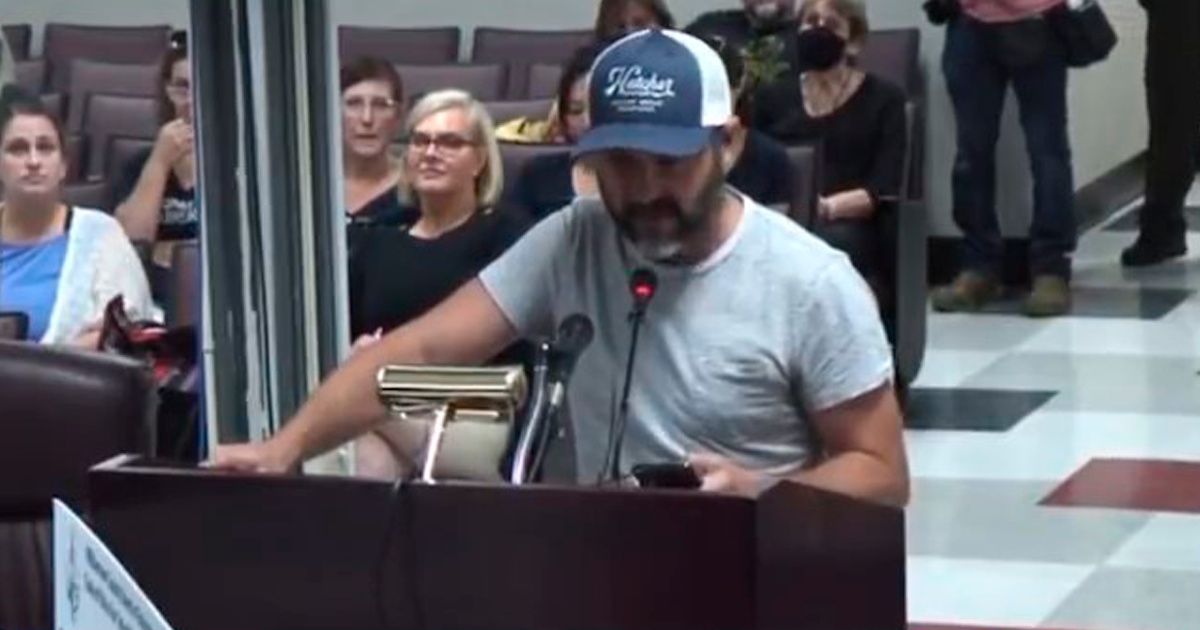
A school board meeting is rarely mistaken for must-see television. There are budgets, policy revisions, procedural motions, and enough fluorescent lighting to make everyone look slightly haunted. Yet in August 2021, a meeting in Williamson County, Tennessee, produced a speech that traveled far beyond the room.
Justin Kanew, the father of a five-year-old kindergartner, addressed parents who opposed a temporary school mask requirement. Rather than delivering a medical lecture or launching into a shouting match, he focused on an idea his young daughter already understood: people sometimes accept a small inconvenience because it may help protect someone else.
Kanew also challenged the use of Christianity as an automatic escape hatch from the district’s policy. His central point was simple enough to fit on a church bulletin, a refrigerator magnet, or perhaps the world’s least controversial bumper sticker: the Bible does not command Christians to avoid masks, but it repeatedly calls them to care for their neighbors.
The Tennessee School Board Meeting Behind the Viral Speech
A temporary mask policy created an immediate uproar
On August 10, 2021, the Williamson County Board of Education voted 7–3 to require face coverings in elementary schools. The temporary rule applied to elementary students, staff members, and visitors while they were inside school buildings or riding school buses.
The vote came as the Delta variant was driving a new wave of COVID-19 infections and local school nurses were reporting a sharp rise in cases. National health organizations were recommending universal indoor masking in schools at that stage of the pandemic, particularly because younger children were not yet eligible for vaccination.
The policy was hardly received with a polite round of “noted for the minutes.” Opponents packed meetings, protested outside, and confronted people who supported the requirement. Video from the August 10 gathering showed masked doctors and other attendees being heckled as they left. Some protesters shouted that they knew who the supporters were and would find them. The sheriff’s office later reviewed reports involving threats and disorder.
That atmosphere matters because Kanew’s later speech was not delivered during a quiet disagreement over fabric preferences. It arrived in the middle of a conflict in which a basic public-health policy had become tangled with politics, religion, parental rights, distrust of government, and the general American hobby of turning local meetings into national culture-war auditions.
Why Justin Kanew decided to speak
Kanew attended the board’s regular meeting on August 16. He later explained that he had not planned to address the board, but changed his mind after hearing speaker after speaker oppose masks and repeat broader political grievances.
When his turn came, he identified himself as the father of a new kindergartner. He explained that his daughter had been one of only a few masked students in her class. Naturally, she asked why she had to wear one when many classmates did not.
His answer was not complicated: “Because we want to take care of other people.”
According to Kanew, his five-year-old understood. He found it disappointing that some adults seemed unableor unwillingto accept the same principle. The remark spread rapidly online because it reduced months of furious debate to a question a child could understand: Are we willing to tolerate something mildly annoying when doing so may help another person?
Kanew’s speech was reported nationally after video clips circulated on social media. News coverage emphasized both the calmness of his delivery and the contrast between his daughter’s response and the hostility displayed during previous meetings.
What Kanew Said About Masks and the Bible
The Bible contains no commandment against face coverings
Kanew said he had asked a pastor friend whether there was a genuine biblical basis for refusing the school’s mask requirement. The pastor’s answer, as Kanew summarized it, was no.
That conclusion is not especially mysterious. The Bible does not discuss surgical masks, school-board policies, aerosol transmission, or whether a dinosaur-patterned face covering coordinates with a kindergarten backpack. Ancient biblical writers were addressing different societies, technologies, and medical realities.
Consequently, claiming that Christianity directly forbids a temporary mask policy requires interpretation that goes well beyond the text itself. Several Christian scholars and commentators made the same distinction during the pandemic: believers could debate whether a mandate was effective, reasonable, or legally justified, but the Bible does not classify wearing a health-related face covering as sinful.
Christian legal and theological discussions published during the pandemic noted that Scripture neither commands nor prohibits modern masks. Russell Moore similarly argued that disliking a mask or believing it interferes with natural breathing does not automatically transform the dispute into a religious-liberty issue.
The stronger biblical theme is care for other people
Although the Bible never says, “Thou shalt wear a three-layer cotton mask in the pickup line,” it has plenty to say about responsibility toward others.
Jesus identifies love for one’s neighbor as one of the greatest commandments. The New Testament asks believers to consider the interests of others, serve one another through love, protect vulnerable people, and avoid using personal freedom in ways that harm someone else’s conscience or well-being.
Those passages do not settle every policy debate. Two sincere Christians may examine the same mandate and disagree about its design or necessity. Nevertheless, they make it difficult to argue that personal convenience is the highest Christian value.
That was the theological nerve Kanew touched. His argument was not that a school board had received a divine memo. It was that people invoking the Bible against masks were overlooking the book’s far clearer instructions about compassion, humility, and neighborly care.
Christianity Today reported that many evangelical colleges explicitly connected pandemic precautions with loving one’s neighbor. The Gospel Coalition, Sojourners, and other Christian publications made similar arguments, describing temporary mask use as a practical form of concern for people who might face greater medical risks.
Religious freedom is serious, but it is not a magic phrase
Religious freedom protects people from government interference with sincerely held beliefs. It is an essential American principle, not a customer-service coupon that can be applied whenever a public rule becomes inconvenient.
A meaningful religious objection should have some identifiable connection to faith, conscience, doctrine, or religious practice. Simply attaching the word “religious” to a political disagreement does not automatically settle the issue.
Kanew criticized parents who used religious-exemption language without presenting a recognizable biblical teaching against masks. His sharpest summary was: “Avoiding masks is not in the Bible, but taking care of others is.”
The line worked because it distinguished between faith and preference. A person may sincerely dislike mandates. A parent may question whether a rule is proportionate. Those concerns can be debated honestly without recruiting the Bible as an expert witness for a position it never addresses.
Why the Five-Year-Old Story Was So Effective
It replaced abstract arguments with a familiar family moment
Public debates often become less understandable as more experts enter them. Soon everyone is discussing legal authority, infection curves, constitutional doctrine, state preemption, statistical models, and three different definitions of “freedom.” The original human question disappears under a mountain of vocabulary.
Kanew’s daughter brought the issue back to earth. She noticed that she was different from her classmates and asked her father why. He gave her an explanation centered on caring for others, and she accepted it.
Most parents recognize that conversation. Children frequently ask why they must share, wait their turn, wash their hands, buckle a seat belt, lower their voices, or avoid launching a toy truck across a restaurant. Parents explain that living with other people requires rules and consideration.
The story therefore challenged adults without requiring Kanew to call them names. His daughter became an example of moral clarity: she did not need a seminar on epidemiology to understand that an action can be worthwhile partly because it benefits someone else.
It exposed the difference between liberty and community
The mask fight was often presented as a contest between freedom and control. Kanew offered a different frame: freedom and responsibility are not enemies.
Communities routinely impose small restrictions to reduce foreseeable harm. Schools have dress codes, vaccination requirements, fire procedures, sanitation rules, allergy protocols, and pickup systems that occasionally appear to have been designed by air-traffic controllers. Parents may criticize how those rules operate, but few argue that every requirement is inherently tyrannical.
Individual liberty matters. So does the fact that individual decisions can affect teachers, classmates, medically vulnerable relatives, and families who cannot easily absorb another quarantine or missed paycheck.
The speech did not erase that tension. It made the tension visibleand asked listeners to remember the people standing on the other side of their choices.
A School Mask Debate That Became a National Culture War
Williamson County was not alone. Across the United States, school-board meetings became flash points for anger about masks, vaccines, remote learning, race, curriculum, and government authority.
Meetings were disrupted or cut short in several states. Doctors were shouted down, officials received threats, and some districts requested additional security. At the same time, organized political groups recognized that school-board conflicts could energize voters and build influence in local elections.
In Williamson County, arguments about masking overlapped with claims about critical race theory and diversity programs. Kanew addressed those subjects during the same brief appearance, arguing that critics were blending distinct ideas together. The combination illustrated how separate concerns had been gathered into one larger narrative about schools, culture, and parental control.
Contemporary national reporting described these meetings as part of a broader struggle over public education. Later analyses of Williamson County found that the anger surrounding mask rules flowed into campaigns involving books, curriculum, diversity initiatives, and school-board membership.
Why the Speech Persuaded People Online
Kanew remained calm
The internet rewards outrage, but calmness can become striking when everyone else appears ready to challenge a folding chair to a duel. Kanew spoke firmly without trying to overpower the room. That made the substance easier to hear.
A calm delivery also communicated confidence. He did not need to shout that his position was obvious. He presented a concrete experience, explained the principle behind it, and let the contrast speak for itself.
He used a value his opponents recognized
Rather than dismissing Christianity, Kanew engaged with the language of Christianity. He accepted that biblical teaching mattered and then asked whether the anti-mask claim actually matched that teaching.
This is an important communication technique. People rarely reconsider their views because an opponent announces that their values are ridiculous. They are more likely to listen when a speaker shows how a proposed action may fit values they already hold.
Kanew’s argument connected mask wearing with neighborly love, care for vulnerable people, and responsible participation in a community. Those concepts were familiar to his Christian audience even if they disagreed with his policy conclusion.
He kept the moral claim modest
Kanew did not claim that masks were sacred objects or that every public-health decision was infallible. His central claim was narrower: religious language should not be misused, and helping protect other people is compatible with biblical ethics.
That modesty made the argument harder to knock down. One could challenge the district’s data, implementation, timeline, or authority without proving that the Bible prohibited masks. The policy debate remained open, while the supposed scriptural ban looked increasingly flimsy.
Fair Questions Raised by Mask Opponents
Recognizing the power of Kanew’s speech does not require pretending every objection to school masking was absurd. Parents raised concerns about comfort, communication, enforcement, developmental needs, disabilities, and the duration of emergency policies. Masks could make speech less clear, create difficulties for students with hearing loss, and present challenges for some children with sensory or medical conditions.
Good public policy should examine those burdens. It should provide reasonable accommodations, communicate the evidence behind decisions, define when rules will be reviewed, and avoid treating every question as malicious.
The scientific evidence surrounding particular school-mask mandates also developed over time. Studies differed in design and quality, and later researchers debated how much specific mandates changed transmission under varying conditions. A responsible historical account should not flatten those disputes into “one side loved science and the other side hated it.”
In August 2021, however, Williamson County officials were responding to rising cases, the highly transmissible Delta variant, and then-current guidance from the Centers for Disease Control and Prevention and the American Academy of Pediatrics. The policy was temporary and focused on elementary schools. Those facts made it a conventional public-health decision, not evidence that civilization had fallen because six-year-olds were briefly dressed like tiny bank robbers.
Experiences and Reflections Inspired by the Viral Speech
The following scenarios are illustrative composites based on common experiences reported by families, educators, and community members during school masking debates. They are not presented as the author’s personal experiences or as accounts of specific unnamed individuals.
The child who wanted to know why she looked different
Imagine a first grader walking into class and discovering that nearly everyone else is unmasked. She immediately wonders whether her parents made a mistake. Children are experts at detecting difference and part-time attorneys when questioning household rules.
Her father could respond by insulting the other families, frightening her about illness, or insisting that she obey without explanation. A better answer resembles Kanew’s: “Our family is doing this because we want to be careful around other people.”
That explanation gives the child a positive identity rather than a burden. She is not wearing a mask because she is weak or because everyone else is bad. She is practicing consideration. Even when the policy debate is complicated, the family value remains understandable.
The teacher caught between two angry groups
Consider an elementary teacher who arrives at school to find half the parents demanding strict enforcement and the other half warning that enforcement will traumatize their children. The teacher did not write the district policy. She is simply trying to teach reading while managing twenty-five water bottles, three missing crayons, and a mysterious sticky substance near the pencil sharpener.
For educators in that position, respectful disagreement makes an enormous difference. Parents can challenge board decisions without treating teachers as political operatives. A useful question is, “How can we make this workable for students?” An unhelpful question usually begins at maximum volume in the parking lot.
The pastor asked to approve a ready-made exemption
Picture a church member approaching a pastor with an exemption form and expecting a signature. The member may assume that opposition to government automatically equals religious conviction.
The pastor now faces a delicate task. He can respect the person’s concerns while explaining that Christianity does not supply a specific doctrine against school masks. He might also ask whether the objection arises from Scripture, medical circumstances, politics, or personal discomfort.
That conversation can feel awkward, but it protects religious freedom from becoming meaningless. When every preference is labeled sacred, genuinely serious matters of conscience become harder to identify and defend.
The family caring for a vulnerable grandparent
Another family may view school precautions through the experience of a grandparent undergoing cancer treatment or living with a serious respiratory condition. For them, the debate is not merely about what happens in a classroom. It is about whether a child might bring an infection into a home where the consequences could be severe.
Other families may face different hardships, including children who struggle with masks or parents whose jobs make repeated quarantines financially devastating. Listening to those experiences does not produce a perfect rule, but it reduces the temptation to assume that every opponent is selfish or every supporter is fearful.
The board meeting that chooses questions over accusations
Finally, imagine a public meeting where speakers replace conspiracy claims and personal threats with specific questions. What local data supports the policy? When will the board review it? What accommodations are available? How will the district respond if circumstances improve? What protections exist for medically vulnerable students?
Those questions create accountability without turning neighbors into enemies. Democracy works through disagreement, but it depends on accepting that losing a vote is not proof of dictatorship. Citizens may organize, appeal, vote for different board members, or challenge a policy in court. Threatening doctors in a parking lot is not an advanced constitutional procedure.
Kanew’s speech endures because it modeled a more productive form of participation. He disagreed plainly, connected his argument to real family experience, questioned the misuse of religion, and spoke without dehumanizing the people he criticized.
Conclusion: A Small Mask and a Much Bigger Moral Question
The viral Tennessee dad speech was nominally about face coverings, but its deeper subject was civic responsibility. What do people owe one another when facts are contested, institutions are distrusted, and even modest precautions become political symbols?
Justin Kanew did not settle every scientific, legal, or educational argument surrounding school mask mandates. He accomplished something more realistic in less than two minutes: he exposed the weakness of using the Bible as a blanket justification for refusing a rule that the Bible never mentions.
He also offered an alternative rooted in both parenting and faith. His daughter wore a mask because her family wanted to care for other people. She understood that personal choices can have communal consequences. Adults may still debate which policies are necessary, but the principle behind her answer remains difficult to dismiss.
Perhaps that is why the speech resonated. It did not require listeners to believe that governments are always right, experts never make mistakes, or masks solve every problem. It simply asked them to consider whether freedom without responsibility becomes selfishnessand whether religion should be used to avoid caring for the very neighbors it commands believers to love.













