
Movies are built from scripts, performances, cameras, costumes, and an astonishing number of last-minute decisions made while somebody quietly panics near the craft-services table. Behind nearly every famous scene is a production accident, technical breakthrough, casting surprise, or wonderfully strange creative choice.
For this Friday, December 19th edition of movie trivia, we are traveling from Hollywood’s golden age to computer-generated toys, malfunctioning sharks, spinning hallways, and one extremely cooperative stray cat. These 25 nuggets reveal how filmmakers transformed limited budgets, technological problems, and unexpected opportunities into unforgettable pieces of pop culture history.
Classic Movie Trivia That Changed Hollywood
1. Snow White Received One Big Oscar and Seven Tiny Ones
When Walt Disney received a special Academy Award for Snow White and the Seven Dwarfs, presenter Shirley Temple handed him one standard Oscar accompanied by seven miniature statuettes. It was an appropriately theatrical tribute to the film that convinced skeptical Hollywood executives that feature-length animation could become serious entertainment.
2. The Original Tin Man Was Hospitalized by His Makeup
Buddy Ebsen was originally cast as the Tin Man in The Wizard of Oz. However, the aluminum powder used in his makeup caused a severe respiratory reaction, forcing him to leave the production. Jack Haley replaced him, and the makeup formula was changed. Oz apparently required both courage and careful ingredient labeling.
3. Nobody Says “Play It Again, Sam” in Casablanca
It may be one of cinema’s most recognizable quotations, but the precise sentence “Play it again, Sam” is never spoken in Casablanca. Ilsa asks Sam to “play it once,” while Rick later orders him to play the song. Popular culture combined the lines into something neater, proving that collective memory sometimes hires its own editor.
4. William Randolph Hearst Tried to Bury Citizen Kane
Because the central figure in Citizen Kane appeared partly inspired by newspaper magnate William Randolph Hearst, Hearst’s media organization attacked the movie and discouraged theaters from showing it. The attempted suppression only strengthened the film’s legend, while its unusual lighting, editing, sound, and deep-focus photography influenced generations of directors.
5. It’s a Wonderful Life Needed Quieter Snow
Old movie productions often created snow with painted cornflakes, but the crunchy material made recording dialogue difficult. For It’s a Wonderful Life, the production used a quieter mixture involving foam, soap, and water. The result allowed actors to speak naturally while Bedford Falls disappeared beneath a convincing winter blanket.
6. Hitchcock Secretly Filmed Outside the United Nations
The production of North by Northwest was not permitted to film Cary Grant entering the United Nations complex. Alfred Hitchcock worked around the restriction by using concealed cameras to capture Grant approaching the building. It was guerrilla filmmaking performed in a tailored gray suit, decades before compact digital cameras made such tactics ordinary.
7. Psycho Used Chocolate Syrup as Blood
The shower sequence in Psycho was filmed in black and white, allowing chocolate syrup to stand in for blood. Its consistency photographed effectively without needing to look red. The scene relied on rapid editing, suggestive camera angles, sound effects, and Bernard Herrmann’s shrieking strings rather than explicit images of the knife entering Marion Crane’s body.
8. Stanley Kubrick’s Only Competitive Oscar Was for Visual Effects
Despite directing such celebrated movies as Dr. Strangelove, A Clockwork Orange, and The Shining, Stanley Kubrick’s only competitive Academy Award was for the visual effects of 2001: A Space Odyssey. The film’s miniature spacecraft, rotating sets, projection techniques, and meticulously controlled photography helped make space appear genuinely enormous.
9. Days of Heaven Created Locusts With Peanut Hulls
For the crop-destroying locust sequence in Terrence Malick’s Days of Heaven, the production dropped peanut hulls from a helicopter and filmed them falling. The footage was then reversed, making the lightweight pieces appear to rise like a departing swarm. It is a poetic image created through agriculture, aviation, and extremely clever editing.
10. The Godfather’s Famous Cat Was a Studio-Lot Stray
The cat sitting in Don Vito Corleone’s lap during the opening of The Godfather was not part of the screenplay. Director Francis Ford Coppola reportedly found the stray around the Paramount lot and handed it to Marlon Brando. Brando calmly incorporated the animal into his performance, adding tenderness and menace to the same unforgettable image.
Blockbuster Movie Trivia and Behind-the-Scenes Surprises
11. Jaws Became Scarier Because the Shark Rarely Worked
The full-size mechanical sharks built for Jaws frequently malfunctioned in salt water. Steven Spielberg therefore delayed showing the creature and suggested its presence through underwater viewpoints, floating barrels, frightened reactions, and John Williams’ two-note theme. A production disaster accidentally delivered one of the finest lessons in cinematic suspense.
12. A Projector Motor Helped Create the Lightsaber Sound
Star Wars sound designer Ben Burtt began creating the lightsaber’s famous hum with the sound of an aging projector motor. He later combined it with electronic interference captured near a television set. The result turned two ordinary technological noises into the instantly recognizable voice of an elegant weapon from a more civilized age.
13. Indiana Jones Shot the Swordsman Because Harrison Ford Was Sick
The intimidating swordsman encounter in Raiders of the Lost Ark was originally planned as a longer fight. Harrison Ford was suffering from illness during filming, so he suggested that Indiana Jones simply shoot his elaborate opponent. The shortened scene became one of the movie’s biggest laughs and perfectly summarized the character’s impatient practicality.
14. E.T.’s Voice Came From an Unlikely Performer
The distinctive voice of the alien in E.T. the Extra-Terrestrial was largely performed by Pat Welsh, an older woman whose raspy voice attracted the attention of the film’s sound team. Additional vocal elements were blended into the finished effect, creating a creature who sounded vulnerable, ancient, curious, and slightly overdue for a throat lozenge.
15. Back to the Future Recast Its Hero After Filming Began
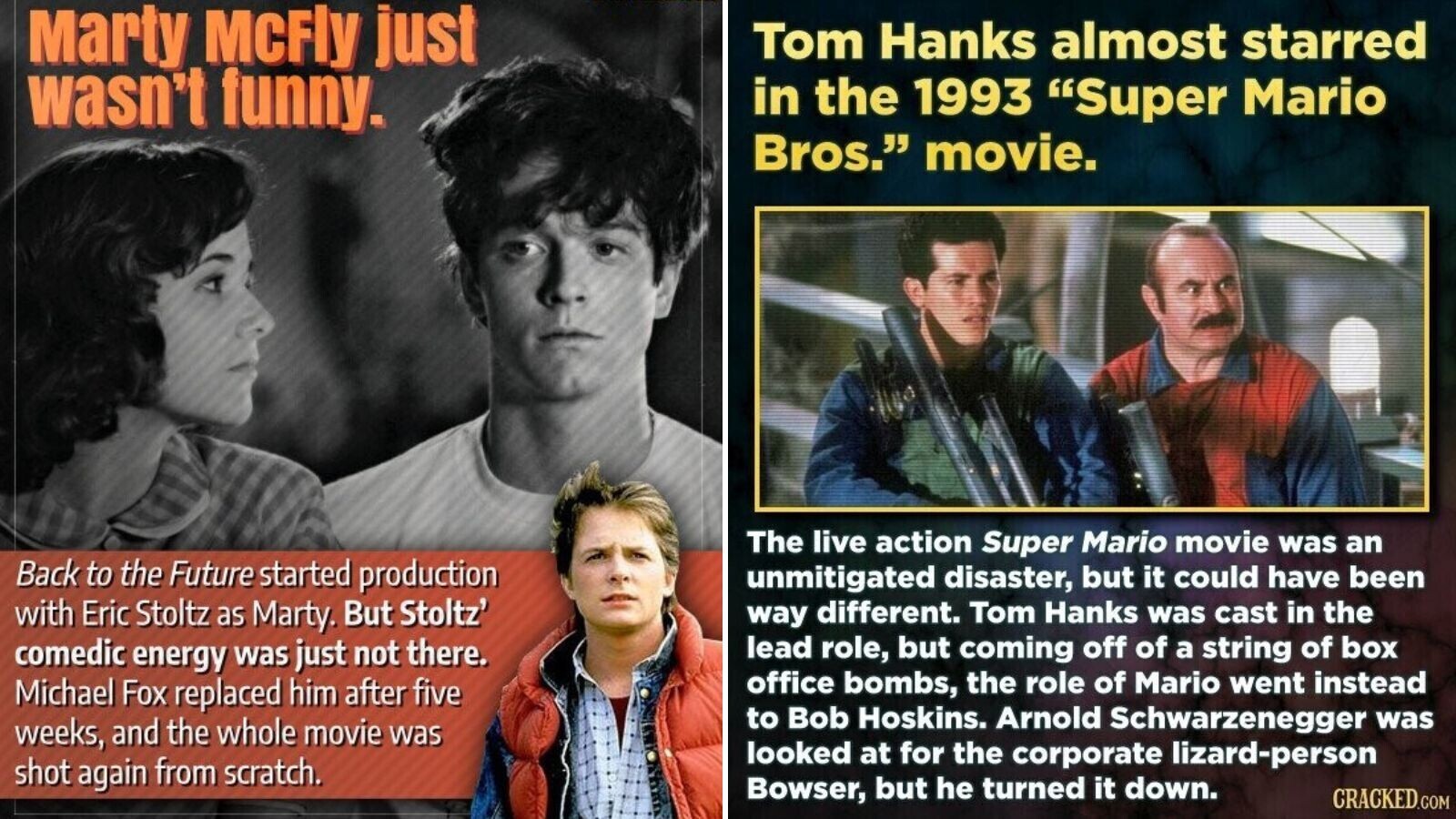
Eric Stoltz initially played Marty McFly, and several weeks of footage were completed before the filmmakers concluded that the performance did not have the comic energy they wanted. Michael J. Fox took over the role, filming around his television schedule. The expensive decision helped create one of the most recognizable characters of the 1980s.
16. Bob Hoskins Often Acted Opposite Empty Space
During production of Who Framed Roger Rabbit, Bob Hoskins frequently had to perform without animated characters physically present. Puppeteers, moving props, rehearsed eye lines, and careful timing helped establish the interactions before animators added Roger and the other Toons. Hoskins made arguments with invisible rabbits seem like an entirely reasonable workplace problem.
17. Jurassic Park Combined New Technology With Giant Robots
Jurassic Park is remembered as a computer-generated imagery milestone, but many of its dinosaurs were enormous animatronic creations built by Stan Winston’s team. Digital animals handled movements that practical machines could not perform, while physical models supplied texture, weight, and direct interaction with actors. The revolution worked because old and new techniques cooperated.
18. Toy Story Was the First Fully Computer-Animated Feature
Released in 1995, Pixar’s Toy Story became the world’s first feature-length movie created entirely with computer animation. The technology was revolutionary, but the film endured because its digital achievement supported a warm story about jealousy, friendship, and toys experiencing an existential crisis whenever a child received a birthday present.
19. James Cameron Drew Jack’s Titanic Sketch
The close-up shots of the hand drawing Rose in Titanic show director James Cameron, not Leonardo DiCaprio. Because Cameron is left-handed while Jack is presented as right-handed, the footage was adjusted for continuity. Cameron also created the artwork seen in Jack’s portfolio, adding “movie sketch artist” to an already crowded résumé.
20. The Matrix’s Digital Rain Came From a Cookbook
The cascading green symbols in The Matrix were assembled from scanned Japanese characters and other visual material, including elements taken from a cookbook. That means one of science fiction’s most ominous images may contain the visual DNA of recipes. Reality is apparently a simulation, and the simulation might be preparing dinner.
Modern Movie Trivia About Effects, Stunts, and Oscar History
21. The Lord of the Rings Used Forced Perspective to Resize Actors
To make Hobbits appear much smaller than human characters, Peter Jackson’s Lord of the Rings trilogy used forced-perspective sets, scale doubles, digital compositing, and specially positioned cameras. Some sets were designed to move with the camera so the size illusion remained convincing throughout a shot. Middle-earth required nearly as much geometry as mythology.
22. The Dark Knight Took IMAX Cameras Into an Action Movie
Christopher Nolan used large-format IMAX cameras for major sequences in The Dark Knight, including its opening bank robbery. These cameras were traditionally associated with documentaries rather than fast-moving studio productions. The experiment helped push premium large-format photography into mainstream narrative filmmaking and gave Gotham City an unusually imposing physical presence.
23. Inception Built a Hallway That Really Rotated
The zero-gravity hotel fight in Inception was achieved largely with a full-size corridor mounted inside a rotating structure. As the set turned, performer Joseph Gordon-Levitt fought against shifting walls and floors while the camera maintained its perspective. The sequence looks dreamlike because the actors were wrestling with actual gravity rather than merely pretending.
24. Mad Max: Fury Road Put Real Vehicles in Real Danger
Although digital effects were used to remove safety equipment, combine landscapes, and enhance certain images, much of Mad Max: Fury Road involved practical vehicles, stunt performers, explosions, and desert photography. The production built an entire fleet of bizarre functioning machines, demonstrating that post-apocalyptic transportation can be both mechanically impressive and catastrophically fuel-inefficient.
25. Parasite Made Best Picture History
At the 2020 Academy Awards, Bong Joon Ho’s Parasite became the first primarily non-English-language movie to win Best Picture. It also won awards for directing, international feature, and original screenplay. Its historic victory showed that a culturally specific story about class, ambition, architecture, and peach allergies could connect with audiences around the world.
What These Movie Trivia Nuggets Reveal About Pop Culture History
These facts are entertaining because they expose the gap between what audiences see and what filmmakers actually do. A terrifying shark can emerge from broken machinery. A futuristic sound can begin with an outdated projector. An elegant snowfall can be soap foam, while an insect invasion can be a helicopter releasing peanut shells.
Movie history is filled with improvisation because production rarely unfolds exactly as planned. Budgets change, actors become unavailable, equipment refuses to cooperate, and scenes that seemed perfect on paper collapse during filming. The strongest filmmakers treat those obstacles as creative opportunities rather than invitations to throw a megaphone into the nearest decorative fountain.
The stories also demonstrate that technical achievement alone does not guarantee cultural importance. Toy Story was groundbreaking software wrapped around relatable emotions. Jurassic Park blended digital innovation with physical craftsmanship. Parasite broke an awards barrier because its precise filmmaking served a funny, unsettling, deeply human story.
A 500-Word Movie-Trivia Experience for Your Next Film Night
A movie-trivia night becomes far more memorable when it is treated as an experience instead of a test. Nobody wants to spend Friday evening feeling as though they accidentally enrolled in Advanced Cinematic Accounting. The best approach is to use trivia as a doorway into the films, allowing each fact to change how the audience watches a familiar scene.
Start with a mixture of recognizable classics and unexpected discoveries. A group may immediately know Star Wars, Jaws, or Back to the Future, but a detail from Days of Heaven or North by Northwest can introduce a different period of filmmaking. This balance keeps longtime movie enthusiasts interested without making casual viewers stare helplessly at the snack table.
One enjoyable format is to reveal the fact only after showing a short scene. Play the opening office sequence from The Godfather, for example, and ask viewers whether the cat was trained, scripted, or discovered by accident. Watch the rotating-hallway fight from Inception and let everyone guess how much was practical. The reveal becomes more satisfying because the audience has examined the evidence.
Trivia can also improve repeat viewings. Once viewers know that Jaws concealed its shark because the machinery was unreliable, the movie’s structure looks different. The floating barrels stop being simple props and become evidence of Spielberg solving a production problem. After learning how The Lord of the Rings manipulated perspective, viewers begin noticing tables, doorways, camera angles, and carefully measured distances.
Food can join the theme without requiring anyone to sculpt a life-size animatronic dinosaur from mashed potatoes. Serve Reese’s Pieces for an E.T.-inspired snack, chocolate syrup on ice cream as a less alarming tribute to Psycho, or something involving cannoli for The Godfather. Peanut hulls should remain optional, particularly when a ceiling fan is operating.
A simple scoring system keeps the evening lively. Award one point for identifying the movie, another for guessing the behind-the-scenes fact, and a bonus point for explaining why the production choice improved the scene. The bonus encourages conversation rather than pure memorization. It also gives persuasive movie fans a socially acceptable opportunity to deliver a three-minute speech about practical effects.
Most importantly, leave room for discussion. Ask which accidental solution produced the greatest artistic benefit. Debate whether modern computer effects have made filmmaking more flexible or merely created different problems. Compare the physical dinosaurs in Jurassic Park with fully digital characters in later movies. The answers reveal what each participant values: realism, imagination, performance, innovation, or wonderfully reckless stunt work.
By the end of the night, the group should have more than a collection of answers. Everyone should understand that famous movies are not polished objects that appeared fully formed. They are records of thousands of decisions, compromises, inventions, and happy accidents. That knowledge makes cinema feel less distant and more exciting, because every flawless moment may be hiding a gloriously messy story.














