
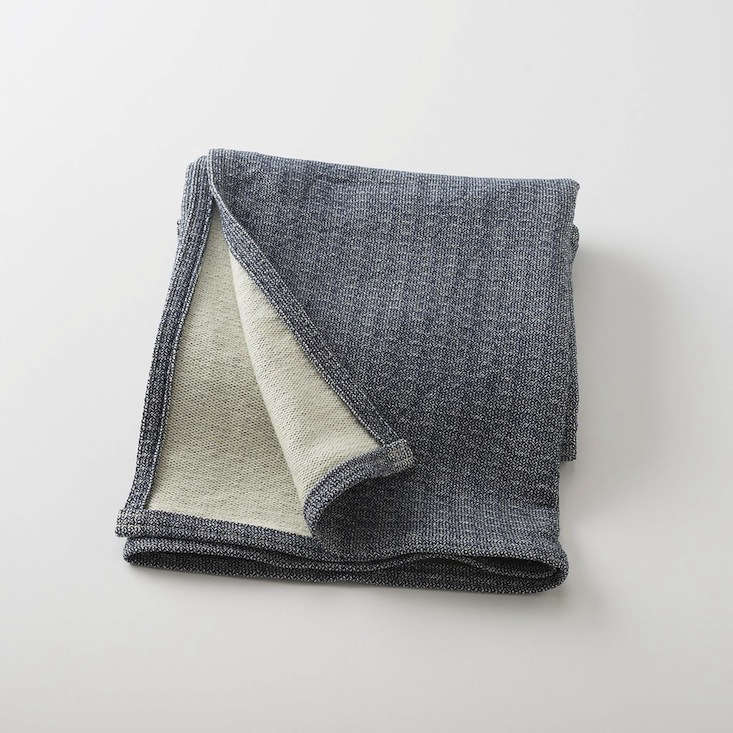
Some home accessories demand attention. They arrive with tassels the size of small rodents, patterns that argue with the wallpaper, or care instructions requiring a graduate degree in textile science. The Everyday Wool Throw takes a quieter approach. It is designed to be useful, attractive, and comfortable without behaving like the most important object in the room.
Originally offered by Schoolhouse Electric, this American-made throw paired a marled navy surface with a contrasting cream reverse. Its lightweight, double-sided construction made it suitable for living rooms, bedrooms, reading chairs, and any household member who believes the thermostat is controlled by a hostile government agency.
What Is the Everyday Wool Throw?
The Everyday Wool Throw is a medium-size decorative blanket designed to provide an extra layer of warmth without the bulk of heavy winter bedding. At 50 by 60 inches, it is large enough to cover one adult comfortably from shoulders to feet, yet compact enough to fold over an armchair or store in a basket.
Its most distinctive feature is the reversible design. One side uses a marled navy weave with a denim-inspired appearance, while the reverse presents a solid cream woolen weave. That contrast gives the throw two visual personalities: casual and slightly rugged on one side, soft and understated on the other.
The name may suggest a pure wool blanket, but the fiber label tells a more interesting story. Cotton makes up 75% of the material, while wool accounts for the remaining 25%. That composition is not a compromise accidentally discovered after the marketing department went home. It is a deliberate blend that combines cotton’s familiar feel with some of wool’s warmth and texture.
A Historically Familiar Fiber Combination
Cotton-and-wool textiles are not a recent invention dreamed up during a particularly energetic product meeting. American woven coverlets from the 18th and 19th centuries were frequently made with cotton or linen combined with wool. Cotton could provide structure and softness, while wool contributed warmth, color, and dimensional texture.
The Everyday Wool Throw updates that practical tradition for a modern home. Instead of an ornate historical pattern, it uses a restrained navy-and-cream palette that fits easily into contemporary, rustic, industrial, coastal, and transitional interiors.
Why the Cotton-Wool Blend Works
Cotton Adds Familiar Comfort
Cotton is widely used in home textiles because it feels approachable. It is breathable, naturally soft, and less intimidating than delicate luxury fibers. In a throw blanket, a cotton-rich composition can create a smoother hand and make the fabric comfortable against bare arms or legs.
Cotton also helps prevent the throw from feeling excessively dense. A heavy all-wool blanket can be wonderful during a snowstorm, but it may feel like unnecessary emergency equipment during an ordinary evening in a heated home. The Everyday Wool Throw aims for adaptable comfort rather than maximum insulation.
Wool Contributes Warmth and Resilience
Wool fibers naturally trap air, helping create insulation without requiring an enormous amount of material. Wool is also valued for breathability, elasticity, moisture management, and resistance to wrinkles, odors, and minor stains. Research summarized by Woolmark indicates that wool bedding can provide effective thermal insulation and moisture buffering compared with some cotton-and-acrylic alternatives.
In this throw, the 25% wool content provides some of those benefits while the cotton majority keeps the overall texture and weight more relaxed. It is best understood as a versatile cotton-wool throw, not as a substitute for a thick expedition blanket designed to survive three nights on a mountain.
The Blend Creates a More Casual Character
Pure wool can look polished, formal, or heritage-inspired. Cotton can feel lighter and more everyday. Combining the two produces a textile that works particularly well in rooms where people actually live.
That distinction matters. A good everyday throw must tolerate being folded badly, sat on accidentally, carried from room to room, and temporarily occupied by a pet who contributes nothing financially to the household. It should look better with use rather than requiring perfect presentation at all times.
Design Details That Make It Easy to Use
Marled Navy Adds Depth Without Visual Clutter
Marled fabric is created by combining yarns with slightly different tones, producing subtle color variation. From a distance, the navy side looks calm and solid. Up close, the weave has greater depth and movement than a flat, uniformly dyed surface.
This makes the throw particularly useful in minimalist rooms. Minimalist design can occasionally wander into “waiting room with an excellent architect” territory. A marled textile introduces warmth and texture without adding a loud pattern or another decorative object that needs dusting.
The Cream Reverse Brightens Darker Furniture
The cream side provides a lighter alternative and creates an attractive contrast when the throw is folded. On a charcoal sofa, walnut chair, dark leather bench, or navy bedspread, a visible strip of cream can break up the darker surface.
Reversible textiles are also useful when a room changes with the seasons. The navy side feels especially natural in fall and winter, while the cream side can make the same throw appear lighter during spring. No storage bin, seasonal shopping trip, or ceremonial changing of the household textiles is required.
The 50-by-60-Inch Size Is Genuinely Practical
Throw blankets are smaller than standard bed blankets because they are intended for targeted warmth and decoration. A 50-by-60-inch throw is well suited to one person on a couch, an afternoon nap, a reading chair, or an additional layer over the lower half of a bed.
It may not be large enough for two adults who both insist they are receiving exactly 50% of the blanket. Couples seeking diplomatic stability may prefer an oversized throw. For solo lounging, however, the proportions are sensible and easy to manage.
How to Style an Everyday Wool Throw
Drape It Over a Sofa Arm
For a relaxed living room, fold the throw lengthwise and drape it over one arm of the sofa. Allow the navy side to dominate while exposing a narrow section of the cream reverse. This creates contrast and shows that the blanket is reversible without displaying it like evidence in a courtroom.
On a neutral sofa, the navy weave supplies a grounded accent. On dark upholstery, reverse the arrangement and let the cream side provide visual relief. Brown leather, gray linen, olive velvet, natural canvas, and warm wood tones all pair comfortably with this color combination.
Place It Across the Foot of a Bed
A folded throw across the foot of a bed adds color and makes the room feel more complete. It also serves a practical purpose during nights when a comforter is almost warm enough but your feet have submitted a formal complaint.
For a tailored appearance, fold the blanket into thirds and align it evenly across the mattress. For a more casual bedroom, place it diagonally across one lower corner. Professional stylists commonly use both neat folds and intentionally loose draping to add texture and make furniture look inviting.
Create a Reading-Nook Essential
A reading chair becomes more inviting when it includes a small side table, warm lamp, comfortable pillow, and accessible throw. Fold the blanket over the chair back or keep it rolled in a woven basket nearby.
The cotton-wool blend is particularly appropriate for this setting because it provides useful warmth without overwhelming the sitter. It can cover the lap and legs while leaving arms free to hold a book, tablet, or mug of coffee that everyone hopes will not become a future stain-removal experiment.
Use It in a Guest Room
Guests have different temperature preferences. One person sleeps happily in an icebox; another begins requesting additional bedding when the room drops below 74 degrees. A lightweight throw gives visitors control without requiring them to search closets or build an improvised blanket fort.
Place the throw at the foot of the bed or on a luggage bench. Its restrained colors will coordinate with striped sheets, white bedding, plaid accents, denim upholstery, and many classic guest-room palettes.
Is the Everyday Wool Throw Warm Enough?
Warmth depends on room temperature, air movement, weave density, body size, and personal preference. Because this throw is lightweight and only 25% wool, it should be viewed as an extra layer rather than extreme-cold bedding.
It is well suited to air-conditioned rooms, mild fall weather, cool mornings, drafty offices, evening television, and additional warmth over standard bedding. During a severe winter, it would work best alongside a comforter, quilt, or heavier wool blanket.
A cotton-wool blend can be more comfortable across multiple seasons than a thick pure-wool blanket. Cotton helps the textile feel breathable, while wool provides enough insulation to make a noticeable difference. This balance is the real meaning of “everyday” in the product name: it is useful under ordinary conditions, not only when the weather forecast begins using dramatic language.
How to Care for a Cotton-Wool Throw
Read the Original Care Label First
Fiber percentages do not tell you everything about cleaning. The weave, dye, finishing process, and preshrinking treatment also determine whether a blanket can be washed safely. Federal rules require most wool products sold in the United States to disclose fiber content, country of origin, and the responsible manufacturer or marketer. Care instructions should also guide the safest cleaning method.
Never assume that a cotton-rich wool blend can automatically be placed in a normal wash cycle. Wool fibers may shrink, stiffen, or felt when exposed to heat, aggressive agitation, or unsuitable detergent.
Air It Out Between Cleanings
Wool-containing blankets usually do not need frequent washing. Shake the throw gently outdoors, remove surface lint with a soft clothes brush, and allow it to air in a dry, shaded location. Routine airing can freshen the fabric while reducing unnecessary wear from repeated cleaning.
Spot-Clean Spills Promptly
Blot liquid with a clean absorbent cloth rather than rubbing it deeper into the weave. Use a small amount of mild, wool-safe detergent and cool or lukewarm water if the care label permits spot treatment.
Avoid scrubbing. Friction can alter the surface and encourage felting or fuzziness. Wool-care guidance generally recommends soaking or blotting stained areas gently instead of aggressively rubbing the fibers.
Use Cold Water When Washing Is Allowed
When a label specifically identifies a wool blanket as machine washable, use cold water, a gentle or wool cycle, and detergent formulated for wool. Do not add chlorine bleach, and avoid a high-speed spin unless the manufacturer permits it.
For items not labeled washable, professional dry cleaning may be the safer option. Pendleton, for example, warns that washing non-washable wool blankets can cause substantial shrinkage, permanent stiffening, and loss of softness.
Dry It Without Heat
Reshape the throw while damp and dry it flat or evenly supported away from direct sunlight. Hanging a soaking-wet blanket from one narrow edge may distort the weave because wet textiles become considerably heavier.
A hot dryer is the fastest route from “handsome wool throw” to “surprisingly expensive mat for a medium-size dog.” Unless the label explicitly authorizes machine drying, air-drying is the cautious choice.
Store It Clean and Protected
Before long-term storage, make sure the throw is completely clean and dry. Food residue, skin oils, and undisturbed natural fibers can attract clothes-moth larvae. Fold the blanket loosely and place it in a clean, sealed container or protective textile bag in a cool, dry area.
Inspect stored wool periodically. Cedar products may contribute a pleasant scent, but they should not replace cleaning, inspection, and secure storage when moth activity is a concern.
Potential Drawbacks to Consider
It Is Not a Pure Wool Blanket
Buyers seeking the deep insulation, lofty texture, and heritage character of a 100% virgin-wool blanket may find the 25% wool content too modest. The Everyday Wool Throw prioritizes versatility and lighter comfort rather than maximum wool performance.
It May Require More Care Than a Synthetic Throw
Polyester fleece can often survive frequent machine washing, energetic children, pets, snack accidents, and other events that appear in no interior-design photograph. A cotton-wool throw may require more thoughtful cleaning and drying.
The Size Is Intended Mainly for One Person
At 50 by 60 inches, it is a conventional personal throw rather than a full bedding layer. It can accent a queen- or king-size bed, but it will not replace a standard blanket. Two-person couch use may also involve negotiations, strategic pulling, and eventual accusations.
Texture Preferences Vary
Wool sensitivity is highly personal. A cotton-rich blend is often less assertively woolen than a pure-wool textile, but shoppers who strongly dislike fuzzy or textured fibers should still examine the fabric in person when possible.
Who Would Appreciate This Throw?
The Everyday Wool Throw is especially appealing to people who favor practical objects with restrained design. Its navy-and-cream palette works for homeowners who enjoy American utility style, modern cabin interiors, traditional craftsmanship, denim-inspired colors, or unfussy contemporary rooms.
It also suits anyone who wants a decorative blanket that earns its place by being useful. Some throws exist mainly to complete a photograph. This one is meant to live on the couch, migrate to the bedroom, warm a reading session, cover chilly feet, and return to the sofa looking only slightly less organized than before.
The American-made construction and historically familiar cotton-wool combination may also appeal to buyers interested in domestic textile traditions. American blanket makers have long used wool for its insulation, resilience, and enduring character, while cotton has remained a central material in household textiles.
What to Look for in a Similar Everyday Wool Throw
Because the original product is archived, shoppers may need to compare current alternatives. Start by checking the exact fiber percentages. A product described casually as a wool throw may contain wool blended with cotton, acrylic, polyester, or other fibers.
Next, evaluate the size. A 50-by-60-inch throw is suitable for individual use, while larger options around 60 by 80 inches provide more coverage. Consider the weave as well. Tightly woven blankets generally feel structured and durable, while loose knits may feel softer but can be more vulnerable to snags from jewelry, pet claws, or rough furniture.
Review the care label before buying. A machine-washable wool blend may be more practical for homes with children or pets. A dry-clean-only blanket can still be a worthwhile long-term purchase, but only when the owner is comfortable providing the required care.
Finally, choose a color and pattern that can remain in the room for years. Neutral plaids, marled solids, subtle stripes, navy, charcoal, camel, cream, and earthy greens tend to be easier to integrate than trend-driven patterns. The best everyday throw should continue looking appropriate after the rest of the room has changed.
Everyday Wool Throw: A 500-Word Ownership Experience
Living with an everyday throw is less about dramatic first impressions and more about discovering how frequently one simple object becomes useful. On the first day, the navy-and-cream blanket might be folded neatly over the sofa arm, positioned with the precision of a furniture catalog. By the third day, it has probably moved to the reading chair. By the end of the week, nobody remembers where it was originally supposed to live.
A typical morning begins with someone carrying the throw from the living room to a sunny chair near the window. The lightweight fabric covers the legs without feeling like a heavy winter blanket. The cotton-rich weave feels familiar and relaxed, while the wool content adds enough warmth to make a cool room comfortable. It is the kind of layer that works well while drinking coffee, checking email, or pretending that reading headlines counts as a peaceful morning routine.
In the afternoon, the throw may become part of the room rather than part of an outfit. Folded across a chair, its marled navy face adds texture to a neutral space. Turning one corner outward reveals the cream reverse, making the blanket look more dimensional. There is no complicated styling formula. Fold it, drape it, or perform the popular technique known as “drop it over the chair and claim that was intentional.”
Evening is when the blanket earns its name. The temperature falls, the television comes on, and the throw is pulled across the lap. It provides targeted warmth without the trapped, overheated feeling associated with some thick synthetic blankets. Because it is not oversized, it stays manageable when changing positions or getting up to refill a drink.
The size also establishes boundaries. One person can use it comfortably, but sharing requires cooperation. A second person may quietly borrow six inches, then twelve, then half the blanket. This is how otherwise stable relationships discover previously unknown disagreements about textile distribution.
During the night, the throw can move to the bedroom and rest across the lower portion of the bed. It is especially useful when the main comforter keeps the upper body warm but leaves the feet unconvinced. The extra layer supplies localized insulation without requiring heavier bedding across the entire mattress.
Daily use eventually brings small maintenance moments. A crumb lands on the navy weave and disappears suspiciously well. A pet leaves hair on the cream side. A splash of coffee prompts immediate blotting and several minutes of regret. The blanket is shaken outdoors, brushed lightly, and allowed to air instead of being washed after every minor incident.
Over time, those routines become part of the product’s appeal. The throw is not too precious to use, yet it rewards reasonable care. It softens the visual edges of furniture, warms the person sitting beneath it, and moves naturally between rooms. Its value does not come from being the thickest, softest, or most luxurious blanket available. It comes from being the one people reach for repeatedly.
That is the strongest argument for an Everyday Wool Throw or a well-made modern equivalent. A successful home textile should not merely occupy space. It should improve ordinary moments: a cool morning, a quiet reading session, a guest’s chilly night, an unplanned nap, or an evening on the couch. When a blanket can perform all those jobs while making the room look better, it has achieved something surprisingly rare in home decorit has become both attractive and genuinely useful.










