
Receiving a large amount of money can feel exciting right up until the investing question arrives. Maybe it is a bonus, inheritance, tax refund, business payout, or a pile of cash that has been sitting in a savings account while you waited for the “right” market moment. Suddenly, your money is looking at you like a golden retriever holding a tennis ball: So? What are we doing?
The classic decision is whether to invest everything immediately as a lump sum or spread purchases over time through dollar-cost averaging, often called DCA. Both approaches can be sensible. Neither can predict next month’s headlines, rescue a poorly diversified portfolio, or make a bad investment magically charming. The better choice depends on your goals, time horizon, financial foundation, and ability to stick with a plan when markets become dramatic.
What Is Lump-Sum Investing?
Lump-sum investing means putting the full amount of available money into your chosen investments at one time. For example, someone with $120,000 might invest the entire amount today in a diversified mix of low-cost stock and bond funds based on their long-term plan.
The biggest advantage is simple: the full amount begins participating in the market immediately. If the market rises after you invest, every dollar is already on the field. There is no benchwarming cash waiting for its big entrance in month six.
Lump-sum investing is often associated with the idea of time in the market. Investors do not need to be brilliant at predicting short-term price moves. They need a sensible allocation, enough time for the plan to work, and the discipline not to jump out of the boat because the water got choppy for a few days.
Why Lump-Sum Investing Often Has the Higher Expected Return
Markets can fall at any time, including immediately after an investor makes a purchase. That risk is real, and pretending otherwise would be financial advice with a fake mustache. Still, long-term investors generally expect risky assets such as stocks to offer positive returns over extended periods in exchange for accepting volatility.
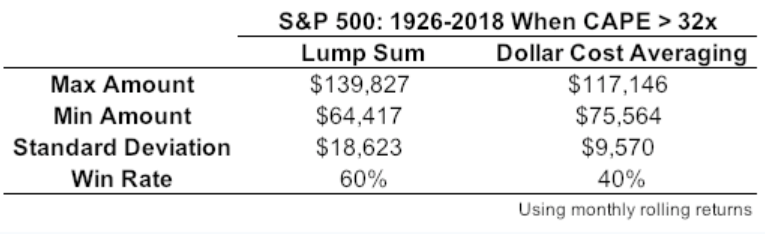
When money stays in cash while waiting to be invested, it is not participating in potential market gains. That is why historical research has often found that investing a lump sum immediately outperforms spreading the same money across a schedule. The simple reason is not mystical market wizardry. More money is invested for more time.
That does not mean a lump sum will always win in the short run. It means it has often held the mathematical advantage over many past periods because markets have generally spent more time moving upward than downward.
What Is Dollar-Cost Averaging?
Dollar-cost averaging means investing a fixed dollar amount at regular intervals, regardless of whether prices are rising, falling, or making everyone refresh their brokerage app a little too often. Instead of investing $120,000 all at once, an investor could invest $20,000 each month for six months.
Because each contribution buys a fixed dollar amount, the investor purchases more shares when prices are lower and fewer shares when prices are higher. This can smooth the average purchase price across a volatile period.
DCA is especially common with paycheck investing. When money becomes available every two weeks or every month, investing part of each paycheck is a practical way to build wealth steadily. In that case, there may be no giant lump sum sitting around waiting to be deployed. You are simply investing new money as it arrives.
DCA Is Not the Same as Delaying Every Investment
This distinction matters. Dollar-cost averaging is a method for gradually investing money that is already available. Regular contributions from income are different because the cash has not existed long enough to be invested earlier.
If you receive a bonus today and decide to invest it over twelve months, you are intentionally keeping part of that money in cash for a while. That may help you emotionally, but it also creates an opportunity cost if markets rise during the waiting period.
The Core Trade-Off: Expected Return vs. Emotional Comfort
The lump sum versus dollar-cost averaging decision is often presented as a battle between “smart math” and “scared feelings.” That is too simplistic. Good investing requires both sound math and a plan you can actually follow.
Lump-sum investing generally offers more immediate market exposure. DCA can reduce the regret of investing the full amount just before a market drop. The question is not whether one strategy is universally superior for every person and every calendar date. The question is which approach gives you a reasonable chance of earning long-term returns without panicking, abandoning the plan, or turning your investment account into a haunted house of impulse decisions.
| Approach | Main Benefit | Main Trade-Off |
|---|---|---|
| Lump-sum investing | More money is invested sooner. | A market drop soon after investing can feel painful. |
| Dollar-cost averaging | Reduces the pressure of choosing one entry date. | Some money remains in cash and may miss gains. |
| Hybrid approach | Balances immediate exposure with a staged plan. | Still leaves part of the money uninvested temporarily. |
A Simple Example: When Lump Sum Wins
Imagine two investors each have $120,000 available to invest. Investor A puts the full amount into a diversified fund when the share price is $100. Investor B invests $20,000 at the beginning of each month for six months.
Suppose the share price rises steadily from $100 to $110 over the six-month period. Investor A buys 1,200 shares on day one. At $110 per share, the investment is worth about $132,000.
Investor B buys fewer shares as prices climb because each $20,000 contribution purchases less at higher prices. In this simplified example, Investor B ends with roughly 1,144 shares, worth about $125,850 at the final $110 share price.
The lesson is not that markets always rise in a neat little staircase. Markets rarely behave that politely. The lesson is that when prices move higher during the DCA period, money held back in cash misses part of the advance.
A Simple Example: When Dollar-Cost Averaging Wins
Now use the same $120,000 and six-month schedule, but imagine the price begins at $100 and falls to $90, then $80, then $70 before recovering to $75 and finally $85.
The lump-sum investor owns 1,200 shares purchased at $100. At the end of the period, those shares are worth about $102,000.
The DCA investor buys more shares during the lower-priced months. In this simplified illustration, the investor accumulates roughly 1,460 shares. At $85 per share, the ending value is about $124,100.
That sounds wonderful for DCA, and it can happen. But it is important to remember that this example assumes the market declines while the staged purchases are occurring. Neither strategy knows the future. The outcome depends heavily on what prices do after the first investment is made.
These examples ignore fees, taxes, fund distributions, spreads, and market changes between purchase dates. They are illustrations, not forecasts.
When Lump-Sum Investing May Fit Better
Lump-sum investing may be a strong fit when the money is intended for a long-term goal, your investment plan is already established, and you can tolerate the possibility of a market decline shortly after investing.
It may also make sense when you have already built an emergency fund, addressed expensive debt, and selected a diversified portfolio that matches your risk capacity. In other words, you are not investing next month’s rent, tuition money, or the cash you need to repair a car that has been making the sound of a small dragon.
Long horizons can make short-term entry points less important. Someone investing for retirement decades away may care more about maintaining a sensible asset allocation and continuing contributions than about whether the market dips next Tuesday.
Questions That Support a Lump-Sum Decision
- Is this money for a long-term goal rather than a near-term expense?
- Do you have a stable financial cushion outside the investment account?
- Is your portfolio diversified instead of concentrated in one stock, sector, or trendy headline?
- Could you stay invested if the account value dropped shortly after purchase?
- Are you investing according to a written plan rather than a market prediction?
When Dollar-Cost Averaging May Fit Better
Dollar-cost averaging can make sense for investors who know that investing everything in one day would cause enough stress to derail the plan. A technically perfect strategy is not very useful if it leads to sleepless nights, panic-selling, or a decision to leave all future savings in cash forever.
DCA may also be useful when a large sum feels emotionally overwhelming, when market volatility is unusually distracting, or when an investor is transitioning from cash to a new long-term allocation. The key is to treat DCA as a defined process, not a vague excuse to postpone investing indefinitely.
A disciplined DCA plan usually includes a fixed amount, a fixed interval, and a fixed end date. “I will invest some of it when the news feels better” is not a strategy. That is a weather forecast written by a squirrel.
Questions That Support a Dollar-Cost Averaging Decision
- Would an immediate market decline make you abandon your investment plan?
- Can you create a short, automatic schedule and follow it regardless of headlines?
- Do you understand that DCA reduces timing pressure but does not remove market risk?
- Are you comfortable with the possibility that markets may rise while some money remains in cash?
- Will transaction costs, account minimums, or fund fees remain reasonable across multiple purchases?
Why Asset Allocation Matters More Than the Entry Date
The lump sum versus dollar-cost averaging debate can become so dramatic that investors forget the larger question: What are you buying?
Putting money into a diversified portfolio of stock and bond funds is very different from putting it into one highly speculative stock, one cryptocurrency, or the company your cousin insists is “basically guaranteed.” A careful purchase schedule cannot fix a portfolio that is built around concentration risk.
Before choosing how quickly to invest, decide what role the money should serve. Is it for retirement? A house down payment? College costs? A business reserve? Each goal has a different timeline and a different ability to tolerate market losses.
Money needed soon generally deserves more stability than money intended for a distant goal. Meanwhile, money invested for decades may benefit from an allocation designed to grow over time, while still recognizing that growth assets can decline sharply along the way.
Costs, Taxes, and Account Logistics
Investment strategy is not only about market charts. Costs and taxes can matter too. Repeated purchases may be easy and inexpensive at some brokerages, especially when fractional shares and automatic investing are available. At other platforms, transaction fees, fund minimums, or bid-ask spreads can make frequent small trades less attractive.
Taxable accounts add another layer of recordkeeping because each purchase can create a separate tax lot. That is not necessarily a reason to avoid DCA, but it is worth understanding before creating dozens of tiny positions. Tax-advantaged retirement accounts may have annual contribution limits and different withdrawal rules, so investors should verify account-specific details before moving a large amount.
Keep the practical side boring. Boring is beautiful in personal finance. Automated transfers, low costs, diversified funds, and a written plan rarely make exciting dinner-party conversation, but they often make better long-term habits.
A Practical Decision Framework
- Protect your basics first. Maintain an emergency reserve and address high-interest debt before treating every available dollar as investable capital.
- Define the goal. Identify what the money is for and when you will need it.
- Choose the allocation. Decide on a diversified mix that fits your time horizon and risk capacity.
- Pick the funding method. Use lump sum, DCA, or a hybrid method based on both expected return and emotional sustainability.
- Automate the plan. Reduce opportunities for market headlines to hijack your judgment.
- Review, but do not obsess. A quarterly or annual review is usually more useful than refreshing prices every twelve minutes.
Common Mistakes to Avoid
Waiting Forever for the Perfect Dip
Investors often delay because they are afraid of buying at the top. The problem is that “the top” is only obvious in the rearview mirror, where everything has suspiciously good lighting. Waiting for certainty can leave cash on the sidelines for years.
Using DCA as a Disguise for Fear
DCA is reasonable when it has a clear schedule and purpose. It becomes less useful when it is repeatedly extended because every month brings a new reason to wait.
Ignoring the Portfolio Itself
Choosing a flawless purchase schedule for an unsuitable investment is like carefully selecting a seatbelt before driving a shopping cart down a highway. The asset allocation and diversification decision usually matter more than whether you purchased on Monday or Thursday.
Forgetting That Cash Has a Job Too
Not every dollar should be invested. Cash can support emergencies, planned expenses, and short-term goals. The objective is not to eliminate cash entirely. It is to give each dollar an appropriate job.
Experiences Related to the Lump Sum vs. Dollar Cost Averaging Decision
The following are composite, illustrative investor experiences rather than client stories or guarantees of results.
One common experience is the investor who receives a large bonus and immediately starts staring at market news as though it contains a secret coded message. On Monday, the market is up, so investing feels reckless. On Tuesday, the market is down, so investing feels terrifying. By Friday, the money is still in cash and the investor has learned only that financial headlines are excellent at producing indigestion.
For this person, a structured dollar-cost averaging plan can be useful because it replaces daily emotional negotiations with a calendar. The investor may decide that a fixed amount will be invested automatically on the first business day of each month. Once the schedule exists, the question changes from “Should I invest today?” to “Did the automatic contribution happen?” That is a much calmer question.
Another familiar experience comes from the investor who chooses a lump sum, then watches the market fall almost immediately. This is the nightmare scenario that makes people swear they are cursed by Wall Street personally. The emotional challenge is not necessarily the loss itself; it is the feeling that they made a foolish decision at exactly the wrong moment.
Yet a short-term decline does not automatically prove that lump-sum investing was a mistake. Long-term investing involves accepting that prices can move against you after you buy. Investors who understand this before investing are often better prepared to stay disciplined. They know the strategy was based on a long horizon, not on a promise that the first month would be pleasant.
Then there is the investor who uses a hybrid approach. They invest a meaningful portion immediately and create a short schedule for the rest. This can feel like a compromise, but it should still be intentional. A hybrid plan works best when it has rules: how much is invested now, how much is invested later, how often, and when the process ends. Otherwise, it can become a permanent half-step between investing and worrying.
Many experienced investors eventually discover that their best system is the one that reduces unnecessary decision-making. They automate regular investments, keep a diversified allocation, maintain cash for real-life surprises, and stop treating every market movement as a personal emergency. Their portfolio is not exciting every day. That is usually a compliment.
The most valuable lesson is that investing behavior matters. A person who chooses a reasonable strategy and follows it through market highs, market lows, election cycles, scary headlines, and group-chat stock tips may have a better real-world outcome than someone who chases the theoretically perfect plan but abandons it whenever anxiety arrives.
Final Thoughts
The lump sum versus dollar-cost averaging decision is not a test of courage or intelligence. Lump-sum investing often has the advantage of getting money into the market sooner. Dollar-cost averaging can offer a smoother emotional path and reduce the regret associated with one poorly timed entry point.
The best answer depends on your financial foundation, time horizon, portfolio design, and ability to stay consistent. Build the plan before the next dramatic headline appears. Then let your long-term goalsnot temporary market noisedo the driving.














