
A garage wall is rarely just a wall. It is a potential tool station, sports-equipment hub, gardening center, household supply zone, and occasional hiding place for something you were certain you had donated three years ago.
Thoughtful garage wall ideas can reclaim floor space, make frequently used items easier to find, and turn a neglected room into a functional extension of your home. The trick is not to cover every available inch with random hooks. A successful setup matches each section of wall with the objects, activities, and storage demands around it.
Before buying cabinets or drilling into drywall, measure the garage, mark doors and utilities, locate wall studs, and sort your belongings into categories. Planning storage zones before installation helps prevent the classic garage makeover problem: building a beautiful system and then discovering the lawn mower has nowhere to live. Lowe’s recommends mapping the room, preserving parking clearance, and assigning areas to categories such as garden tools, recycling, and seasonal equipment.
1. Install a Flexible Pegboard Tool Wall
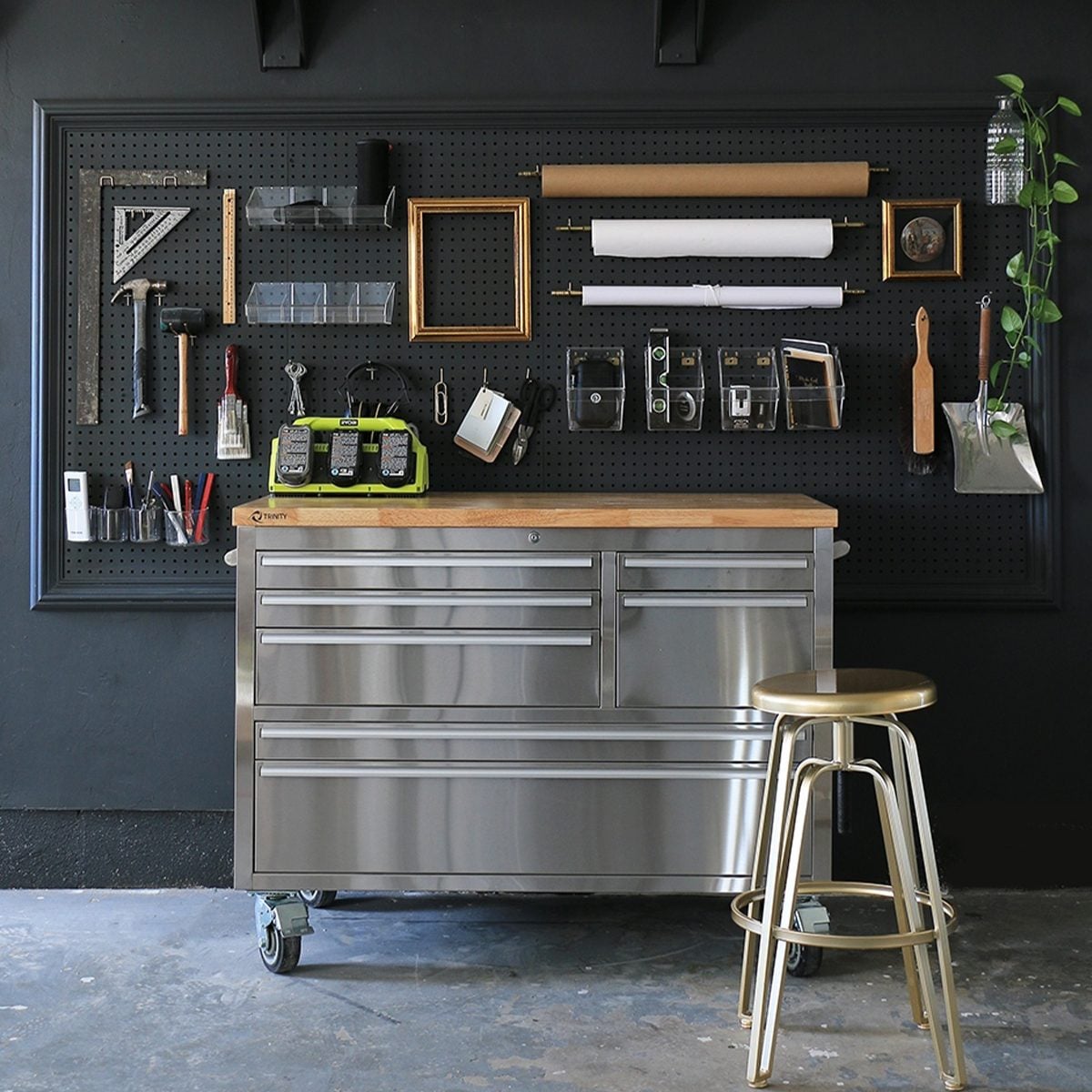
Pegboard remains one of the most practical garage wall storage solutions because its hooks, baskets, shelves, and holders can be rearranged as your tool collection changes. Instead of committing every wrench and paintbrush to a permanent location, you can move accessories whenever your projects evolve.
This Old House describes pegboard as an efficient way to organize tools and supplies while retaining the flexibility to expand or adjust the arrangement. HGTV likewise recommends mounting pegboard above a basic worktable to create an affordable, functional workstation.
How to Make Pegboard Look Intentional
Choose a panel large enough to create a visual zone rather than scattering several tiny pieces across the wall. Frame the edges with simple wood trim, paint the panel a contrasting color, and group tools by task. Place measuring tools together, painting supplies together, and frequently used hand tools within comfortable reach.
Traditional hardboard pegboard is economical, while metal and heavy-duty plastic versions may be better suited to damp garages or heavier accessories. Whatever material you select, mount it with the required space behind the panel so hooks can engage properly. Fasten the framing securely to studs or appropriate masonry anchors rather than trusting a few optimistic drywall screws.
A useful finishing touch is to trace the outlines of commonly used tools or add small labels beneath their positions. This makes it obvious when something is missing and reduces the chance that your favorite screwdriver will begin a new life beneath a pile of extension cords.
2. Cover a Wall With Slatwall Panels
For a cleaner, more finished alternative to pegboard, consider PVC, composite, or metal slatwall. Horizontal grooves accept movable hooks, racks, baskets, shelves, and specialty holders, allowing one wall to accommodate objects of dramatically different shapes.
Slatwall is particularly useful for bicycles, helmets, hoses, folding chairs, sports gear, garden tools, and other bulky items that do not fit neatly on conventional shelves. Bob Vila highlights slatwall as a customizable system whose accessories can be repositioned along the panels, while The Home Depot notes that track and slatwall systems provide adaptable vertical storage for larger equipment.
When Slatwall Is Worth the Investment
A full slatwall installation generally costs more than a small pegboard, but it offers a polished appearance and excellent long-term flexibility. It is a strong choice for homeowners who regularly change hobbies, have growing children with rotating sports equipment, or want the garage to resemble an organized workshop rather than a hardware-store clearance aisle.
Install slatwall across an entire work zone or use it as a wide horizontal band between lower cabinets and upper shelving. Before purchasing accessories, verify that they are compatible with the specific panel system. Similar-looking tracks are not always interchangeable, and discovering that fact after installation is an expensive form of character development.
Never assume a panel or hook can support a particular item simply because it looks sturdy. Follow the manufacturer’s published load limits, mounting pattern, and fastener requirements.
3. Add Wall-Mounted Shelves From Floor to Ceiling
Open shelving is one of the simplest garage wall ideas for turning unused vertical space into practical storage. Shelves can hold clear bins, automotive supplies, paper goods, gardening products, coolers, small appliances, and seasonal decorations while keeping the floor open for vehicles and equipment.
Family Handyman recommends wall-mounted shelving as a straightforward way to maximize garage storage, and Lowe’s notes that wall shelving can create a safer, more productive workspace by moving stored belongings off the floor.
Use Shelf Height Strategically
Reserve shelves between waist and eye level for items you use frequently. Place lightweight, seasonal belongings on upper shelves, and keep heavy containers lower so you are not balancing a 40-pound bin above your head while standing on a folding stool that has seen better days.
Wire shelving allows air circulation and makes dust less noticeable, although small objects may need bins or shelf liners. Solid plywood or laminated shelves provide a flatter surface and can be customized to unusual wall dimensions. Adjustable standards and brackets are especially useful because shelf spacing can change when your storage needs do.
Use matching bins to reduce visual clutter, but do not let stylish containers become anonymous mystery boxes. Label the front and at least one side so the contents remain identifiable when bins are rearranged.
4. Create a Wall of Closed Garage Cabinets
Open storage is convenient, but not every garage item deserves an audience. Wall-mounted cabinets conceal messy supplies, protect tools from dust, and create a calmer appearance. They are particularly valuable for sharp objects, automotive fluids, fertilizers, cleaning products, and other materials that should not be accessible to children or pets.
Lowe’s identifies utility cabinets as a practical way to store items behind doors and notes that lockable models can restrict access to tools and household chemicals. Bob Vila’s testing of garage storage systems also emphasizes that cabinets, racks, and pegboard serve different needs and budgets, making a mixed system more useful than relying on one storage type alone.
Combine Cabinets With an Open Work Zone
A highly functional arrangement places base cabinets or a workbench below, open pegboard or slatwall in the middle, and wall cabinets above. Everyday tools remain visible, while unattractive containers and less frequently used supplies stay behind doors.
Leave adequate clearance between cabinets and parked vehicles, especially near car doors and walking routes. Consider shallow upper cabinets if the garage is narrow. Dark cabinets can create a professional workshop look, while white or light-gray finishes help brighten garages with limited natural light.
Cabinets must be anchored according to their instructions. A wall cabinet filled with power tools is not the place to test whether gravity is feeling generous.
5. Build a Dedicated Sports and Bicycle Wall
Bicycles, balls, rackets, helmets, skateboards, and camping gear can consume an astonishing amount of floor space. Assigning them a dedicated wall keeps equipment together and makes it easier for family members to return items after use.
HGTV recommends wall or ceiling hooks for large objects such as ladders and garden tools, while Better Homes & Gardens suggests heavy-duty track systems with bicycle-specific hooks as an adaptable bike-storage method.
Design the Zone Around the Users
Hang adult bicycles higher and children’s bicycles lower so younger riders can retrieve their own equipment safely. Add baskets for helmets and gloves, short hooks for rackets, and a vertical ball rack or bungee-cord corral near the floor.
Keep the most frequently used gear near the garage door. Seasonal items such as skis, snowboards, or camping chairs can occupy higher positions. Maintaining clear walking and parking paths is more important than achieving a perfectly symmetrical display.
Before mounting a bicycle vertically, confirm that the selected hook is designed for the bike’s weight and wheel type. Protect painted walls with washable panels or small bump guards where tires are likely to make contact.
6. Turn One Wall Into a Fold-Down Workstation
A folding workbench can provide a sturdy project surface without permanently occupying valuable floor area. When closed, it becomes a slim wall panel; when open, it can support repairs, crafts, potting tasks, or small woodworking projects.
This Old House recommends wall-mounted fold-down benches for occasional DIYers because they provide a useful work surface and tuck away when not needed. Family Handyman also features compact folding workbench designs as space-saving options for busy garages.
What to Include Around the Bench
Add a pegboard above the work surface, a narrow shelf for frequently used supplies, and task lighting that does not cast your own shadow over the project. A magnetic strip can hold drill bits or small metal tools, while lidded bins keep screws and hardware from performing their traditional disappearing act.
Position electrical tools close to grounded outlets and avoid running extension cords across traffic paths. If the workstation will support heavy equipment, use robust hinges, proper wall blocking, and folding brackets rated for the anticipated load.
A durable, replaceable work surface is usually more practical than an expensive decorative top. Plywood or butcher block can be sanded, repaired, or replaced after years of glue, paint, oil, and mysterious dents.
7. Improve the Walls With Durable Paint or Paneling
Not every garage wall upgrade needs to involve storage. A fresh finish can make the entire room brighter, cleaner, and more connected to the rest of the home. Light neutrals reflect available light, while charcoal, navy, or deep green can create a dramatic accent behind cabinets and tools.
The Spruce identifies paint as one of the least expensive ways to improve garage walls and also suggests drywall, OSB, plywood, and PVC panels as functional alternatives. Sherwin-Williams recommends preparing the surface carefully, priming where needed, and applying paint evenly rather than attempting to hide dirt and damage beneath a heroic coat of color.
Choose a Finish That Can Handle Real Life
Garage walls encounter dust, muddy tires, lawn equipment, fingerprints, and occasional splashes. A washable interior coating with good stain resistance is generally more practical than an ultra-flat decorative finish. Sherwin-Williams notes that interior paints vary in scrubbability, stain resistance, coverage, and ease of touch-up, all of which matter in a hardworking space.
Repair cracks, address water intrusion, and clean mildew before painting. The Environmental Protection Agency advises controlling moisture through ventilation, air movement, and correction of condensation sources rather than merely covering visible symptoms.
Homes built before 1978 may contain lead-based paint. The EPA recommends determining whether lead is present and following lead-safe renovation practices that minimize and contain dust.
8. Create Clearly Labeled Activity Zones
The most successful garage organization does not treat every wall as one giant storage surface. It divides the room into zones based on activities: gardening, automotive care, household overflow, sports, recycling, woodworking, or outdoor entertaining.
Gladiator recommends breaking the garage into sections and mapping what will be stored in each area. Better Homes & Gardens similarly advises sorting and purging belongings before building an organization system so you know exactly what must return to the space.
Make Each Zone Easy to Maintain
Place long-handled garden tools near the yard entrance, car-care products near the parking bay, and sports equipment near the main garage door. Store backup household supplies on shelving closer to the interior door. Frequent-use items should remain visible and reachable, while rarely used belongings can move to upper shelves.
Give each wall zone a visual identity with a painted rectangle, label strip, matching bins, or different accessory type. For example, the gardening wall might use green labels, while the automotive section uses gray. This simple cue helps everyone understand where objects belong without requiring a 40-page garage operations manual.
Leave some empty wall capacity. A system packed to 100 percent on installation day has no room for new equipment, changing hobbies, or the inflatable holiday decoration someone will inevitably bring home in November.
How to Choose the Right Garage Wall Idea
The best option depends on what you store, how often you use it, and whether the layout may change. Pegboard works well for small tools and hobby supplies. Slatwall and track systems handle mixed or bulky equipment. Shelves are efficient for labeled containers, while cabinets conceal clutter and restrict access to hazardous products.
Before installation, consider four practical questions:
- What must remain accessible? Daily-use tools belong between waist and eye level.
- What is heavy? Heavy objects need properly rated hardware anchored into studs, masonry, joists, or structural blocking.
- What creates risk? Chemicals, sharp tools, and valuable equipment may require lockable cabinets.
- What may change? Growing families and evolving hobbies benefit from adjustable systems.
The Home Depot and Lowe’s both emphasize customizable combinations of hooks, shelving, panels, bins, and cabinets rather than a single universal solution.
Real-World Experience: What Makes a Garage Wall System Work
In practice, the biggest improvement rarely comes from buying the most expensive storage system. It comes from deciding what the garage is supposed to do. A household that parks two vehicles needs a different wall plan from someone using half the garage as a workshop, home gym, or gardening room.
A useful first experience is the temporary-layout test. After sorting the garage, place bins, bicycles, tools, and equipment near their proposed wall zones without installing anything. Walk around the parked vehicles, open every car door, carry a laundry basket through the room, and retrieve several commonly used objects. This simple rehearsal exposes awkward placements before they become permanent holes in the wall.
Another lesson is that visible storage works only when the objects are reasonably attractive and easy to return. A row of carefully arranged hand tools on pegboard can look excellent. Twenty half-empty chemical bottles, tangled cords, and unmatched containers generally cannot. Closed cabinets and opaque bins are valuable not because they magically organize belongings, but because they reduce visual noise.
It is also wise to install less storage than you initially think you need. Homeowners often fill every shelf and hook immediately, leaving no flexibility. A better approach is to complete the main zones, live with the layout for several weeks, and add accessories only where repeated inconveniences appear. Perhaps the extension cords need a deeper hook. Perhaps helmets require a basket. Perhaps the shelf above the workbench is positioned exactly where your forehead would prefer it not to be.
Labeling should be specific enough to guide behavior. A bin marked “Miscellaneous” is not organization; it is a small plastic garage within the garage. Labels such as “Car-Washing Supplies,” “Camping Cookware,” or “Exterior Paint Tools” make it easier to locate items and prevent unrelated objects from accumulating together.
Seasonal rotation can further improve a wall system. During summer, bicycles, garden tools, and outdoor games should occupy accessible positions. Winter equipment can move higher or farther back. When the seasons change, reverse the arrangement. Adjustable rails, slatwall, pegboard, and shelf standards make this rotation much easier than fixed hooks.
Lighting is another practical consideration that is often ignored until the storage is finished. Deep shelves and dark cabinets can create shadows that make labels difficult to read. Add bright overhead lighting and focused illumination above work surfaces. Lighter wall colors can also make a garage feel larger and reduce the cave-like atmosphere common in rooms with few windows.
Finally, schedule a brief wall reset two or three times a year. Return misplaced objects, discard empty containers, inspect anchors, and confirm that heavy items remain secure. The goal is not to make the garage photograph-ready every day. It is to create a system that can recover quickly after real projects, busy weekends, and the occasional moment when everyone decides the nearest horizontal surface is an acceptable storage plan.
Conclusion
Effective garage wall ideas do more than decorate blank surfaces. They move clutter off the floor, establish logical activity zones, protect valuable tools, and make the garage easier to use every day. Pegboard offers affordable flexibility, slatwall handles changing storage demands, shelves support labeled containers, and cabinets hide items that should not remain exposed.
Start by sorting your belongings and measuring the room rather than shopping for hardware immediately. Then combine two or three complementary solutions instead of forcing every object into one system. With secure installation, durable finishes, clear labels, and a little unclaimed space for future needs, your garage walls can become the hardest-working surfaces in the house.













