
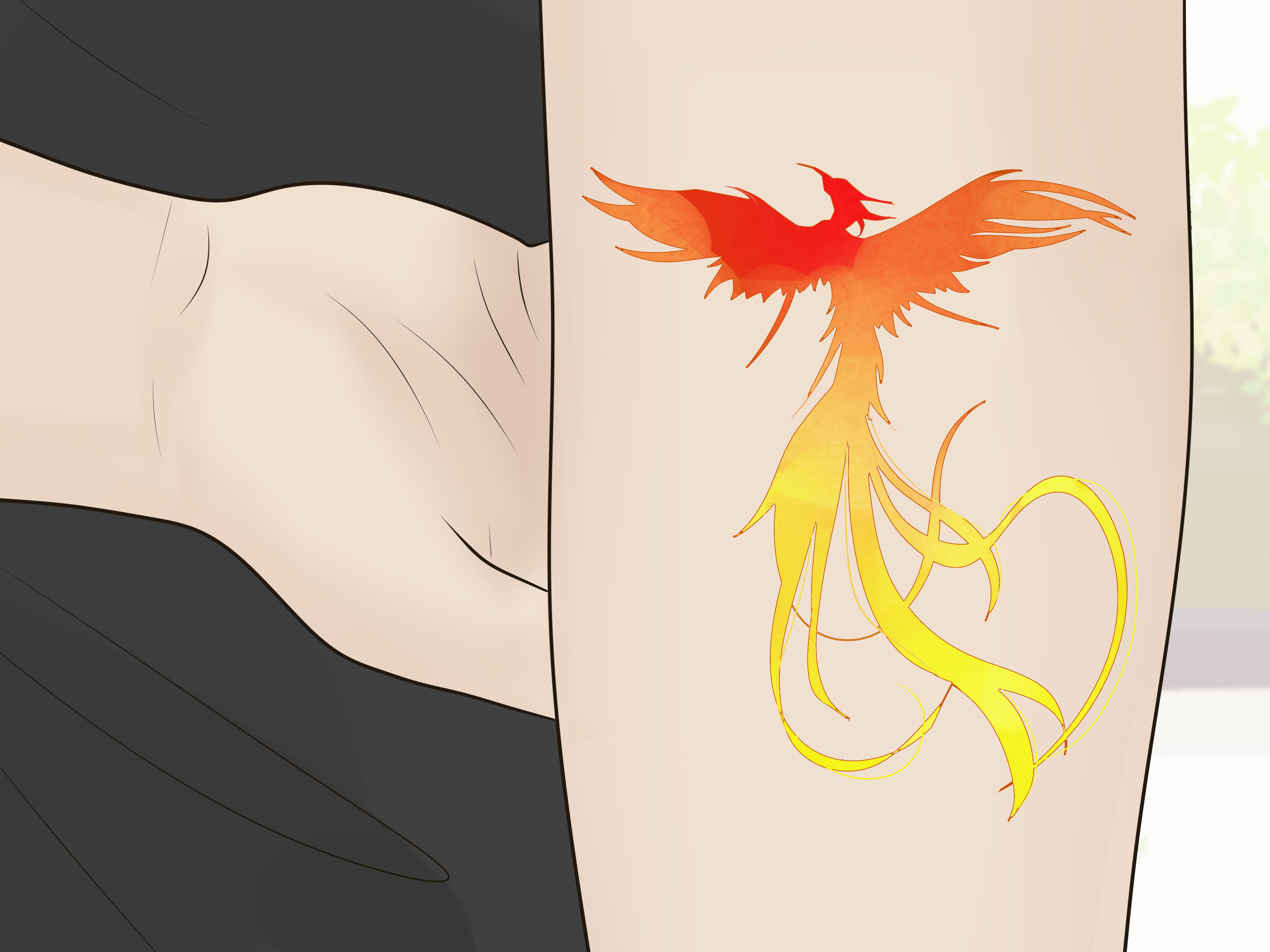
A phoenix tattoo is not merely a spectacular bird with excellent fire-management skills. It is one of body art’s most powerful symbols of survival, renewal, transformation, and hope. For many wearers, the design marks the end of a difficult chapter and the beginning of a life rebuilt with greater purpose.
Although the familiar image of a bird rising from its ashes comes mainly from Greek and Roman traditions, similar sacred birds appear in Egyptian, Chinese, Japanese, Persian, and Christian art. These figures are related through themes such as immortality, virtue, cosmic order, and regeneration, but they are not interchangeable. Understanding those differences can help you choose a phoenix tattoo that is visually striking, personally meaningful, and culturally thoughtful.
What Does a Phoenix Tattoo Mean?
The central phoenix tattoo meaning is rebirth after destruction. The mythical bird completes its life cycle, dies, and returns in renewed form. In popular versions of the legend, flames consume the aging bird before a new phoenix rises from the ashes.
That dramatic cycle explains why phoenix tattoos are often chosen after experiences such as grief, divorce, addiction recovery, illness, professional failure, relocation, or a major change in identity. The ashes represent what has ended. The ascending bird represents the person who continues.
Rebirth and New Beginnings
A phoenix tattoo can celebrate the decision to begin again without pretending the past never happened. Unlike symbols that suggest a perfectly clean slate, the phoenix carries its ashes into the story. Its strength exists because of what it survived.
This makes the design especially meaningful for someone entering a new phase of life. A graduation, career change, spiritual awakening, or escape from an unhealthy relationship can all become personal “phoenix moments.” The tattoo says, “That chapter burned down, but the book is not finished.”
Resilience and Survival
Resilience is not about never falling apart. It is about finding a form in which you can rise again. A phoenix tattoo recognizes that recovery may be messy, gradual, and occasionally accompanied by emotional smoke alarms.
Some designs emphasize this meaning by showing one wing still surrounded by embers while the other reaches into open air. The contrast creates a visual bridge between hardship and freedom.
Transformation and Personal Growth
The phoenix does not simply return as an identical copy of its former self. Symbolically, it returns renewed. For that reason, a phoenix tattoo can represent emotional maturity, spiritual development, or the shedding of an identity that no longer fits.
A person may choose the bird after learning to establish boundaries, forgive themselves, live more honestly, or accept a major change. Here, the flames do not symbolize punishment. They symbolize transformation under pressure.
Immortality and the Cycle of Life
Because the phoenix repeatedly dies and returns, it has long been connected with immortality and the cyclical nature of existence. A memorial phoenix tattoo may express the belief that love, influence, or spiritual presence continues after physical death.
The design can also reflect acceptance of life’s repeating patterns: endings make room for beginnings, loss creates new priorities, and winter is rarely the final season.
The Phoenix in Greek and Roman Tradition
Classical accounts describe the phoenix as a rare or unique bird associated with the sun, extraordinary longevity, and periodic renewal. The Greek historian Herodotus wrote about a sacred bird connected with Heliopolis in Egypt, although he made clear that he had not personally seen it. In his account, the bird returned after a long cycle and carried the remains of its predecessor in a container made with fragrant myrrh.
Later Greek and Roman writers expanded the legend. Over time, fire, a funeral pyre, aromatic spices, and rebirth from remains became central features of the story. The now-famous image of the phoenix dramatically springing from a pile of glowing ashes developed through this evolving classical tradition rather than appearing in exactly the same form in every ancient source.
For tattoo art, the classical phoenix commonly represents:
- Triumph over adversity
- Renewal after loss
- The persistence of the soul
- Solar power and vitality
- The destruction of an old identity
A Greek-inspired phoenix tattoo may feature an eagle-like body, radiant feathers, a sun disk, laurel leaves, columns, or flames arranged like a ceremonial crown.
The Egyptian Bennu and the Origins of Renewal Symbolism
The ancient Egyptian Bennu bird is frequently discussed as a possible influence on the classical phoenix. Associated with the sun, creation, divine renewal, and the god Osiris, Bennu was often represented as a heron-like bird. Its mythology connected it with the beginning of creation and with recurring cycles of life.
However, Bennu should not be treated as simply the Egyptian spelling of the Greek phoenix. Egyptian sources do not present the exact modern story of a bird building a fiery nest and emerging from its own ashes. The two traditions share solar and regenerative themes, but their stories and visual identities differ.
Meaning of a Bennu-Inspired Tattoo
A tattoo based specifically on Bennu may symbolize creation, spiritual awakening, the rising sun, sacred time, or the return of life after death. It may feature a long-legged heron, an Egyptian crown, a solar disk, papyrus plants, the Nile, or geometric elements inspired by temple art.
Someone interested in Egyptian symbolism should show their artist historical references rather than requesting a standard flaming eagle with a few hieroglyphs added for seasoning. Accuracy creates a more meaningful design and prevents unrelated symbols from being tossed together like mythological trail mix.
Chinese Fenghuang Symbolism
The fenghuang is often called the “Chinese phoenix” in English, but it is a distinct mythical bird. It is not primarily defined by dying in flames or rising from ashes. Traditionally, it is associated with virtue, harmony, prosperity, peace, and righteous rule. It is frequently described as a sovereign among birds.
In imperial imagery, the fenghuang became closely associated with the empress, while the dragon represented the emperor. Dragon-and-fenghuang pairings can therefore express balance, marriage, harmony, and the complementary forces of a well-ordered union. In art, the bird may appear with peonies, paulownia trees, clouds, or other auspicious motifs.
Meaning of a Fenghuang Tattoo
A fenghuang tattoo may represent:
- Grace joined with moral strength
- Peace and social harmony
- Prosperity and good fortune
- Balance within a partnership
- Dignity, leadership, and noble conduct
The design is often colorful and elegant, with a long flowing tail and features inspired by several beautiful birds. Before adding flames, consider whether you want a historically inspired fenghuang or a modern hybrid combining Chinese and Western phoenix imagery. Either approach can work, but the distinction should be intentional.
The Phoenix in Japanese Art and Tattooing
In Japan, the mythical bird commonly called hō-ō developed from the Chinese fenghuang tradition. It is associated with peace, virtue, good government, imperial authority, and the arrival of an auspicious age. Like the fenghuang, it is not traditionally centered on self-destruction and rebirth from ashes.
Japanese-inspired phoenix tattoos are often large, flowing compositions designed to move with the body. Sweeping tail feathers can wrap around the shoulder, thigh, ribs, or back, while clouds, wind bars, peonies, chrysanthemums, or paulownia leaves complete the composition.
Japanese Phoenix Tattoo Meaning
Depending on the artistic approach, a Japanese phoenix tattoo may communicate dignity, harmony, fidelity, justice, spiritual refinement, or the hope that peace will follow conflict. Modern Japanese-style designs may also incorporate the Western rebirth meaning, creating a contemporary fusion rather than a strictly traditional interpretation.
Because Japanese tattoo composition has its own visual grammar, choosing an artist experienced in large-scale Japanese work matters. A magnificent tail needs room to flow. Compressing it into a two-inch ankle tattoo may leave the legendary bird looking less like an omen of peace and more like a startled chicken.
Christian Meaning of the Phoenix
Christian artists and writers adopted the phoenix as an allegory of resurrection, eternal life, and hope in salvation. The bird’s apparent return after death offered a natural comparison with the Resurrection of Christ.
In European religious art, phoenix imagery sometimes appears alongside symbols of faith, charity, sacrifice, and redemption. Museum collections include works in which the phoenix specifically represents Christ’s Resurrection or the theological virtue of hope.
A Christian phoenix tattoo may therefore combine the bird with a cross, halo, crown of light, scripture reference, olive branch, or rays breaking through clouds. For some believers, the design expresses confidence that death is not the final word. For others, it symbolizes spiritual renewal through repentance and grace.
Phoenix Tattoos and Modern Spirituality
Outside a specific religious tradition, the phoenix has become a broad spiritual symbol of inner renewal. It may represent the death of the ego, the release of destructive habits, or the awakening of a more authentic self.
The fire can be interpreted as purification, but that does not mean pain automatically makes someone wiser. Fire can destroy as easily as it can refine. The deeper spiritual meaning lies in what the wearer consciously builds afterward.
A rising phoenix may also symbolize reclaiming personal power. This interpretation is common among people who have spent years being defined by a diagnosis, family role, social expectation, or past mistake. The tattoo becomes a declaration that their identity is larger than the worst thing that happened to them.
How Design Elements Change Phoenix Tattoo Meaning
Flames and Embers
Bright flames emphasize destruction, purification, passion, and active transformation. Embers create a quieter mood, suggesting that the crisis has passed but still shapes the wearer’s life.
Ashes
Visible ashes make the rebirth symbolism unmistakable. They may represent grief, a previous identity, a failed relationship, or circumstances that can no longer be restored.
Open Wings
A phoenix with fully extended wings suggests freedom, confidence, protection, and victory. Upward-facing wings create a stronger sense of ascension, while curved wings can feel protective and inward-looking.
The Sun
Adding the sun reinforces the phoenix’s ancient solar associations. Sunrise imagery suggests a beginning, while a blazing midday sun conveys vitality, clarity, and power.
Lotus Flowers
A lotus grows from muddy water and is widely used as a symbol of spiritual development. Paired with a phoenix, it creates a layered message about beauty and wisdom emerging from difficult conditions. Because lotus symbolism varies among Buddhist, Hindu, and modern contexts, the exact visual tradition should be chosen carefully.
Feather Colors
Red, orange, and gold emphasize energy, courage, passion, and fire. Blue or purple feathers can suggest intuition, spiritual depth, mystery, or a cooler form of transformation. Black-and-gray phoenix tattoos often feel more reflective, memorial, or solemn.
These color interpretations are flexible modern associations, not a universal ancient code. Your phoenix will not lose its mythology license because you prefer teal.
Popular Phoenix Tattoo Styles and Placements
Realistic phoenix tattoos use detailed feathers, dramatic lighting, and believable anatomy. They work best on larger areas such as the back, chest, thigh, or upper arm.
Neo-traditional designs combine bold outlines with saturated colors and decorative shapes. This style is ideal for a phoenix surrounded by flowers, flames, jewels, or banners.
Japanese-style phoenix tattoos favor large compositions, rhythmic movement, clouds, wind, and long ornamental feathers. Full backs, sleeves, and thigh panels provide sufficient space.
Watercolor phoenix tattoos use splashes and gradients to suggest heat, motion, and transformation. Strong underlying linework can help the design remain readable as it ages.
Blackwork and geometric phoenix tattoos emphasize shape, symmetry, and contrast. They suit wearers who want rebirth symbolism without turning their arm into a permanent fireworks display.
Vertical placements such as the forearm, calf, spine, and side of the torso naturally support an ascending bird. The back allows the wings to spread, while the shoulder and upper arm create movement when the wearer turns or lifts an arm.
Choosing a Phoenix Tattoo That Tells Your Story
Begin with the meaning, not the search results. Ask yourself what the ashes represent and what the rising bird represents. Without that distinction, the tattoo may be beautiful but emotionally generic.
Next, decide which cultural tradition fits your intention. A classical fire phoenix, Egyptian Bennu, Chinese fenghuang, and Japanese hō-ō carry overlapping but different meanings. Bring reliable visual references to your artist and discuss which elements can be combined without turning separate traditions into decorative clutter.
Finally, choose an artist whose portfolio demonstrates the style and scale you want. Detailed feathers, smooth color gradients, Japanese backgrounds, and blackwork symmetry require different strengths. A phoenix is usually a complex design, and its wings deserve more planning than a last-minute menu selection.
Experiences Behind a Phoenix Tattoo: From the First Sketch to the Healed Design
The experience of getting a phoenix tattoo often begins long before anyone switches on a tattoo machine. People may spend months collecting references because they are not simply choosing a bird. They are trying to translate an emotionally complicated period into one readable image.
Consider someone who wants a phoenix after leaving a long, unhealthy relationship. During the consultation, the artist might ask which part of that journey matters most. Is the tattoo about surviving the relationship, grieving lost years, or discovering independence? If the answer is independence, the final bird may face upward with open wings. If the focus is grief, the artist may retain smoke and dark feathers around the lower body before allowing the upper feathers to brighten.
Another wearer may choose a phoenix after losing a loved one. In that case, the tattoo does not necessarily mean the person has “moved on.” It may represent carrying love into a changed life. A date, flower, handwritten word, constellation, or subtle color can personalize the memorial without overwhelming the bird.
The design process can be surprisingly emotional. Seeing a rough sketch may be the first time an abstract experience feels visible and contained. That moment can bring relief, but it can also reveal that the original idea no longer feels right. A good consultation leaves room for revision. Permanent body art is not the ideal place to practice aggressive spontaneity.
During the tattoo session, large phoenix pieces may require several appointments. Outlining establishes the structure; shading gives the body volume; color and highlights create the impression of heat and movement. Long sessions can become tiring, particularly on the ribs, spine, chest, or inner thigh. Eating beforehand, staying hydrated, wearing practical clothing, and following the artist’s preparation instructions usually make the experience less dramatic.
The first view of a completed phoenix can feel intense because the design is fresh, swollen, and much brighter than it will appear after healing. Some people immediately feel empowered. Others need time to adjust to seeing a major personal story permanently displayed on their body. Both reactions are normal.
Healing is also part of the experience. The design may look cloudy or flaky before settling. Medical organizations advise choosing hygienic tattoo practices, following aftercare instructions, watching for unusual reactions, and protecting healed tattooed skin from ultraviolet exposure. Tattoo inks can occasionally cause allergic reactions or infections, so worsening redness, severe pain, pus, fever, or other concerning symptoms should not be treated as a heroic test of resilience. They require professional medical attention.
Months later, the phoenix often becomes less of a public announcement and more of a private anchor. It may remind the wearer how far they have traveled when another difficult season arrives. The tattoo does not guarantee that life will never collapse again. Its promise is more realistic: collapse does not have to be the end.
That may be the most honest phoenix tattoo meaning of all. Rebirth is not a single dazzling event. It is a practicechoosing, repeatedly, to create a life from whatever remains.
Conclusion
A phoenix tattoo represents far more than a mythical bird surrounded by flames. It can express rebirth, resilience, immortality, spiritual transformation, moral virtue, harmony, or hope after loss. Its exact message depends on the tradition, composition, colors, accompanying symbols, and personal story behind it.
The Western phoenix rises through destruction. The Egyptian Bennu evokes creation and solar renewal. The Chinese fenghuang and Japanese hō-ō emphasize virtue, harmony, dignity, and auspicious order. Christian art uses the phoenix as an image of resurrection and eternal hope.
Whichever tradition inspires your design, treat it as more than attractive decoration. Research the symbolism, work with a skilled artist, and create a bird that reflects your own definition of rising. After all, the best phoenix tattoo is not the one with the largest flames. It is the one that makes the ashes meaningful.










