
Solder flux is supposed to make electronics repair easier. It removes troublesome oxides, improves solder wetting, and helps molten solder behave like a cooperative metal instead of an angry silver marble. Yet one unfortunate GeForce2 GTS reballing attempt showed that a bad tube of flux can turn a routine repair into a tiny, expensive barbecue.
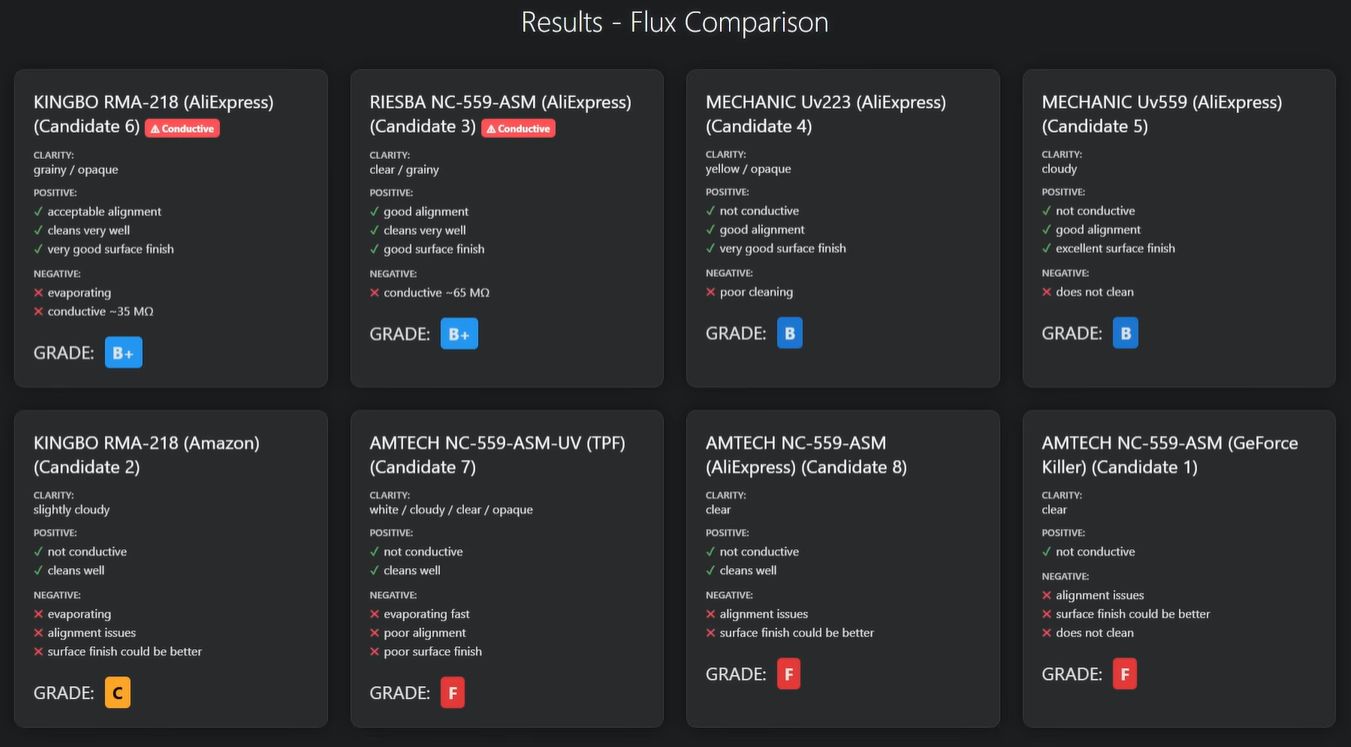
After a replacement batch of counterfeit-labeled AMTECH NC-559-ASM flux behaved very differently from an earlier purchase, eight solder flux pastes were put through a practical comparison. Some helped BGA balls settle neatly into place. Others encouraged bridges, rough surfaces, stubborn residue, and additional heating that an aging graphics chip definitely did not request.
The resulting solder flux paste test is more than an entertaining tale about questionable marketplace products. It demonstrates why flux chemistry, authenticity, thermal stability, cleaning requirements, and process control all matter when reballing a BGA chip.
How Solder Flux Became the Prime Suspect
The repair involved a GeForce2 GTS, a vintage graphics processor packaged as a ball grid array. Instead of visible leads around the edge, a BGA chip connects to its circuit board through an organized field of solder balls underneath the package. Reballing means removing the old solder, cleaning the pads, placing new balls with a stencil, and reflowing them without damaging the chip.
That last part is where the trouble began. The newly purchased flux did not behave like the earlier batch from the same marketplace seller. The solder balls resisted flowing and settling correctly, so more heat and time were applied. Eventually, the graphics processor was cooked.
It would be too simple to declare that the flux alone murdered the GPU in the electronics workshop with the hot-air nozzle. Excessive peak temperature, uneven heating, insufficient preheating, inaccurate temperature measurement, or excessive time above the solder’s melting point may also have contributed. However, uncooperative flux can push a technician toward all of those dangerous conditions.
That made the flux a reasonable suspectand created an excellent reason to compare eight different solder flux pastes under similar reballing conditions.
What Flux Actually Does During Soldering
It Attacks Surface Oxides
Copper pads, component terminations, and solder balls develop oxide layers when exposed to air. Molten solder does not wet an oxidized surface properly. Flux contains activators that react with these oxides when heated, exposing cleaner metal beneath.
It Slows Reoxidation
Cleaning the surface before soldering is not enough because heat accelerates oxidation. Flux spreads over the working area and forms a temporary barrier that limits contact with oxygen while the solder is molten.
It Improves Wetting and Ball Coalescence
Once oxides are controlled, molten solder can spread across compatible metal surfaces and form the intermetallic bond needed for an electrically and mechanically sound connection. During BGA reballing, good flux also helps individual balls pull into centered, rounded positions.
It Provides Tack
Tacky flux paste holds small components or loose solder spheres in place before reflow. Too little tack allows balls to wander. Excessive or inconsistent tack can make stencil release difficult and may leave balls stranded in the wrong places.
How the Eight Flux Pastes Were Compared
The comparison used sections of a BGA chip rather than relying only on a simple soldering-iron demonstration. That matters because a paste that performs adequately on a large through-hole joint may behave very differently beneath a dense grid of tiny solder balls.
The pastes included inexpensive marketplace products, counterfeit or imitation AMTECH-labeled material, several Mechanic products believed to be genuine, and Riesba NC-559-ASM. Although the test was not a laboratory certification program, it revealed substantial practical differences.
| Test Category | Signs of Good Flux | Warning Signs |
|---|---|---|
| Tack and placement | Balls remain positioned and release cleanly from the stencil | Sliding balls, clumps, or difficult stencil removal |
| Activation | Oxides are removed quickly as the solder reaches reflow | Persistent dullness or poor wetting |
| Ball pull-in | Solder spheres snap into centered, rounded positions | Misaligned, elongated, or partially collapsed balls |
| Bridging | Each ball remains separate | Adjacent balls merge into conductive bridges |
| Surface finish | Even, smooth solder surfaces | Pitting, pockmarks, or heavily oxidized-looking surfaces |
| Thermal endurance | Flux remains active through the required heating cycle | Premature drying, charring, or rapid loss of activity |
| Residue | Controlled, predictable residue compatible with the process | Sticky, conductive-looking, burned, or difficult deposits |
| Cleanup | Residue responds to the cleaner specified by the manufacturer | Smearing, swelling, or resistance to ordinary isopropyl alcohol |
What the Results Revealed
Flux Pastes With Similar Labels Can Behave Very Differently
Several products looked broadly similar in their syringes, yet their performance diverged once heated. With the better-performing pastes, the solder balls visibly pulled into position and developed a smooth finish. Poor performers produced bridges or rough, pockmarked surfaces associated with inadequate oxide control.
This is an important lesson for anyone buying generic NC-559-style flux. A familiar number printed on a syringe does not prove that the material follows the original formula. The contents may vary between sellers, factories, or even batches from the same listing.
Riesba Produced the Best Overall Result
Riesba NC-559-ASM was the strongest performer in the practical comparison. It allowed the balls to settle well and produced an attractive solder finish. The name may be less familiar than AMTECH, Kester, AIM, or Indium, but the observed result was better than brand recognition alone would have predicted.
That does not automatically make every Riesba syringe a universal winner. Marketplace supply chains can change, and a successful sample is not the same as a documented manufacturing qualification. It does show why performance testing is more useful than judging flux by packaging graphics or online popularity.
Some Mechanic Fluxes Worked but Were Harder to Clean
The Mechanic products demonstrated that strong reflow performance and easy cleanup are separate qualities. A paste may control oxidation and produce decent solder balls while leaving residue that does not dissolve readily in isopropyl alcohol.
Using more alcohol and scrubbing harder is not always the answer. Certain residues require a purpose-designed flux remover, an aqueous cleaning process, or another cleaner approved by the manufacturer. Randomly escalating to aggressive solvents may damage plastics, markings, adhesives, coatings, sockets, or nearby components.
“No-Clean” Does Not Mean “No Questions Asked”
The term “no-clean” is widely misunderstood. It normally means that properly processed residue can remain on an assembly under specified conditions without creating an unacceptable reliability risk. It does not promise that the board will look spotless, that every residue dissolves in alcohol, or that cleaning is never appropriate.
Fluxes are commonly classified under IPC J-STD-004 using letters and numbers. The first part describes the main nonvolatile material family: rosin, resin, organic, or inorganic. Another character indicates low, moderate, or high activity. The final digit describes the result of a halide-related test.
A classification such as ROL0 can provide useful information, but it is not a complete application guide. A technician still needs the technical data sheet to understand recommended alloys, activation temperatures, residue characteristics, cleaning chemistry, storage conditions, and shelf life.
No-clean residue may be acceptable on an ordinary consumer board but undesirable in high-impedance, high-voltage, humid, medical, aerospace, or conformally coated electronics. Residue trapped beneath a low-clearance component can also be difficult to inspect or remove later.
Why Poor Flux Can Lead to an Overheated BGA Chip
Bad flux does not necessarily destroy a component through direct chemical attack during a single repair. The more immediate danger is process distortion.
Imagine that the solder balls remain dull and refuse to pull into shape. The operator raises the hot-air temperature. Nothing convincing happens, so the nozzle stays in place longer. The center of the package becomes hotter than expected while the corners remain below proper reflow temperature. The flux eventually burns away, oxygen reaches the solder, and the operator adds still more heat.
A controlled BGA rework profile avoids this improvisational spiral. Professional guidance generally divides the cycle into preheat, soak, reflow, and cooling stages. Preheating reduces the temperature difference between the top and bottom of the assembly. The soak stage activates the flux and helps temperatures become more uniform. Reflow takes the solder above its liquidus temperature for a limited period, followed by controlled cooling.
The temperature displayed by a hot-air station is not necessarily the temperature of the chip or solder balls. Airflow, nozzle distance, board thickness, copper planes, package size, and bottom heating all affect the actual result. Thermocouples placed on representative locations provide far more useful information than trusting the heater’s front-panel number.
How to Buy Solder Flux Paste Without Gambling a GPU
-
Use an authorized distributor when the repair matters.
Saving a few dollars on flux makes little sense when the component is rare, valuable, or irreplaceable. -
Look for a technical data sheet and safety data sheet.
Missing documentation is a major warning sign, especially when the syringe imitates a recognized brand. -
Verify the exact product designation.
Similar names may refer to no-clean, RMA, water-washable, lead-free, or high-temperature formulas. -
Check storage and expiration guidance.
Age, heat, contamination, and repeated exposure to air can change viscosity and performance. -
Buy a manageable quantity.
A giant jar is not economical when most of it ages on a shelf while you perform three repairs per year. -
Test every unfamiliar batch.
A previously successful listing does not guarantee that the next syringe contains identical material.
A Repeatable Bench Test for Comparing Flux Pastes
A hobbyist can improve on an informal comparison without building a million-dollar reliability laboratory. The key is controlling as many variables as possible.
- Use identical scrap BGA packages or matching test coupons.
- Remove old solder and prepare every surface with the same method.
- Use solder balls from one lot with the same diameter and alloy.
- Apply a measured or visually standardized amount of flux.
- Use the same stencil, fixture, nozzle, airflow, and nozzle distance.
- Record board, package, and solder temperatures with thermocouples.
- Keep peak temperature and time above liquidus consistent.
- Photograph the results under identical lighting and magnification.
- Score bridges, missing balls, alignment, surface texture, residue, and cleanup.
- Repeat each test instead of trusting one unusually good or bad run.
Blind labeling is also useful. Place each flux in a numbered container and evaluate the solder result before checking the brand. That prevents a premium label from receiving an imaginary bonus point for excellent typography.
Cleaning and Safety Matter Too
Flux fumes should not be treated as workshop aromatherapy. Heated rosin and other flux ingredients can release irritating decomposition products. Use effective local fume extraction near the work, provide general ventilation, avoid placing your face over the board, and follow the product’s safety data sheet.
Wear appropriate eye protection and avoid prolonged skin contact with paste or cleaning solvents. Keep containers closed when not in use, and do not eat or drink at the soldering bench. Solvent-soaked wipes should be handled and discarded according to their safety instructions.
Before cleaning a repaired board, determine what residue is present and which materials surround it. Test the cleaner on a noncritical area when compatibility is uncertain. After cleaning, inspect beneath magnification for residue, displaced components, damaged solder mask, loose balls, or fibers left by wipes and brushes.
Experience Notes: What a Careful Second Attempt Looks Like
The most useful experience to take from a failed BGA reballing job is not “never trust flux.” It is “never allow one uncertain material to control the entire repair.” Experienced technicians treat flux as one variable within a larger process involving preparation, heat delivery, observation, timing, and inspection.
Consider a realistic second attempt after losing a vintage GPU. The first change would be to stop using the suspect syringe immediately. It should be labeled, isolated, and retained only for comparisonnot returned to the drawer where it can ambush another project six months later.
The next step would be practicing on a donor chip with no historical or financial value. A technician might prepare two identical sections, apply a known professional flux to one and the questionable paste to the other, and run the same recorded thermal profile. Even a basic comparison can reveal differences in bubbling, smoke, spreading, ball movement, residue color, and cleanup.
Temperature measurement often produces the biggest surprise. A hot-air station set to 350°C does not mean the silicon has reached 350°C, but it also does not guarantee the chip is safe. One area may lag while another overshoots. A bottom preheater can reduce the amount of intense top heat required, while thermocouples reveal whether the package is heating evenly.
Another common lesson is that more flux is not always the same as better flux. A generous layer may help transfer heat and prevent oxidation, but excessive paste can bubble, move balls, spread contamination, or obscure the moment of reflow. The useful amount is the quantity that maintains activity and tack without flooding the stencil or package.
Visual cues also become more meaningful with experience. Properly reflowed balls tend to become round and settle into a consistent pattern. Balls that remain grainy, misshapen, or dull may indicate inadequate heat, oxidation, incompatible solder, contaminated surfaces, or exhausted flux. The correct response is not automatically “hold the nozzle there longer.” The correct response is to identify which variable is wrong.
Cleanup offers another diagnostic opportunity. Residue that turns white, smears endlessly, or swells when exposed to alcohol may require a different cleaner. Scrubbing aggressively around tiny pads can cause more damage than leaving a qualified no-clean residue in place. Product documentation should determine the cleaning method, not impatience.
Finally, experienced repair work includes knowing when to stop. If solder refuses to behave within a validated temperature and time window, continuing to heat a rare component is not perseverance. It is an uncontrolled experiment. Allow the assembly to cool, inspect the setup, verify the alloy and flux, and practice on scrap before making another attempt.
That pause may feel slow, but it is much faster than searching auction sites for another GeForce2 GTS while explaining to yourself that the smell is probably normal.
Conclusion
Testing eight solder flux pastes after a GeForce2 GTS failure exposed a simple truth: flux is an engineered process material, not interchangeable mystery jelly. Products with nearly identical labels can differ in activation, tack, thermal stability, solder-ball behavior, residue, and cleanability.
Riesba NC-559-ASM performed particularly well in the reported comparison, while other products produced bridges, rough surfaces, or stubborn residue. However, the larger lesson is not to crown one marketplace brand forever. It is to buy documented material from a reliable source, test unfamiliar batches on scrap, use a measured thermal profile, and stop heating when the process stops behaving predictably.
Good flux makes difficult rework look almost magical. Bad flux makes the technician compensate with more heat until the magic smoke applies for early retirement.
Note: The reported comparison was a practical workshop test rather than a controlled laboratory qualification. Product formulations and marketplace suppliers may change, so confirm current technical documentation and test each unfamiliar batch before repairing valuable hardware.










