
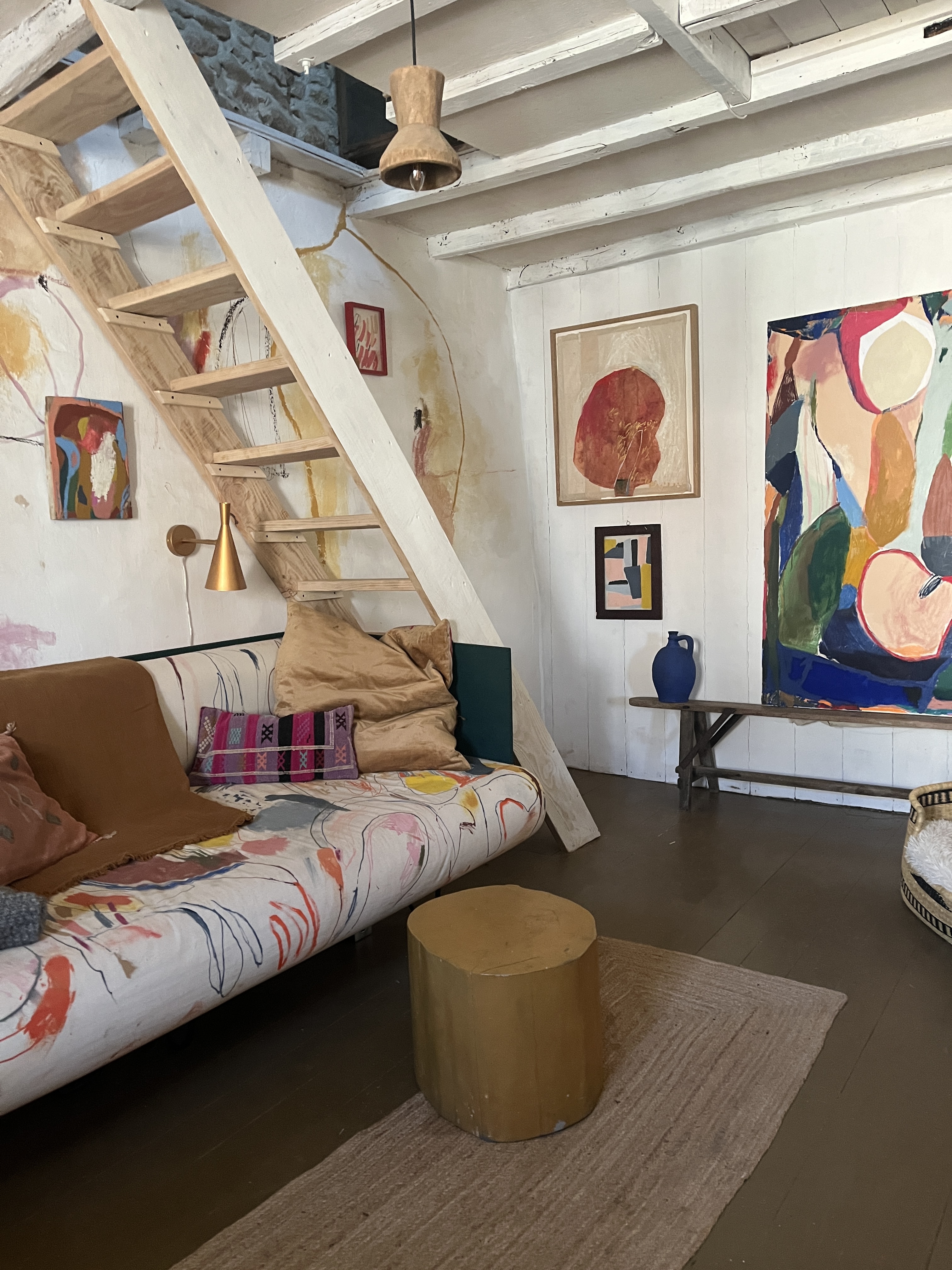
Some people renovate a farmhouse with paint swatches, floor samples, and the emotional support of twelve Pinterest boards. Artist Heather Chontos took a more thrilling route: she treated her 18th-century French stone farmhouse as if the entire place had quietly volunteered to become a painting. Walls, upholstery, old drawers, scraps of wood, vintage textiles, and even the stubborn little corners most homeowners ignore became part of her visual language.
Set in the countryside of southwest France, Chontos’s antique stone home is not a polite backdrop for art. It is the art. The farmhouse feels less like a finished interior and more like a living sketchbooklayered, intuitive, funny, raw, practical, and wildly alive. In a world obsessed with beige perfection and “quiet luxury” so quiet it sometimes forgets to speak, Heather Chontos’s French farmhouse practically sings opera in muddy boots.
The result is a rare kind of artist home: deeply personal, visually brave, and rooted in the belief that a house should not merely hold a life. It should show evidence of one.
Who Is Heather Chontos?
Heather Chontos is an American multidisciplinary artist known for bold abstract paintings, sculptural objects, textile experiments, and expressive interiors that blur the line between home and studio. Born in New York and shaped by a creative life across cities such as London, New York, Paris, Barcelona, Berlin, and rural Europe, Chontos brings a restless, instinctive energy to everything she makes.
Her work often features sweeping gestures, intense color, organic shapes, and a sense of movement that feels both spontaneous and emotionally precise. She has worked in set design, styling, creative direction, painting, sculpture, and design collaborations, which helps explain why her interiors never feel flat. She understands rooms the way a painter understands composition: balance matters, but so does risk.
Chontos’s background also explains why her farmhouse does not follow the usual renovation script. Instead of hiding imperfections, she amplifies character. Instead of separating fine art from daily life, she lets them share the same table, spill the same coffee, and occasionally argue over who gets the best light.
The Farmhouse: A Stone-Built Work in Progress
The phrase “18th-century French stone farmhouse” may summon images of lavender, linen, copper pots, and a suspiciously photogenic loaf of bread. Chontos’s home certainly has atmosphere, but it avoids cliché. The structure is old, rugged, and full of texturethe kind of building that seems to have seen centuries of weather and still refuses to complain.
Rather than smoothing it into a showroom version of rural France, Chontos leaned into the age of the place. Stone walls, worn timber, uneven surfaces, and vintage materials create a setting where contemporary abstraction feels surprisingly at home. Her paintings do not fight the old architecture. They wake it up.
In many historic homes, art is hung carefully on the wall. In Chontos’s farmhouse, the wall itself may become the artwork. Painted marks, hand-drawn gestures, and bursts of color turn the house into a creative field. The farmhouse becomes a canvas, but not in a gimmicky way. It is more like a conversation between centuries: old stone says, “I have been here forever,” and Chontos replies, “Excellent, hold stillI have an idea.”
Why This Home Feels Different From a Typical French Country Interior
French country style is often reduced to a formula: rustic beams, pale walls, antique tables, weathered ceramics, and maybe a linen curtain swaying as if auditioning for a perfume commercial. Chontos’s farmhouse includes some of those ingredients, but the recipe is completely different.
Her home is colorful, imperfect, and personal. It does not chase symmetry for its own sake. It welcomes surprise. A painted textile might sit beside an old wooden piece. A vivid abstract gesture might interrupt a quiet wall. A salvaged object may be repurposed not because it is trendy, but because it has energy.
This approach makes the farmhouse feel honest. It is not decorated to impress guests who arrive wearing white trousers and carrying market baskets. It is built around use, instinct, family, work, animals, weather, and the physical reality of making art. That is why the space resonates so strongly: it has not been styled into silence.
Art on the Walls, Art in the Furniture, Art in the Everyday
One of the most compelling aspects of Heather Chontos’s farmhouse is how completely art enters daily life. Her paintings appear not only on canvases but across surfaces and objects. Upholstery, walls, drawers, panels, fabrics, and found materials become places for mark-making.
This gives the home a layered, almost diary-like quality. The rooms do not feel “finished” in the conventional sense. They feel accumulated. A mark may record a mood, a season, a burst of frustration, or a sudden moment when the light made everything look impossible to ignore. In Chontos’s world, the house is not frozen after renovation. It keeps changing.
That idea is powerful for anyone interested in interior design. A home does not have to be a museum of good taste. It can be a working document. It can hold experiments. It can admit that some decisions are made with planning and others are made because the wall looked lonely at 3:00 p.m.
Color as Confidence, Not Decoration
Color is central to Chontos’s farmhouse, but it is not used as a decorative afterthought. In her work, color behaves like a force. It moves. It interrupts. It carries emotion. It can be playful one moment and moody the next.
This is one reason the farmhouse feels so alive. The color does not merely coordinate with cushions. It creates rhythm. A bright painted form can transform an old stone room from charming to electric. A bold textile can make an antique chair feel less like a relic and more like a co-conspirator.
For homeowners afraid of color, Chontos’s approach offers a useful lesson: color does not have to be perfect to be powerful. In fact, the slight wrongness of an unexpected color can make a space memorable. A room does not always need to match. Sometimes it needs to wake up, stretch, and say something interesting before coffee.
The Bloomsbury Spirit: Living Inside the Artwork
Observers often connect Chontos’s farmhouse to the Bloomsbury tradition, especially the creative world of Charleston farmhouse in England, where artists Vanessa Bell and Duncan Grant painted furniture, walls, doors, and everyday objects. That comparison makes sense, not because Chontos copies the Bloomsbury style, but because she shares its central belief: art belongs in life, not on a pedestal wearing museum shoes.
Like the Bloomsbury artists, Chontos treats domestic space as a site of invention. A chair is not just a chair. A wall is not just a wall. A room is not simply a container for furniture. Everything can be activated through touch, color, line, and imagination.
That spirit feels especially fresh today, when many interiors are designed for photographs first and people second. Chontos’s farmhouse reverses the priority. It is photogenic, yes, but its real beauty comes from use. You can feel the hand, the experiment, the mistake that became better than the plan.
Materials With Memory
Chontos often works with materials that already have a past: old wood, antique textiles, worn paper, salvaged objects, and weathered surfaces. This matters because her work is not only about color and gesture. It is also about history, touch, and transformation.
In the farmhouse, aged materials do not function as rustic props. They are collaborators. A piece of old fabric can hold a painted mark differently than new canvas. A scratched surface can add depth before the artist even begins. A drawer, panel, or remnant can become a small stage for color.
This approach gives the home emotional richness. New things can be beautiful, of course, but old things bring complicationsand complications are excellent for art. They ask better questions. They resist easy answers. They make a room feel as though it has lived several lives and is currently considering a few more.
Design Lessons From Heather Chontos’s French Farmhouse
1. Let the House Have a Personality
The biggest lesson from Chontos’s farmhouse is simple: do not bully an old house into becoming a new apartment. Historic buildings have quirks, and those quirks are often the best part. Rather than erase unevenness, Chontos uses it. The stone, wood, and age of the farmhouse create a grounding contrast to her vivid abstract work.
2. Use Art as Structure, Not Accessory
In many interiors, art is the final layer. In Chontos’s home, art is part of the architecture of feeling. Painted walls, textiles, and objects shape the identity of the rooms. The takeaway is not that everyone should paint their ceiling before lunch. The takeaway is that art can guide a home’s mood from the beginning.
3. Mix Old and New Without Apologizing
Antique stone and contemporary abstraction could seem like opposites, but in Chontos’s farmhouse they make each other better. The old architecture gives the artwork depth; the artwork gives the old architecture motion. This is the magic of contrast. A room becomes more interesting when not everything comes from the same decade, catalog, or algorithm.
4. Make Room for Imperfection
Perfection is often the enemy of charm. Chontos’s home embraces evidence of the hand. Marks, textures, irregular surfaces, and spontaneous decisions create warmth. In a practical sense, this is also freeing. A home that allows imperfection is easier to live in because it does not collapse emotionally when someone sets down a mug without a coaster.
5. Let Daily Life Influence Design
This farmhouse is not an abstract concept. It is a place for living, working, making, collecting, and changing. That is why it feels authentic. The best interiors often emerge from the habits of the people inside them. Chontos’s home works because it reflects her actual life, not a fantasy version of someone else’s.
Why the Farmhouse Resonates With Modern Readers
Heather Chontos’s French farmhouse captures something many people crave: permission. Permission to make a home more personal. Permission to use color without a committee meeting. Permission to keep old objects, alter them, paint them, move them, and let them become part of the story.
It also speaks to a larger shift in interior design. After years of minimalist sameness, many homeowners are hungry for rooms with character. The rise of expressive interiors, collected homes, vintage pieces, craft, murals, and artist-designed textiles reflects a desire for spaces that feel less manufactured.
Chontos’s farmhouse is not “maximalist” in the shallow sense of simply having more stuff. It is expressive because everything feels connected to a way of seeing. The color, the antiques, the painted surfaces, and the handmade details all come from the same creative impulse. That is what separates a soulful interior from a cluttered one.
The Farmhouse as a Portrait
The most interesting homes are portraits of their inhabitants. Heather Chontos’s farmhouse is a portrait in motion. It reveals her love of color, her trust in intuition, her respect for old materials, and her refusal to separate art from ordinary life.
It also shows the courage required to live with one’s own creative decisions. Many people admire bold interiors from a distance but retreat to safe choices at home. Chontos does the opposite. She commits. She lets the house carry risk. She allows rooms to become evidence of creative appetite.
That courage is what makes the farmhouse memorable. It is not just pretty. It has nerve.
How to Bring the Heather Chontos Spirit Into Your Own Home
You do not need an 18th-century stone farmhouse in southwest France to borrow a little of this magic, which is good news for those of us currently surrounded by drywall, rental agreements, and suspicious overhead lighting. The real lesson is not about copying Chontos’s house. It is about adopting her freedom.
Start with one surface. A small wall, a cabinet interior, a plain lampshade, a thrifted chair, or a tired wooden tray can become a place for experiment. Use paint, fabric, collage, or even a bold arrangement of objects. The point is to make one decision that feels alive rather than merely acceptable.
Next, bring in materials with texture. Vintage textiles, old frames, handmade ceramics, weathered wood, and imperfect furniture can soften a room instantly. Pair them with contemporary art or bright color to avoid creating a time capsule. The goal is not “grandmother’s attic,” unless your grandmother was secretly a genius set designer with excellent lighting.
Finally, let your rooms evolve. A home does not need to be solved once and for all. Move things. Paint something. Change your mind. Add a strange object because it makes you smile. The Chontos farmhouse reminds us that beauty can come from action, not just planning.
Experience Section: What Living With an Artful Farmhouse Teaches You
Spending time with a home like Heather Chontos’s 18th-century French stone farmhouseeven just through photographs, interviews, and close observationchanges the way you look at interiors. At first, the color grabs you. Then the stone. Then the painted walls. Then the textiles. But after a while, what stays with you is not one object or one room. It is the feeling that the house has been allowed to become itself.
That is a surprisingly rare experience. Many homes are decorated to avoid mistakes. They are careful, balanced, tasteful, and slightly terrified. A Chontos-inspired home suggests another possibility: what if the mistake is where the good part begins? What if the odd chair, the too-bright paint, the old table with scratches, or the handmade object that refuses to match anything is actually the thing that gives a room its pulse?
One practical experience related to this topic is the discovery that creativity often works better when it is given limits. An old farmhouse provides plenty of them. Thick stone walls do not care about your modern wiring dreams. Uneven floors ignore your desire for mathematical perfection. Small windows, rough plaster, and awkward corners force decisions that a blank new build never would. But those limits can become creative partners. Instead of asking, “How do I hide this?” the better question becomes, “How do I make this sing?”
Another lesson is that handmade spaces age differently. A mass-produced room can look dated the moment a trend changes. A personal room ages more generously because it was never trying to be fashionable in the first place. Painted furniture, collected textiles, and expressive walls gather meaning over time. They become part of family memory. They hold the season when you made them, the mood you were in, the guests who noticed, and the dog who absolutely was not supposed to sleep on that chair but did anyway.
There is also a refreshing emotional lesson here: homes are allowed to be joyful. Serious design does not have to look solemn. Chontos’s farmhouse proves that sophistication can include humor, color, movement, and a little chaos. A room can be intelligent without wearing a gray turtleneck. It can be refined and still have mud on its boots.
For anyone building, renovating, renting, or simply rearranging a bedroom on a Sunday afternoon, the farmhouse offers a generous invitation. Look closely at what you already have. The old cabinet may not need replacing; it may need a painted interior. The boring corner may not need another basket; it may need art. The blank wall may not need a print everyone else owns; it may need your hand, your eye, your nerve.
In the end, the experience of Heather Chontos’s farmhouse is not about envy. It is about encouragement. It reminds us that a home can become a canvas at any scale. A French stone farmhouse is a spectacular canvas, certainly. But so is a hallway, a breakfast nook, a studio apartment, a porch, a desk, or the inside of a drawer. The canvas is wherever life is asking for more color.
Conclusion: A Home That Refuses to Be Quiet
Heather Chontos’s 18th-century French stone farmhouse is compelling because it refuses to separate art from living. It is not simply a house with paintings in it. It is a house that has been painted into being, shaped by instinct, history, labor, color, and daily use.
For design lovers, the farmhouse offers more than visual inspiration. It offers a philosophy. Keep the old soul. Add your own marks. Let rooms change. Trust color. Use what you have. Make the house answer back.
In a design culture that often rewards safe beauty, Chontos’s farmhouse is a reminder that the most unforgettable homes are not always the most polished. They are the ones brave enough to reveal a human hand. And in this French stone farmhouse, that hand is everywheredrawing, painting, arranging, repairing, and turning ordinary surfaces into a life-sized work of art.













