
Note: This original article is based on real maritime archaeology discoveries, underwater heritage research, museum records, and reputable historical sources.
Introduction: When the Ocean Becomes a Time Capsule
The sea is dramatic. It swallows ships, hides cities, preserves secrets, and occasionally returns a 2,000-year-old “computer” just to remind us that history has better plot twists than most streaming shows. Across the world, underwater archaeologists have discovered artifacts that rewrite what we know about trade, technology, war, religion, navigation, and daily life. These objects were not politely waiting in museum cases. They were buried under silt, guarded by coral, softened by saltwater, and surrounded by fish who, frankly, showed very little appreciation for ancient craftsmanship.
From the Antikythera Mechanism to the treasures of Spanish galleons, the most fascinating sea artifacts are more than shiny objects. They are evidence. A bronze gear can reveal ancient astronomy. A ceramic bowl can map global trade. A ship’s lantern can turn a naval disaster into a human story. This article explores 10 artifacts discovered from the depths of the sea, focusing on real underwater finds that continue to inspire historians, divers, museum visitors, and anyone who has ever looked at the ocean and wondered, “What is hiding down there?”
1. The Antikythera Mechanism: The Ancient Computer of the Deep
The Antikythera Mechanism is the kind of artifact that makes modern people briefly stop bragging about smartphones. Discovered in a Roman-era shipwreck near the Greek island of Antikythera in 1900, this corroded bronze device turned out to be an astonishing piece of ancient engineering. It contained a system of hand-cut gears used to model astronomical cycles, predict eclipses, and track calendar events.
For decades, the mechanism looked like a lump of greenish metal with trust issues. But advanced imaging revealed inscriptions, gears, and mechanical relationships far more sophisticated than scholars initially imagined. The artifact suggests that ancient Greek scientific knowledge was not just theoretical; it could be translated into precise mechanical devices. In other words, someone in the ancient Mediterranean built a portable sky calculator while the rest of us still struggle to set the microwave clock.
2. The Uluburun Shipwreck Ingots: Bronze Age Trade in Metal Form
The Uluburun shipwreck, found off the coast of Turkey, is one of the most important underwater archaeological discoveries ever made. Dating to the Late Bronze Age, around the 14th century B.C., the wreck carried a cargo that reads like an ancient international shopping list: copper ingots, tin ingots, glass, ivory, jewelry, pottery, and luxury goods from across the Mediterranean and Near East.
The copper and tin ingots are especially important because they show how bronze was produced and traded. Bronze requires copper and tin, and the Uluburun cargo carried them in a practical ratio for metalworking. This was not random luggage. It was a floating supply chain. The ship shows that ancient trade routes were complex, organized, and impressively global for their time. Long before container ships and tracking numbers, merchants were already moving raw materials across seas with ambition, risk, and probably a lot of seasickness.
3. Thonis-Heracleion Statues: A Sunken Egyptian City Speaks
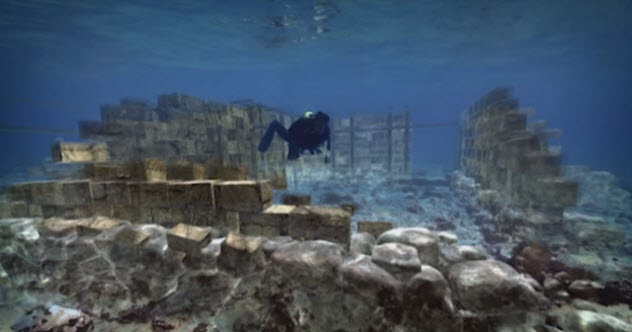
For centuries, Thonis-Heracleion was known mostly from ancient texts. Then underwater archaeology turned rumor into reality. Rediscovered in Aboukir Bay near Alexandria, Egypt, the submerged city revealed enormous statues, temple remains, inscriptions, coins, ceramics, and ritual objects. These finds showed that Thonis-Heracleion had once been a major port and religious center before natural forces helped pull it beneath the waves.
Among the most striking discoveries were colossal statues connected to temples and royal or divine imagery. These artifacts are not merely beautiful; they help explain how Egypt interacted with Greek traders, foreign visitors, and Mediterranean commerce. The city was a gateway between cultures. Its underwater remains are a reminder that cities can disappear from the map without disappearing from history. Sometimes they just need a patient archaeologist, a sonar system, and excellent waterproof equipment.
4. The Sodré Astrolabe: Navigation Before GPS Had a Glow-Up
Off the coast of Oman, archaeologists recovered a small copper-alloy disk from the wreck of the Esmeralda, a Portuguese ship connected to Vasco da Gama’s early 16th-century fleet. The object was later identified as a mariner’s astrolabe, a tool sailors used to measure the altitude of the sun and calculate latitude at sea.
This artifact is considered one of the oldest known mariner’s astrolabes. It represents the Age of Exploration, when navigation required mathematics, observation, courage, and absolutely no “recalculating route” voice from a phone. The astrolabe’s markings and royal symbols connect it to Portuguese oceanic expansion. Small as it is, the artifact captures a giant historical shift: the moment when ocean navigation became a force that reshaped world trade, politics, and cultural contact.
5. Titanic Artifacts: Personal Stories on the Ocean Floor
The RMS Titanic rests deep in the North Atlantic, and its debris field has yielded thousands of artifacts, including dishes, jewelry, clothing, ship fittings, and personal belongings. These objects are powerful because they make the famous disaster feel immediate and human. A plate is not just a plate when it was once part of a floating palace. A piece of jewelry is not just decoration when it belonged to a passenger whose journey ended in tragedy.
Recovered Titanic artifacts are also surrounded by ethical debate. Many experts argue that the site should be treated as a memorial and preserved with great care. The tension between recovery, exhibition, ownership, and respect is one of the biggest issues in underwater cultural heritage. The Titanic reminds us that sea artifacts are not only treasures; they can be memories, evidence, and graveside witnesses.
6. USS Monitor Turret and Lantern: Civil War History Beneath the Atlantic
The USS Monitor, the famous Civil War ironclad, sank off Cape Hatteras, North Carolina, in 1862. Its wreck later became the first U.S. national marine sanctuary. Among the most important recovered artifacts are the ship’s revolving gun turret, Dahlgren guns, steam engine components, propeller, anchor, and a red signal lantern.
The turret is a landmark in naval technology because the Monitor helped introduce a new era of ironclad warships. Yet the smaller artifacts are just as moving. The red lantern, possibly among the last things seen as the ship went down, gives the wreck a human dimension. These objects require long conservation because saltwater can turn metal into a fragile historical sponge. Recovering them is only half the adventure; preserving them is the part where science rolls up its sleeves.
7. Queen Anne’s Revenge Artifacts: Blackbeard’s Ship Gets Real
The wreck believed to be Queen Anne’s Revenge, Blackbeard’s flagship, was found near Beaufort Inlet, North Carolina. Archaeologists recovered cannons, a bronze bell, medical tools, ceramic fragments, lead shot, and even tiny scraps of paper found inside a cannon. Those paper fragments were linked to an early 18th-century travel book, suggesting that even pirates had reading material. Apparently, “pirate book club” was not completely out of the question.
These artifacts help separate historical Blackbeard from the cartoonish version with dramatic smoke and theatrical menace. The ship’s objects reveal practical life aboard a pirate vessel: weapons, repairs, medicine, navigation, food, and reused materials. The finds also show how archaeology can confirm identity through many clues rather than one perfect “Aha!” object. History often works less like a movie reveal and more like a detective quietly assembling receipts.
8. Nuestra Señora de Atocha Treasure: Silver, Gold, and the Cost of Empire
The Spanish galleon Nuestra Señora de Atocha sank in 1622 near the Florida Keys during a hurricane. Centuries later, treasure hunters recovered silver bars, coins, gold, emeralds, bronze cannons, and other artifacts from the wreck. It became one of the most famous shipwreck recoveries in modern history.
The Atocha is dazzling, but its importance goes beyond sparkle. Its cargo reflects the Spanish empire’s extraction of wealth from the Americas and the enormous risks of colonial sea travel. Every coin and ingot carries economic history, but also human history: miners, sailors, merchants, enslaved laborers, royal officials, and families connected to a global imperial system. The treasure is beautiful, but it is not simple. Like many artifacts from the sea, it asks us to admire the craftsmanship while also thinking carefully about the world that produced it.
9. San José Galleon Artifacts: The “Holy Grail” of Shipwrecks
The Spanish galleon San José sank in 1708 near Cartagena, Colombia, during a battle with British forces. The wreck is famous because it reportedly carried an enormous cargo of gold, silver, emeralds, and coins. Recent investigations have documented and recovered selected artifacts, including coins, ceramic pieces, and ship materials, while debates continue over ownership, preservation, and national heritage.
The San José is often called the “Holy Grail of shipwrecks,” but that nickname can make the story sound like a treasure hunt with dramatic music. Archaeologically, its real value lies in what it can reveal about colonial trade, naval warfare, ship construction, and the movement of wealth across the Atlantic world. The challenge is balancing public fascination with responsible conservation. Not every treasure should be treated like a prize. Some need to be treated like a library written in metal, clay, and wood.
10. The Belitung Shipwreck Ceramics: Tang Dynasty Goods on the Maritime Silk Road
The Belitung shipwreck, discovered near Indonesia, contained a massive cargo of Tang Dynasty ceramics and other luxury goods. The ship was likely an Arab dhow traveling along the Maritime Silk Road in the ninth century. Its cargo included thousands of bowls, jars, and decorated ceramics, showing the scale of trade between China, Southeast Asia, and the Islamic world.
These ceramics are stunning, but their bigger story is connectivity. The Belitung cargo proves that the sea was not a barrier between civilizations. It was a highway. The ship’s goods reveal demand, taste, manufacturing skill, and long-distance commercial organization. A ceramic bowl from the seafloor can tell us about kilns in China, merchants in ports, sailors crossing dangerous waters, and customers hundreds or thousands of miles away. That is a lot of gossip for one bowl.
Why Sea Artifacts Matter More Than Treasure
It is easy to get distracted by gold. Gold is shiny, dramatic, and excellent at making headlines. But underwater archaeology is not just about treasure. A wooden comb, a cooking pot, a navigation tool, or a torn book page can be more historically valuable than a chest of coins. These objects explain how people lived, worked, traveled, traded, prayed, fought, and survived.
Sea artifacts also preserve context. Where an object is found matters. Its position in a wreck, its relationship to other objects, and the surrounding environment help archaeologists interpret what happened. Removing artifacts without documentation is like ripping pages out of a mystery novel and then wondering why the ending makes no sense.
The Science Behind Recovering Objects From the Ocean
Recovering artifacts from the sea is slow, expensive, and extremely technical. Divers and remotely operated vehicles must document sites carefully. Objects may be covered in concretions, corroded by salt, weakened by marine organisms, or trapped under sediment. Once recovered, many artifacts must spend years in conservation labs. Metal objects may require desalination and chemical stabilization. Wood may need controlled treatment to prevent collapse. Ceramics may look sturdy, but even they can suffer damage after centuries underwater.
This is why responsible archaeology often favors preservation in place when possible. Leaving an artifact underwater can sometimes protect it better than rushing it into the open air. The ocean is a rough storage unit, but sudden exposure can be worse. Conservation is where archaeology meets chemistry, patience, and the ability to stare at a rusty object for years without losing hope.
Experience Section: What Exploring Sea Artifacts Feels Like
Experiencing the world of sea artifacts is different from reading ordinary history. On land, ruins usually stand where people left them. Underwater, everything feels hidden, filtered, and slightly dreamlike. Even when you are only visiting a museum exhibit, there is a sense that the object has traveled through two worlds: the human world that made it and the ocean world that kept it. That journey gives sea artifacts a strange emotional power.
Imagine standing in front of a recovered ship’s lantern. It may not glitter like emeralds from a Spanish galleon, but it can feel more personal. A lantern suggests darkness, urgency, and a human hand reaching for light. Nearby, a ceramic bowl from a trade ship tells another kind of story. Someone packed it, counted it, sold it, or hoped to sell it. Then the sea interrupted the business plan. Centuries later, the bowl becomes a messenger from a world that did not know we would be looking back at it.
The most memorable experience is realizing that underwater artifacts are not silent. They speak through details. A navigational astrolabe says, “People were brave enough to cross oceans with math and metal.” The Antikythera Mechanism says, “Ancient science was far more advanced than you assumed.” The Uluburun ingots say, “Global trade did not begin yesterday.” Titanic objects say, “Technology can fail, and human stories matter more than luxury.” The Queen Anne’s Revenge paper fragments say, “Even pirates reused scraps, and yes, apparently reading material could survive in the least expected places.”
For travelers, visiting maritime museums can be surprisingly moving. The best exhibits do not simply display objects; they recreate the conditions of discovery, recovery, and conservation. You see the artifact, then you learn what it took to rescue it from saltwater. Suddenly, the object is not just old. It is fragile, stubborn, and lucky. You begin to appreciate conservators as quiet heroes who battle corrosion instead of dragons. Less cinematic, maybe, but very important.
For divers, underwater heritage sites create an even stronger experience. Visibility may be limited, currents may be difficult, and the wreck may appear slowly out of the blue like a memory assembling itself. Responsible divers understand that looking is not the same as taking. The best underwater experience is one of respect. A shipwreck is not a souvenir shelf. It is an archaeological site, an ecosystem, and sometimes a memorial.
For writers, students, and history lovers, these discoveries offer endless inspiration. They show that history is not fixed in textbooks. It is still being found. New scans, new dives, and new conservation methods continue to reveal details hidden for centuries. The ocean keeps its secrets well, but not perfectly. Every artifact recovered from the depths adds another sentence to the human story, and sometimes that sentence is funnier, sadder, smarter, or stranger than anyone expected.
Conclusion: The Deep Sea Is History’s Most Mysterious Archive
The greatest artifacts discovered from the depths of the sea are not valuable only because they are rare, old, or expensive. They matter because they connect us to human curiosity, ambition, tragedy, creativity, and survival. The Antikythera Mechanism reveals ancient genius. The Uluburun cargo exposes Bronze Age trade networks. The Titanic’s personal belongings preserve memory. The USS Monitor’s recovered parts mark a turning point in naval history. The Belitung ceramics show the reach of the Maritime Silk Road. Together, these discoveries prove that the ocean is not empty space between continents. It is an archive, a museum, a cemetery, a trade route, and occasionally a very salty filing cabinet.
As underwater technology improves, more artifacts will undoubtedly emerge from the seafloor. The challenge is to recover knowledge, not merely objects. When handled responsibly, sea artifacts help us understand the past without stripping it of context. They remind us that history is not always buried underground. Sometimes it is waiting under waves, wrapped in coral, and guarded by a crab with no formal museum training.














