
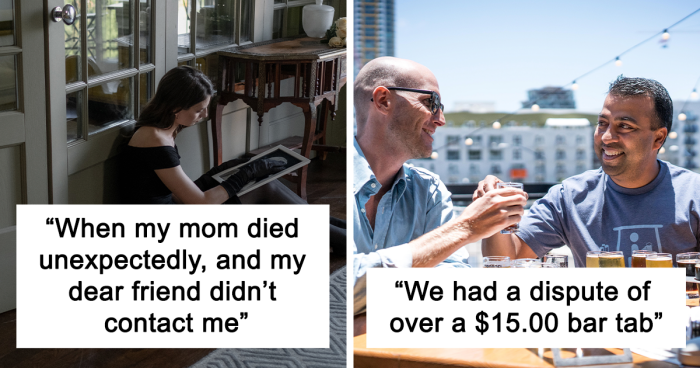
Friendship is supposed to be the relationship where you can arrive wearing sweatpants, admit that you have made a terrible decision, and receive support instead of a professionally prepared slideshow titled “Reasons You Are a Disaster.” A close friend knows your history, your insecurities, your emergency snack preferences, and possibly enough embarrassing stories to ruin a future political campaign.
That intimacy makes a friendship wonderful, but it also creates enormous potential for betrayal. A stranger cannot reveal your deepest secret, steal your emergency fund, neglect your pet, or secretly help your partner cheat. Only someone who has been given access to your life can misuse that access so effectively.
The situations below are original, anonymized composites inspired by publicly shared friendship-breakup accounts. They are not verbatim reproductions of individual posts. Broader themes such as betrayal, selfishness, disappearing support, romantic conflict, unequal effort, and clashing values also appear repeatedly in friendship-dissolution research.
Healthy friendships generally depend on mutual concern, trust, respect, communication, and reasonable boundaries. Positive social connections can support well-being, but relationships characterized by manipulation, cruelty, or chronic stress may require firmer limits or a complete exit.
When a Terrible Choice Becomes a Friendship-Ending Betrayal
Not every mistake deserves permanent exile. Good people forget birthdays, say clumsy things, and occasionally cancel dinner because their couch has formed a powerful emotional bond with them. The difference between an ordinary failure and a friendship-ending offense often comes down to severity, repetition, accountability, and remorse.
A friend who causes harm, understands it, apologizes without excuses, and changes their behavior may be able to rebuild trust. A friend who denies everything, blames the victim, recruits an audience, and posts an inspirational quote about “protecting their peace” is probably not beginning a meaningful repair process.
35 Horrid Things That Made People End Their Closest Friendships
-
1. They Slept With Their Friend’s Partner
Few betrayals achieve such brutal efficiency. The friend violates personal loyalty while participating in romantic deception, leaving the injured person to mourn two relationships at once. The subsequent “It just happened” explanation rarely helps. Taxes just happen. Affairs require scheduling.
-
2. They Helped Conceal an Affair
Some people discovered that a close friend had known about their partner’s cheating for months. Remaining silent while offering ordinary relationship advice transformed the friend from an uncomfortable observer into an active participant in the deception.
-
3. They Stole Money From Someone Who Trusted Them
Borrowing money during a crisis is one thing. Taking cash, using a credit card without permission, or emptying a shared account is another. Financial betrayal turns generosity into evidence that the victim was considered easy to exploit.
-
4. They Neglected a Pet They Promised to Protect
Several friendship-ending stories involve someone agreeing to feed, walk, or watch an animal and then simply not doing it. Forgetting one feeding is a mistake. Leaving a pet without proper care for days demonstrates a level of irresponsibility that no cheerful apology can magically disinfect.
-
5. They Spread a Lie That Threatened a Career
A malicious rumor at work can damage income, professional credibility, and future opportunities. When the person spreading it is a trusted friend, the betrayal feels especially calculated because they usually know exactly which accusation will cause the most harm.
-
6. They Turned Private Confessions Into Public Entertainment
Close friends often share fears, medical concerns, family problems, and relationship struggles. Repeating those details at parties or in group chats converts vulnerability into gossip. The offender may call it “just telling a story,” but somehow the storyteller is never the one being humiliated.
-
7. They Mocked Someone’s Grief
When a parent, sibling, partner, or pet dies, friends are not expected to deliver a perfect speech. They are expected to display basic humanity. Complaining that the grieving person is “bringing down the mood” can permanently reveal how shallow the friendship always was.
-
8. They Disappeared During a Serious Crisis
Some friends enthusiastically attend birthdays, vacations, and brunches but vanish during illness, hospitalization, divorce, or unemployment. A single absence may have an explanation. A complete disappearance followed by a casual return when life becomes fun again feels more like subscription-based friendship.
-
9. They Sabotaged a Pregnancy or Major Life Announcement
Jealous friends have revealed pregnancies, engagements, promotions, and other personal news before the person involved could share it. Others deliberately created drama during the announcement. Stealing someone’s moment is not honesty, spontaneity, or excitement. It is emotional pickpocketing.
-
10. They Used Their Friend’s Identity or Personal Information
Opening accounts, signing documents, making purchases, or impersonating someone online can create lasting financial and legal damage. A person who treats access to personal information as an opportunity has moved far beyond being a disappointing friend.
-
11. They Secretly Recorded a Vulnerable Moment
Recording someone while they are crying, intoxicated, changing clothes, arguing, or experiencing a medical episode is a severe privacy violation. Sharing the recording for laughs makes the cruelty unmistakableand usually makes ending the friendship the simplest decision in the room.
-
12. They Abused Someone More Vulnerable
Witnessing a friend mistreat a child, elderly relative, dependent adult, employee, or partner can force an immediate moral decision. Loyalty does not require protecting an abuser. Sometimes ending the friendship is only the first necessary action.
-
13. They Revealed Deeply Bigoted Beliefs
A friendship may collapse when someone begins directing racist, antisemitic, homophobic, sexist, or otherwise dehumanizing abuse at others. Calling hatred “dark humor” does not make it funny. It simply gives prejudice a tiny novelty hat.
-
14. They Were Cruel to Animals
Deliberately hurting, frightening, abandoning, or failing to provide essential care for an animal can instantly change how someone views a friend. It reveals not a difference in taste, but a frightening absence of empathy.
-
15. They Repeatedly Endangered People and Felt No Remorse
Driving while severely impaired, starting violent fights, or bringing dangerous substances into someone’s home can put everyone nearby at risk. A refusal to acknowledge that danger leaves friends protecting themselves from the next incident.
-
16. They Invented Emergencies for Attention
Some people fabricated illnesses, accidents, pregnancies, deaths, or threats to keep friends emotionally trapped. Concern becomes difficult to recover after discovering that repeated midnight emergencies were carefully produced episodes in a one-person drama series.
-
17. They Rewrote Every Conflict Until They Became the Victim
When confronted, manipulative friends may deny events, dispute obvious facts, criticize the other person’s memory, and accuse them of being cruel for mentioning the problem. Eventually, every conversation becomes a courtroom where the evidence mysteriously disappears.
-
18. They Tried to Isolate Their Friend From Everyone Else
A controlling friend may resent partners, coworkers, relatives, or new acquaintances. They demand constant access while describing every outside relationship as suspicious. Friendship should expand a person’s life, not operate like a small country with closed borders.
-
19. They Could Not Tolerate Their Friend’s Success
Jealousy sometimes appears as silence after good news, backhanded compliments, deliberate discouragement, or attempts to ruin opportunities. A friend does not have to release balloons after every promotion, but visible disappointment at another person’s happiness is revealing.
-
20. They Treated the Friendship as a Backup Plan
Some people only call when their preferred plans collapse, they need transportation, or their romantic partner is unavailable. Repeatedly treating a friend as an emergency replacement communicates the relationship’s exact position on the priority list.
-
21. They Exploited Free Labor for Years
Moving furniture once is friendship. Expecting free childcare, transportation, technical support, home repairs, photography, and event planning without reciprocation is an unpaid internship with worse management. Resentment grows when affection seems permanently tied to usefulness.
-
22. They Borrowed Constantly and Never Repaid Anything
The real problem is rarely one unpaid lunch. It is the pattern of promises, excuses, new requests, and visible spending on luxuries while the debt remains untouched. Eventually, the lender realizes the friend does not consider repayment a moral obligation.
-
23. They Lied About Nearly Every Part of Their Life
Discovering that a friend invented jobs, illnesses, relationships, qualifications, or family tragedies can make the entire bond feel fictional. Even harmless memories become questionable because there is no longer a reliable border between reality and performance.
-
24. They Secretly Pursued a Friend’s Ex While Pretending Otherwise
Dating a friend’s former partner is not universally forbidden, but secrecy changes the equation. Hiding messages, arranging secret meetings, and offering misleading reassurance demonstrate awareness that an important boundary is being crossed.
-
25. They Organized a Group Attack Instead of Having a Conversation
Rather than discussing a concern privately, some friends recruit others for an ambush. The target arrives expecting dinner and receives a committee-led character assassination. Constructive feedback is specific and respectful; humiliation with witnesses is a performance.
-
26. They Made a False Accusation to Avoid Consequences
Blaming a friend for theft, cheating, workplace misconduct, or another serious offense can permanently damage reputations and relationships. Even after the truth emerges, the victim may still face lingering suspicion created by someone they once trusted.
-
27. They Invaded a Home or Digital Accounts
A spare key is not an unlimited-access membership. Entering without permission, reading private messages, checking location data, or searching through belongings shows an alarming belief that closeness eliminates the right to privacy.
-
28. They Used Their Friend as an Unwilling Alibi
Someone may casually announce that they told a partner, employer, or relative they were “with you” during questionable activities. This drags the friend into deception and potential danger without consent. Friendship is not a complimentary witness-protection program.
-
29. They Bullied People Who Could Not Fight Back
A person can behave warmly toward friends while humiliating service workers, younger classmates, employees, or socially isolated people. Watching that behavior often raises an uncomfortable question: Is this kindness genuine, or merely reserved for people considered useful?
-
30. They Celebrated a Friend’s Misfortune
A smirk after a breakup, excitement over a failed exam, or satisfaction when a business struggles can reveal hidden hostility. Sometimes the relationship survives years only because the jealous friend was waiting for the other person to fall.
-
31. They Exploited Someone During Bereavement
Grieving people may be exhausted, distracted, and dependent on support. Taking money, manipulating inheritance discussions, pressuring major decisions, or using the crisis to gain control is especially cruel because it targets someone at their weakest.
-
32. They Ghosted Immediately After a Major Loss
People sometimes disappear because they feel awkward around grief, but prolonged silence after a close friend loses a loved one can feel like abandonment. Returning months later with memes and no acknowledgment does not restore the missing support.
-
33. They Abandoned Old Friends to Impress Wealthier People
Some friendships end after a person decides that longtime companions are no longer fashionable, affluent, or professionally useful. Social climbing may produce an impressive contact list, but it also reveals that loyalty had a surprisingly specific income requirement.
-
34. They Refused Accountability After Repeated Harm
A sincere apology includes recognition, responsibility, repair, and changed behavior. “I’m sorry you feel that way” includes none of those ingredients. When every offense ends with excuses and repetition, leaving may be the only consequence the person understands.
-
35. They Became Threatening After a Boundary Was Set
Repeated unwanted contact, threats, stalking, property damage, or harassment transforms a friendship problem into a safety issue. In such cases, a direct farewell may not be appropriate. Saving evidence, blocking contact, involving trusted people, and seeking professional or legal help may be necessary.
Why Ending a Close Friendship Can Hurt So Much
Friendship breakups are sometimes minimized because there is no formal divorce, custody agreement, or sad playlist officially assigned to them. Yet losing a close friend can remove emotional support, shared routines, social connections, and an important part of one’s identity. Research on friendship dissolution recognizes both active endings, such as direct confrontation, and passive endings in which contact slowly fades.
The grief may also feel confusing when ending the friendship was clearly necessary. Missing someone does not prove the decision was wrong. People can miss the laughter, history, or earlier version of a relationship while still recognizing that its current form is unsafe or destructive.
How to Decide Whether to Repair the Friendship or Walk Away
Before ending a relationship over a painful but non-dangerous incident, consider whether the behavior was isolated or repeated. Look at the person’s response when confronted. Do they acknowledge what happened? Can they describe the harm without immediately defending themselves? Are they willing to accept consequences and rebuild trust slowly?
Clear, specific communication can sometimes prevent resentment from becoming permanent. Assertive boundary-setting focuses on the behavior, explains its impact, and states what must change. However, boundaries are only meaningful when they are enforced. Repeating a boundary indefinitely while accepting the same violation merely turns it into a recurring announcement.
Immediate distance may be appropriate when the behavior involves violence, stalking, serious theft, abuse, coercion, credible threats, or repeated attempts to sabotage safety. The goal is not to stage the perfect dramatic final speech. The goal is to protect yourself.
Experience-Based Reflections: What Friendship Breakups Teach Us
The Small Violations Often Arrive Before the Shocking One
Many people describe a final betrayal as sudden, but their earlier experiences often contained warning signs. The friend regularly ignored small requests, shared “minor” secrets, borrowed items without asking, or turned every disagreement into a guilt campaign. None of those moments seemed large enough to justify ending a ten-year friendship. Together, however, they established a pattern: one person’s comfort consistently mattered more than the other person’s boundaries. The final offense did not create the problem from nothing. It made the existing problem impossible to explain away.
History Can Become a Trap
People frequently remain in destructive friendships because they have known the other person since childhood, college, or the era when everyone’s eyebrows were making questionable choices. Shared history feels valuable, and it is. But time already invested is not a contract requiring unlimited future investment. A long friendship can explain why someone deserves an honest conversation or a chance to repair harm. It does not require tolerating behavior that would be unacceptable from anyone else.
Relief and Grief Can Exist Together
After ending a toxic friendship, people may feel devastated one morning and unusually peaceful that afternoon. They miss the jokes but not the criticism. They miss the trips but not the financial pressure. They miss having someone to call but not wondering whether the conversation will later become public gossip. This emotional mixture is normal. Grief reflects attachment and lost possibilities; relief reflects the removal of chronic tension. Neither feeling cancels the other.
Mutual Friends Complicate Everything
A friendship breakup rarely occurs in perfect isolation. Other people may demand explanations, carry messages, organize surprise reconciliations, or insist that everyone “be mature” by pretending nothing happened. Experience suggests that brief, neutral explanations work better than launching a public prosecution. Saying that trust was seriously broken and that distance is necessary usually communicates enough. Friends who respect both parties can maintain separate relationships without becoming unpaid diplomats.
Closure Does Not Always Come From the Other Person
Many people wait for a former friend to admit everything, apologize beautifully, and demonstrate complete understanding. That moment may never arrive. Some people protect their self-image by denying harm forever. Closure may instead come from accepting the available evidence, writing down what happened, discussing it with someone trustworthy, and deciding what future behavior will no longer be tolerated. The absence of an apology does not invalidate the injury.
The Experience Can Improve Future Friendships
A painful ending can temporarily make every new relationship feel suspicious. Over time, however, it may sharpen awareness of healthier qualities: consistency, discretion, accountability, generosity, and genuine happiness for another person’s success. The lesson is not that nobody can be trusted. It is that trust should grow through repeated behavior rather than titles such as “best friend.” Strong social bonds remain important, so healing should eventually include building new connectionsnot constructing an emotional bunker with excellent Wi-Fi.
Conclusion
Friendship is voluntary, which is both its beauty and its protection. People choose to remain because the relationship brings trust, affection, support, and mutual respect. When those qualities are replaced by exploitation, cruelty, deception, or danger, ending the friendship is not necessarily coldhearted. It may be the clearest acknowledgment that closeness without safety is not genuine closeness.
Some broken friendships can be repaired through honest communication, accountability, and consistent change. Others end because one terrible act reveals a character trait that cannot be ignored. Either way, the most useful question is not simply, “How long have we been friends?” It is, “What does this friendship repeatedly ask me to sacrifice?”
Editorial note: This article presents original analysis and composite scenarios informed by publicly reported experiences and established guidance on friendship, trust, boundaries, social connection, and relationship dissolution. It is not intended to identify, diagnose, or judge any specific individual.













