
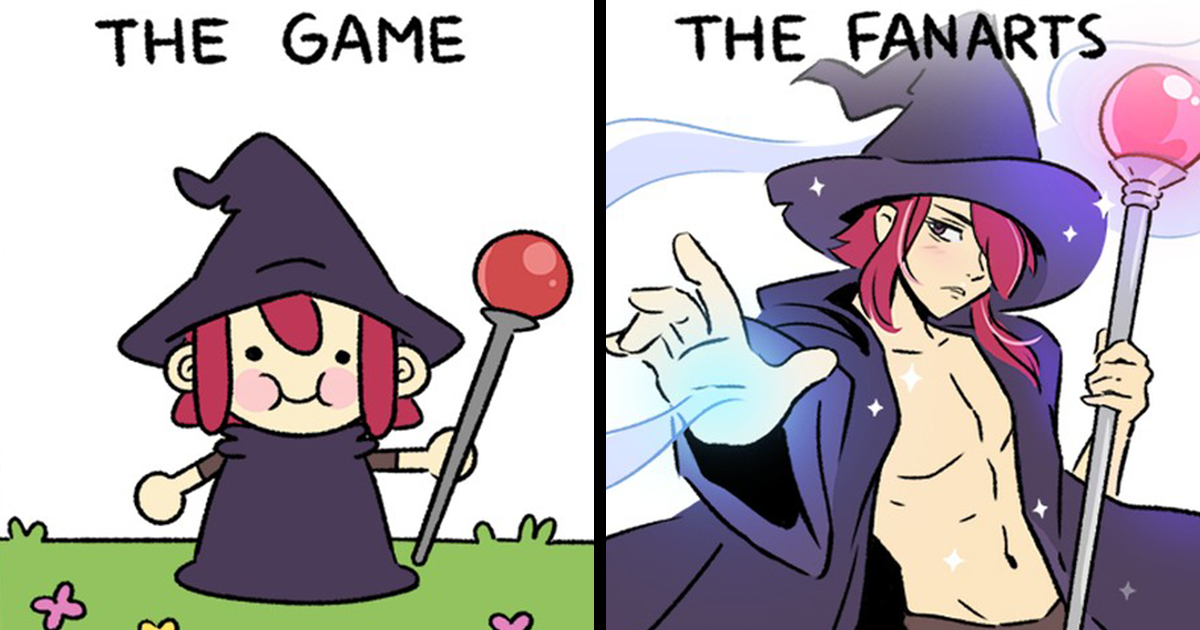
Note: This article discusses the humor, characters, creative background, and gaming culture behind the Clueless Hero comic series. The featured gallery contains 35 comic images from the artists’ fictional video game universe.
Saving a kingdom sounds glamorous until you discover that the local villagers expect you to locate six missing chickens, deliver a suspicious mushroom to a wizard, and defeat an ancient evil using a wooden sword that appears to have been purchased at a yard sale.
That gap between the heroic fantasy promised by video games and the wonderfully ridiculous things players actually do is where Clueless Hero thrives. Created by Luis Lee and Ana Gaby Perez, the gaming webcomic follows an adorably confused adventurer stumbling through a fictional video game world. It also looks beyond the hero’s quest to explore the developers, executives, players, and fans responsible for keeping the imaginary franchise alive.
The result is a comic series that feels like someone opened the back panel of an RPG and discovered that it was powered by side quests, questionable inventory systems, exhausted developers, and one hero who definitely did not read the tutorial.
A Fantasy World Built From Familiar Gaming Nonsense
The world of Clueless Hero is fictional, but its rules will feel immediately familiar to anyone who has spent an evening exploring digital kingdoms. There are courageous adventurers, non-player characters, monsters, treasure chests, magical items, dramatic villains, mysterious quests, and enough gaming logic to make a health potion nervous.
Instead of constructing a detailed parody of one particular franchise, Lee and Perez draw from a broad library of role-playing game conventions. The hero resembles the classic silent protagonist: brave enough to challenge a monster, yet apparently unable to ask why every locked door requires a different jewel-encrusted key.
The artists have identified The Legend of Zelda and RPGs more generally as major influences. They have explained that the mechanics and narrative habits of these games become increasingly funny when examined closely. That observation is practically the comic’s secret recipe: take a rule players normally accept, inspect it for several seconds, and wait for it to become absurd.
Why Can a Hero Carry 47 Swords?
Video games ask players to accept some astonishing ideas. A character may carry an entire armory without developing back problems. Food restores health instantly, even if it is eaten during combat. A shopkeeper will refuse to provide a discount to the person currently saving civilization. Meanwhile, guards repeat the same sentence forever and somehow remain employed.
Clueless Hero finds humor in these invisible agreements between games and players. We know inventory systems are unrealistic, but we rarely question them while playing. We simply place another battle-ax beside the 82 wheels of cheese already in our backpack and continue walking as though physics signed a waiver.
Comedy works especially well when it establishes a recognizable pattern and then breaks it. Game-design discussions frequently describe surprise and the subversion of player expectations as powerful tools for creating memorable experiences. The comic applies the same principle in miniature: readers recognize the gaming rule, anticipate the obvious outcome, and then receive a punchline that exposes how strange the rule was all along.
A Hero Who Is Lovable Because He Is Lost
The title character is not clueless in a mean-spirited way. He is enthusiastic, sincere, and usually willing to help. Unfortunately, enthusiasm is not the same as understanding the mission briefing.
That makes him an effective comedy protagonist. A hypercompetent warrior would solve every problem efficiently, which is excellent for kingdom security but terrible for punchlines. The Clueless Hero, by contrast, can misinterpret instructions, use the wrong item, trust an obviously suspicious stranger, or accidentally expose the nonsense beneath a supposedly epic situation.
The creators have said that the comic’s name was chosen after they had developed the main character and general concept. They wanted a title that reflected his personality and the bewildered way he interacts with the adventures around him.
The Silent-Protagonist Effect
Silent heroes are common in games because they can serve as vessels for the player. Their limited dialogue makes it easier for us to project our own reactions onto them. In comedy, however, silence can create an entirely different impression.
Is the hero nobly contemplating his destiny, or did he forget what the wizard said five seconds ago? Is he fearlessly staring at the final boss, or is he trying to remember which button raises the shield?
Clueless Hero plays inside that ambiguity. Its protagonist may look like a legendary adventurer, but his actions often resemble those of a player who skipped the instructions, entered the wrong dungeon, and is now surviving through snacks and confidence.
The Comic Does Not Stop at the Edge of the Screen
One of the series’ smartest choices is its willingness to leave the fantasy world. The comics do not focus exclusively on the hero and his quests. They also visit the fictional developers building the game, the executives making business decisions, and the fans trying to play it.
This expands the comic from a straightforward RPG parody into a broader satire of gaming culture. A bug inside the game may be frustrating for a player, embarrassing for a developer, and somehow described as an “unexpected engagement feature” by an executive carrying a presentation remote.
By showing several sides of the fictional franchise, Lee and Perez gain access to a much larger collection of jokes:
- Players who ignore the main story for dozens of hours
- Developers attempting to repair one bug without creating five more
- Marketing announcements that surprise the production team
- Executives pursuing trends that do not fit the game
- Fans analyzing tiny details more carefully than the creators did
- Characters trapped inside systems that make sense only to programmers
The perspective shift also gives the fictional world a sense of continuity. The game is not merely a backdrop for isolated jokes. It feels like a product with an audience, a workplace, a business model, and a growing collection of technical emergencies.
Developers Are Part of the Adventure Too
Games may contain magical forests and immortal dragons, but their development involves deadlines, revisions, meetings, testing, technical limitations, and the occasional feature that sounded simple until someone tried to build it.
The behind-the-scenes strips turn those realities into accessible comedy. Readers do not need to understand programming to recognize the terror of learning that management has publicly promised a feature no one discussed with the development team.
These jokes work because they translate complex production problems into familiar human experiences. Nearly everyone has received an unrealistic request, watched a small task grow uncontrollably, or attended a meeting that produced more questions than answers. The gaming setting supplies the costumes; workplace chaos supplies the universal punchline.
Clean Art Keeps the Punchlines Moving
The visual style of Clueless Hero is colorful, expressive, and easy to read. Characters have clear silhouettes, emotions are immediately recognizable, and each panel delivers only as much detail as the joke requires.
That restraint matters. A comedy comic cannot make readers conduct an archaeological excavation every time they look for the punchline. The eye needs to move naturally from setup to reaction to payoff.
The artists frequently use facial expressions and body language to carry the final beat. A blank stare, an awkward pause, or a defeated posture may say more than an additional speech bubble. It is the visual equivalent of letting a joke sit quietly on the table while everyone realizes what just happened.
The approachable style also allows the creators to jump between settings without losing clarity. A strip can move from a fantasy battlefield to a developer’s office and then to a gamer’s living room while still feeling like part of the same comic universe.
Why the 35 New Pics Feel So Relatable
The 35-comic selection gives readers multiple ways to recognize themselves. Some jokes target the internal logic of fictional worlds, while others focus on player behavior, development mishaps, and the everyday habits surrounding gaming.
You may recognize the player who hoards powerful items for a future emergency and then completes the entire game without using them. You may recognize the adventurer who spends an hour designing a character’s face, only to cover it with a helmet during the opening mission. You may even recognize the person who insists on completing one more quest at midnight and suddenly notices that birds are singing outside.
The series understands that players are not always rational. We climb mountains because they are visible. We reload earlier saves because an imaginary shopkeeper sounded disappointed. We investigate decorative barrels even after the previous 200 barrels contained nothing.
These behaviors become especially funny when transferred to a character who must live with them. To a player, searching every corner is sensible exploration. To the hero, it may involve entering twelve strangers’ homes and silently inspecting their cabinets.
Gaming Knowledge Adds Flavor, Not an Entrance Exam
Longtime gamers will notice more references because they understand the genres being teased. They know why suspicious walls deserve inspection, why escort missions create anxiety, and why a room filled with healing supplies usually means something enormous is waiting behind the next door.
However, the series does not depend entirely on specialized knowledge. Many strips are built around ordinary situations: misunderstanding directions, procrastinating, making confident mistakes, dealing with unreasonable customers, or trying to solve a simple problem in the most complicated way possible.
That broader foundation makes the comic welcoming. Experienced gamers can appreciate the precise references, while casual readers can enjoy watching a cheerful fantasy hero make decisions with the strategic elegance of a shopping cart missing one wheel.
How Two Friends Turned a Game Idea Into a Webcomic
Lee and Perez met in college and became friends. After graduating, they began developing games with other friends, and the concept that eventually became Clueless Hero emerged from that work. Their original ambition combined both media: develop the comic and eventually turn its fictional world into an actual game.
That origin helps explain why the strips understand game development as well as gameplay. The creators are not observing gaming culture from a distant hill while holding binoculars backward. Their humor comes from genuine familiarity with the medium.
The official series has been published online for years, with hundreds of episodes appearing through its website and platforms such as Tapas. The comic’s presence across dedicated webcomic pages and social media reflects the flexible nature of digital cartooning: a strip can live in an archive, circulate as a standalone image, and find new readers long after its original publication.
The Library of Congress has recognized born-digital comics as an important part of modern comics culture, collecting selected webcomics through web archiving. Series such as Clueless Hero demonstrate why the format matters: independent creators can build a recurring world, publish directly, and develop a relationship with readers without requiring a traditional newspaper page or printed issue.
Could Clueless Hero Become a Real Game?
Despite being presented as a video game universe, Clueless Hero is not currently the playable game its characters seem to inhabit. The creators’ official FAQ jokes about its fictional status while confirming that developing some form of game has long been an end goal.
They have also named Nintendo as a dream collaborator, noting both the company’s influence on their love of gaming and the compatibility between its properties and the comic’s visual style.
The idea makes sense. The comic already has a protagonist, a visual identity, supporting characters, enemies, recurring locations, and a world organized around game mechanics. More importantly, it understands that mechanics themselves can be jokes.
A playable adaptation could allow players to misuse quest items, confuse NPCs, exploit strange rules, and discover punchlines through experimentation. Comedy-design discussions often emphasize that humor in games is not limited to dialogue; it can emerge from level design, systems, timing, music, and player interaction.
Of course, transforming a comic about ridiculous game development into a real development project would introduce a beautifully appropriate risk: the creators might experience the exact production problems they have spent years joking about.
What Clueless Hero Reveals About the Player Experience
The most enjoyable part of reading Clueless Hero may be the slow realization that the hero is not uniquely confused. He is behaving exactly like many of us behave when we play.
Players constantly move between two identities. Inside the story, we are noble warriors pursuing destiny. Outside the story, we are people staring at maps, reorganizing menus, lowering the difficulty, and wondering whether the glowing object is important or merely decorative.
The comic brings those identities together. Its hero occupies an epic fantasy world, but he often follows the imperfect reasoning of the person holding the controller. He becomes distracted, experiments with systems, takes instructions too literally, or attempts a solution that no sensible resident of that world would consider.
The Great Side-Quest Disappearance
Consider the classic open-world experience. The main story urgently warns that civilization is collapsing. A beloved character may be in danger. Dark clouds gather over the capital. The soundtrack itself appears to be shouting, “Please hurry.”
Then a villager mentions a missing cooking pot.
Three hours later, the player has crossed two provinces, entered a fishing contest, collected twelve flowers, purchased a decorative hat, and completely forgotten the approaching apocalypse.
Clueless Hero turns that behavior into character comedy. The humor comes not only from the absurd quest priorities but from how normal they feel to players. We accept that saving the world can be postponed because a stranger offered 20 coins and a recipe.
The Emotional Weight of Imaginary Choices
Games also persuade people to care deeply about decisions that have no physical consequences. A player may spend 20 minutes choosing a dialogue response because they do not want to upset a fictional blacksmith. Someone else may restart an entire mission after accidentally selecting a rude sentence.
From the outside, this behavior is ridiculous. From inside the experience, it is evidence that the world feels meaningful.
The comic can laugh at that investment without dismissing it. Its jokes are affectionate because the creators understand why players become attached to characters, routines, items, and places. The humor says, “Yes, this is strangeand yes, we do it too.”
Failure Becomes a Story Worth Sharing
Some of the best gaming memories are not victories. They are disasters. Players remember the horse that became trapped on a roof, the companion who walked into danger, the boss defeated through a bizarre accident, or the carefully planned strategy destroyed within four seconds.
Failure is entertaining when it produces a surprising narrative. A flawless victory may confirm that the player mastered the system, but a ridiculous failure creates a story that can be repeated to friends.
Clueless Hero captures that energy. Its protagonist does not need to behave perfectly because imperfection creates the adventure. His mistakes reveal hidden assumptions about the game world and invite readers to compare them with their own experiences.
Why Players Enjoy Seeing Their Habits Exposed
Relatable humor gives readers the pleasure of recognition. The punchline arrives, and a tiny voice says, “I have absolutely done that.”
A comic about hoarding potions becomes funnier when the reader remembers finishing an RPG with 70 unused healing items. A joke about character customization becomes personal when someone recalls spending longer selecting eyebrows than defeating the first boss.
This recognition creates community. Players may prefer different genres, platforms, or difficulty settings, but many share the same habits. They explore suspicious corners. They test boundaries. They complain about tutorials and then forget the controls. They promise to stop after one quest and proceed to complete seven.
The fictional world of Clueless Hero therefore feels real in an unexpected way. Its geography and monsters may be invented, but the behavior inside it comes from authentic gaming experiences.
Conclusion: A Hero Gamers Can Proudly Misunderstand
Clueless Hero succeeds because it treats gaming with both knowledge and affection. Luis Lee and Ana Gaby Perez understand the conventions well enough to dismantle them, but they never make the audience feel foolish for enjoying those conventions.
The comic celebrates the odd relationship between players and games: the rules we accept, the systems we exploit, the characters we protect, and the urgent missions we ignore because we spotted something shiny beside a waterfall.
Across these 35 images, readers enter a fictional gaming world populated by heroes, developers, executives, fans, and one extremely patient supply of non-player characters. The jokes may begin with RPG logic, but they reach into workplace frustration, procrastination, ambition, confusion, and the universal human tradition of pressing a button before reading what it does.
The Clueless Hero may not know where he is going, but that is perfectly fine. Most memorable gaming adventures begin with a destination and immediately wander in the opposite direction.













