
America is a country where someone can drive a pickup truck covered in political stickers, stop beside a building shaped like a giant hamburger, order a meal large enough to require structural engineering, and complain that the measuring system is confusingall before lunch.
The “No Context USA” Twitter page, now associated with the platform called X, turned moments like these into a highly shareable collection of funny American posts. Its winning formula was beautifully simple: locate a photograph, screenshot, sign, product, vehicle, meal, or online exchange that seemed unmistakably American, then present it with little or no explanation. The missing context was not a flaw. It was the joke.
When Bored Panda featured the account in November 2022, it reported that the page had attracted more than 103,000 followers. The gallery brought together political contradictions, enormous portions, roadside oddities, ruthless internet replies, patriotic merchandise, and several inventions that appeared to have been designed during a dare.
The result is not a complete portrait of the United States, of course. It is closer to a digital funhouse mirror: exaggerated, selective, slightly distorted, and frequently more entertaining than the ordinary view.
Why No-Context Humor Works So Well
No-context comedy relies on surprise. A viewer sees something familiara restaurant, truck, T-shirt, airport passenger, or text conversationbut one detail breaks the expected pattern. The brain spends half a second asking, “What is happening here?” The answer is often, “Nobody knows, but it is magnificent.”
This reaction fits the incongruity theory of humor, which explains comedy as the discovery of something that violates an expected pattern. The funniest posts create a collision between normal surroundings and deeply abnormal behavior: a serious military sign labeled “Frustration Area,” a compact disc containing 12 hours of one song, or a man calmly eating chips while admiring his car as if he has just witnessed the birth of an heir.
Social media makes these moments even more powerful. People use X for entertainment, news, conversation, and commentary, while visual jokes can travel quickly because they require almost no setup. One screenshot can be understood in seconds, reposted immediately, and transformed by replies that are sometimes funnier than the original post.
40 of the Funniest “No Context USA” Posts
The following highlights are editorial descriptions of posts featured in the viral collection. Some are clever, some are ridiculous, and a few suggest that America’s unofficial national motto may be “It seemed like a good idea at the time.”
Patriotism, Protest, and Perfect Timing
- The politically complicated pickup truck. A red truck displayed American flags, Pride flags, and a large “Trump Lost” message. It looked less like a vehicle and more like an entire cable-news panel traveling to the hardware store.
- The accidental “deck” photograph. A homeowner proudly sent someone a picture after trimming the bushes around a deck. One missing letter transformed innocent yard maintenance into a joke that practically wrote itself.
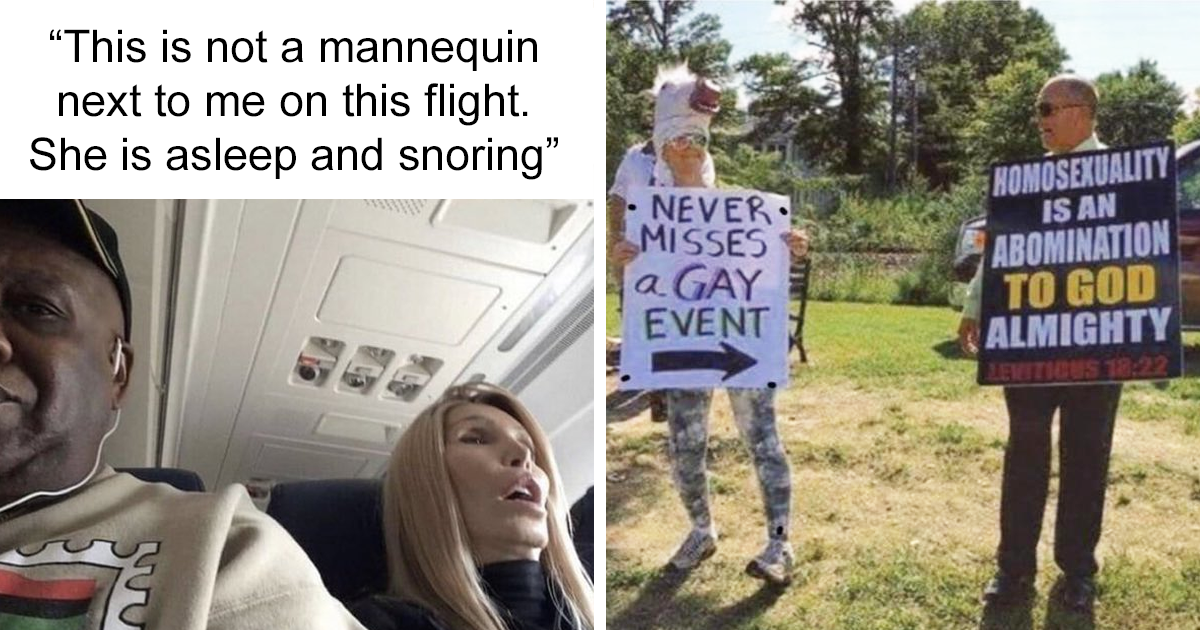
- The protester’s most reliable companion. A person dressed in a colorful horse-like costume stood beside an anti-gay demonstrator with a sign observing that the protester never missed a gay event. Attendance deserves recognition.
- Measuring distance in whales. A size comparison used basketball courts to explain the length of a blue whale. When someone complained that Americans would measure with anything except meters, another person threatened them from “three whales away.”
- Rock versus paper. Dwayne “The Rock” Johnson posted that nobody could defeat him. The verified account for Paper appeared in the replies to question that confidence. Somewhere, Scissors began preparing for the winner.
- The adoption misunderstanding. In a discussion about childhood lies, an adopted person remembered believing they had been the easiest baby for their mother to deliver. The eventual explanation must have been quite a family meeting.
- The Mariah Carey rationing system. A jukebox notice limited how often “All I Want for Christmas Is You” could be played before December. This was less a music policy and more an emergency plan for employee survival.
- The suspiciously motionless passenger. An airline traveler slept in a posture so stiff and perfectly arranged that viewers wondered whether someone had purchased an extra seat for a department-store mannequin.
- The Reddit volunteer. A painfully awkward online conversation about romantic attraction ended with one commenter volunteering for the assignment. It demonstrated both confidence and a heroic absence of hesitation.
- The man admiring his new car. A driver sat nearby with a bag of chips, silently staring at his vehicle. He had the expression of someone who had completed a major life goal and was now holding a private awards ceremony.
These posts illustrate the account’s main trick: the image provides enough information to recognize the situation but not enough to explain why anyone made these choices.
Signs, Stickers, and Internet Replies
- Freedom, imported. A cardboard box labeled “American Freedom” also carried a “Made in China” mark. It was an accidental political cartoon with excellent packaging.
- The poorly defended gun decal. A vehicle displayed a “Come and Take It” gun sticker. Later, its rear window was broken. Apparently, somebody interpreted the message as a customer-service invitation.
- Definitely not Bernie Sanders. An older man who strongly resembled Bernie Sanders wore a shirt reading “I Am Not Bernie.” That is exactly what Bernie Sanders might wear when attempting to buy groceries unnoticed.
- Doja Cat’s holiday identity crisis. After changing her display name to “Christmas,” the musician discovered she could not easily change it back and publicly requested help. Even celebrities can be defeated by account settings.
- The beach comeback that crossed the line. One screenshot showed how quickly online humor can become needlessly cruel. It is a reminder that a surprising reply is not automatically a good joke.
- The official Frustration Area. A sign bearing those words appeared beside an exhausted-looking service member. Finally, the government had created a properly designated location for Monday morning.
- The giant political pig. A bizarre pink caricature resembling a famous politician appeared without explanation. It belonged somewhere between parade art, satire, and a fever dream after watching election coverage.
- The truck-stop robbery warning. A notice warned drivers about two women allegedly stealing wallets. Someone added that they had been robbed seven times, implying an extraordinary commitment to ignoring safety advice.
- The best country in the nation. A patriotic sign declared America the greatest country “in the nation.” Geography surrendered quietly and went home.
- The perfect Gotye reply. Someone joked that Gotye released one enormous hit and disappeared. Another user delivered the inevitable “somebody that we used to know” punchline with surgical precision.
Memes and compact visual jokes do more than generate laughter. Researchers and cultural writers have noted that they can reflect, reinforce, criticize, or disrupt shared beliefs. A political sticker, reply, or typo becomes a miniature argument about identityjust with better timing.
Food, Shopping, and Consumer Fever Dreams
- The Florida mail mountain. One resident photographed the enormous pile of political advertising received in roughly two and a half weeks. The local recycling bin presumably requested paid leave.
- The $4K misunderstanding. One person meant that they could produce video in 4K resolution. The other believed they were offering a $4,000 deposit. Technology and money briefly spoke completely different languages.
- The naval dinner tray. A photograph of a military meal showed a brown entrée and equally unenthusiastic sides. The plate looked as though flavor had been removed for security reasons.
- Twelve hours of “Cotton-Eyed Joe.” A homemade CD promised “songs” for a date. It contained one song repeated for half a day, proving that romance and psychological warfare sometimes share office space.
- Remembering 2008 selectively. One user praised the year’s music. Another mentioned the financial crisis. The first explained that they were 11 and mainly remembered the songsan efficient summary of childhood economics.
- Discount anxiety disorders. A storefront sign accidentally appeared to advertise anxiety disorders for $45. Few retail promotions have identified their target audience so effectively.
- Christopher Sittin. A photograph showed Christopher Walken seated in an airport. The internet replaced his surname with “Sittin,” collected its easy victory, and moved on.
- The cigarette shirt challenge. A man wore a shirt instructing everyone not to give him a cigarette under any circumstances. Naturally, multiple people immediately offered him cigarettes. Americans respect freedom, especially the freedom to ignore instructions.
- A person who looks like 2008. A commenter claimed that someone did not merely resemble a celebrity or character; they resembled the entire year 2008. Strangely, the description made perfect sense.
- The alternative JFK theory. A post jokingly claimed that nobody shot President Kennedy and that his head simply “did that.” It was historically useless but impressively direct.
American consumer culture has long produced memorable objects, giant roadside foods, oversized advertising, themed restaurants, and souvenirs that turn everyday products into spectacles. Smithsonian and Library of Congress collections show that this fascination with novelty existed long before social media began documenting it.
Vehicles, Restaurants, and Everyday American Theater
- Military protection for McDonald’s. A photograph showed an armed service member standing near a McDonald’s entrance. Without context, it appeared that someone had finally recognized the strategic importance of the McRib.
- Yoda-branded grapes. A package of green grapes featured Yoda on the label. The marketing logic was apparently “small, green, recognizable,” which is honestly more planning than many campaigns receive.
- First class was canceled. A headline announced that an airline would eliminate international first class because travelers were not buying enough tickets. The caption treated the decision as a hilariously extreme response to weak sales.
- The unfortunate party photograph. A badly timed hand placement turned an ordinary group picture into something everyone involved probably noticed three seconds after it was uploaded.
- Saving fuel for more guns. A bumper sticker announced that the driver conserved gasoline to purchase additional firearms. Environmentalism had entered an unexpected partnership.
- Testing positive for America. A patriotic shirt announced that its wearer had tested positive for being American. The recommended treatment presumably involved grilling meat and purchasing another flag.
- The meal that serves three men. An enormous frozen dish came with a serving suggestion measured not in people but specifically in men. Women, children, and moderately hungry uncles were left to perform their own calculations.
- The football snack helmet. A plastic helmet held dips and chips in separate compartments. It answered the ancient question: How can sports fans eat snacks without briefly forgetting which team they support?
- The privacy-free restroom. A public bathroom stall contained gaps so large that privacy became a theoretical concept. The design appeared suitable for people who enjoy using restrooms while maintaining community engagement.
- The McDonald’s guitar. A guitar shaped like the Golden Arches combined fast food and rock music into one glorious promotional object. Somewhere, a musician was preparing a solo called “Sweet Child O’ Fries.”
The prominence of trucks, highways, restaurant branding, and roadside discoveries is not accidental. Route 66 and similar roads became symbols of mobility, freedom, commerce, and the American road trip. Meanwhile, SUVs and light trucks have grown into a major share of U.S. vehicle production, giving modern meme collectors plenty of oversized canvases for bumper stickers.
What the No Context USA Twitter Page Says About American Culture
America Turns Size Into a Personality Trait
Giant meals, giant vehicles, giant signs, giant roadside objects, and giant opinions appear repeatedly. American novelty architecture has historically used scale to capture the attention of travelers: buildings resemble products, statues tower above highways, and ordinary foods become “the world’s largest” versions of themselves. Social media simply gave this old tradition a new gallery.
Contradictions Make the Best Material
Several posts are funny because two incompatible messages occupy the same space. Imported “American Freedom,” fuel conservation for buying guns, a proudly patriotic grammatical mistake, and a vehicle carrying seemingly conflicting political symbols all compress complicated cultural debates into one image.
Americans Happily Laugh at Themselves
The page succeeds partly because many Americans recognize the absurdity. The comments are filled not only with criticism but with affectionate recognition: “Yes, that is ridiculous, and yes, I have seen something similar outside a gas station.” Self-directed humor can make flaws easier to discuss, provided it does not turn into cruelty or flatten millions of people into one stereotype.
The United States Is Too Diverse for One Punchline
A viral gallery naturally favors extremes. It does not show the quiet library, ordinary apartment, routine commute, neighborhood bakery, or uneventful family dinner. The United States contains major regional, cultural, economic, political, and linguistic differences. A funny collection can reveal recognizable tendencies, but it should not be mistaken for a national census.
Even the running joke about Americans refusing to use the metric system is more complicated than it appears. The United States legally recognizes metric measurement and uses a hybrid system, although customary units remain prominent in daily life. Reality, inconveniently, keeps demanding context.
Experience Notes: What Scrolling Through No Context USA Feels Like
The typical scrolling experience begins with confidence. The first picture seems easy to understand: perhaps it is a strange sign, a large truck, or an unusually committed display of flags. The viewer smiles, assumes the next post will be similar, and continues. Within minutes, that confidence is gone. A military member is guarding a fast-food restaurant. Grapes are being sold with a Star Wars character. A compact disc threatens a date with 12 uninterrupted hours of the same novelty song. The feed stops feeling like a social media account and begins to resemble an unsupervised road trip.
Part of the enjoyment comes from recognizing ordinary American settings. Parking lots, chain restaurants, airports, grocery stores, interstate exits, pickup trucks, political mailers, and public restrooms are not exotic. Most are intentionally boring. The strange detail therefore becomes more powerful. A giant frozen meal would be less amusing in a fantasy movie, where enormous food is expected. Place it beneath supermarket lighting with a label claiming that it serves “three men,” and suddenly it becomes accidental performance art.
The comments create a second layer of experience. Viewers compete to produce the shortest, sharpest interpretation, and a perfect reply can permanently change how the original image is seen. Christopher Walken becomes Christopher Sittin. A blue whale becomes a unit of distance. A service member near McDonald’s becomes part of a high-level operation to protect a seasonal sandwich. The audience is not passively consuming the joke; it is helping finish it.
There is also a peculiar feeling of familiarity, even for readers who have never visited the location shown. American movies, television, advertising, music, political coverage, and global brands have exported many of these visual cues around the world. A person in another country may never have entered a U.S. truck stop, yet they understand that an aggressive warning sign, a wall of merchandise, and a suspiciously large beverage belong to the same cultural ecosystem.
The best way to enjoy the collection is with affectionate skepticism. Some posts capture genuine cultural habits, including car-centered travel, commercial spectacle, outspoken political expression, large portions, and enthusiasm for customized merchandise. Others are simply isolated moments involving one unusually creative person. Treating every image as representative of 330 million people would be like studying one chaotic family photograph and claiming to understand the entire human species.
Finally, the feed provides the pleasant relief of low-stakes confusion. Not every online post needs to trigger an argument, announce a crisis, or demand a detailed opinion. Sometimes a guitar shaped like a restaurant logo is enough. Humor can release tension, encourage social connection, and give people a brief way to process contradictions that would otherwise feel exhausting. The posts work because they permit viewers to look at an enormous, complicated country and say, for a moment, “I have no idea what is going on, but I am glad someone took a picture.”
Conclusion: Context Is Optional, Comedy Is Everywhere
The “No Context USA” Twitter page succeeds because America constantly produces scenes that appear fictional even when they are completely real. Its funniest posts combine confidence, excess, contradiction, commercial creativity, internet timing, and the fearless belief that almost any object can be improved with a flag, a slogan, cheese, or all three.
Yet the account is most enjoyable when viewed as a comedy collection rather than a final verdict on American culture. These images capture memorable fragments: one sign, one reply, one roadside stop, one questionable product. Together, they form a wonderfully chaotic scrapbook of a country that rarely does anything halfwayincluding being strange.













