
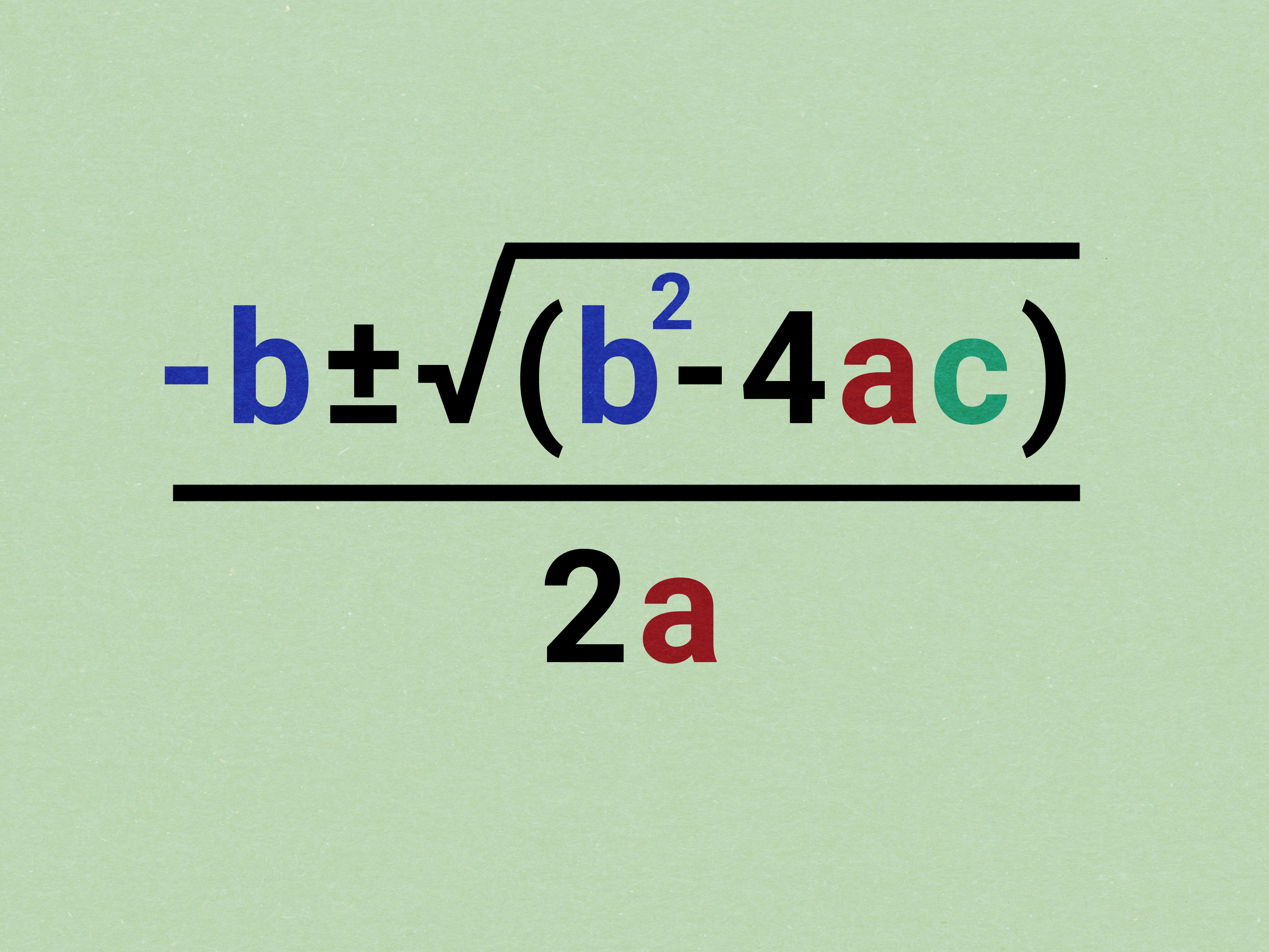
Some math topics walk into class wearing sunglasses, leaning on a locker, and acting like they own the building. The quadratic formula is one of them. It looks dramatic, it sounds dramatic, and it has scared generations of students into gripping their pencils like tiny life rafts. But here is the good news: once you understand what the formula is doing and how to use it step by step, it stops being a monster and starts being a very reliable tool.
If you want to solve quadratic equations using the quadratic formula, this guide will walk you through the process in plain American English, with real examples, common mistakes, and a few sanity-saving tips along the way. We will look at how to identify a, b, and c, how to rewrite equations in standard form, what the discriminant actually tells you, and why the formula is often the best backup plan when factoring decides to be difficult on purpose.
By the end, you will not just know the formula. You will know how to use it confidently, how to check your answers, and how to avoid the classic algebra blunders that make students mutter things at their homework that should not be repeated in polite company.
What Is the Quadratic Formula, Exactly?
The quadratic formula is a method for finding the solutions, or roots, of any quadratic equation written in this form:
ax2 + bx + c = 0
Here, a, b, and c are numbers, and a cannot be zero. If a were zero, the equation would not be quadratic anymore. It would be linear, and the quadratic formula would have every right to leave the room.
The formula itself is:
x = (-b ± √(b2 – 4ac)) / 2a
That little ± sign is not decoration. It means you are usually finding two possible solutions: one using addition and one using subtraction. Many students forget that symbol and accidentally throw one of the answers into a mathematical black hole.
One reason the quadratic formula is so important is that it works even when other methods do not. Factoring is great when the numbers behave nicely. But some quadratic equations refuse to be friendly. The quadratic formula does not care. It still gets the job done.
Why the Quadratic Formula Matters
Quadratic equations show up everywhere: algebra classes, standardized tests, physics problems, business models, engineering calculations, and situations involving area, motion, and optimization. If you have ever seen a parabola, you have already met the graph of a quadratic function.
Learning the quadratic formula matters because it gives you a dependable system. Instead of guessing factors and hoping for the best, you can apply the same structured method over and over. That makes it especially useful when the equation does not factor cleanly or when the solutions are irrational or complex.
Even better, the formula teaches more than just answer-hunting. It helps you understand how the coefficients in a quadratic equation affect the number and type of solutions. In other words, it is not just a tool. It is a little algebra microscope.
Start with Standard Form or Prepare for Chaos
Before you plug anything into the formula, make sure the equation is written in standard form:
ax2 + bx + c = 0
This step is easy to skip and surprisingly effective at causing trouble when ignored. If the equation is not already equal to zero, move every term to one side first.
Example of rewriting into standard form
Suppose you are given:
x2 + 5x = 14
That is not standard form yet. Subtract 14 from both sides:
x2 + 5x – 14 = 0
Now you can identify the coefficients:
- a = 1
- b = 5
- c = -14
That sounds simple, and it is. But it is also one of the biggest places people make mistakes. If you misread a negative sign here, the whole answer goes sideways like a shopping cart with one bad wheel.
How to Solve Quadratic Equations Using the Quadratic Formula
Here is the clean, repeatable process.
Step 1: Write the equation in standard form
Make sure the equation looks like ax2 + bx + c = 0.
Step 2: Identify a, b, and c
Read the coefficients carefully. Include the signs. Negative numbers are still numbers, even if they are being dramatic.
Step 3: Substitute into the quadratic formula
Write the full formula first, then replace a, b, and c with the values from the equation.
Step 4: Simplify the expression under the square root
This part, b2 – 4ac, is called the discriminant. It tells you what kind of answers to expect.
Step 5: Simplify the result as much as possible
You may get whole numbers, fractions, radicals, or even complex numbers.
Step 6: Check your answers
Substitute the solutions back into the original equation if needed. It is not glamorous, but it catches errors before they become full-grown homework disasters.
The Discriminant: The Formula’s Mood Ring
The discriminant is the expression inside the square root:
b2 – 4ac
This one piece of the formula tells you how many solutions you have and what kind they are.
- If the discriminant is positive, there are two real solutions.
- If the discriminant is zero, there is one real solution repeated twice.
- If the discriminant is negative, there are two complex solutions.
This is incredibly helpful because it gives you a preview before you finish solving. It is like reading the movie description before pressing play, except with fewer explosions and more parentheses.
Worked Example 1: A Quadratic with Two Real Solutions
Solve:
x2 – 3x – 10 = 0
First, identify the coefficients:
- a = 1
- b = -3
- c = -10
Plug them into the formula:
x = (-(-3) ± √((-3)2 – 4(1)(-10))) / 2(1)
Simplify:
x = (3 ± √(9 + 40)) / 2
x = (3 ± √49) / 2
x = (3 ± 7) / 2
Now split it into two answers:
x = (3 + 7) / 2 = 5
x = (3 – 7) / 2 = -2
Final answer: x = 5 and x = -2
Nice and clean. This one actually factors too, but it still makes a good formula example because the numbers simplify neatly.
Worked Example 2: A Quadratic with Irrational Solutions
Solve:
2x2 + 3x – 2 = 0
Identify the coefficients:
- a = 2
- b = 3
- c = -2
Use the formula:
x = (-3 ± √(32 – 4(2)(-2))) / 2(2)
Simplify the discriminant:
x = (-3 ± √(9 + 16)) / 4
x = (-3 ± √25) / 4
x = (-3 ± 5) / 4
Now solve both parts:
x = (-3 + 5) / 4 = 1/2
x = (-3 – 5) / 4 = -2
Final answer: x = 1/2 and x = -2
Worked Example 3: A Quadratic with Complex Solutions
Solve:
x2 + 4x + 13 = 0
Identify the coefficients:
- a = 1
- b = 4
- c = 13
Substitute into the formula:
x = (-4 ± √(42 – 4(1)(13))) / 2
x = (-4 ± √(16 – 52)) / 2
x = (-4 ± √(-36)) / 2
Since √(-36) = 6i:
x = (-4 ± 6i) / 2
x = -2 ± 3i
Final answer: x = -2 + 3i and x = -2 – 3i
This is where the discriminant earns its paycheck. Because the discriminant is negative, you know there are no real x-intercepts. The parabola never crosses the x-axis in the real-number plane.
Common Mistakes When Using the Quadratic Formula
1. Forgetting to set the equation equal to zero
If the equation is not in standard form, your values of a, b, and c will be wrong from the beginning.
2. Losing a negative sign
This happens all the time, especially with b. Use parentheses when substituting. Writing -(-3) is much safer than trying to do it in your head and hoping your brain does not wander off.
3. Forgetting the plus-or-minus symbol
The ± sign usually means two answers. Ignore it, and you have only done half the job.
4. Dividing only the square root by 2a
The entire numerator, -b ± √(b2 – 4ac), is divided by 2a. Not just the radical. Not just part of it. The whole thing.
5. Stopping before simplifying
If the square root can be simplified or the fraction can be reduced, do it. Final answers should be clear, clean, and complete.
When Should You Use the Quadratic Formula?
You can use the quadratic formula for any quadratic equation, but that does not always mean it is the fastest option. If an equation factors instantly, factoring may be quicker. If it is in a form like x2 = 49, the square root property may be easier.
Still, the quadratic formula is the best choice when:
- the equation does not factor nicely,
- you want a consistent method every time,
- you need exact answers,
- or the discriminant suggests irrational or complex roots.
Think of it as the dependable multitool of algebra. It may not always be the quickest gadget in the drawer, but it is the one you trust when the problem gets weird.
Experiences Students Commonly Have When Learning the Quadratic Formula
Learning how to solve quadratic equations using the quadratic formula often starts the same way for a lot of students: with mild panic. The formula looks long, the symbols feel crowded, and the square root sitting in the middle gives off strong “there will be consequences” energy. At first, students often assume they have to memorize a mysterious spell rather than follow a logical algebra process. That feeling is normal.
One of the most common experiences is the moment when the formula suddenly becomes less scary after a few worked examples. At the beginning, many students stare at x = (-b ± √(b2 – 4ac)) / 2a as if it were written in the secret dialect of ambitious calculators. But after plugging in values for a, b, and c several times, the pattern starts to settle in. The equation stops looking like a wall of symbols and starts looking like a checklist. That shift matters. It is often the exact moment confidence begins to replace dread.
Another common experience is discovering that most mistakes are not “math intelligence” problems at all. They are organization problems. Students who write neatly, use parentheses, and keep track of signs usually perform much better than students who try to race through the steps. In other words, the quadratic formula often rewards patience more than brilliance. This can be strangely encouraging. You do not need to be a math wizard wearing an invisible cape. You need to slow down and keep the algebra tidy.
There is also the classic surprise of the discriminant. Many students love the moment they realize the expression b2 – 4ac is not just busywork under a radical. It actually predicts whether the solutions will be real, repeated, or complex. That feels like unlocking bonus content. Instead of blindly solving the equation, students begin to anticipate the result. Math becomes less about surviving the problem and more about reading what the structure is already telling you.
In classrooms, the quadratic formula also tends to create a funny split between two types of learners. Some students love it because it is predictable. Give them a formula, a standard form, and a pencil, and they are happy. Other students resist it at first because it feels mechanical. But even those students often come around when they see that the formula works for messy equations that factoring refuses to handle. It earns trust the hard way: by being useful.
Many learners also remember the first time they get complex solutions and think, “Wait, am I still allowed to do that?” Yes, absolutely. That moment can be oddly satisfying because it reveals that the quadratic formula is not just for easy textbook problems. It is broad enough to handle equations whose graphs do not cross the x-axis at all. For students, this can feel like a jump from basic algebra into a bigger mathematical world.
Teachers and tutors often notice another pattern: students improve fastest when they say the steps out loud or annotate each line. “Standard form. Identify coefficients. Substitute carefully. Simplify the discriminant. Split the plus and minus. Check.” It may sound simple, but that kind of routine turns confusion into process. And process is what builds consistency on quizzes, homework, and exams.
Over time, students usually stop seeing the quadratic formula as a chapter requirement and start seeing it as a reliable backup plan. They may still prefer factoring when it works quickly, but they know the formula is there when the numbers get stubborn. That is a powerful academic experience. It changes the mindset from “I hope this problem is nice to me” to “I know what to do even if it is not.”
So if your experience with the quadratic formula has included frustration, sign errors, rewriting problems three times, and one dramatic sigh per minute, congratulations: you are having a very authentic algebra journey. The key is not perfection. The key is repetition with attention. The formula gets friendlier every time you use it correctly. Eventually, what once looked intimidating starts to feel almost routine. Not glamorous, maybe. But wonderfully manageable.
Final Thoughts
The quadratic formula is one of the most useful tools in algebra because it gives you a reliable method for solving quadratic equations in standard form. Once you know how to identify the coefficients, substitute carefully, and interpret the discriminant, the process becomes much more straightforward.
So the next time a quadratic equation appears and factoring refuses to cooperate, do not panic. Put the equation in standard form, keep an eye on your signs, respect the ±, and let the quadratic formula do what it was born to do. Algebra may still be algebra, but at least now it has a map.













