
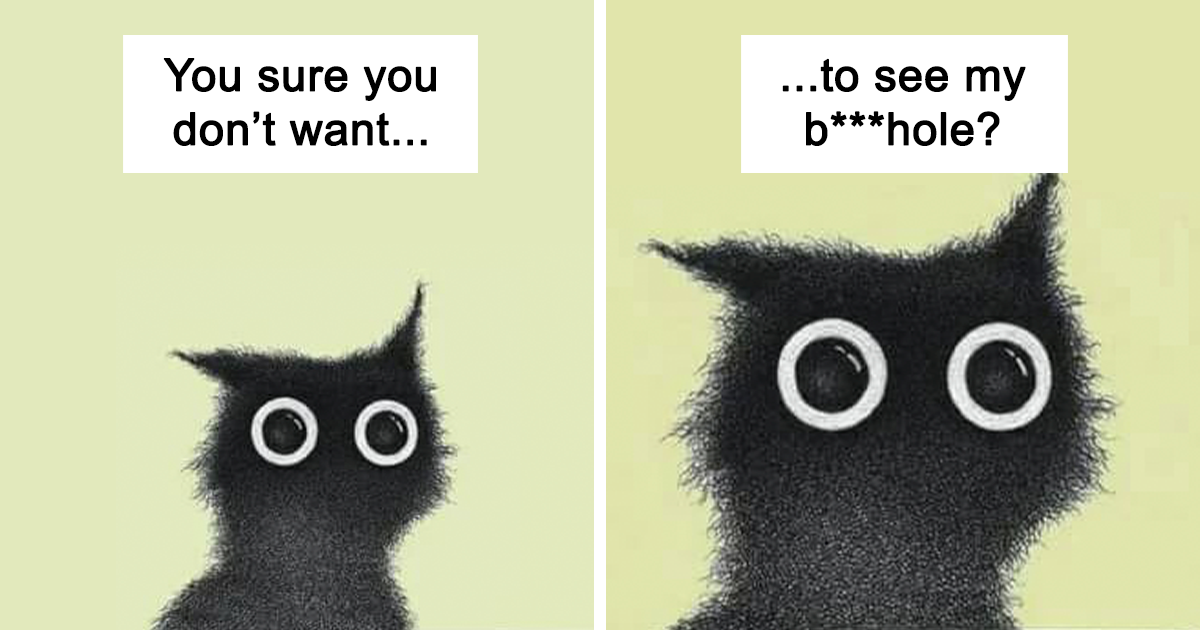
Cats have spent centuries perfecting an impressive résumé: professional napper, part-time philosopher, unpaid kitchen supervisor, and full-time destroyer of unattended cardboard. Portuguese illustrator Luís Coelho understands this complicated species remarkably well. Through his project Purr in Ink, he turns familiar feline habits into charming black-and-white illustrations filled with tenderness, mischief, and wonderfully strange thoughts.
Coelho’s cats may be small, but they carry enormous emotional responsibilities. They worry, comfort one another, ask awkward questions, celebrate tiny victories, and stare into the distance as though they have just remembered an embarrassing thing they did in 2014. Some behave exactly like real cats. Others act like nervous humans wearing furry pajamas. Most somehow manage to do both.
This collection celebrates 60 of the artist’s most wholesome cat illustrations while exploring why his simple drawings feel so expressive. There are no giant action scenes or elaborate backgrounds here. A pair of bright eyes, a carefully curved tail, and one perfectly timed sentence are often enough to deliver the jokeand occasionally a surprisingly sincere emotional punch.
Meet Luís Coelho, the Human Behind Purr in Ink
Luís Coelho describes himself as the person behind the cat drawings and thoughts published through Purr in Ink. His characters are traditionally drawn with pen on paper, using repeated lines and hatching to construct their soft, slightly chaotic fur. He treats the process as slow and meditative rather than rushing toward a polished digital result.
Coelho studied painting and illustration before following other professional paths. His present style began taking shape after he invited his nieces to choose animals for him to draw as imaginary guardians of their dreams. That playful exercise helped inspire the wide-eyed, dreamlike creatures that later became central to his work. Sharing those drawings online eventually allowed him to leave an office job and work as an illustrator full time.
His technique is built around discovery. Coelho may begin with reference images and rough pencil shapes, but he does not always know how a piece will end. He gradually develops the animal line by line, allowing unexpected marks and apparent mistakes to influence the finished character. Depending on the complexity, an illustration can require many hours of patient work.
That careful process explains an appealing contradiction in his art. The cats look spontaneous, as though they appeared during a five-minute doodling break, yet their coats are composed of countless deliberate strokes. The humor feels effortless because the labor remains quietly hidden beneath the fluff.
Why Cats Make Such Brilliant Illustrated Characters
Cats are ideal comedy performers because their body language is naturally dramatic. They stalk, pounce, scratch, hide, stretch, freeze, swish their tails, and transform from elegant statues into airborne noodles without warning. Many of these actions are connected to normal play, communication, territorial behavior, or responses to stimulation.
They are also emotionally readable without being completely predictable. A relaxed posture can communicate comfort, while flattened ears, tense muscles, widened eyes, or rapid tail movements may suggest fear, irritation, or overstimulation. Vocalizations add another layer: cats may meow for attention, trill during friendly encounters, or purr in several different emotional and physical contexts.
Coelho exaggerates these recognizable signals just enough to make them funny. A worried cat becomes almost entirely eyes. An alarmed cat appears to have been assembled from static electricity. A sleepy one melts toward the floor like an abandoned scoop of ice cream. Because the poses are rooted in real feline behavior, viewers understand the situation before they finish reading the caption.
Cats also have a long history as artistic subjects. Long before social media turned them into reaction images and keyboard-playing celebrities, painters, illustrators, writers, and craftspeople were already using felines to represent affection, mystery, independence, mischief, and domestic life. Their playful nature has inspired artists across centuries, while internet culture simply made the audience larger and the sharing considerably faster.
60 Wholesome Cat Illustrations and the Moods They Capture
The reader-friendly captions below describe the moods, jokes, and recurring situations represented across the featured selection. They are thematic descriptions rather than official artwork titles.
1–10: Cats Who Think Too Much
- The Midnight Question. A tiny cat suddenly remembers that existence is temporary but breakfast is several hours away.
- The Professional Overthinker. One suspicious thought becomes twelve suspicious thoughts and an emergency meeting behind the sofa.
- The Meaning of the Red Dot. A cat wonders whether the laser pointer is prey, destiny, or an elaborate human betrayal.
- The Window Philosopher. The outside world is enormous, beautiful, and inconveniently located behind glass.
- The Empty Bowl Crisis. A visible patch at the bottom of the dish confirms that civilization has collapsed.
- The Unanswered Meow. A cat delivers a powerful speech while the audience continues doing laundry.
- The Forgotten Mission. The journey across the room ends when the traveler can no longer remember why it began.
- The Suspicious Sound. An ordinary household creak becomes a supernatural event requiring maximum pupil expansion.
- The Existential Loaf. Four legs disappear beneath one body while several serious questions remain.
- The Great Nothing. A cat stares intensely at a blank wall, perhaps seeing ghosts or perhaps enjoying excellent wall content.
11–20: Small Acts of Feline Friendship
- The Quiet Check-In. One cat sits beside another without demanding an explanation, solution, or password.
- The Shared Blanket. Two independent creatures agree that personal boundaries can be renegotiated during cold weather.
- The Emergency Head Bump. A gentle nudge delivers affection more efficiently than a twelve-page emotional letter.
- The Backup Napper. A worried friend arrives with the only support strategy cats truly trust: sleeping nearby.
- The Brave Little Guardian. A very small animal promises protection despite being frightened by grocery bags.
- The Tail Connection. Two tails touch while their owners pretend not to notice the secret handshake.
- The Rainy-Day Companion. Nothing is fixed, but everything feels softer when someone watches the weather beside you.
- The Cat Who Stayed. When the world feels noisy, one round friend quietly refuses to leave.
- The Mutual Grooming Agreement. Affection is expressed through careful cleaning and the occasional unauthorized ear inspection.
- The Friendship Box. Two cats enter one cardboard container and immediately discover advanced relationship management.
21–30: Cats Managing Human Employees
- The Keyboard Supervisor. Productivity improves when a cat sits directly on the most important keys.
- The Bathroom Escort. Privacy is an outdated human concept that responsible cats cannot support.
- The Alarm Clock With Whiskers. Breakfast begins at dawn, regardless of weekends, holidays, or medical advice.
- The Meeting Assistant. A tail passes in front of the camera just as the employee attempts to sound professional.
- The Bed Allocation Manager. A nine-pound cat successfully occupies 87 percent of a queen-size mattress.
- The Quality Inspector. Every package must be opened, smelled, entered, and approved before the human may continue.
- The Reading Companion. The best place to sit is precisely between the reader’s eyes and the final paragraph.
- The Hydration Consultant. Fresh water in a clean bowl is ignored in favor of one mysterious drop inside the sink.
- The Wardrobe Curator. Black clothing receives white fur; white clothing receives black fur. Balance has been restored.
- The Remote-Control Specialist. The cat changes the channel by lying on technology and accepting no responsibility.
31–40: Adorable Agents of Chaos
- The 3 A.M. Athlete. An invisible starting pistol launches a high-speed race through every room.
- The Gravity Researcher. A cup is slowly pushed toward the edge of a table in the name of science.
- The Curtain Expedition. A vertical fabric surface becomes a mountain because nobody explicitly said it was not one.
- The Paper-Bag Monster. The bag moves by itself, makes suspicious noises, and occasionally reveals two enormous eyes.
- The Plant Consultant. Several leaves are removed to improve a houseplant’s aerodynamics.
- The Sock Hunter. A harmless piece of laundry is defeated after an intense struggle under the bed.
- The Invisible Opponent. A cat leaps sideways with an arched back, bravely confronting absolutely nothing.
- The Toilet-Paper Sculptor. One roll becomes a dramatic installation exploring fragility, movement, and human despair.
- The Shelf Rearranger. Decorative objects are relocated to the floor, where they apparently belonged all along.
- The Zooming Potato. A round cat briefly achieves impossible speed before collapsing into an innocent loaf.
41–50: Gentle Lessons From Tiny Cats
- Rest Without Guilt. The cat offers a revolutionary idea: being tired is a sufficient reason to sleep.
- Choose the Sunny Spot. Happiness sometimes requires moving six inches to the left.
- Ask Clearly. Repeated meowing demonstrates the value of direct communication and unreasonable persistence.
- Protect Your Peace. When company becomes exhausting, climb somewhere nobody else can reach.
- Celebrate Small Things. A bottle cap can be an excellent toy when approached with commitment.
- Stretch Before Everything. No serious activity should begin until the spine has become impressively long.
- Accept Imperfection. A crooked ear, unruly fur, or awkward landing does not cancel personal magnificence.
- Return to Comfort. The familiar blanket is still valuable even after a courageous seven-minute adventure.
- Be Curious Carefully. Inspect the new object, but keep one paw ready for immediate retreat.
- Love in Your Own Language. Affection may look like cuddling, following, blinking slowly, or occupying someone’s clean laundry.
51–60: Pure Wholesome Cat Energy
- The Pocket-Sized Encourager. A tiny cat believes in you with the confidence of someone who has never paid rent.
- The Warm Welcome. A curled tail and bright eyes make an ordinary return home feel like a major event.
- The Biscuit Maker. A soft blanket becomes a bakery staffed by one extremely focused employee.
- The Dream Guardian. A wide-eyed creature waits beside the bed to protect its sleeping human from imaginary monsters.
- The Sunbeam Collector. Warm light is gathered carefully and stored in the belly for later use.
- The Accidental Hat. One cat sits on another, creating an inconvenient but fashionable arrangement.
- The Courageous Kitten. A small paw reaches toward a large world, pauses, and bravely reaches again.
- The Purring Medicine. The problem remains, but its sharp edges feel quieter beside a contented cat.
- The Forever Home. A once-lonely animal finally sleeps deeply because it no longer needs to remain alert.
- The Final Slow Blink. No speech is necessary; trust appears in the gentle closing and opening of two illustrated eyes.
What Makes Luís Coelho’s Cat Illustrations So Distinctive?
Detailed Fur Meets Minimalist Storytelling
The cats are technically intricate, but their surroundings are often extremely simple. This balance keeps the viewer’s attention on posture, expression, and text. Each short line adds volume to the animal while the surrounding white space gives the joke room to breathe.
Cross-hatching and stippling can make the characters look soft, nervous, fluffy, or electrically surprised. Similar line-based approaches appear in other contemporary cat illustrations, but Coelho’s combination of dense texture, oversized eyes, and compact emotional writing gives Purr in Ink its own recognizable personality.
Human Feelings Without Losing the Catness
Anthropomorphic animal art sometimes turns its subjects into ordinary people with decorative ears. Coelho avoids that trap. His cats may discuss loneliness, self-doubt, friendship, or purpose, yet they still hide in boxes, demand food, stare at walls, and interrupt whatever the humans are doing.
That mixture is essential. The drawings feel relatable because the emotions are human, but they remain funny because those emotions are delivered by creatures whose daily schedule consists largely of sleeping, eating, and launching surprise attacks on shoelaces.
Kindness Without Forced Positivity
The illustrations are wholesome, but they are not relentlessly cheerful. Some cats are anxious. Some feel awkward or lonely. Others clearly have no idea what is happening. The comfort comes from recognition rather than from pretending every problem can be solved by a motivational slogan printed over a sunset.
A worried character may simply receive company. A tired one may be permitted to rest. A frightened cat may take one cautious step instead of completing a heroic transformation. These modest emotional victories make the work feel gentle rather than sugary.
A Reader’s Experience: Spending Time With 60 Illustrated Cats
Opening a collection of 60 cat illustrations sounds like a lightweight activity. You expect a few smiles, several excellent tails, and perhaps a renewed suspicion that your own cat has been secretly sharing household information with artists. Then the emotional range begins to appear.
The first reaction is usually recognition. You notice the cat staring at an empty bowl as though facing a historic injustice, and you remember the animal who once woke you because three pieces of kibble had shifted to one side. Another drawing shows a cat attempting to fit inside an absurdly small box. Suddenly, you are thinking about the expensive bed your pet ignored in favor of its packaging.
That familiarity creates an immediate connection. Coelho does not need long explanations because cat owners already understand the setup. We know the sound of paws accelerating through a quiet house at night. We know the concentration required to push a pen off a desk. We know that a closed door is not merely a door; it is a personal insult and possibly a constitutional crisis.
Yet the collection becomes more affecting when the cats begin expressing recognizably human concerns. A character wonders whether it is good enough. Another offers silent company to a friend. One appears overwhelmed by the size of the world, while another treats getting out of bed as a meaningful achievement. The drawings give these experiences a softer shape. Anxiety looks less frightening when it has whiskers. Loneliness feels less permanent when a second cat quietly sits down nearby.
The black-and-white presentation contributes to this intimacy. Without bright colors or elaborate scenery, the viewer meets each character almost in private. There is nothing competing with the eyes, the curve of the back, or the short line of text beneath the drawing. You pause because the image looks simple, then notice how much patience is contained in the fur.
After several illustrations, you may begin reading them differently. The cats stop being generic cute animals and become tiny actors. One is clearly the dramatic friend. Another is the practical one who brings snacks. A third has not slept because it heard a mysterious noise in the hallway and has already developed four theories. Their personalities emerge through small variations in posture and expression.
The humor also works as a useful pause from the speed of online content. Many feeds reward louder jokes, faster edits, brighter colors, and increasingly exaggerated reactions. Coelho’s work often asks for the opposite. A mostly empty page contains one carefully drawn animal and one thought. The viewer has time to notice the craftsmanship before moving on.
For artists, the collection offers another kind of experience. It demonstrates that a recognizable style does not require endless visual ingredients. Coelho repeatedly uses cats, ink, white space, and brief captions, yet the emotional possibilities remain broad. Limitation becomes a strength. Instead of constantly inventing a new universe, he investigates the enormous universe already hiding inside a raised paw, a nervous stare, or a curled tail.
For cat lovers, the illustrations can feel like affectionate documentation. Cats are often described as aloof, but anyone who has lived closely with one knows that feline affection can be subtle and highly specific. It may arrive as a head bump, a quiet presence, a warm body against the legs, or a decision to sleep nearby. Cats reserve many social and tactile signals for trusted companions, which helps explain why these small gestures can feel so meaningful.
By the time the sixtieth illustration arrives, the collection has quietly accomplished more than delivering cute cat art. It has transformed ordinary behaviors into stories about trust, uncertainty, persistence, companionship, and rest. You may leave with a favorite drawing, but you are equally likely to leave with a slightly kinder interpretation of your own strange habits.
Perhaps that is the central pleasure of Purr in Ink. The cats make us laugh because they resemble people, and they comfort us because their lives seem simpler. They worry, but then they nap. They fail dramatically, but remain magnificent. They become frightened, retreat into a box, and eventually peek out again. Frankly, many of us could use that kind of emotional strategy.
Why These Wholesome Cat Drawings Continue to Connect
Online audiences have no shortage of cute animal content. What gives Coelho’s work lasting appeal is the relationship between craftsmanship and emotional accuracy. The drawings are detailed enough to reward a closer look, simple enough to understand immediately, and sincere enough to survive beyond the first joke.
His cats do not need grand adventures. Their victories are wonderfully small: finding warmth, receiving reassurance, surviving an awkward moment, sharing a blanket, or discovering that someone stayed. These are ordinary experiences, but the illustrations treat them as worthy of attention.
That may be the most wholesome idea in the entire collection. A quiet moment does not have to be spectacular to matter. Sometimes it only needs a pen, a few hundred lines, and a round cat looking directly at your emotional defenses.













