
Note: This article is an original, fully rewritten synthesis based on real public information about Lucas Levitan’s “Photo Invasion” project, digital illustration culture, social media creativity, visual storytelling, and the way humorous photo art spreads online.
Most people scroll through Instagram and see brunch, beaches, pets, sunsets, gym selfies, and the occasional mysterious cup of coffee photographed like it is accepting an Oscar. Illustrator Lucas Levitan sees something else entirely. A person standing near a wall may become the sidekick of a giant cartoon creature. A peaceful landscape may suddenly host a tiny dramatic rescue mission. A casual street photo may turn into a one-frame comedy sketch with better timing than half the sitcoms on television.
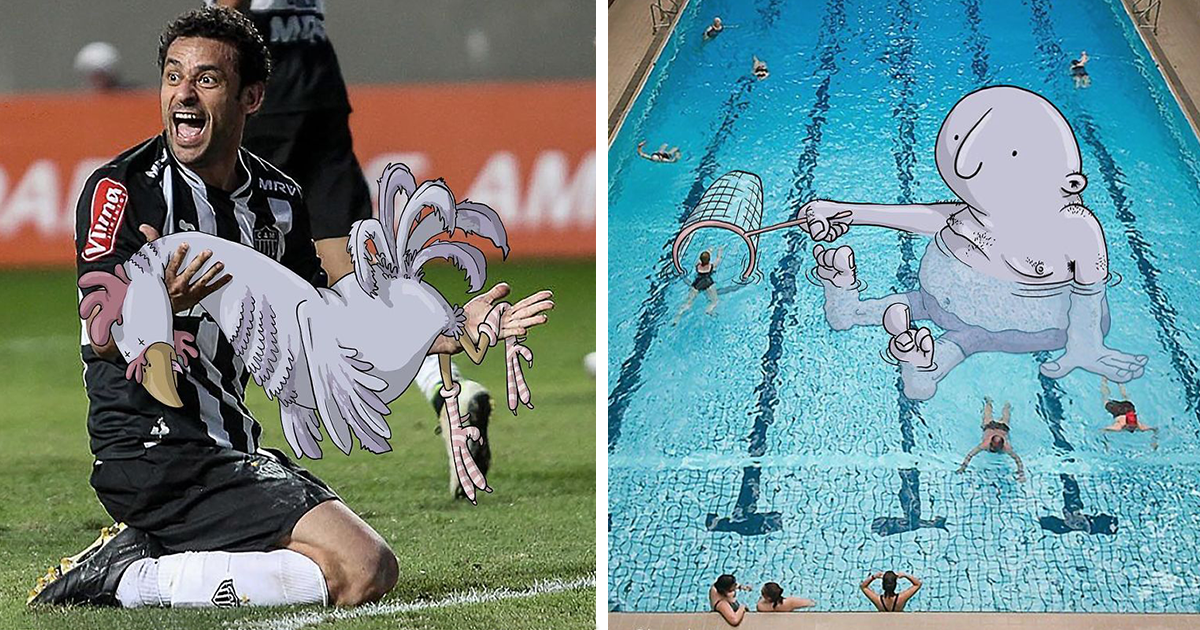
That is the charm behind “Illustrator Adds Funny Cartoons To Strangers’ Instagram Photos (Part 3)”: the idea that an ordinary image can hide a second, sillier universe. Levitan, a Brazilian illustrator and multimedia artist based in London, is widely known for his ongoing project Photo Invasion, in which he adds funny cartoons to other people’s Instagram photos. The results are playful, surprising, and often just weird enough to make your brain do a happy little backflip.
Instead of treating photos as finished objects, Levitan treats them as invitations. A shadow becomes a monster. A hand gesture becomes a magic spell. A person jumping in midair becomes someone being launched by an invisible cartoon machine. The original photo remains recognizable, but the illustration bends the meaning into something new. It is not just drawing over a picture; it is visual storytelling with a punchline.
What Is “Photo Invasion”?
Photo Invasion is Levitan’s signature creative series. The basic concept sounds simple: find a photo, add an illustration, and change the story. But the magic is in the timing. The cartoon is not pasted randomly into the frame. It is carefully placed so it interacts with the original subject, angle, lighting, body language, or background. The best “invasions” feel as if the cartoon character was always there, waiting for someone with a mischievous pencil to reveal it.
Levitan has described the project as a one-frame story. That phrase matters. These are not long comics with panels, dialogue balloons, and complicated plots. They are tiny visual jokes. You understand them in a second, then enjoy the cleverness for several more. In today’s fast-moving social media world, that is a powerful format. A good Instagram cartoon has to land quickly, but a great one makes people stop scrolling.
Why Strangers’ Instagram Photos Make the Perfect Canvas
Instagram is full of accidental stages. People pose beside fountains, under signs, on stairs, in parks, at beaches, and in front of dramatic city walls. They do not always realize it, but they are creating ready-made scenes. Levitan’s work recognizes the comic potential hiding in those scenes.
A person leaning out of a window might become a castle guard arguing with a dragon. A runner on the street might be chased by a tiny imaginary beast. A woman with windblown hair might suddenly look like she is being operated by a cartoon weather machine. A man sitting alone on a bench might be joined by a strange little character who clearly has no respect for personal space. The humor often comes from contrast: real life is calm, while the cartoon universe is absolutely not.
This is why funny cartoons added to photos work so well online. The viewer gets two pleasures at once. First, there is the familiar world of everyday photography. Second, there is the surprise of an illustrated twist. The combination feels fresh because it turns a common social media habitposting photosinto a collaborative playground.
The Art of Making a Photo Funnier Without Breaking It
Adding a cartoon to a photo is easy in theory. Anyone can doodle a mustache on a picture. Making the result feel clever, charming, and worth sharing is much harder. Levitan’s strongest work succeeds because he respects the original image while gently hijacking its meaning. Think of it as comedy with good manners and a tiny rubber chicken in its pocket.
1. The Cartoon Must React to the Photo
The illustration usually works because it responds to something that already exists in the image. A curved object might become a slide. A puddle might become an ocean. A raised hand might become a traffic signal for miniature creatures. The photo provides the setup; the drawing delivers the punchline.
2. The Scale Creates the Joke
Levitan often plays with size. Tiny characters can make a giant human look like part of their world. A person’s shoe might become a building. A bicycle wheel might become a circus ring. A coffee cup might become a swimming pool for a very ambitious cartoon swimmer. When scale is flipped, ordinary objects become absurdly important.
3. The Best Ideas Feel Obvious After You See Them
Great visual humor often has that “why didn’t I think of that?” feeling. Once the cartoon is added, the new interpretation seems inevitable. Of course that shadow was a creature. Of course that cloud was a beard. Of course that person stretching on the sidewalk was secretly wrestling an invisible octopus. The joke works because it reveals a hidden possibility rather than forcing one onto the image.
Why This Series Went Viral
The internet loves transformation. Before-and-after makeovers, clever edits, unexpected mashups, and optical illusions all perform well because they reward attention. Photo Invasion fits perfectly into that culture. It takes something ordinary and makes it surprising without requiring a long explanation.
The series also has a friendly kind of mischief. Levitan has called himself a “Photo Invader,” and the word “invasion” gives the project a playful edge. However, the tone is not cruel or mocking. The cartoons usually add charm, not embarrassment. In many cases, the original photographers receive more attention because their images become part of a widely shared artwork. That sense of creative exchange helped the project grow beyond a simple drawing experiment.
Another reason the project spread is that it invites participation. People have used hashtags such as #IWantToBeInvaded to ask for their photos to be transformed. That turns the audience into possible collaborators. Instead of simply watching the artist work, followers can imagine their own photos being invaded by a small cartoon troublemaker with excellent timing.
Lucas Levitan’s Style: Playful, Clean, and Instantly Recognizable
Levitan’s illustration style is approachable. His characters are often simple, rounded, expressive, and full of movement. They do not overpower the photos. They slip into them. That restraint is important. If the drawings were too detailed or visually heavy, they might compete with the original image. Instead, his cartoons usually feel light enough to belong in the scene while still being strange enough to steal the show.
His background in illustration, animation, photography, and creative direction also shows. The images are not just funny doodles; they are composed. Placement, perspective, gesture, and negative space all matter. A tiny character tugging at a person’s shoelace can be funnier than a giant monster if the timing is right. Comedy, like real estate, depends on location.
How the Cartoons Change the Meaning of the Original Photos
The most interesting part of Photo Invasion illustrations is not only that they are cute or funny. It is that they change the story. A beach photo may become a rescue scene. A city wall may become a stage. A person lying on the grass may become a giant in a cartoon village. The original photo says, “Here is a moment.” The illustration says, “Actually, here is the secret chaos happening inside that moment.”
This kind of remixing is a major part of internet culture. Memes, reaction images, GIF edits, and fan art all rely on recontextualization. Levitan’s work belongs to that larger tradition, but it has a distinctive warmth. He is not simply making fun of the photo. He is finding another possible life inside it.
Is It Art, Comedy, or Social Media Magic?
The answer is yes. It is art because it requires visual skill and imagination. It is comedy because the goal is often laughter, surprise, or amused confusion. It is social media magic because the format feels built for sharing. People can enjoy the image instantly, tag a friend, and move on with a slightly better day.
There is also a deeper reason the project connects with viewers. Many people take photos to preserve reality. Levitan’s work reminds us that reality is only one version of the story. A photo may record what happened, but imagination can suggest what almost happened, what secretly happened, or what definitely did not happen but would have been funnier.
Respecting the Original Photographer
One key detail in the project is credit. Levitan is known for crediting the original image creators when he posts his invaded photos. That matters because the project depends on someone else’s photograph as a starting point. In online creative culture, attribution is not just polite; it is part of the artwork’s ethical foundation.
The best remix art acknowledges the source while adding something meaningfully new. In this case, the new element is not a filter or a quick caption. It is a full reinterpretation. The original photographer provides the real-world scene; the illustrator reveals the hidden cartoon universe. When done with care, both sides benefit: the photographer’s image receives fresh attention, and the illustrator gets to tell a new story.
Why People Love Seeing Their Photos “Invaded”
At first, the idea of someone drawing on your photo might sound alarming. Nobody opens Instagram hoping their vacation picture will be kidnapped by a tiny illustrated goblin. But the response to Levitan’s project has often been enthusiastic because the edits feel affectionate. Being “invaded” becomes a badge of honor, almost like having your photo selected for a secret comedy upgrade.
There is also something delightful about seeing your own image through another person’s imagination. You might remember taking a photo at a train station, but the illustrator sees a cartoon conductor wrestling a cloud. You might see a picture of your dog; the artist sees a royal beast guarding a kingdom of socks. That unexpected interpretation can make familiar memories feel new again.
Lessons for Artists Inspired by Photo Invasion
Artists who want to create similar work can learn several lessons from Levitan’s approach. First, look before you draw. The best idea usually comes from observing the photo carefully. What shapes repeat? Where is the empty space? What is the subject doing? Is there an awkward pose, a dramatic shadow, a strange object, or a line that could become something else?
Second, keep the concept simple. If viewers need a detective board and three cups of coffee to understand the joke, the image may be trying too hard. A strong visual gag should feel immediate. Third, respect the source material. Whether using your own photos or collaborating with others, credit and permission practices matter. Creative play should not erase the people who made the original image possible.
The SEO Power of Visual Humor
From a content perspective, topics like Illustrator Adds Funny Cartoons To Strangers’ Instagram Photos are powerful because they combine curiosity, creativity, and shareability. The title itself promises a transformation. Readers want to know what kind of cartoons, what kind of photos, and how funny the results are. It is a naturally clickable concept without needing exaggerated hype.
Related keywords such as funny Instagram cartoons, photo illustration, cartoons on photos, digital art, Instagram photo edits, and Lucas Levitan Photo Invasion fit naturally into the subject. The key is to use them in context, not stuff them into every sentence like a robot trying to win a spelling bee. Good SEO helps people find the article; good writing makes them stay.
Why Part 3 Still Feels Fresh
A “Part 3” only works if the concept has enough creative fuel to keep going. Fortunately, Instagram produces endless raw material. Every day, millions of new photos appear: dramatic travel shots, sleepy pets, stylish outfits, awkward poses, architectural lines, food close-ups, and landscapes waiting to be invaded by tiny illustrated weirdos. As long as people keep posting, there will be new opportunities for cartoon storytelling.
The ongoing appeal comes from variation. One image may be sweet. Another may be bizarre. Another may be slightly dark in a harmless cartoon way. The viewer never knows what the next photo will become. That element of surprise keeps the series from feeling repetitive. It is the same game every time, but the board keeps changing.
Experience Section: What This Topic Teaches Us About Creativity Online
There is a useful lesson hiding inside “Illustrator Adds Funny Cartoons To Strangers’ Instagram Photos (Part 3)”: creativity does not always begin with a blank page. Sometimes it begins with noticing. Many artists get stuck because they wait for a huge original idea to arrive wearing a cape and carrying a dramatic soundtrack. Levitan’s project shows another route. Start with what already exists. Look at it longer than everyone else. Ask what else it could be.
Anyone who has tried to make visual content for the web knows how difficult it is to stop the scroll. People move quickly. They skim headlines, glance at images, and decide in half a second whether something deserves attention. Funny photo cartoons succeed because they create an instant question: “What am I looking at?” Then they answer it with a joke. That tiny moment of curiosity is priceless.
For photographers, this topic is a reminder that composition can create possibilities beyond the original intention. A photo with negative space, unusual perspective, strong silhouettes, or expressive body language becomes more flexible. Even if the photographer never expected an illustrator to add a cartoon, those visual ingredients make the image more open to reinterpretation. In a way, the best invaded photos are collaborations between planned photography and accidental comedy.
For illustrators, the experience is almost like improv. In comedy improv, performers accept what is already on stage and build from it. In photo illustration, the artist accepts the visual facts of the image and adds a new idea. The wall is there. The person is there. The shadow is there. Now the question becomes: what cartoon truth can live inside this real scene? That mindset helps artists become more flexible, more observant, and less precious about perfection.
For social media creators, the project also shows the value of a recognizable format. Levitan did not create one funny edit and disappear into the internet fog. He built a repeatable idea with a clear identity. People could understand it, remember it, and ask to participate. That is how a creative series becomes more than a single viral post. It becomes a small world with its own rules.
There is also a lesson about humor. The funniest edits are rarely the loudest. They are not overloaded with five characters, twelve speech bubbles, and a joke wearing tap shoes. Often, one small character doing the exact wrong thing in the exact right place is enough. A tiny creature holding an umbrella under a splash of water. A cartoon fisherman casting a line into a coffee cup. A miniature worker repairing the moon in a night-sky photo. The joke works because it is simple, visual, and generous.
Finally, this topic reminds us why people still love handmade-looking art in a digital world. Filters can polish a photo. Apps can beautify a face. Algorithms can recommend the next trend. But a clever drawing placed in the perfect spot feels human. It carries the personality of the artist. You can sense the moment when someone looked at a normal image and thought, “Wait a second, that could be a monster eating spaghetti.” That little spark is what makes the series memorable.
In the end, Photo Invasion is not only about adding cartoons to Instagram photos. It is about adding imagination to everyday life. It tells viewers that the world is funnier, stranger, and more flexible than it looks. The next time you scroll past a simple vacation picture, a street scene, or a dramatic selfie, you may wonder what is hiding inside it. A tiny dragon? A confused astronaut? A fish with an attitude problem? With the right illustrator, even the most ordinary photo can become a story worth laughing at.
Conclusion
“Illustrator Adds Funny Cartoons To Strangers’ Instagram Photos (Part 3)” continues to resonate because it celebrates the playful side of digital creativity. Lucas Levitan’s Photo Invasion project proves that a photo does not have to stay trapped in its original meaning. With a smart illustration, a casual Instagram post can become a comic scene, a miniature adventure, or a strange little masterpiece that makes thousands of people smile.
The project works because it is simple, clever, and deeply human. It rewards observation. It respects humor. It turns strangers into collaborators and everyday images into visual jokes. Most importantly, it reminds us that imagination is not limited to blank sketchbooks or studio walls. Sometimes it is hiding in someone else’s photo, waiting for a cartoon character to walk in and cause just the right amount of trouble.













