
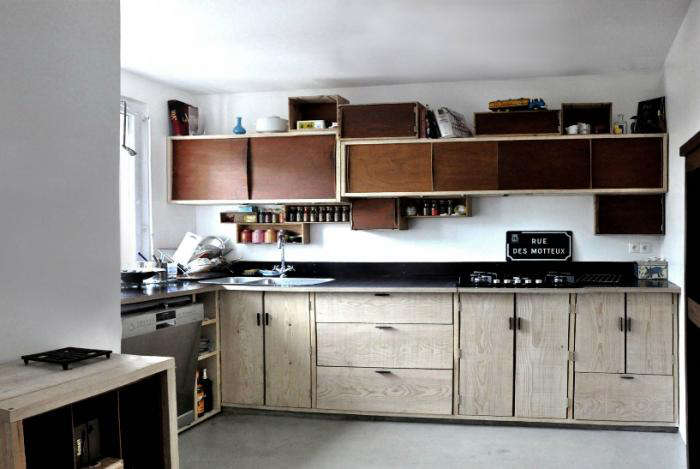
Paris kitchens are often imagined as graceful little theaters of copper pans, buttery light, and someone casually whisking a sauce while wearing linen that never wrinkles. Lovely, yes. Realistic? Only if your dishwasher also speaks fluent French and your baguette never leaves crumbs. The truly interesting Paris kitchen is not always polished, symmetrical, or obedient. Sometimes it is rough-edged, reclaimed, cleverly improvised, and just a little rebellious.
A nonconformist kitchen in Paris is not a room trying to impress guests with marble perfection. It is a kitchen that has a point of view. It might use salvaged wood where glossy cabinetry is expected. It might turn metal screens into cabinet doors, leather straps into pulls, and an old sink into the star of the show. It is less “catalog showroom” and more “architectural jazz solo”structured, intentional, but not afraid to bend the melody.
The idea is closely associated with the work of Ciguë, a French architecture and design studio based near Paris, known for treating interiors as experiments in material, craft, and lived experience. In one much-discussed kitchen project outside the center of Paris, the studio used reclaimed elementswood pallets, repurposed boxes, metal mesh, leather, and vintage fixturesto create a room that feels both humble and intellectually sharp. It is a kitchen with dirt under its fingernails and excellent taste.
What Makes a Kitchen “Nonconformist”?
A nonconformist kitchen refuses to follow the standard checklist: seamless cabinets, hidden everything, matching finishes, and surfaces so spotless they look afraid of toast. Instead, it asks a better question: What if the kitchen could tell the truth?
In design terms, that truth often begins with visible materials. Wood looks like wood. Metal looks like metal. Shelves reveal their structure. Cabinet pulls are not decorative jewelry; they are working parts. Scratches, knots, dents, and age are not flaws to hide. They are evidence that the room has a life beyond the mood board.
It Values Character Over Perfection
Perfection can be beautiful, but it can also be a little boringlike a dinner guest who only talks about interest rates. A nonconformist Paris kitchen welcomes irregularity. A reclaimed countertop may carry marks from a previous life. A vintage sink may not be perfectly sleek, but it has presence. Cabinet fronts made with mesh or screen material may reveal shadowy hints of plates and jars inside, creating a layered look that feels more human than machine-made.
It Uses Materials With Memory
Reclaimed wood, old boxes, salvaged fixtures, and reworked hardware are not just sustainable choices; they are storytelling tools. A pallet countertop suggests movement, labor, and reuse. Leather pulls soften hard surfaces and age beautifully over time. A wooden block shelf may look simple, but it also feels direct and architectural. The room becomes a quiet argument against disposable design.
It Works Hard Without Looking Overdesigned
The best Paris kitchens understand limitation. Many city apartments do not have sprawling suburban floor plans, enormous islands, or pantry space big enough to shelter a small orchestra. So the kitchen must do more with less. Open shelving, compact layouts, movable pieces, and multipurpose surfaces become essential. The nonconformist version simply makes those solutions expressive instead of apologetic.
The Paris Factor: Small Space, Big Personality
Paris has a long tradition of turning spatial constraints into style. Apartments may be compact, historic buildings may come with odd corners, and plumbing may appear to have been planned by a poet with a grudge. Yet those limitations often lead to smarter, more personal interiors.
In many Paris apartments, the kitchen is not isolated from daily life. It may be open to the living area, tucked into a wall, squeezed under a slope, or arranged around a single strong work surface. That visibility changes the design challenge. The kitchen cannot behave like a back-of-house utility zone. It must function, but it must also belong to the home’s visual rhythm.
This is where nonconformist design shines. Instead of disguising the kitchen, it gives the kitchen confidence. A raw wood counter can connect with old beams. Metal mesh can echo industrial Paris. A vintage sink can soften the austerity of modern lines. The result is not random. It is edited imperfection.
Inside the Look: Key Elements of a Nonconformist Paris Kitchen
1. Reclaimed Wood Countertops
Reclaimed wood brings warmth and history into a kitchen instantly. In a nonconformist Paris kitchen, it may appear as a countertop made from pallets or salvaged boards rather than a pristine slab ordered from a showroom. This choice adds texture, but it also changes the emotional tone of the room. The kitchen feels approachable, almost workshop-like, as if chopping onions is part of a larger creative process.
Of course, reclaimed wood needs proper sealing and maintenance if it is used near water or food preparation areas. The goal is romance with responsibility. Nobody wants a countertop that looks poetic but behaves like a sponge at a soup festival.
2. Vintage Sinks With Presence
A vintage sink can anchor a kitchen the way a fireplace anchors a living room. It introduces weight, memory, and utility. In a contemporary Paris kitchen, placing an old sink into a reclaimed counter creates contrast: the familiar meets the experimental. It also prevents the room from feeling too designed. The sink says, “I was here before the trend report, and I will be here after it.”
3. Metal Screen Cabinet Doors
Cabinet doors made from wooden frames and metal screens offer a clever middle ground between open shelving and closed storage. They hide just enough. They reveal just enough. The effect is muted transparency: dishes, jars, and tools become part of the room’s texture without shouting for attention.
This is especially useful in small kitchens, where solid upper cabinets can feel heavy. Mesh or screen fronts allow the eye to travel deeper, keeping the space visually lighter while still protecting everyday items from the full chaos of open shelving.
4. Leather Pulls Instead of Standard Hardware
Leather cabinet pulls are a small detail with outsized personality. They are tactile, inexpensive compared with many designer handles, and they soften the industrial feeling of wood and metal. Over time, leather develops patina, which fits perfectly into the nonconformist philosophy: let materials age honestly.
They also add a handmade quality. A kitchen does not need to look like a laboratory to feel modern. Sometimes a strip of leather does more for a room than a drawer full of brushed brass trying too hard.
5. Repurposed Boxes and Open Blocks
Using wooden boxes as cabinet carcasses or blocks of wood as shelving turns storage into composition. These elements create rhythm, shadow, and irregularity. They also suggest that the kitchen was assembled through observation and invention rather than purchased in one obedient package.
This approach is not for everyone. If you require every jar label to face forward and every drawer gap to measure exactly the same, a nonconformist kitchen may raise your blood pressure. But for people who enjoy rooms that feel alive, these small irregularities are the magic.
Why This Style Feels Modern, Not Messy
The difference between nonconformist and chaotic is discipline. A rebellious kitchen still needs structure. In fact, the more unusual the materials, the more important the design logic becomes. Reclaimed wood, metal screens, vintage fixtures, and leather details work best when the palette is controlled and the layout is practical.
One reason the Paris version feels sophisticated is that it often pairs rough materials with simple forms. The lines are clean even when the surfaces are imperfect. The cabinetry may be unconventional, but it is not confused. The sink may be vintage, but it is placed with intention. The whole room has a calm backbone.
How to Bring the Nonconformist Paris Kitchen Look Home
Start With One Reclaimed Feature
You do not need to rebuild your entire kitchen from salvaged crates while whispering “authenticity” into a candle. Begin with one strong reclaimed feature: a shelf, a small prep table, a vintage stool, or a wood counter section. Let it become the room’s character piece.
Mix Open and Closed Storage
Open shelving can be beautiful, but it also exposes your relationship with coffee mugs to public judgment. A balanced approach works better. Use open shelves for objects you reach for daily or genuinely enjoy seeing. Use closed storage for the less glamorous citizens of the kitchen: food processor parts, mismatched containers, and that one lid nobody can identify.
Choose Honest Materials
Wood, steel, stone, ceramic, glass, and leather age better when they are allowed to be themselves. Avoid fake distressing when possible. Real patina is charming. Artificial patina can look like a theme restaurant where the theme is “grandpa’s garage, but make it expensive.”
Let the Kitchen Connect to the Living Space
In many Paris apartments, the kitchen is part of the social area. You can borrow that idea by treating the kitchen as furniture rather than purely as cabinetry. A table, bench, shelf, or movable island can make the room feel less built-in and more collected.
Keep the Palette Tight
If the materials are expressive, the color palette should be restrained. Natural wood, blackened metal, off-white walls, muted stone, and warm leather create a flexible foundation. Add color through art, ceramics, produce, or textiles. A bowl of lemons is cheaper than custom lacquer and far less likely to cause renovation regret.
Design Analysis: The Beauty of Useful Rebellion
A nonconformist kitchen in Paris succeeds because it is not rebellion for rebellion’s sake. It does not reject function. It rejects sameness. The design is practical, but it avoids the sterile efficiency that makes some modern kitchens feel like airport lounges with induction cooktops.
The deeper lesson is that kitchens can be both working rooms and cultural rooms. They show what we value: convenience, craft, sustainability, memory, beauty, speed, slowness, display, privacy. A reclaimed Paris kitchen says that newness is not the only form of luxury. Sometimes luxury is having a room that feels made, not merely installed.
This approach also speaks to sustainable design. Reuse reduces waste, but it also changes how people relate to objects. When a cabinet door has texture or a counter has visible history, you are less likely to treat it as disposable. The kitchen becomes something to maintain, repair, and adapt over time.
Common Mistakes to Avoid
Using Too Many Salvaged Pieces at Once
Too much salvage can turn charming into cluttered. Select a few meaningful materials and give them breathing room. A reclaimed counter, leather pulls, and mesh doors may be enough. Add more only if the room still feels clear.
Forgetting Daily Maintenance
Nonconformist does not mean impractical. Wood near water needs sealing. Open shelves need dusting. Vintage sinks need compatible plumbing. Leather pulls should be installed securely. The goal is romance that survives breakfast.
Copying the Look Without the Logic
The best version of this style responds to the home. A Paris kitchen may use reclaimed wood because it speaks to the building’s layered history. Your kitchen should respond to your own space. Use the principleshonest materials, creative reuse, compact functionnot just the visual tricks.
Experience Section: Living With the Spirit of a Nonconformist Kitchen in Paris
The experience of a nonconformist Paris kitchen is not only visual. It changes how the room feels in everyday use. Imagine entering a compact apartment after walking through a gray Paris afternoon. The kitchen is not large, but it has presence. A wooden counter catches the light unevenly. A vintage sink sits with quiet confidence. Behind metal mesh, cups and plates appear as soft silhouettes. Nothing is shouting, yet everything has something to say.
Cooking in this kind of kitchen feels different from cooking in a flawless showroom. You are less afraid to make a mess. Flour on a reclaimed counter does not feel like vandalism. A splash of water near an old sink does not create panic. The room seems to understand that cooking involves chopping, spilling, tasting, wiping, and occasionally wondering why onions are so emotionally aggressive.
There is also a slower rhythm to the space. Because storage is visible or semi-visible, you become more aware of what you own. You reach for the same ceramic bowl because it feels good in the hand. You hang a pan where it is useful, not where a cabinet plan says it should disappear. The kitchen becomes personal through repetition.
Guests respond to this atmosphere, too. In a conventional kitchen, people may compliment the finishes. In a nonconformist kitchen, they ask questions. Where did that sink come from? Is that leather on the cabinets? Did someone make these shelves? Suddenly, the kitchen is not just a place where food appears. It becomes a conversation starter, a small museum of decisions.
The Parisian part matters because Paris has a way of making constraints feel glamorous. A small kitchen forces choices. You cannot keep every gadget, every pan, every “maybe I’ll use this one day” appliance. The room asks you to edit. That editing can be freeing. Instead of designing for imaginary dinner parties of twenty, you design for the real rituals: morning coffee, market vegetables, late pasta, a glass of wine with a friend, Sunday soup, Tuesday toast.
Living with this style also teaches patience. Reclaimed materials are not always uniform. Vintage pieces may require repair. Open storage requires curation. But that effort creates attachment. You remember installing the leather pulls. You remember sanding the shelf. You remember finding the old stool that now sits beside the counter. The kitchen becomes a record of participation.
Perhaps the best experience of a nonconformist kitchen is that it gives permission. Permission to reuse. Permission to mix old and new. Permission to let a room be imperfect and still deeply beautiful. In a culture obsessed with before-and-after transformations, this kitchen suggests another possibility: before, during, after, and still evolving.
That may be the real charm of a nonconformist kitchen in Paris. It does not freeze life into a perfect image. It leaves room for bread crumbs, flowers in a chipped glass, a pan still warm from lunch, and the next idea waiting on the counter.
Conclusion
A Nonconformist Kitchen in Paris is more than a design mood; it is a philosophy. It values material honesty over polish, memory over mass production, and usefulness over decorative perfection. Inspired by experimental Parisian architecture and the enduring practicality of small-space living, this kitchen style proves that rebellion can be warm, functional, and surprisingly elegant.
For homeowners, renters, designers, and dreamers, the lesson is simple: a kitchen does not need to conform to be beautiful. It needs clarity, craft, and a little courage. Add reclaimed wood, reveal structure, choose tactile details, and allow the room to show its life. The result may not look like everyone else’s kitchenand that is exactly the point.
Note: This article is original editorial content synthesized from real design, architecture, home renovation, and kitchen-living references, with emphasis on Parisian interiors, reclaimed materials, small-space planning, and nonconformist design principles.














