
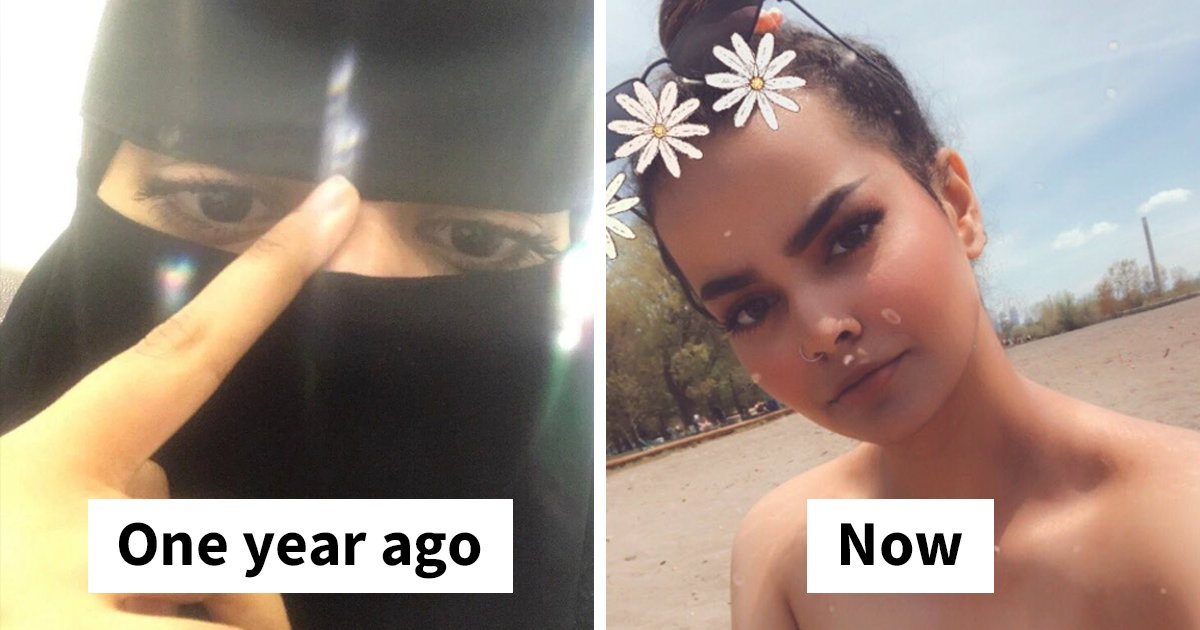
A single before-and-after photo can sometimes say what a thousand think pieces try to explain with charts, footnotes, and a suspicious amount of caffeine. That is why the story behind the headline “Saudi Girl Compares Pics With And Without A Niqab To Celebrate Being Free” traveled so quickly across the internet. It was not simply about clothing. It was about control, identity, family pressure, public judgment, religious expectations, online courage, and the complicated meaning of freedom when a young woman finally gets to decide how she appears in the world.
The story is widely associated with Rahaf Mohammed, the young Saudi woman who fled her family in 2019 and drew international attention after barricading herself in a Bangkok airport hotel room while asking for protection. Her case became a global human rights story because she used social media in real time to explain that she feared being returned. Eventually, she was granted protection and resettled in Canada. Later, when she shared images comparing herself in a niqab with a newer image of herself living freely, the internet did what the internet does best: it reacted, debated, applauded, criticized, overanalyzed, and somehow made the comment section look like a family dinner where everyone brought opinions instead of dessert.
Why the Niqab Photo Comparison Became So Powerful
The power of the image comparison came from contrast. In one picture, Rahaf appeared covered in a niqab, a face veil that leaves only the eyes visible. In the other, she appeared in clothing of her own choosing, presenting herself as a woman living outside the restrictions she said had shaped her life. The point was not that one piece of clothing is automatically oppression and another is automatically liberation. That would be too easy, and real life has a habit of refusing to fit into tiny internet boxes.
The deeper point was choice. For many Muslim women around the world, modest dress, hijab, abaya, or niqab can be a personal expression of faith, dignity, privacy, and identity. For others, especially those who say they were forced into specific clothing by family, law, community pressure, or fear, the same garment can represent control. That difference matters. A scarf chosen freely and a veil enforced by threat may look similar from a distance, but the lived experience behind them is worlds apart.
In Rahaf’s case, the comparison was framed as a celebration of personal freedom. It was a visual way of saying, “This is who I was expected to be, and this is who I now choose to be.” That message hit hard because clothing is one of the most visible ways societies negotiate women’s autonomy. A woman’s outfit can become a battleground long before anyone asks what she thinks, wants, fears, or dreams. Apparently, fabric can start arguments faster than politics at Thanksgiving.
The Real Story Behind Rahaf Mohammed’s Escape
Rahaf Mohammed’s story became international news in January 2019. She was 18 when she left her family during a trip and attempted to travel onward, hoping to seek asylum. After arriving in Thailand, she said she feared being forcibly returned. Reports at the time described how she barricaded herself in a hotel room at Bangkok’s airport and used Twitter to reach activists, journalists, diplomats, and the wider public.
Her social media posts sparked the hashtag #SaveRahaf, which helped transform a private crisis into a global human rights case. Supporters argued that she should have access to refugee protection and should not be returned to a situation where she believed she faced danger. Human rights organizations and media outlets closely followed the case, and the United Nations refugee agency became involved. Within days, Canada accepted her for resettlement.
The speed of her case was unusual. Many asylum seekers spend years navigating complex systems, uncertain interviews, legal barriers, and long waits. Rahaf’s visibility helped protect her, but it also exposed her to harassment. Once her story became public, she was not only escaping family control; she was also stepping into the bright, chaotic stadium lights of global attention. Freedom arrived, yes, but it arrived carrying a suitcase full of pressure.
Understanding the Niqab, Hijab, and Abaya Without Turning the Topic Into a Costume Guide
To understand why this story resonated, it helps to clarify a few terms. The hijab usually refers to a headscarf covering the hair and neck. The niqab covers the face, leaving the eyes visible. The abaya is a loose robe traditionally worn by many women in Saudi Arabia and across the Gulf. These garments are not identical, and they do not carry the same meaning for every person who wears them.
In Saudi Arabia, women’s dress has long been shaped by a mix of religious interpretation, social expectation, family enforcement, and state-backed morality rules. In recent years, official messaging has shifted. Saudi leaders have indicated that the black abaya is not necessarily required as long as clothing is “decent” and respectful. Yet legal reforms and daily reality do not always move at the same speed. In conservative families and communities, expectations can remain strict even when public policy appears more flexible.
That is why Rahaf’s photo comparison was not just about whether Saudi rules had changed on paper. It was about what happens inside homes, families, communities, and personal lives. Laws matter. Culture matters. Family power matters. And when all three point in the same direction, a young woman may feel that her wardrobe is not a wardrobe at all, but a lock.
Saudi Women’s Rights: Progress, Limits, and the Fine Print Nobody Should Ignore
Saudi Arabia has introduced major social changes over the past decade. Women gained the right to drive in 2018, a reform that drew worldwide attention. In 2019, changes allowed many women over 21 to apply for passports and travel without male guardian permission. Women have also entered more areas of public life, education, work, tourism, sports, and entertainment.
Those changes are real, and dismissing them entirely would be inaccurate. For many Saudi women, reforms have opened doors that were once bolted shut. A woman driving herself to work is not a small symbol in a country where that act was once illegal. A woman holding her own passport is not just paperwork; it is mobility, planning, opportunity, and the ability to leave without asking permission from a male relative.
But the story is not a neat “then bad, now perfect” transformation. Human rights groups continue to argue that Saudi Arabia’s male guardianship system has not been fully dismantled. Issues related to marriage, divorce, child custody, shelters, prisons, and family authority still raise serious concerns. Women’s rights activists have also faced arrest, travel bans, and intimidation. In other words, the headline version says “reforms,” while the footnote version says, “Please keep reading before celebrating too loudly.”
Why Social Media Changed Everything
Rahaf’s case showed how social media can become a lifeline. Before platforms like Twitter, a young woman stopped in an airport could have vanished into bureaucracy. Her story might have been reduced to a private family matter, a local immigration issue, or a quiet deportation. Instead, she posted, people shared, journalists followed, activists amplified, and authorities faced global scrutiny.
That does not mean social media is magic. It can be cruel, invasive, and wildly misinformed. It can turn real people into symbols before breakfast and villains by lunch. But in Rahaf’s case, visibility helped create protection. The world was watching, and that mattered.
Her later photo comparison worked the same way. It was personal, but it was also public. By sharing the images, she controlled the narrative of her transformation. She was not waiting for a journalist, government official, critic, or relative to define her. She used her own image to say that freedom, for her, meant self-direction.
The Backlash: Why Women’s Freedom Still Makes People Weirdly Nervous
The online reaction to Rahaf’s photos was divided. Many people celebrated her courage and saw the images as a powerful statement about escaping coercion. Others attacked her, accused her of betraying her culture or religion, or tried to shame her for how she dressed. The backlash revealed something uncomfortable: some people do not merely disagree with women’s choices; they believe women should not have choices to begin with.
This is where the conversation must be careful. Criticizing forced dress is not the same as mocking women who choose modest dress. Defending a woman’s right to remove a niqab must also mean defending another woman’s right to wear one voluntarily. The principle is not “less fabric equals more freedom.” The principle is consent. Freedom is not a dress code with better lighting.
A woman should not be forced to cover. She should not be forced to uncover. She should not have to perform liberation for strangers, and she should not have to prove modesty to relatives, governments, or random accounts with profile pictures of sports cars. The real measure of freedom is whether she can choose without fear.
Why This Story Still Matters Today
Years after Rahaf’s escape, the discussion around Saudi women’s rights continues. The kingdom has changed in visible ways. More women are working, driving, attending public events, and participating in social life. At the same time, activists and rights groups continue to warn that reforms are incomplete and that women who challenge authority can face consequences.
The reason Rahaf’s photo comparison still matters is that it reduces a complicated political and cultural debate to something instantly human. You do not need a law degree to understand the emotional weight of a young woman saying, “I was controlled, and now I am free.” Whether someone agrees with every choice she made is not the point. The point is that she survived a situation she described as dangerous and claimed the right to define her own life.
Her story also challenges outsiders to avoid lazy stereotypes. Saudi women are not a single group with one opinion. Muslim women are not a monolith. Some women love the abaya. Some reject it. Some wear hijab proudly. Some remove it quietly. Some are negotiating with family. Some are navigating faith. Some are trying to be safe. The internet often wants one dramatic answer, but women’s lives are not clickbait containers.
Freedom, Clothing, and the Right to Be Complicated
The most important lesson from this story is that freedom is not always glamorous. Sometimes it looks like a passport. Sometimes it looks like a locked hotel-room door. Sometimes it looks like a tweet typed in panic. Sometimes it looks like choosing an outfit without asking permission. And sometimes it looks like dealing with strangers who suddenly think your life choices are a public group project.
Rahaf’s before-and-after images became viral because they turned personal autonomy into something visual. But the real transformation was not just outside. It was the shift from being spoken for to speaking. From being managed to choosing. From being hidden by expectation to being visible on her own terms.
That is why the story continues to attract readers. It sits at the intersection of women’s rights, religious freedom, family control, migration, online activism, and identity. It asks a question that is bigger than one woman and one photo: Who gets to decide what freedom looks like?
Experiences and Reflections Related to the Topic
Stories like Rahaf’s often feel distant to readers who have never lived under strict family or social control. But the emotional experience is more familiar than it first appears. Many people know what it feels like to perform a version of themselves for others. A teenager may dress one way at home and another way with friends. A college student may hide a career dream from parents. A young adult may keep a relationship, belief, hairstyle, or opinion private because honesty feels too expensive.
Now imagine that pressure multiplied by law, tradition, family authority, and fear of punishment. For women who feel forced to wear certain clothing, the issue is not fabric alone. It is the daily reminder that their body is treated as a public matter. Leaving the house becomes negotiation. A mirror becomes inspection. A photo becomes evidence. A simple outfit choice becomes a vote on obedience.
People who leave restrictive environments often describe freedom as exciting and terrifying at the same time. The first days can feel unreal. Choosing what to wear, where to go, whom to meet, what to post, or even how to walk outside can feel like using muscles that were never allowed to develop. Freedom is wonderful, but it can also be awkward. Nobody hands you a manual titled “Congratulations, You Are Now In Charge of Your Own Life.” If such a manual exists, it is probably buried under laundry and unpaid bills.
There is also grief. People may celebrate escape while mourning family ties, language, food, memories, and the version of home they wished they had. Outsiders sometimes imagine freedom as a clean break, but real freedom can be messy. A woman may be relieved to be safe and still miss parts of her old life. She may reject control but still value her culture. She may criticize coercion while respecting faith. Human beings are allowed to be complicated, despite the internet’s ongoing campaign against nuance.
Another common experience is learning privacy again. When someone’s survival story becomes public, people feel entitled to updates, judgments, and explanations. Rahaf’s viral visibility helped her, but it also meant that strangers watched her transformation closely. That creates a new kind of pressure: the pressure to symbolize freedom perfectly. But no one should have to be a flawless ambassador for liberation. Real people grow, make mistakes, change opinions, and occasionally post things they may later rethink. That is not failure; that is being alive.
For readers, the best response is not to turn Rahaf into a poster, a scandal, or a debate trophy. The better response is to ask what systems make escape necessary in the first place. Are women safe when they say no? Can they travel freely? Can they study, work, marry, divorce, worship, doubt, dress, and speak without coercion? Can they choose modesty without being stereotyped and choose visibility without being shamed?
The image of a Saudi woman comparing life with and without a niqab remains powerful because it invites a larger conversation about dignity. Not the shallow kind of dignity that demands silence and perfect appearances, but the real kind: the right to own your name, your story, your movement, your beliefs, your clothing, and your future. That kind of freedom is not a trend. It is not a viral moment. It is the quiet, daily work of becoming yourself.
Conclusion
The story behind “Saudi Girl Compares Pics With And Without A Niqab To Celebrate Being Free” is more than a viral before-and-after image. It is a reminder that freedom is not measured by what a woman wears, but by whether she gets to choose it. Rahaf Mohammed’s journey from fear and public appeal to resettlement and self-expression became a global symbol because it combined personal courage with the power of digital visibility.
Her photos sparked debate because they touched a nerve that societies everywhere still struggle with: women’s autonomy. Some saw rebellion. Some saw courage. Some saw controversy. But at the center was a young woman claiming the right to define her own life. That is the part worth remembering after the trending hashtags fade.














