
Some movies hand us heroes we want to hug. Others hand us people we would avoid at a dinner party, a group chat, and possibly a court deposition. Yet that is exactly what makes them fascinating. Films centered on insufferable characters can be funny, exhausting, brilliant, uncomfortable, or all four before the popcorn cools.
The best movies about unlikable protagonists do more than parade bad behavior. They ask why arrogance, selfishness, obsession, vanity, greed, or moral laziness can be so watchable. Sometimes the character is supposed to be awful. Sometimes the movie thinks the character is charming, and viewers strongly disagree. Either way, these films prove that a person does not have to be likable to be unforgettable.
Why Insufferable Characters Make Great Movies
An insufferable character is not simply a villain. Villains often know they are doing evil. Insufferable characters are usually worse at self-awareness than a cat walking across a laptop during a Zoom call. They justify everything, blame everyone, and treat basic empathy like an optional software update.
That tension creates drama. We watch to see whether they will change, collapse, win, or finally hear the words every audience member has been whispering for ninety minutes: “Please stop talking.” Below are 22 movies that built their stories around characters who are difficult, abrasive, selfish, delusional, or spectacularly exhausting.
22 Movies That Focused On Insufferable Characters
1. Uncut Gems
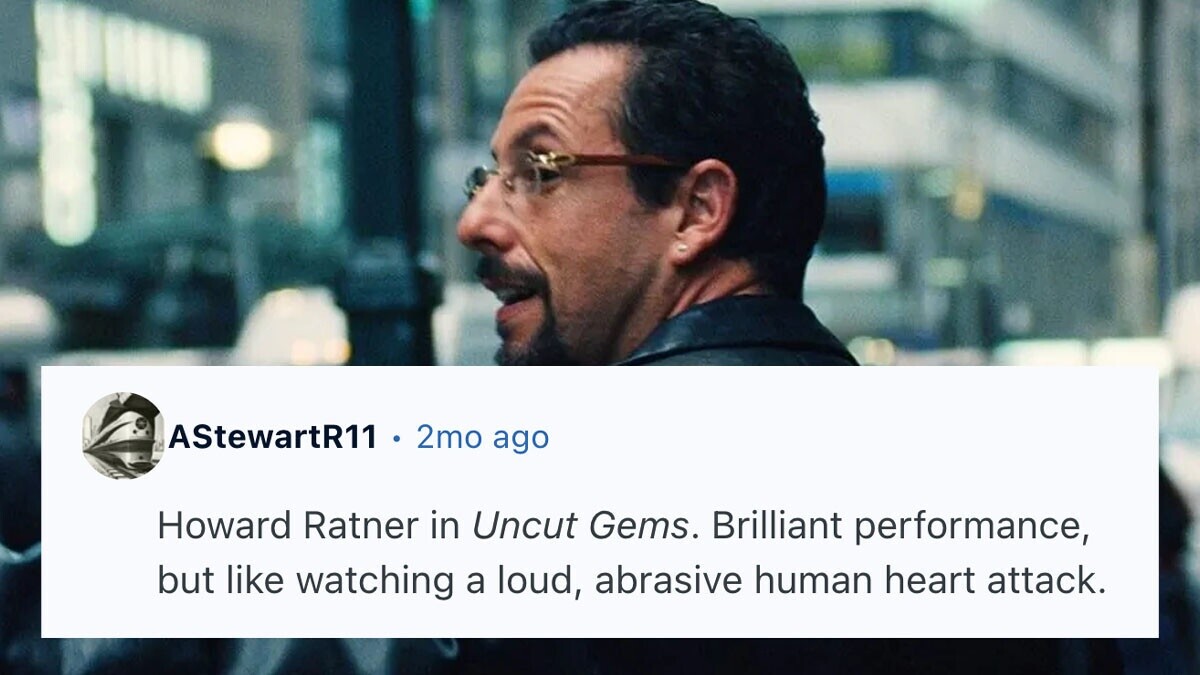
Howard Ratner, played by Adam Sandler, is a walking panic attack in designer glasses. In Uncut Gems, he gambles, lies, negotiates, cheats, and sprints through New York like a man allergic to consequences. Howard is not evil in a grand cinematic sense; he is simply addicted to the next big score. That makes him unbearable and strangely magnetic. Watching him is like watching someone juggle knives during a tax audit.
2. Into the Wild
Into the Wild presents Christopher McCandless as an idealist chasing freedom, but many viewers find his choices frustrating. His rejection of comfort, family, and caution can feel brave one moment and painfully self-absorbed the next. The film works because it refuses to reduce him to a saint or a fool. He is curious, intense, romantic, stubborn, and tragically underprepared for the wilderness he imagines as salvation.
3. The War of the Roses
In The War of the Roses, Oliver and Barbara Rose turn divorce into an Olympic sport for emotional destruction. Michael Douglas and Kathleen Turner play a couple whose resentment mutates into full-contact domestic warfare. Their privilege makes the chaos even sharper. They have the house, the money, the status, and still manage to create a private apocalypse because neither one can surrender the final word.
4. Whiplash
Whiplash gives us two difficult characters locked in a brutal dance: Andrew Neiman, the ambitious drummer, and Terence Fletcher, the abusive instructor. Fletcher is the obvious monster, but Andrew’s obsession is not exactly cuddly either. The movie is riveting because it treats greatness as a dangerous drug. Everyone wants the performance to be perfect; nobody wants to live next to the people who demand it.
5. Trainwreck
Amy Schumer’s character in Trainwreck is messy by design. Amy drinks too much, sabotages intimacy, avoids responsibility, and behaves as if emotional maturity is a scam invented by couples who own matching mugs. The comedy works when it lets her be genuinely flawed rather than adorably quirky. She is not insufferable because she parties; she is insufferable because she keeps mistaking avoidance for independence.
6. District 9
Wikus van de Merwe begins District 9 as a smug bureaucrat with a clipboard and a deeply irritating confidence in systems he barely understands. He is not the heroic outsider at first; he is part of the machine. His transformation forces him to experience the cruelty he once helped administer. That arc makes him more interesting than a standard hero, even if his early scenes make viewers want to confiscate his office badge.
7. The Predator
The Predator is packed with loud personalities, chaotic choices, and characters who often feel more like punchlines than people. The film’s insufferable streak comes from its constant need to be snarky, tough, and self-aware at the same time. Instead of letting tension breathe, the characters frequently undercut danger with banter. The result is a movie where the alien hunters are sometimes less exhausting than the humans.
8. Gone With the Wind
Scarlett O’Hara is one of cinema’s most famous difficult protagonists. In Gone With the Wind, she is charming, manipulative, resilient, vain, strategic, and emotionally volcanic. Her survival instinct is remarkable, but her selfishness can be breathtaking. Scarlett fascinates because she refuses to be passive, yet the same force that keeps her alive also makes her nearly impossible to love peacefully.
9. The Mosquito Coast
Harrison Ford’s Allie Fox in The Mosquito Coast is the type of man who calls himself a visionary when everyone else hears “family emergency.” He drags his wife and children into his grand experiment, convinced that his intelligence gives him moral authority over everyone nearby. His arrogance transforms idealism into tyranny. The film is a study in how a dream can become a trap when led by a man who cannot admit he is wrong.
10. Something Borrowed
Something Borrowed turns romantic indecision into a group project nobody requested. Rachel, Darcy, and Dex are tangled in friendship, betrayal, and suppressed feelings, but the emotional math often comes out messy. The insufferable part is not simply that people make mistakes; romantic comedies need mistakes. It is that the characters keep stepping on each other’s hearts while asking the audience to call it destiny.
11. Frenzy
Alfred Hitchcock’s Frenzy is not built around lovable company. Its characters exist in a grim world of suspicion, violence, and moral decay. The discomfort comes from spending time with people who are abrasive, desperate, or predatory. The film’s nasty edge is intentional. Hitchcock uses unpleasant personalities and suffocating tension to create a thriller where charm is in short supply and danger feels uncomfortably close.
12. High Fidelity
Rob Gordon in High Fidelity is the patron saint of men who confuse having opinions with having emotional depth. He knows music, makes lists, judges everyone’s taste, and revisits past relationships with the self-awareness of a scratched CD. The film is funny because Rob is recognizable. He is not a cartoon villain; he is a charming, insecure, self-centered guy who needs to learn that heartbreak is not a personality credential.
13. Valerian and the City of a Thousand Planets
Valerian and the City of a Thousand Planets offers dazzling visuals, inventive worlds, and a lead character whose swagger can feel several sizes too large. Major Valerian is written as roguish and irresistible, but his confidence often lands closer to smug. The movie’s universe is colorful and strange enough to invite wonder, yet its central romance depends on a hero who can test the audience’s patience with every flirtatious smirk.
14. Glengarry Glen Ross
Glengarry Glen Ross is basically an aquarium full of sharks who have learned real estate terminology. The salesmen lie, threaten, flatter, and panic their way through a brutal workplace built on humiliation. Nobody is easy to admire, and that is the point. The film turns desperation into poetry, showing men whose pride has curdled into cruelty. It is miserable, electric, and darkly funny in the way only professional despair can be.
15. Dear Evan Hansen
Evan Hansen is designed as a lonely, anxious teenager, but the story places him in a moral situation that many viewers find nearly impossible to forgive. In Dear Evan Hansen, his lies pull a grieving family deeper into fantasy. The problem is not that Evan is imperfect; imperfection is human. The problem is that his need for belonging causes serious harm, making sympathy and frustration wrestle through the entire movie.
16. Ferris Bueller’s Day Off
Ferris Bueller is charming, inventive, and beloved by nearly everyone in his fictional universe. He is also, depending on your tolerance level, a glorious menace. In Ferris Bueller’s Day Off, he manipulates friends, deceives adults, and treats consequences like background extras. The movie’s energy is infectious, but part of its lasting debate comes from one question: is Ferris a free spirit, or just a very charismatic headache?
17. Natural Born Killers
Mickey and Mallory Knox in Natural Born Killers are intentionally grotesque creations: violent, media-saturated, romanticized, and horrifying. Oliver Stone’s film does not ask viewers to like them. Instead, it attacks the culture that turns killers into celebrities. The characters are insufferable in the most extreme sense because their self-mythology feeds on chaos. They are not just bad people; they are bad people with a fan base.
18. The Shining
Jack Torrance enters The Shining already carrying resentment, ego, and instability. The Overlook Hotel may intensify his madness, but Jack is hardly a warm family man before the ghosts start networking. His bitterness toward Wendy and Danny makes the horror feel domestic before it becomes supernatural. Jack is terrifying because his insufferable traitsentitlement, anger, wounded prideare recognizable long before the axe arrives.
19. Falling Down
Falling Down follows William Foster, a man whose public breakdown has often been misread as heroic rebellion. The film is more disturbing than that. Foster is angry, entitled, and convinced the world owes him cooperation. His frustrations may begin in ordinary annoyances, but his response becomes dangerous and cruel. He is insufferable because he treats personal disappointment as permission to terrorize everyone around him.
20. The Devil Wears Prada
Miranda Priestly is icy, impossible, and iconic. The Devil Wears Prada understands that she is both a workplace nightmare and a master of her world. Andy Sachs can also be frustrating as she judges the fashion industry while benefiting from it, then discovers that ambition has a cover charge. The movie works because its characters are not neatly good or bad. They are stylish, stressed, compromised, and armed with excellent coats.
21. Sideways
Sideways gives us Miles and Jack, two men on a wine-country trip that becomes a masterclass in midlife self-sabotage. Miles is snobbish, depressed, and allergic to joy unless it has tasting notes. Jack is selfish, reckless, and determined to turn his upcoming wedding into a technicality. They are funny because they are pathetic in specific ways. The movie finds humanity in them without pretending they are easy company.
22. Anora
Anora thrives on characters who are impulsive, privileged, desperate, loud, and often spectacularly unreasonable. Its world is full of people chasing money, status, escape, or control, and very few pause long enough to behave gracefully. What makes the film compelling is its refusal to flatten its central character into a stereotype. Anora can be sharp, messy, funny, vulnerable, and furiousa complicated person surrounded by even more complicated chaos.
What These Movies Teach Us About Unlikable Protagonists
The common thread across these films is not that every character is “bad.” It is that each movie asks the audience to spend meaningful time with people who make social harmony impossible. Some are narcissists. Some are dreamers who hurt others. Some are professionals trapped in systems that reward cruelty. Some are simply funny disasters wearing human clothes.
Movies about insufferable characters work best when the film knows the character is difficult. Glengarry Glen Ross never asks us to admire its salesmen as moral heroes. Uncut Gems does not pretend Howard Ratner is making wise choices. Whiplash knows that obsession and abuse can produce thrilling art without becoming healthy life advice. That awareness matters.
Problems arise when a movie seems convinced a character is charming while the audience is checking the exits. A smug lead, a selfish romantic hero, or a manipulative friend can derail a story if the script does not understand how that behavior lands. The difference between “complex” and “please remove this person from the room” is often tone.
Viewer Experience: Why We Keep Watching People We Cannot Stand
There is a strange pleasure in watching insufferable characters from the safety of a couch. In real life, we avoid people like Howard Ratner, Miranda Priestly, Jack Torrance, or Rob Gordon whenever possible. We mute them, block them, change seats, invent appointments, or suddenly become very interested in the snack table. In movies, though, we lean closer. The screen gives us distance. We can study the chaos without becoming collateral damage.
Part of the appeal is recognition. Most viewers have met a High Fidelity-style know-it-all who treats taste like a moral ranking system. Many have worked for someone with a tiny drop of Miranda Priestly’s frostbite energy. Plenty have known a Ferris Bueller type: dazzling, fun, and absolutely exhausting to clean up after. These characters exaggerate familiar behavior until it becomes entertainment.
Another reason we watch is that unlikable characters create momentum. Nice people often communicate, apologize, and make sensible decisions. That is wonderful for real life and terrible for drama. Insufferable characters lie when honesty would help. They double down when they should retreat. They chase the one thing guaranteed to ruin them. Their flaws are engines. Without Howard’s gambling, Uncut Gems stops moving. Without Scarlett O’Hara’s stubbornness, Gone With the Wind loses its central fire. Without Fletcher’s cruelty, Whiplash becomes a very intense music lesson with better boundaries.
There is also the uncomfortable thrill of judgment. Watching these movies lets us feel morally organized for a moment. We can say, “I would never do that,” while conveniently ignoring the smaller versions of those flaws in ourselves. Maybe we are not ruining lives in a real estate office, but we have been petty. Maybe we are not dragging a family into the jungle, but we have confused our plans with everyone else’s needs. Insufferable characters are mirrors, but the glass is warped just enough to make the reflection entertaining.
The best experiences come when a film balances irritation with insight. A character who is only annoying becomes a chore. A character who is annoying for a reason becomes a story. Sideways understands loneliness underneath snobbery. Young Adult, though not on this list, works similarly by exposing pain beneath cruelty. The Shining turns resentment into horror. Anora uses abrasive energy to reveal class, power, and vulnerability. These movies remind us that “likable” is not the same as “worth watching.”
That may be the real lesson. Cinema does not exist only to introduce us to role models. Sometimes it introduces us to cautionary tales, emotional car crashes, charming frauds, brilliant monsters, and people who should never be allowed near a group vacation itinerary. We watch them because they make stories messy. We remember them because they make comfort impossible. And occasionally, against our better judgment, we even miss them when the credits roll.
Conclusion
Movies focused on insufferable characters can be risky, but when they work, they become unforgettable. They test our patience, challenge our sympathy, and force us to think about ambition, ego, cruelty, insecurity, and self-deception. From Uncut Gems to Glengarry Glen Ross, from The Devil Wears Prada to Anora, these films prove that a character does not need to be pleasant to carry a story. Sometimes the most irritating person in the room is also the reason we cannot look away.
Note: This article is an original synthesis based on real films, widely discussed character interpretations, and established movie details. It is written for web publication in standard American English.














