
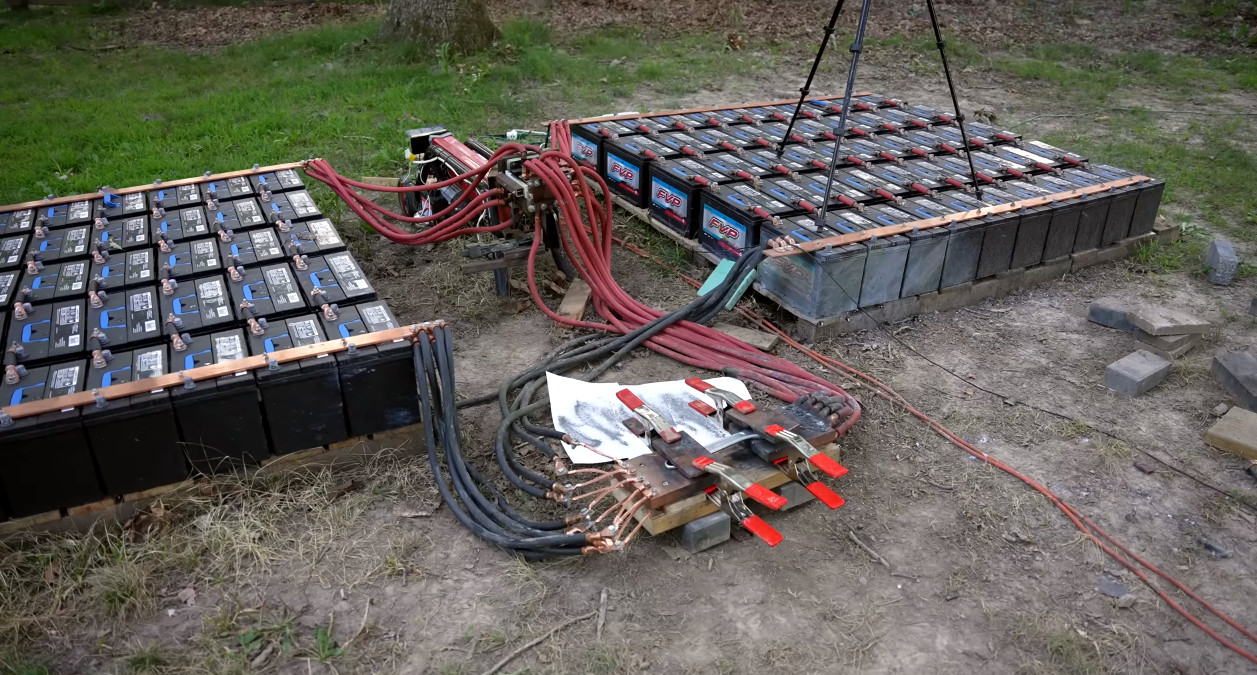
Some experiments sound like they were invented by a bored engineer, a daredevil YouTuber, and a fire marshal all trapped in the same garage during a thunderstorm. “Wiring up 100 car batteries” is one of those ideas. It has the strange magnetism of a science fair project that accidentally wandered into industrial power territory wearing safety glasses and a nervous smile.
At first glance, a car battery seems familiar. It sits quietly under the hood, starts the engine, powers the radio, and occasionally ruins your morning by clicking sadly when you are already late. But one battery is not the same as one hundred batteries. Stack enough stored energy together and you leave the world of weekend tinkering and enter a place where current, heat, hydrogen gas, acid, metal, and human overconfidence start forming a very enthusiastic committee.
This article is not a tutorial for building a monster battery bank. Instead, it is a guided tour of what makes the idea fascinating, what makes it dangerous, and what we can learn from the physics without turning your driveway into a low-budget lightning lab.
What Happens When You Combine Lots of Car Batteries?
A typical car battery is a lead-acid battery designed to deliver a large burst of current for a short time. Its main job is starting an engine, not powering a neighborhood, melting tools, or acting as the villain in an electrical safety training video.
When batteries are connected together, the arrangement matters. In a broad electrical sense, batteries in series increase voltage, while batteries in parallel increase available capacity and current potential while maintaining roughly the same nominal voltage. That sounds tidy on paper. In real life, batteries are not identical little soldiers standing in perfect formation. They age differently, charge differently, warm up differently, and develop different internal resistance over time.
With a small, professionally designed battery pack, engineers manage these differences using matching, monitoring, protection circuits, spacing, ventilation, fusing, enclosures, testing, and maintenance rules. With 100 random car batteries, those tiny differences can become a full-blown group project where the weakest battery somehow gets assigned the most dramatic role.
Why 100 Batteries Is Not Just “One Battery, But More”
Scaling up electrical storage is not like adding more chairs to a dining table. Add more batteries and the complexity does not grow politely; it grows like a vine that discovered energy drinks.
More batteries mean more connection points, more chances for loose terminals, more heat paths, more stored energy, more gas release during charging, more weight, more acid, and more ways for a small mistake to become a large problem. A single poor connection can heat up. A damaged battery can behave unpredictably. A tool dropped across terminals can become much more exciting than the tool manufacturer intended.
Even before anyone talks about sparks or dramatic arcs, there is the boring danger: logistics. One car battery is heavy. One hundred car batteries are not a “project.” They are a forklift’s opinion. Moving them, storing them, spacing them, and protecting them from accidental contact requires industrial thinking, not just enthusiasm and a free Saturday.
The Big Concept: Current Is the Scary Part
Voltage gets most of the attention because it sounds dramatic. Current, however, is the muscle. Car batteries are designed to supply high current quickly. That is exactly why they are useful for starting engines. It is also why a large battery bank can turn metal hot, damage equipment, start fires, and create arcs that behave less like a spark and more like a tiny angry sun.
When people watch extreme battery demonstrations online, they often focus on the visible show: glowing metal, loud pops, vaporized bits, and showers of sparks. The real lesson is not “cool, electricity is spicy.” The lesson is that stored energy does not care whether the situation was planned, improvised, or filmed vertically for social media.
High-current systems demand short-circuit protection, careful design, proper isolation, and emergency planning. Without those, the system is not “powerful.” It is simply waiting for a mistake with excellent timing.
Lead-Acid Batteries Bring Chemical Hazards Too
Car batteries are often lead-acid batteries, which means the hazard is not only electrical. The electrolyte can contain sulfuric acid, a corrosive substance that can damage skin, eyes, clothing, tools, flooring, and the general mood of everyone nearby.
Battery acid is one of those things that sounds old-fashioned until it touches something it should not. Then it becomes extremely modern and urgent. Proper workplaces that handle lead-acid batteries use protective equipment, emergency washing facilities, acid-resistant surfaces, spill-control materials, and clear procedures. That is not overkill. That is experience wearing a hard hat.
There is also the issue of lead. Lead-acid batteries are widely recycled in the United States, and that is good news. But “recyclable” does not mean “casual.” Damaged, leaking, or discarded batteries need responsible handling through retailers, automotive shops, recycling centers, or hazardous waste programs, not a corner of the garage where they can slowly become a chemical mystery.
Hydrogen Gas: The Invisible Guest Nobody Invited
Charging lead-acid batteries can release hydrogen gas. Hydrogen is light and disperses quickly when ventilation is good, but it can also ignite easily under the wrong conditions. This is why professional battery charging areas pay attention to ventilation, ignition sources, fire protection, and emergency planning.
The tricky part is that hydrogen does not arrive with a marching band. You may not see it. You may not smell it. It may simply collect where airflow is poor and wait for a spark, flame, or electrical event to make the situation memorable for all the wrong reasons.
With one battery, good practice matters. With many batteries, it matters more. With 100 batteries, “open a window and hope” is not a safety strategy. It is a wish wearing a baseball cap.
Series, Parallel, and the Myth of Simple Scaling
Battery arrangements are often described with two simple words: series and parallel. The basic concepts are easy enough to understand, but large battery systems are not simple because real batteries are imperfect.
Why Matching Matters
Battery age, capacity, internal resistance, state of charge, and temperature can all affect how current moves through a system. If batteries are not well matched, some may work harder than others. That can lead to faster wear, heat buildup, poor performance, and failure.
This is one reason professional battery systems are engineered as systems, not assembled like a pile of electronic leftovers. The batteries, conductors, protective devices, chargers, monitoring systems, and enclosure are designed together. A battery bank is not just a collection of batteries. It is an ecosystem with consequences.
Why Protection Is Not Optional
Protection devices exist because electricity is extremely good at finding shortcuts. In small devices, protection may seem invisible. In large systems, protection becomes central to the design. Overcurrent protection, isolation, safe switching, monitoring, ventilation, and emergency shutoff planning are all part of responsible energy storage.
The more energy stored in one place, the less forgiving the system becomes. A small spark may be annoying. A high-current fault can be destructive. The difference is not personality; it is physics.
Why Online Experiments Look Easier Than They Are
Extreme electrical videos can make dangerous setups look oddly casual. A camera cuts from the pile of batteries to the dramatic result, and the viewer sees the action but not the risk assessment, safety perimeter, protective planning, prior failures, or people standing just out of frame thinking, “Please do not let today be paperwork day.”
Creators with deep experience may understand hazards that a viewer does not notice. They may have remote controls, barriers, fire equipment, protective gear, test instruments, and a plan for what happens if something goes wrong. Or they may not, which is its own separate horror movie.
The important takeaway for readers is simple: entertainment is not engineering documentation. A video can show that something happened. It does not prove that it was safe, repeatable, legal, efficient, or wise.
What 100 Car Batteries Teach Us About Energy Storage
Large battery banks are not automatically ridiculous. Hospitals, data centers, telecom facilities, forklifts, solar systems, and backup power installations all use battery storage in serious ways. The difference is design discipline.
Professional systems ask practical questions: What is the load? How much energy is needed? How will the batteries be charged? What happens during a fault? How is heat managed? How is gas handled? Who maintains the system? What standards apply? How are failed units removed? How is the end-of-life material recycled?
A pile of 100 car batteries asks a different question: “What happens if we gather enough stored current in one place to make the room nervous?” It is a compelling question, but not the same as a useful power system.
The Environmental Side: Lead-Acid Batteries Are Recyclable, Not Disposable
One surprising bright spot in this topic is recycling. Lead-acid batteries have one of the strongest recycling networks of any consumer product in the United States. Lead, plastic, and acid can be recovered and reused through established systems. Many retailers charge a core fee to encourage customers to bring old batteries back instead of tossing them into the waste stream.
This matters because lead is toxic and improper disposal can harm people and the environment. A used battery should not be treated like ordinary trash. It belongs in a proper recycling path, usually through an auto parts retailer, dealership, service center, or local household hazardous waste program.
So, while the image of 100 old batteries may look like the beginning of a mad-science spectacle, the responsible ending is much less dramatic: collection, recycling, documentation, and nobody getting acid on their shoes.
Common Misconceptions About Big Battery Banks
Misconception 1: “It’s Only 12 Volts, So It’s Safe”
A single car battery has a relatively low nominal voltage, but low voltage does not mean low hazard. The available current can still be enormous. A short circuit can create heat, sparks, burns, fire, and flying debris. The danger is not just shock; it is stored energy moving through the wrong path.
Misconception 2: “More Batteries Means More Reliable”
Not necessarily. More batteries can mean more weak points. Without proper matching, monitoring, and protection, adding batteries can increase failure opportunities rather than reliability.
Misconception 3: “If It Worked Once, It’s Fine”
Electrical systems can survive a bad idea once and fail the next time. Heat, internal damage, loose connections, and chemical stress may build quietly. “It did not explode” is not a certification standard, although it is admittedly a sentence many hobbyists have whispered with relief.
What a Responsible Reader Should Take Away
The headline “Wiring Up 100 Car Batteries So You Don’t Have To” works because most people instinctively understand that they do not want to be the person standing next to the grand experiment when the universe asks for a demonstration. The topic is fun because it is extreme. It is educational because it reveals how much engineering hides behind everyday power.
Your car battery is not boring. It is a compact chemical energy storage device that can deliver high current, produce gas during charging, contain corrosive electrolyte, and still be recyclable through one of the most successful material recovery systems in the country. That is a lot of personality for a plastic box under the hood.
Multiply that by 100 and the lesson becomes clear: energy storage deserves respect. Not fear, not panic, and definitely not backyard improvisation with a wrench and optimism. Respect.
Experience Notes: What This Topic Feels Like in the Real World
Anyone who has spent time around automotive batteries knows they have a strange ability to look harmless right up until they are not. They sit there silently, squared-off and dusty, as if they are just another heavy object in the garage. Then you try to move one and remember that “portable” is a generous word. Now imagine moving 100 of them. That is no longer a weekend project. That is a small logistics company with lower back pain.
The first real-world lesson is that weight changes your thinking. A single battery can be carried carefully. A large group requires planning: stable storage, clear walkways, spill prevention, and safe handling. You begin to understand why professional battery rooms look boring. Boring is the goal. Boring means nothing is leaking, tipping, heating, arcing, or creating a surprise cloud of regret.
The second lesson is that connections are everything. In small electronics, a loose wire may cause a flicker. In a high-current battery environment, a poor connection can become hot enough to damage insulation or metal. That is why professionals do not treat terminals, conductors, and protective devices as decorative accessories. They are the difference between controlled energy and chaos with a voltage label.
The third lesson is that batteries age like people at a family reunion: not at the same speed, and not always gracefully. Two batteries that look identical on the outside may behave very differently under load. One may be weaker, warmer, more sulfated, more discharged, or closer to failure. In a large group, those differences matter. The system will not politely distribute stress just because the batteries are lined up neatly.
The fourth lesson is that safety equipment looks unnecessary until the exact second it becomes priceless. Eye protection, gloves, ventilation, fire extinguishers, spill materials, and emergency washing access may not make a video more exciting, but they make real work survivable. The most experienced people are often the least casual because they have seen how fast a routine job can become a story told in a much quieter voice.
The fifth lesson is that big power attracts big curiosity. People want to see what happens when metal meets current. They want the spark, the glow, the dramatic demonstration. That curiosity is understandable. It is also why the safest version of this topic is educational, not instructional. You can appreciate the science without recreating the stunt. You can understand the risk without volunteering your garage as tribute.
Finally, there is something oddly poetic about car batteries. They spend most of their lives doing a practical job with no applause. They start engines in freezing parking lots, power accessories, support vehicle electronics, and then, at the end of their service life, many return through a recycling loop to become useful again. That is a better ending than becoming part of a risky experiment. The smartest thing 100 car batteries can do is remind us that stored energy is powerful, chemistry is serious, and good engineering is often the art of preventing exciting things from happening.
Conclusion
Wiring up 100 car batteries is the kind of idea that grabs attention because it combines familiar objects with extreme scale. But the real story is not the spectacle. It is the engineering lesson hiding underneath: large battery banks require careful design, matching, protection, ventilation, chemical safety, and responsible recycling.
Car batteries are useful, recyclable, and impressively powerful for their size. They are also capable of releasing dangerous current, corrosive electrolyte, and flammable gas under the wrong conditions. So yes, the title is right: someone else may have explored the wild edge of this concept so you do not have to. The rest of us can enjoy the lesson from a safe distance, preferably with both eyebrows intact.














