
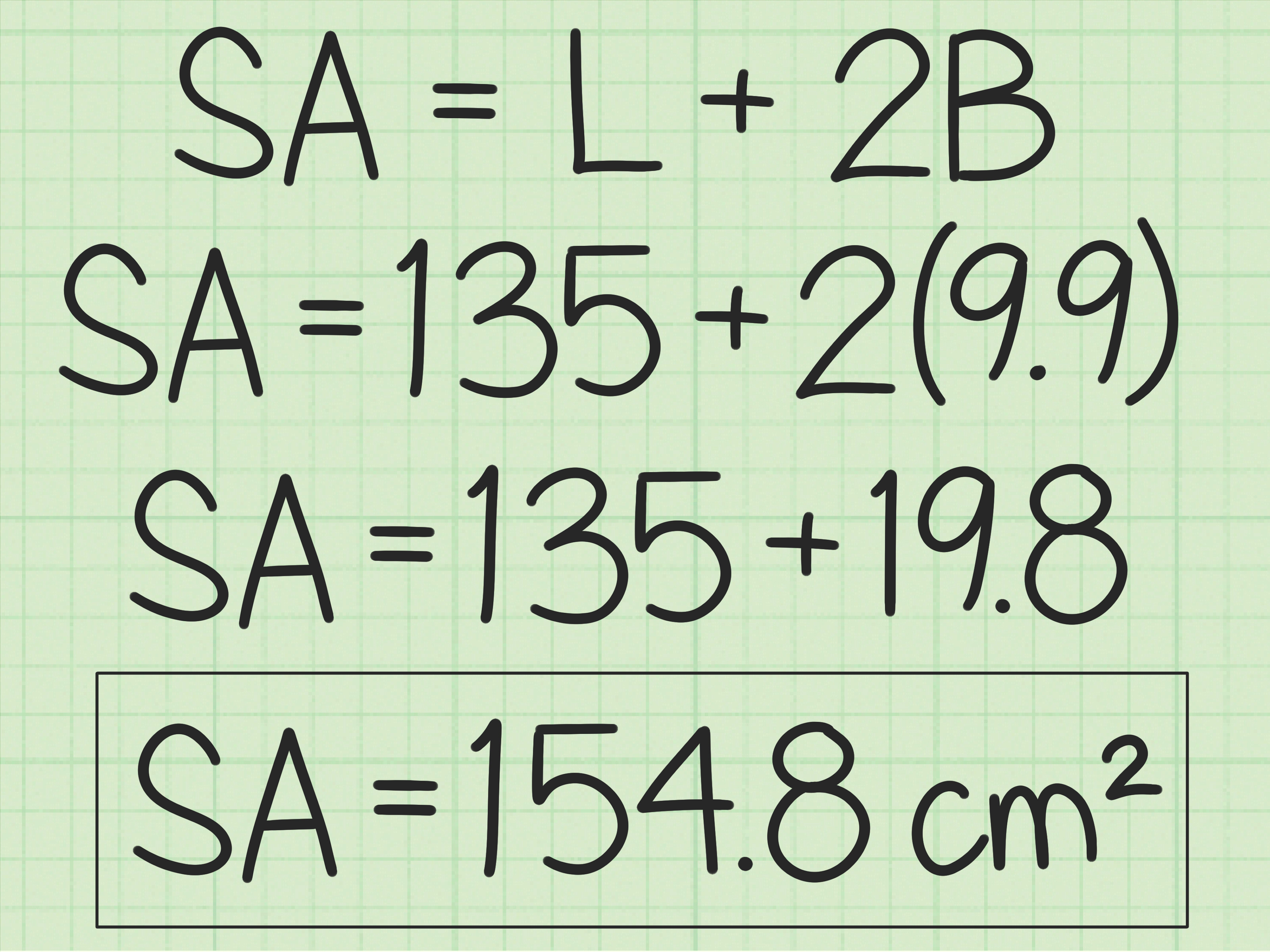
Finding the surface area of a triangular prism sounds like one of those math tasks that arrives wearing a tiny villain cape. There are triangles. There are rectangles. There are letters pretending to be numbers. But once you see what a triangular prism is made of, the whole thing becomes much friendlier.
A triangular prism has two matching triangular bases and three rectangular side faces. Surface area simply means the total area covering the outside of the solid. Imagine wrapping the prism in paper. The amount of paper needed is the surface area. No magic wand required, although a pencil and calculator will definitely help.
The most useful formula is:
Surface Area = 2B + P × L
In this formula, B is the area of one triangular base, P is the perimeter of the triangular base, and L is the length of the prism. Another common version is:
Surface Area = triangle base × triangle height + (side1 + side2 + side3) × prism length
Both formulas say the same thing: add the areas of the two triangles and the three rectangles. Let’s walk through the process in 12 clear steps, with examples, tips, and enough plain-English explanation to keep your brain from packing a suitcase and leaving.
What Is a Triangular Prism?
A triangular prism is a three-dimensional solid with two congruent triangular faces and three rectangular faces. The triangular faces are parallel to each other, while the rectangles connect the matching sides of the triangles.
Common real-life examples include camping tents, Toblerone-style chocolate boxes, certain roof shapes, ramps, wedges, and packaging designs. If it has a triangle on each end and stretches straight through space like a geometry sandwich, it is probably a triangular prism.
The Surface Area Formula for a Triangular Prism
The main formula is:
SA = 2B + P × L
Where:
- SA = total surface area
- B = area of one triangular base
- P = perimeter of the triangular base
- L = length of the prism
To find the triangular base area, use:
B = 1/2 × base × height
Then multiply the perimeter of the triangle by the prism length to find the total area of the three rectangular faces. Finally, add everything together.
How to Find Surface Area of a Triangular Prism in 12 Steps
Step 1: Identify the Two Triangular Bases
Start by finding the two matching triangles. These are called the bases of the prism. They are the “ends” of the shape, not necessarily the bottom part sitting on the table. In geometry, the base is about structure, not furniture placement.
The two triangular bases are always congruent, meaning they have the same size and shape. Since there are two of them, you will eventually double the area of one triangle.
Step 2: Label the Triangle Measurements
Look at one triangular face and identify the measurements you need. Usually, you need the triangle’s base and height to find its area. The triangle height must be perpendicular to the base, meaning it meets the base at a right angle.
Be careful here: the height of the triangle is not always one of the slanted sides. If a problem gives you a dashed line inside the triangle, that line is often the triangle height. Geometry loves hiding the important information in plain sight.
Step 3: Label the Prism Length
The prism length is the distance between the two triangular bases. It may also be called the depth, height of the prism, or length of the solid. This is the measurement used to calculate the three rectangular side faces.
For example, if the triangular ends of a tent are 10 feet apart, then 10 feet is the prism length.
Step 4: Check That All Units Match
Before calculating, make sure all measurements use the same unit. If one side is in centimeters and another is in meters, convert first. Otherwise, your answer may look official but behave like a math raccoon in a trench coat.
Common units include inches, feet, centimeters, and meters. Surface area is always written in square units, such as square inches, square feet, square centimeters, or square meters.
Step 5: Find the Area of One Triangular Base
Use the triangle area formula:
B = 1/2 × base × height
Suppose the triangular base has a base of 6 inches and a height of 4 inches. Then:
B = 1/2 × 6 × 4 = 12 square inches
That means one triangular end has an area of 12 square inches.
Step 6: Double the Triangle Area
A triangular prism has two triangular bases, so multiply the area of one triangle by 2:
2B = 2 × 12 = 24 square inches
This gives the total area of both triangular faces.
Step 7: Find the Perimeter of the Triangular Base
Next, add the three side lengths of the triangle:
P = side1 + side2 + side3
If the triangular base has side lengths of 6 inches, 5 inches, and 5 inches, then:
P = 6 + 5 + 5 = 16 inches
This perimeter helps you find the total area of the rectangular side faces.
Step 8: Multiply the Perimeter by the Prism Length
The three rectangular faces wrap around the triangle. Their combined area equals the perimeter of the triangular base multiplied by the prism length:
Lateral Area = P × L
If the perimeter is 16 inches and the prism length is 10 inches, then:
Lateral Area = 16 × 10 = 160 square inches
This gives the area of all three rectangular faces together.
Step 9: Add the Triangle Areas and Rectangle Areas
Now combine the two parts:
Surface Area = 2B + P × L
Using the numbers above:
Surface Area = 24 + 160 = 184 square inches
So the total surface area of the triangular prism is 184 square inches.
Step 10: Try a Right Triangular Prism Example
Let’s solve another example. Suppose a triangular prism has a right triangle as its base. The triangle has side lengths of 3 cm, 4 cm, and 5 cm. The prism length is 10 cm.
First, find the area of one triangular base:
B = 1/2 × 3 × 4 = 6 square centimeters
There are two triangular bases:
2B = 2 × 6 = 12 square centimeters
Now find the perimeter of the triangle:
P = 3 + 4 + 5 = 12 centimeters
Multiply the perimeter by the prism length:
P × L = 12 × 10 = 120 square centimeters
Add both parts:
SA = 12 + 120 = 132 square centimeters
The surface area is 132 cm².
Step 11: Use the Expanded Formula When Helpful
Sometimes you may see this formula:
SA = bh + (a + b + c)L
Here, b and h are the base and height of the triangular face, while a, b, and c represent the three side lengths of the triangle. This formula works because two triangle areas equal:
2 × 1/2 × b × h = bh
So instead of writing 2B, the formula simplifies the two triangular faces into bh.
Step 12: Write the Final Answer in Square Units
Never forget the unit label. Surface area is measured in square units because you are measuring flat coverage. A length of 12 cm is not the same thing as an area of 12 cm².
Correct examples include:
- 132 cm²
- 184 in²
- 75 ft²
- 9.5 m²
Leaving off the squared unit is like showing up to a math party without snacks. Technically possible, but people will notice.
Common Mistakes When Finding Triangular Prism Surface Area
Mistake 1: Using the Slanted Side as the Triangle Height
The triangle height must be perpendicular to the base. If you use a slanted side by accident, the triangle area will be wrong. Always look for the right angle marker or dashed altitude line.
Mistake 2: Forgetting the Second Triangle
A triangular prism has two triangular bases. Finding the area of only one triangle is a very common mistake. Remember: one triangle is lonely; two triangles make the prism complete.
Mistake 3: Mixing Up Prism Length and Triangle Height
The triangle height is used to find the area of the triangular base. The prism length is used to find the rectangular side areas. These are different measurements, even if a diagram labels them in a confusing way.
Mistake 4: Forgetting Square Units
Surface area answers need square units. If the measurements are in inches, the surface area is in square inches. If the measurements are in centimeters, the surface area is in square centimeters.
Why the Formula Works
The formula works because a triangular prism is made of five flat faces: two triangles and three rectangles. If you unfold the prism into a flat net, you can see every face laid out like a cardboard pattern.
The two triangular faces give you 2B. The three rectangles have widths equal to the three sides of the triangle and lengths equal to the prism length. So their total area is:
side1 × L + side2 × L + side3 × L
Factor out the prism length:
(side1 + side2 + side3) × L
Since side1 + side2 + side3 is the perimeter of the triangle, the rectangular area becomes:
P × L
Put it all together:
SA = 2B + P × L
Another Full Example With Step-by-Step Work
Find the surface area of a triangular prism with a triangular base of 8 inches, a triangle height of 6 inches, triangle side lengths of 8 inches, 7 inches, and 7 inches, and a prism length of 12 inches.
Find the Area of One Triangle
B = 1/2 × 8 × 6 = 24 square inches
Find the Area of Both Triangles
2B = 2 × 24 = 48 square inches
Find the Perimeter of the Triangle
P = 8 + 7 + 7 = 22 inches
Find the Lateral Area
P × L = 22 × 12 = 264 square inches
Add Everything Together
SA = 48 + 264 = 312 square inches
The surface area is 312 in².
Quick Checklist for Solving Any Triangular Prism Surface Area Problem
- Find the two triangular bases.
- Identify the base and height of one triangle.
- Find the area of one triangle.
- Double the triangle area.
- Add the three side lengths of the triangle.
- Multiply the triangle perimeter by the prism length.
- Add the triangular areas and rectangular areas.
- Write the answer in square units.
Practical Experiences: Learning Surface Area Without the Headache
One of the easiest ways to understand the surface area of a triangular prism is to stop staring at the formula for a moment and imagine building the shape yourself. Picture a small cardboard tent. You cut out two matching triangles for the front and back. Then you cut out three rectangles to connect the sides. When you tape those five pieces together, you get a triangular prism. When you add the area of those five pieces, you get the surface area.
Students often struggle because diagrams can look more complicated than the actual shape. A triangular prism drawn in a textbook may have dotted lines, tilted angles, and labels scattered around like confetti after a very nerdy parade. But if you redraw the prism as a net, the problem becomes much clearer. The three rectangular faces line up beside each other, and the two triangles sit at the ends. Suddenly, surface area is not mysterious. It is just addition with better posture.
A helpful classroom trick is to color-code the faces. Color the two triangles one color and the three rectangles another color. Then calculate the areas by group. This separates the problem into two smaller jobs: triangle area and rectangle area. Students who feel overwhelmed by the formula usually do better when they first see the prism as five individual surfaces.
Another useful experience is measuring an everyday object shaped like a triangular prism. A tent, gift box, wedge-shaped doorstop, or triangular package can make the formula feel real. Measure the triangle on one end, then measure the length of the object. Once you calculate the surface area, you can connect the answer to real-world tasks such as wrapping, painting, covering, or manufacturing the object.
For example, suppose you wanted to wrap a triangular prism-shaped box. You would need enough paper to cover both triangular ends and all three long rectangular sides. That is exactly what the surface area formula calculates. If you were painting a small triangular roof model, you would use the same thinking. Surface area tells you how much outside space needs covering.
When practicing, always write down what each number means before using it. Label the triangle base, triangle height, three triangle sides, and prism length. This tiny habit prevents most errors. Many wrong answers happen not because the student does not understand surface area, but because one measurement gets used in the wrong place. Geometry rewards organization. It is not glamorous, but neither is accidentally multiplying the triangle height by the wrong side and wondering why the answer looks suspicious.
The best way to master triangular prism surface area is to solve several problems with different triangle types. Try a right triangle, an isosceles triangle, and an equilateral triangle. The overall method stays the same, even when the triangle changes. Once that idea clicks, you no longer have to memorize a dozen separate tricks. You simply ask: What are the two triangle areas? What are the three rectangle areas? Add them together, and you are done.
Conclusion
Finding the surface area of a triangular prism becomes simple when you break the shape into its parts. A triangular prism has two triangular bases and three rectangular faces. Find the area of one triangular base, double it, find the perimeter of the triangle, multiply that perimeter by the prism length, and add everything together.
The key formula is:
SA = 2B + P × L
Once you understand what each part represents, the formula stops looking like a secret code and starts acting like a shortcut. Use clear labels, keep your units consistent, and always write the final answer in square units. That is the clean, reliable way to solve triangular prism surface area problemsno cape-wearing math villain required.
SEO Tags
Note: This educational article synthesizes standard geometry methods used by reputable math-learning resources and presents them in original, web-ready language.













