
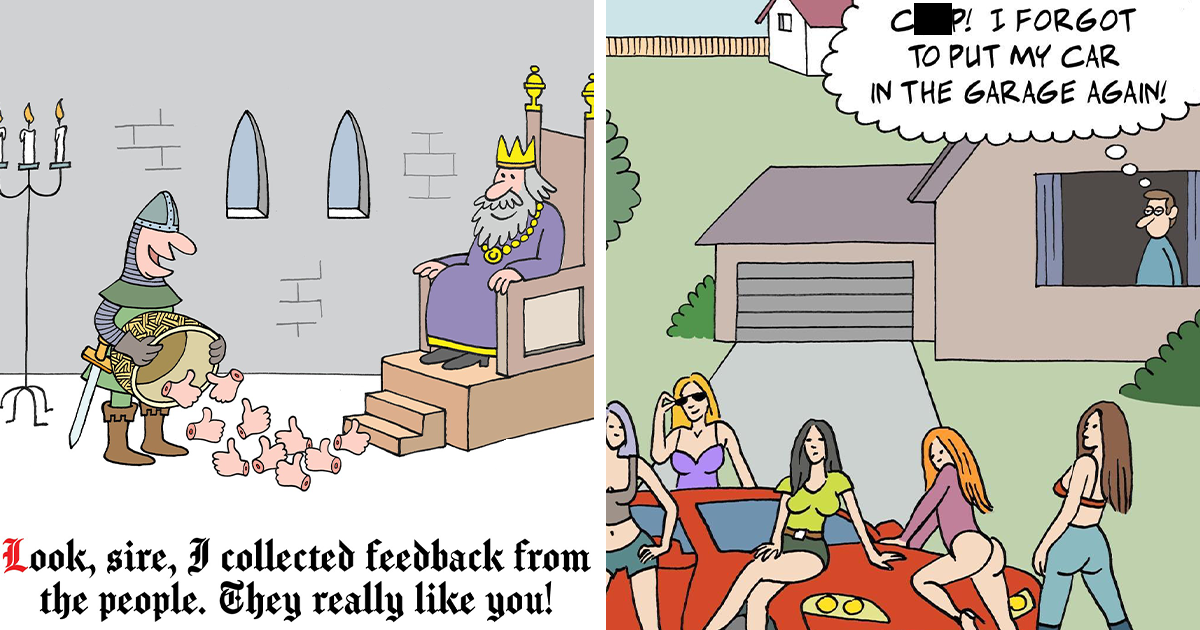
Some comics gently tap you on the shoulder. Others kick open the door, toss a fish into a board meeting, and ask why everyone is acting like this is not normal. The work of Belgian cartoonist Dieter Bevers, better known online as Quatsch, belongs happily in the second category. His comics are absurd, playful, and delightfully strange in the way a good daydream can be strange: familiar enough to understand instantly, but weird enough to make your brain do a tiny backflip.
In the collection titled “This Comics Artist Illustrates Absurd And Fun Situations That Might Make You Laugh (29 New Pics)”, Quatsch continues doing what he does best: taking everyday ideas, human habits, animal behavior, social awkwardness, and visual puns, then blending them into cartoons that feel like jokes whispered by a very mischievous imagination. These are not long, heavy comic strips that demand a dramatic soundtrack and a cup of black coffee. Most of them work quickly. A single image. A clever twist. One odd detail. Boomyour lunch break is officially improved.
That speed is part of the charm. Online readers scroll fast, but a strong single-panel comic can stop the thumb like a banana peel in a cartoon chase scene. Quatsch’s humor does not rely on complicated worldbuilding. Instead, it thrives on instant recognition: animals behaving like humans, humans behaving like confused furniture, and ordinary objects suddenly developing suspiciously strong personalities.
Who Is Dieter Bevers, the Artist Behind Quatsch Cartoons?
Dieter Bevers is a Belgian freelance cartoonist and illustrator who publishes under the name Quatsch. The word itself has a wonderfully comic flavor. In German and Dutch-influenced usage, “quatsch” can suggest nonsense, silliness, or foolish talk, which is basically the perfect banner for cartoons where logic politely leaves the room and lets absurdity host the party.
Bevers has been recognized in cartoon competitions and has built an online audience through short, witty illustrations that often mix human behavior with animal worlds. His style is intentionally simple and clean. Rather than overwhelming readers with hyper-detailed backgrounds, he places the joke front and center. The result feels efficient but not lazy. Every line has a job. Every expression matters. Every strange setup looks as if it has been trimmed down until only the funny bone remains.
What makes Quatsch’s comics especially memorable is the way they treat absurdity as if it were completely normal. A less confident cartoonist might shout, “Look how weird this is!” Quatsch simply presents the situation with a straight face. That calm delivery is what makes the joke louder. When a comic shows an impossible scenario with the energy of a Tuesday afternoon errand, the contrast becomes the punchline.
Why Absurd Comics Work So Well Online
Absurd humor has always had a special place in comics because drawings can make impossible things look immediately believable. A novel may need a paragraph to explain why a spider is wearing a cardigan and discussing dinner plans. A cartoon can show it in one second. The reader understands the setup before the logical side of the brain has time to file a complaint.
This is one reason webcomics and social media cartoons are so shareable. They compress a full comedic idea into a small visual package. You do not need to know a long backstory, memorize character names, or join a twelve-volume mythology. You can arrive late, laugh quickly, and still feel like you got the entire joke. That is powerful in a digital world where attention is treated like a rare gemstone guarded by notifications.
Quatsch’s comics fit that environment naturally. Many of his works are single-panel cartoons, which means the entire setup and punchline happen at once. The joke is not always “told” in the traditional sense. Sometimes it is discovered. Your eyes scan the drawing, notice the unusual detail, and suddenly the scene clicks. That moment of discovery is where the laugh lives.
The Art of Making the Ordinary Look Ridiculous
One of the strongest patterns in Quatsch cartoons is the transformation of familiar moments into ridiculous situations. A bus ride, a dinner table, a pet behavior, a fancy room, a workplace scene, or a simple object can become the launchpad for a visual joke. The humor often begins with a normal question: What if this everyday thing happened in the wrong context? What if an animal took a human habit literally? What if a phrase became a physical object? What if the background character was the real punchline?
This approach works because it gives the reader two layers at once. The first layer is familiar, which makes the cartoon accessible. The second layer is bizarre, which makes it funny. Think of it as comedy with one foot in the grocery store and the other foot in outer space. The cart has wheels, but nobody is pretending the destination is normal.
For example, Quatsch often plays with animals as stand-ins for people. Sharks can sit at a table. Fish can become part of a social joke. Insects can adopt domestic habits. These swaps are funny because they reveal how strange human behavior already is. When an animal does something ordinary, the ordinary suddenly looks suspicious. Why do we dress up for dinner? Why do we care about status? Why do we create rules, etiquette, and tiny social dramas around everything from dating to dessert? A good absurd cartoon does not answer these questions. It just draws a raccoon in the right place and lets us laugh at ourselves.
Simple Drawing, Sharp Timing
At first glance, Quatsch’s visual style may look modest. But simple cartooning is not the same as easy cartooning. In fact, simplicity can be brutal because there is nowhere to hide. If the composition is weak, the reader notices. If the expression is off, the joke loses energy. If the visual clue is too obvious, the gag feels flat. If it is too hidden, the reader scrolls away before the punchline lands.
Quatsch’s cartoons often succeed because they understand timing in a visual sense. The eye moves through the image in a specific order: setting, character, expression, odd detail, realization. That rhythm is the comic equivalent of a stand-up comedian pausing before the punchline. The drawing sets up the expectation, then quietly breaks it.
Single-panel comics are especially demanding because they cannot rely on multiple frames to build tension. Everything must be arranged inside one image. The setting must be clear, the idea must be readable, and the twist must land fast enough to feel spontaneous. When it works, it feels effortless. When it fails, it feels like a joke wearing shoes that are two sizes too big. Quatsch’s better cartoons avoid that wobble by keeping the central idea clean.
Why the Humor Feels Both Silly and Smart
The best absurd comics are not random for the sake of being random. A duck in a hat is not automatically funny, although we should admit it is a strong start. The real joke needs a relationship between the strange element and the familiar world around it. Quatsch’s cartoons often create that relationship through contrast: animal instinct versus human manners, literal meaning versus figurative language, cute imagery versus darkly clever implication, or normal social rules versus completely impossible participants.
That is why the humor feels silly and smart at the same time. You laugh first, then realize the joke had structure. It is like finding a tiny engineering blueprint inside a whoopee cushion. The absurdity may appear loose and goofy, but the cartoon usually depends on a precise connection. Something is in the wrong place, but it is the exact wrong place.
This style also avoids the trap of over-explaining. Many online jokes lose power because they arrive with too much text. Quatsch usually trusts the reader to make the final leap. That trust makes the audience feel involved. Instead of being spoon-fed a punchline, the reader gets to assemble it in their head, which creates a more satisfying laugh.
The Role of Animals in Quatsch’s Absurd World
Animals are comedy gold because they come with built-in expectations. We think we know what a cat, shark, fish, spider, dog, or bird is supposed to do. When a cartoon gives that animal a human situation, the mismatch becomes instantly funny. A shark in the ocean is nature. A shark at a restaurant table is a lawsuit waiting to happen.
Quatsch uses this mismatch to build scenes that feel like tiny fables without moral lectures. His animals are not always cute mascots. Sometimes they are awkward, selfish, confused, proud, dramatic, or oddly professional. In other words, they behave like people. That is where the comedy sneaks in. The animal mask makes human behavior look new again.
There is also a long cartoon tradition behind this technique. From classic newspaper strips to modern Instagram webcomics, artists have used animals to exaggerate human habits. Animals give creators permission to be playful. A frustrated office worker might feel ordinary, but a frustrated fish with office-worker energy becomes memorable. Quatsch’s work belongs to that tradition while maintaining its own offbeat tone.
Why Readers Keep Coming Back for New Pics
The phrase “29 new pics” is part of the appeal. Readers who enjoy a cartoonist’s voice want more than one joke. They want a fresh batch of small surprises. A collection creates a rhythm: laugh, scroll, pause, laugh again, send one to a friend, wonder briefly about the artist’s brain, continue scrolling.
Quatsch’s comics reward that kind of reading because the jokes vary while the worldview stays consistent. You may not know what the next cartoon will show, but you know the rules of the universe: everyday logic is optional, animals are suspiciously articulate, and the punchline may be hiding in the corner wearing a tiny hat.
Another reason readers return is that the comics are easy to share. A funny single-panel cartoon can travel across group chats, social feeds, and office message threads without needing explanation. It becomes a little social gift. You send it to someone and silently say, “This made me laugh, and I suspect your brain is damaged in a compatible way.” That is friendship, basically.
What Creators Can Learn From Quatsch Cartoons
For aspiring comic artists, Quatsch’s work offers several practical lessons. First, a strong idea matters more than visual noise. A cartoon does not need cinematic lighting or five hundred background details if the joke is clear. Second, absurdity works best when it grows from something recognizable. The stranger the twist, the more useful the ordinary setup becomes.
Third, format matters. On social media, a one-panel comic can perform well because it respects the reader’s limited time. That does not mean longer comics are bad. It means the format should match the platform and the joke. Some ideas need a sequence. Others need one perfectly strange image and the courage to stop there.
Fourth, feedback is helpful but not everything. Online reactions can show what connects with readers, but an artist also needs personal judgment. Comedy is partly instinct. Sometimes an idea feels hilarious in the mind and lifeless on the page. Sometimes a tiny sketch becomes unexpectedly strong. The only way to find out is to keep making the work.
The Comfort of Laughing at Nonsense
Absurd comics feel especially refreshing because daily life already contains plenty of nonsense, but not always the fun kind. Emails arrive with mysterious urgency. Appliances break at dramatic times. People say “quick question” and then send three paragraphs. In that environment, a cartoon that openly embraces silliness can feel like emotional fresh air.
Humor does not need to solve every problem to be valuable. Sometimes it simply creates a pause. A good comic gives the reader a few seconds away from stress, routine, or doom-scrolling. It offers a small mental reset: here is a ridiculous fish, here is a confused animal, here is a tiny universe where the rules are bent just enough to make you grin.
That is the quiet strength of Quatsch’s cartoons. They are light, but not empty. They remind us that imagination can turn ordinary observations into jokes, and jokes can turn an ordinary day into something slightly more bearable. Not every laugh has to be huge. Sometimes a small smile is the whole mission.
Experiences Related to Absurd Comics and Why They Stay With Us
One of the most enjoyable experiences with absurd comics is the “wait, what?” moment. You see the image, understand the basic scene, and then your brain catches the twist a second later. That tiny delay is delicious. It feels like opening a normal-looking drawer and finding a raccoon conducting a business meeting inside. You are surprised, but not confused in a bad way. The joke gives you just enough information to solve it yourself.
Many readers have had the experience of finding a comic at exactly the right time. Maybe you are stuck in a long line, taking a short break from homework, waiting for a meeting to start, or lying in bed while promising yourself you will stop scrolling “after one more post.” Then a cartoon appears that is so oddly specific, so cheerfully ridiculous, that it breaks the mood. It does not fix the entire day, but it changes the next five minutes. Sometimes that is enough.
Absurd comics are also fun because they are easy to discuss. A realistic joke may have one clear meaning, but a surreal cartoon invites interpretation. One person laughs at the animal. Another laughs at the wordplay. Someone else notices the background detail. A fourth person says, “I don’t get it,” which can start a surprisingly passionate explanation from everyone else. In this way, a single panel can become a social event. It is not just content; it is a tiny conversation starter wearing clown shoes.
There is also a personal creative lesson in comics like these. They encourage people to look at normal surroundings differently. After spending time with Quatsch-style humor, a bus is not just a bus. It is a possible spaceship for aliens with backpacks. A restaurant is not just a restaurant. It is a stage where sharks might politely complain about the menu. A houseplant is not just a houseplant. It may be judging your life choices with leafy confidence. This way of looking at the world can make daily routines feel less flat.
For artists and writers, that mindset is valuable. Absurdity begins with attention. You notice a phrase, object, habit, or social rule, then ask one playful question: what if this were taken literally? What if the roles were reversed? What if the animal understood the assignment better than the humans? These questions are simple, but they open doors. Behind some doors is nonsense. Behind others is a surprisingly good cartoon.
The best experience, however, may be sharing the comic with someone who laughs immediately. That shared laugh creates a tiny bridge. It says, “We both see how weird this is.” In a world that often feels too serious, too polished, and too algorithmically organized, absurd comics give readers permission to be silly without apology. Quatsch’s cartoons understand that permission very well. They invite us into a place where the impossible is normal, the normal is suspicious, and laughter is waiting patiently in the strangest corner of the frame.
Conclusion
“This Comics Artist Illustrates Absurd And Fun Situations That Might Make You Laugh (29 New Pics)” is more than a simple collection of funny drawings. It is a reminder of how much comedy can fit inside one panel when the idea is sharp, the timing is clean, and the artist is willing to let nonsense behave with perfect confidence. Dieter Bevers, through Quatsch Cartoons, turns everyday observations into playful visual surprises that are quick to understand and hard to forget.
His work proves that absurd humor does not need to be loud or complicated. Sometimes all it takes is a familiar situation, one impossible twist, and a drawing that trusts the reader to make the final connection. Whether you enjoy webcomics, animal cartoons, visual puns, or simply need a cheerful break from real-world seriousness, Quatsch’s comics offer a small but effective dose of delight. And honestly, if a single cartoon can make the day feel a little lighter, that is not nonsense at all. That is a very respectable public service.










