
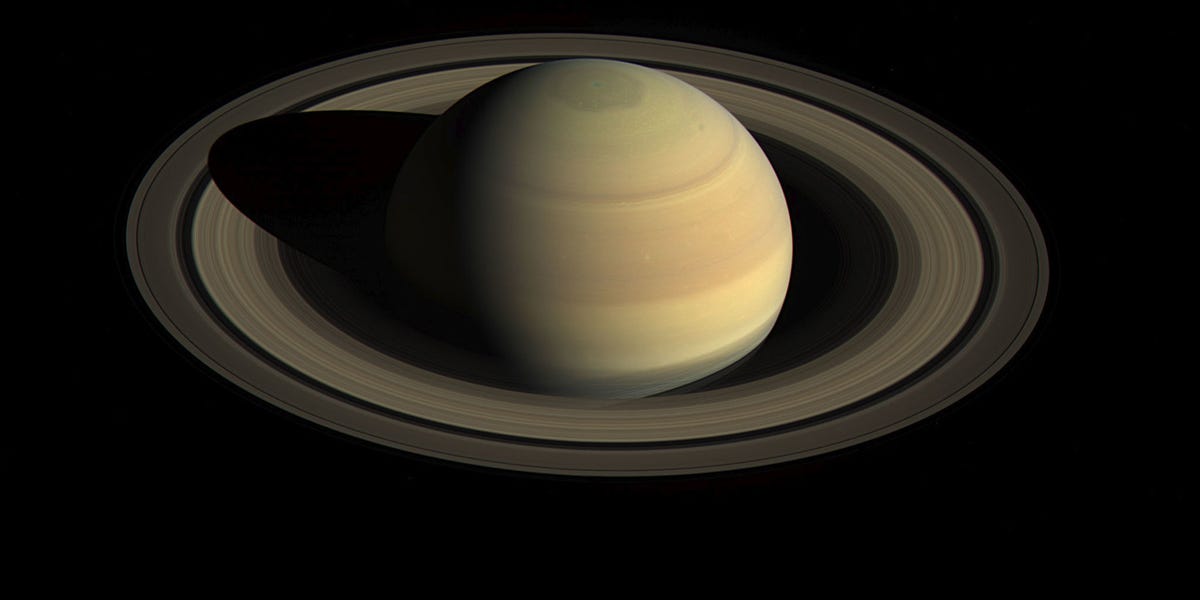
Saturn has always looked like the overachiever of the solar system. Jupiter may be bigger, but Saturn shows up wearing a glamorous ring set and somehow makes everyone else look underdressed. For years, those rings seemed like elegant decoration from a distance. Then spacecraft data ruined the illusion in the best possible way: Saturn’s rings are not just sitting there looking pretty. They are actively shedding material into the planet’s atmosphere.
That is where the headline-worthy idea comes in. Scientists studying data from NASA’s Cassini mission found that ring material falling into Saturn’s upper atmosphere contains much more than simple water ice. Along with water, researchers detected methane, ammonia, carbon monoxide, carbon dioxide, nitrogen-bearing compounds, silicates, and fragments of complex organics. In other words, Saturn is not merely wearing jewelry. The jewelry is flaking off into the atmosphere like a cosmic glitter bomb with chemistry credentials.
The phrase “Saturn’s rings rain methane down on planet” is catchy, but the real story is even better. Methane is part of the downpour, not the whole forecast. What Cassini revealed is a complicated exchange between Saturn and its rings, one that affects the planet’s upper atmosphere, helps explain old observations, and may even tell scientists something about the long-term fate of the rings themselves. Add later Hubble observations showing that the rings are heating Saturn’s upper atmosphere, and suddenly those iconic rings look less like a static halo and more like an active planetary weather system from the outside in.
What Scientists Actually Found During Cassini’s Grand Finale
NASA’s Cassini spacecraft spent more than a decade transforming Saturn from a distant striped giant into a living, changing system. But some of the mission’s most surprising results came at the end, during the spacecraft’s so-called Grand Finale in 2017. In those final orbits, Cassini repeatedly threaded the narrow gap between Saturn and its innermost rings, sampling a region no spacecraft had ever explored so closely before.
Scientists expected some material to be falling from the rings into the planet’s atmosphere. Earlier studies had already suggested a process called ring rain, especially involving water particles. What they did not expect was the chemical variety and the sheer amount of incoming material. Cassini’s instruments found that ring rain was not just an icy drizzle. It was more like a busy stream of water-rich grains, hydrocarbons, and organic fragments pouring into Saturn’s upper atmosphere at remarkable speed.
One of the most eye-catching findings was that water made up only a minority of the material detected in the downpour. That surprised researchers because Saturn’s rings, viewed remotely, appear to be made mostly of water ice. Yet the material Cassini sampled contained significant amounts of methane and other carbon-bearing compounds. That mismatch pushed scientists to rethink what was happening in the innermost ring region and how ring particles were interacting with radiation, Saturn’s magnetic field, and the upper atmosphere.
That final mission phase was a little like reading the fine print on a contract you thought was simple. Saturn’s rings looked icy and straightforward from afar. Up close, they turned out to be chemically messy, active, and willing to share.
Why Methane in Ring Rain Was Such a Shock
Methane matters because it changes the story from “ring ice falls into Saturn” to “ring material is chemically richer than expected.” Saturn’s atmosphere already contains small amounts of methane, so finding methane-related material high in the atmospheric region where Cassini was measuring raised a bigger question: where exactly was this methane-bearing material coming from, and how was it getting there?
Scientists think the innermost D ring plays an outsized role in this process. This thin ring sits closest to Saturn, making it especially vulnerable to erosion and interaction with the planet’s environment. Tiny grains and nanometer-scale particles can become electrically charged, follow magnetic field lines, and move inward. Along the way, radiation and collisions may alter the material, strip components, or break larger organic matter into fragments. By the time the particles tumble into the atmosphere, the chemistry is more complicated than anyone expected.
That is why methane drew so much attention. It was evidence that the ring rain was carrying hydrocarbons and organics, not just frozen water. The presence of methane and related compounds hinted that Saturn’s inner rings might be chemically processed in ways that are hard to see from a telescope. Cassini gave scientists not just a prettier picture of Saturn, but a more honest one.
For SEO purposes, this is the part where the key phrase Saturn ring rain methane earns its keep. For science purposes, this is the part where everyone realizes the solar system is once again more dramatic than expected.
How Ring Rain Reaches Saturn’s Atmosphere
So how do ring particles actually fall onto Saturn? The answer involves gravity, electric charge, magnetic fields, and a lot of very tiny debris. Saturn’s rings are not a single smooth disk. They are a sprawling system made of particles ranging from dust-size bits to chunks large enough to deserve their own ego. The closer that material gets to the planet, the more intense the interaction becomes.
Some particles in the inner rings can pick up electric charges from sunlight, plasma, or collisions. Once charged, they are more easily guided by Saturn’s magnetic field. That creates pathways for ring material to spiral or flow inward toward the atmosphere. Earlier observations had already suggested that this ring rain affected electron densities in Saturn’s ionosphere, creating dark banded regions that matched the magnetic connection to parts of the rings.
In plain English, Saturn’s rings are connected to the planet more intimately than they look. They do not simply orbit overhead like a decorative ceiling fan. They feed material into the atmosphere below. Think less “celestial accessory” and more “slow cosmic conveyor belt.”
This process also helps explain why the composition of Saturn’s upper atmosphere is not determined only by internal planetary chemistry. Some of it is being modified by outside input from the rings. That means Saturn’s atmosphere is not just shaped from within by heat, pressure, and circulation. It is also being seasoned from above by its own ring system.
Hubble Confirmed the Rings Are Heating Saturn
If Cassini showed that material from the rings was falling inward, Hubble helped show the larger atmospheric effect. Using ultraviolet observations collected over decades, astronomers identified evidence that Saturn’s rings are heating the planet’s upper atmosphere. The signal appeared as excess ultraviolet radiation tied to hot hydrogen in the upper atmosphere, suggesting contamination and heating from incoming ring material.
This was a big deal for two reasons. First, it connected the ring rain story to a measurable planetary-scale atmospheric effect. Second, it helped tie together older clues from Voyager, Cassini, ground-based observatories, and newer Hubble data into one broader picture. Saturn’s rings are not passive ornaments. They are part of a real ring-atmosphere interaction system.
That interaction may help explain strange dark bands observed on Saturn in past decades. Researchers have long suspected that ring rain influenced the planet’s ionosphere and infrared behavior at certain latitudes. Hubble’s later work added weight to the idea that the inflow of ring material is not subtle background noise. It is powerful enough to alter temperatures and chemistry in the upper atmosphere.
In other words, Saturn’s rings do not just make the planet photogenic. They change the weather overhead. That is a pretty bold move for something many people still think of as frozen scenery.
Does This Mean Saturn’s Rings Are Disappearing?
In a slow-motion sense, yes. Ring rain is one of the reasons scientists think Saturn’s rings are losing material over time. If particles and molecules are continually falling into the atmosphere, the rings cannot stay exactly the same forever. Some estimates suggest the ring system could fade dramatically on astronomical timescales, though the exact schedule remains uncertain and depends on how material is replenished or redistributed.
The D ring appears especially vulnerable because it sits closest to Saturn and seems to be actively eroding. Some researchers have suggested that material from outer ring regions may slowly feed inward, helping replenish the inner zones, at least for a while. But even that recycling does not make the system immortal.
This gives Saturn’s rings an oddly bittersweet quality. They look timeless, yet they may be temporary. The most iconic planet in the sky might be showing us a beautiful phase rather than a permanent identity. That does not make Saturn less impressive. It makes it more alive.
There is a lesson in that somewhere, probably one involving impermanence, beauty, and maybe not taking your best accessories for granted.
Saturn vs. Titan: Don’t Mix Up Two Different Methane Stories
One reason the methane headline can confuse readers is that Saturn’s moon Titan has its own famous methane weather cycle. Titan has lakes and seas of liquid methane and ethane, clouds made of hydrocarbons, and methane rain that falls onto the moon’s surface. That is an entirely different phenomenon from Saturn’s ring rain, even though both involve methane and both belong to the Saturn system.
On Titan, methane acts a bit like water does on Earth. It evaporates, forms clouds, and falls as rain. On Saturn itself, by contrast, methane in the recent headlines refers to methane-bearing material detected in the stream of particles and compounds coming from the rings into the planet’s upper atmosphere. Same molecule family, very different setting.
Keeping those stories separate matters because Titan’s methane rain is about moon weather and surface liquids, while Saturn’s ring rain is about ring erosion, atmospheric chemistry, and magnetic-field-guided infall. One is an alien weather report. The other is a planetary systems story involving chemistry, plasma physics, and a ring system slowly feeding its parent planet.
Both are amazing. One just sounds more like a weather app from another dimension.
A Science-Based Imagination: What Experiencing Saturn’s Ring Rain Would Be Like
Imagine approaching Saturn not as a tourist in a window seat, but as a probe dropping into one of the most famous neighborhoods in the solar system. From far away, the rings would look thin and elegant, like someone drew them with a silver pencil across black velvet. As you moved closer, the elegance would break apart into reality: countless particles, gaps, ripples, dusty lanes, and electrically charged grains all participating in a gravitational traffic system that has been running for ages.
You would not see “methane rain” in the cozy, Earthlike sense of standing under a cloud and needing an umbrella. Saturn is a gas giant, not a sidewalk café with bad weather. What you would experience instead is a region where material from the rings is moving inward, guided by physics that operates on both tiny and planetary scales. If you were a spacecraft like Cassini, every pass through that gap would feel like threading a needle while the needle is also a storm, a laboratory, and a machine older than human civilization.
The ring rain itself would be invisible in any ordinary sense, but its effects would be everywhere. Molecules and dust fragments would stream into the upper atmosphere. Water-rich grains, methane-bearing compounds, nitrogen-containing molecules, and pieces of organics would enter a realm of hydrogen, helium, charged particles, and intense magnetic influence. Saturn’s atmosphere would not greet that infall politely. It would heat, react, and reshuffle its chemistry.
If human eyes could somehow survive the impossible conditions, the view might be less “rain shower” and more “subtle atmospheric haunting.” You would be watching a planet altered from above by its own ring system. The upper atmosphere would glow in ways instruments understand better than eyeballs do. Ultraviolet signatures would betray heat where there should be less of it. Dark and bright bands connected to ring structure would hint that the rings and planet are in constant conversation, trading matter and energy without asking whether anyone on Earth is ready for that level of drama.
And then there is the emotional part. Saturn already feels unreal in photographs, but the idea that its rings are slowly raining onto the planet makes it feel strangely intimate. The planet and its rings are not separate actors posing together for portraits. They are touching, interacting, and changing one another. The beauty is not just visual. It is dynamic.
This kind of imagined experience also changes how we think about planetary systems beyond Saturn. A ringed planet around another star might seem impossible to study in detail, but Saturn gives scientists a template. If rings can heat atmospheres, alter chemistry, and leave detectable signatures, then maybe similar interactions could be inferred elsewhere. Suddenly, Saturn stops being just the solar system’s fashion icon and becomes a working model for how ring systems evolve and reveal themselves.
So the “experience” of Saturn’s ring rain, at least in scientific imagination, is not about getting soaked in methane. It is about witnessing a giant world being gently rewritten by its own rings. It is about understanding that the solar system’s most polished showpiece is also shedding, reacting, and changing in real time. That makes Saturn feel less like a postcard and more like a living process. Frankly, that is cooler than any umbrella joke I was going to make anyway.
Conclusion
Saturn’s rings are far more than decorative ice. Data from Cassini showed that material from the rings is actively falling into Saturn’s upper atmosphere, and that this ring rain contains methane along with water, ammonia, carbon-bearing molecules, nitrogen compounds, and complex organics. Later Hubble observations helped confirm that this infall is heating the upper atmosphere, giving scientists a clearer picture of how the rings and planet interact.
The result is a richer, stranger, and more exciting Saturn than the old textbook version. The rings are not passive. They are chemically active, physically dynamic, and possibly temporary on long timescales. The methane angle makes for a sharp headline, but the deeper story is about a giant planet and its rings exchanging matter in a way that reshapes both our science and our sense of wonder.
Saturn still wins the beauty contest. It just turns out the contestant is also running an advanced chemistry experiment over its own atmosphere.










