
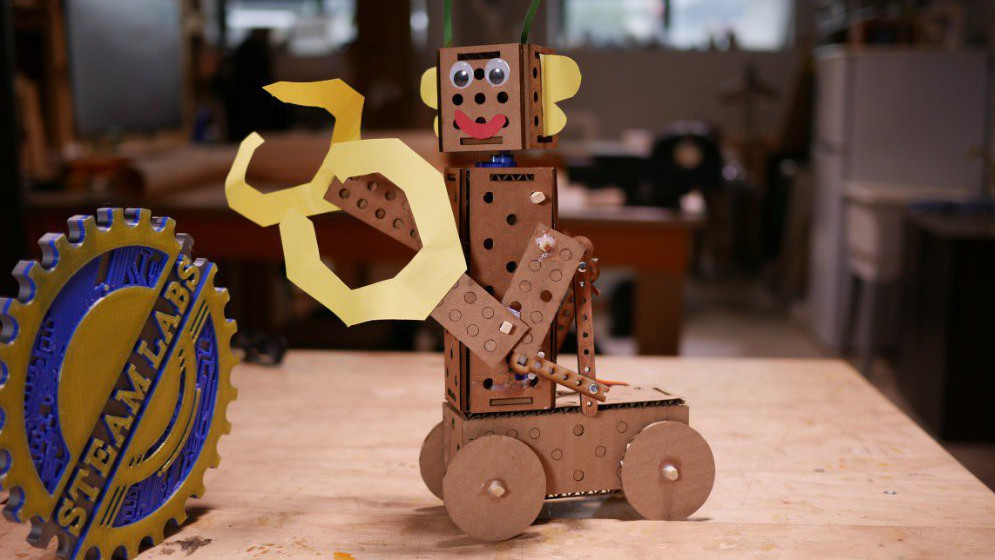
Some toys arrive with glossy plastic, tiny screws, and instructions that look like they were written by a committee of impatient space engineers. A laser cut cardboard robot construction kit takes a friendlier route. It says, “Here is some cardboard, some holes, a few clever parts, and a big invitation to invent.” Suddenly, robotics feels less like a locked laboratory and more like a kitchen-table adventure with wheels, arms, gears, and a little glorious chaos.
The idea behind a laser cut cardboard robot construction kit is beautifully simple: use precisely cut cardboard pieces to help learners build robot bodies, frames, linkages, arms, heads, wheels, and moving mechanisms. Add basic materials such as straws, chopsticks, rubber bands, wooden levers, gears, pulleys, servos, motors, or a microcontroller, and the humble cardboard sheet becomes a playground for engineering. It is affordable, customizable, lightweight, and forgiving enough that mistakes do not feel like disasters. They feel like version one.
That is exactly why this kind of kit matters. Today’s students are surrounded by technology, but they do not always get to see how movement, structure, code, and electricity work together. A cardboard robot kit pulls those ideas out of the screen and puts them directly into a child’s hands. The robot may wobble. The arm may overshoot. The wheels may drift like a shopping cart with personal problems. But every odd movement teaches something useful.
What Is a Laser Cut Cardboard Robot Construction Kit?
A laser cut cardboard robot construction kit is a modular building system made from flat cardboard sheets that have been cut with a laser cutter. Unlike rough hand-cut pieces, laser-cut parts can include clean edges, repeatable slots, tabs, holes, fold lines, and perforations. These details allow students to connect panels into boxes, frames, chassis parts, robot heads, arms, and mechanical supports with less frustration.
One well-known open-source example was created by Andy Forest through STEAMLabs, a community makerspace project that focused on helping kids make and code robots. The kit uses laser-cut corrugated cardboard and wooden pieces to create interlocking rectangles, boxes, levers, gears, pulleys, and linkage bars. Holes in the cardboard allow simple axles made from plastic straws or chopsticks to turn, while cutouts and perforations make it easier to mount small motors or SG90 servo motors.
That combination is important. Electronics have become easier and cheaper for classrooms to use, thanks to small microcontrollers, beginner-friendly coding tools, and affordable motors. The tricky part is often the robot body. Where does the motor attach? How does the arm pivot? How do you connect movement from one point to another? A laser cut cardboard construction kit solves that “mechanical middle” problem by giving students a flexible physical system they can modify.
Why Cardboard Is a Surprisingly Smart Robotics Material
Cardboard does not look glamorous. It does not sparkle like acrylic or feel futuristic like 3D-printed plastic. But for learning robotics, cardboard has secret superpowers.
It Is Affordable and Accessible
Schools, makerspaces, libraries, and parents often need materials that do not destroy the budget. Cardboard is inexpensive, widely available, and easy to replace. If a student cuts a slot in the wrong place or designs a robot body that collapses under the emotional weight of its own ambition, the fix is not painful. Cut another piece. Try again. Laugh a little. Continue.
It Encourages Iteration
Real engineering rarely works perfectly on the first attempt. A cardboard robot kit naturally teaches the design cycle: imagine, build, test, fail, improve, and test again. Because cardboard is quick to cut, fold, glue, and adjust, students can improve designs rapidly. That speed matters. When learners can see the connection between their design choices and the robot’s behavior, abstract engineering ideas become concrete.
It Is Lightweight but Strong Enough for Prototypes
Corrugated cardboard has a layered structure that gives it surprising strength for its weight. It can support small robotic mechanisms, simple arms, wheels, and decorative shells while remaining easy for children to handle. The result is a material that invites experimentation without requiring heavy tools.
It Supports Sustainability Conversations
Cardboard also opens the door to conversations about recycling, responsible design, and material choices. Paper and cardboard remain among the most commonly recycled materials in the United States, and a cardboard robotics project can help students think about how engineers balance cost, function, durability, and environmental impact. A robot made from cardboard is not just a robot; it is a lesson in using everyday materials creatively.
How Laser Cutting Improves the Learning Experience
Hand-cut cardboard projects are fun, but they can quickly become uneven. A crooked slot may make a wheel rub. A misaligned hole may turn a robot arm into a dramatic interpretive dance. Laser cutting brings precision to the process without removing creativity.
With a laser cutter, educators can create repeatable parts for a whole class. Every team can start with the same chassis pieces, axle holes, servo cutouts, and linkage options. Then students can personalize the robot through design decisions: body shape, arm length, gear placement, decorations, sensors, and coding behavior.
Laser cutting also helps students move from two-dimensional design to three-dimensional construction. Learners can draw or modify flat files, cut the pieces, and then assemble them into physical objects. This process strengthens spatial reasoning because students must understand how a flat panel becomes a box, how a slot becomes a joint, and how an axle line affects movement.
STEM Skills Hidden Inside the Fun
The best educational toys do not announce every lesson with a trumpet. They hide learning inside play. A laser cut cardboard robot construction kit does exactly that.
Engineering Design
Students learn how structure affects function. A wide robot base may be more stable. A long arm may reach farther but require more support. A weak joint may twist under load. These are real engineering trade-offs, made visible through cardboard and motion.
Mechanical Thinking
Robots move because forces travel through parts. Linkages transfer motion. Gears change speed or direction. Pulleys guide movement. Axles reduce friction when aligned properly. A cardboard robot kit gives students hands-on exposure to these mechanical ideas without requiring advanced math first.
Coding and Computational Thinking
When students add a microcontroller, servo, LED, sensor, or motor driver, the robot becomes programmable. They can write code that turns wheels, moves an arm, responds to a button, follows a line, or reacts to light. That builds computational thinking: sequencing, debugging, decomposition, pattern recognition, and cause-and-effect reasoning.
Creativity and Storytelling
Robots are not only machines. They are characters. One team may build a cardboard rover for a pretend Mars mission. Another may create a dancing robot with flapping arms. Someone else may design a helpful cardboard creature that delivers sticky notes across a desk. These playful stories keep students emotionally invested in technical problem-solving.
Collaboration
Robot building is rarely a solo sport. One student may become the chassis expert. Another may handle decoration. Another may debug the code. Another may say, “I told you the wheel was crooked,” which is not an official job title but somehow always appears. Group robotics projects teach communication, patience, and shared decision-making.
Why This Kit Works Well in Classrooms and Makerspaces
A classroom robotics activity must balance freedom with structure. Too much freedom can overwhelm beginners. Too much structure can turn learning into furniture assembly with a battery pack. Laser cut cardboard kits hit a useful middle ground.
The pre-cut parts reduce setup headaches. Students do not have to spend the entire session measuring rectangles or trying to punch accurate holes through thick cardboard. At the same time, the material remains open-ended. Learners can combine parts in different ways, modify the design, add decorations, and test unusual mechanisms.
This makes the kit useful for many settings: elementary STEM lessons, middle school engineering units, high school prototyping classes, library workshops, homeschool projects, summer camps, after-school robotics clubs, and community makerspaces. Younger learners can focus on building and motion. Older students can add sensors, code, design constraints, and performance challenges.
Specific Project Ideas for Laser Cut Cardboard Robots
A good construction kit should not make only one robot. It should act like a toolbox for many inventions. Here are several project ideas that fit the strengths of laser-cut cardboard robotics.
1. Cardboard Rover Challenge
Students build a small rover that can travel across a table or floor. The challenge can begin with rubber-band power, then move into motorized wheels and coding. Learners can test wheel size, body shape, weight distribution, and axle alignment. A space-exploration theme makes the activity even more exciting: the rover must carry a “sample,” cross a “crater,” or survive the dangerous landscape known as the classroom carpet.
2. Robotic Arm Prototype
A cardboard robotic arm introduces pivots, levers, end effectors, and control systems. Students can design an arm that moves small objects from one container to another. They can experiment with rubber bands, string, servos, or simple linkages. This project connects naturally to real robotic arms used in space exploration, manufacturing, medicine, and assistive technology.
3. Animatronic Character
Cardboard is perfect for expressive robots. Students can create a robot head with moving eyes, eyebrows, mouth flaps, or waving arms. Add servos and simple code, and the character can blink, nod, or greet visitors. This activity blends engineering with art, theater, and storytelling.
4. Drawing Robot
A drawing robot can hold a marker and move across paper. Students learn about vibration, wheel motion, balance, and repeated patterns. The final artwork may look like a robot sneezed a rainbow, but that is part of the charm.
5. Maze-Solving Robot Body
Older students can use the cardboard kit to build a chassis for a programmable robot that navigates a simple maze. Add distance sensors, line sensors, or bumper switches, and the project becomes a lesson in algorithms, logic, and debugging.
How It Helps Different Types of Learners
Not every student learns best by reading a diagram or watching a lecture. Some need to touch, test, move, adjust, and rebuild. A laser cut cardboard robot construction kit supports visual, tactile, social, and experimental learners.
For visual learners, the physical layout of holes, slots, panels, and linkages makes systems easier to understand. For hands-on learners, the build process creates immediate feedback. For students who enjoy art, the robot can become a character or sculpture. For students drawn to coding, the cardboard body gives their program something real to control.
This cross-disciplinary nature is the magic. A robot kit can teach physics, coding, design, storytelling, measurement, geometry, teamwork, and resilience in one project. It also lowers intimidation. Students who might say, “I am not a robot person,” often become interested when the robot starts as cardboard, markers, tape, and imagination.
Benefits for Parents and Home Learning
At home, a cardboard robot kit can turn screen time into build time. Instead of only playing with digital robots in a game, kids can build a physical robot and then program it. Parents do not need to be engineers to support the process. They can ask simple, powerful questions: What do you want it to do? Why did it turn that way? What could make the arm stronger? What happens if you move the motor?
The kit also teaches patience. A robot may not move correctly at first. The code may work, but the wheel may slip. The arm may lift once, then sag like it just remembered Monday exists. These moments are valuable because they help children learn that problems are normal in engineering. The goal is not instant perfection. The goal is thoughtful improvement.
What to Look for in a Good Cardboard Robotics Kit
Whether choosing a ready-made kit or creating one with a laser cutter, educators and parents should look for several important features.
Modular Parts
The best kits allow students to recombine pieces. Boxes, panels, brackets, linkage bars, wheel supports, and arm sections should work in multiple configurations.
Standard Hole Patterns
Repeated hole spacing makes it easier to attach axles, levers, gears, servo horns, and other components. A predictable pattern supports experimentation.
Compatibility With Common Electronics
Look for designs that can work with beginner-friendly parts such as small servos, DC motors, LEDs, battery packs, switches, microcontrollers, and sensors.
Safe Assembly
Children should not need sharp tools for every step. Laser-cut punch-outs, tabs, and slots make assembly easier and safer. Hot glue, tape, rubber bands, and craft fasteners can handle many connections.
Open-Ended Challenges
A strong kit should include activities but not trap learners into one final build. The most valuable projects invite students to invent their own robot solutions.
Common Mistakes and How to Avoid Them
Cardboard robotics is beginner-friendly, but a few problems appear often.
Weak joints: Reinforce stress points with extra cardboard layers, glue tabs, or wooden pieces.
Misaligned axles: Make sure axle holes line up on both sides of the chassis. If the wheels fight each other, the robot will lose.
Too much weight: Cardboard robots work best when electronics and decorations are placed thoughtfully. A robot with fifteen googly eyes may have personality, but it may also have balance issues.
Unclear goals: Give students a mission. “Build anything” can be exciting, but “build a robot that can move a block 12 inches” gives learners a target.
No time for redesign: The best learning often happens after the first failure. Plan enough time for testing and improvement.
Why Learning Through Play Still Matters
Play is not the opposite of learning. In STEM education, play often becomes the path into serious understanding. A child who builds a cardboard robot dog is exploring structure, motion, balance, electricity, and code. A student who decorates a robot face is making design choices. A team that argues about wheel placement is practicing engineering communication, even if it sounds suspiciously like snack-time diplomacy.
Hands-on robotics makes learning visible. Students do not just answer questions about motion; they create motion. They do not just read about iteration; they experience it when their first prototype turns in circles. They do not just memorize vocabulary; they use terms like axle, lever, pivot, chassis, servo, sensor, and linkage because those words help solve real problems.
The Future of Cardboard Robotics in Education
As laser cutters become more common in schools, libraries, and makerspaces, cardboard robotics kits could become a practical bridge between craft projects and advanced robotics. They are cheaper than many commercial robot platforms, easier to customize than molded plastic kits, and more approachable than metal construction systems.
The future may include downloadable design files, classroom-ready lesson plans, student-designed add-on parts, and hybrid kits that combine cardboard bodies with reusable electronics. A school could cut new robot bodies each semester while reusing motors, sensors, and microcontrollers. That model keeps costs manageable and encourages creative redesign.
Cardboard also allows learners to see technology as something they can shape. Instead of treating robots as mysterious finished products, students discover that a robot is a collection of choices: where to place the motor, how to support the arm, how to route wires, how to write the code, and how to make the whole thing look less like a shoebox having a midlife crisis.
Experiences Related to Laser Cut Cardboard Robot Construction Kit Eases Learning And Play
One of the most memorable experiences with a cardboard robot construction kit begins before the robot moves at all. It starts with the sound of students popping parts out of a laser-cut sheet. There is something satisfying about that moment. The parts look flat and ordinary, but everyone can sense the possibility. A rectangle might become a robot chest. A small square might become a bracket. A row of holes might become the secret to an arm that actually lifts something instead of flopping around like overcooked spaghetti.
In a typical workshop, students often begin with confidence that is both inspiring and wildly optimistic. Someone announces that their robot will walk, talk, dance, deliver snacks, and maybe do homework. Ten minutes later, the team is carefully trying to make two wheels spin in the same direction. That shift is not failure. It is learning becoming real. Big ideas meet physical constraints, and students begin to understand why engineers test small pieces before building the dream version.
The cardboard material makes this process gentle. When a part bends, students can reinforce it. When a hole is in the wrong place, they can cut another piece or adapt the design. When the robot tips forward, they can move the battery pack or widen the base. These are not abstract corrections on a worksheet. They are visible, physical decisions. The robot responds immediately, sometimes politely and sometimes with theatrical collapse.
Another powerful experience is watching different students find different entry points. The student who loves drawing may become the robot’s character designer. The student who enjoys puzzles may focus on linkages and motion. The student who likes computers may take over the coding. The student who usually stays quiet may become the careful builder who notices that the axle is rubbing against the frame. A good cardboard robotics project creates many ways to be useful.
There is also a special kind of pride when a robot made from simple materials begins to move. It may only roll forward a few inches, wave one arm, or blink an LED, but the effect is huge. Students often react as if they have awakened a tiny cardboard creature. That emotional connection matters. Once learners care about the robot, they care about improving it. They want smoother motion, stronger joints, better code, and a cooler name.
For teachers and parents, the experience is equally revealing. Cardboard robotics shows how much learning can happen when adults resist the urge to fix everything immediately. Instead of grabbing the robot and solving the problem, adults can ask, “What do you think is causing that?” or “What could you test next?” The child stays in charge of the investigation. That builds confidence and independence.
A laser cut cardboard robot construction kit also creates a healthy attitude toward failure. When a prototype breaks, students do not see a ruined product; they see information. The arm needs support. The wheel needs clearance. The servo needs a better mount. The code needs a delay. The cardboard becomes a forgiving teacher, and the robot becomes a funny, wobbly, surprisingly effective coach.
By the end of a session, the room usually contains scraps, tape, markers, half-working robots, and at least one machine that spins in circles for reasons no one fully understands yet. But it also contains something more important: students who have practiced engineering design, creative problem-solving, collaboration, and persistence. That is why laser cut cardboard robot kits are more than clever craft projects. They make robotics feel possible. They turn learning into play, and play into invention.
Conclusion
A laser cut cardboard robot construction kit proves that robotics education does not need to begin with expensive machines or intimidating hardware. It can begin with cardboard, curiosity, and a few smartly designed parts. By combining laser-cut precision with low-cost materials, these kits help learners explore engineering, coding, mechanics, design, and creativity in a hands-on way.
The greatest strength of cardboard robotics is its openness. Students can build a rover, an arm, a creature, a moving sculpture, or a prototype that solves a challenge they invented themselves. Along the way, they learn that technology is not magic. It is made of parts, decisions, tests, mistakes, and improvements. And sometimes, it is made of cardboard with googly eyes.














