
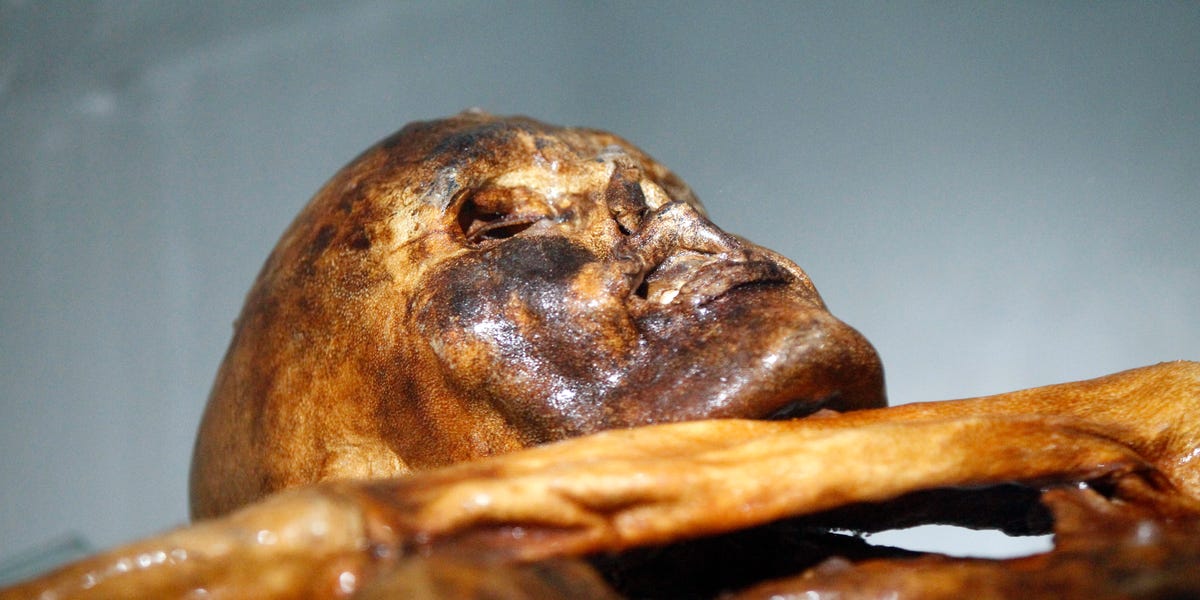
For decades, Ötzi the Iceman has been treated like archaeology’s ultimate mountain mystery: a frozen Copper Age man discovered high in the Alps, carrying tools, wearing practical clothing, and apparently having the worst hiking day in human history. But new genetic research has added an unexpectedly human twist to the story. The famous 5,000-year-old mummified Iceman was not quite the rugged, shaggy Alpine wanderer many people imagined. According to updated DNA analysis, Ötzi was likely darker-skinned, brown-eyed, and experiencing advanced hair loss. In plain English: the world’s most famous ice mummy may have looked less like a prehistoric action hero and more like a middle-aged farmer who forgot to pack sunscreen, a barber, and perhaps a better escape plan.
The phrase “balding farmer” may sound like a tabloid headline that wandered into a science journal wearing hiking boots, but it captures something important. Ötzi’s genome suggests he had unusually high ancestry from early Anatolian farming populations, the people who helped spread agriculture into Europe. He also carried genetic markers associated with male-pattern baldness. Instead of a wild mountain nomad, the evidence points toward a man connected to farming communities, Copper Age technology, and a world where survival required both practical skill and serious stamina.
Who Was Ötzi the Iceman?
Ötzi, also known as the Tyrolean Iceman, is one of the oldest natural human mummies ever found in Europe. He lived more than 5,300 years ago, during the Copper Age, long before Rome, long before the pyramids became tourist magnets, and long before anyone could complain about slow Wi-Fi. His body was discovered in 1991 by hikers near the border of modern Italy and Austria, preserved in Alpine ice with a remarkable collection of clothing, tools, and personal items.
Unlike many ancient mummies that were intentionally prepared after death, Ötzi was naturally preserved. The cold, ice, and mountain conditions helped protect his body, clothing, and equipment for thousands of years. That makes him less like a museum display and more like a time capsule with shoes, a belt pouch, a copper axe, and a surprisingly long résumé of scientific secrets.
The New DNA Study: A Fresh Look at an Old Face
Earlier genetic work gave researchers a first look at Ötzi’s ancestry and health. However, ancient DNA science has improved dramatically since the first genome studies. Researchers later produced a higher-quality genome with less modern contamination, allowing them to draw sharper conclusions about his ancestry, appearance, and genetic risks.
The updated analysis changed the public picture of Ötzi in several ways. First, his skin was probably darker than many artistic reconstructions suggested. Second, he likely had brown eyes and dark hair. Third, he carried genetic markers linked to advanced hair loss, meaning he may have been balding or nearly bald at the time of his death. Finally, his ancestry was strongly connected to early farmers from Anatolia, a region that overlaps with present-day Turkey.
That last point matters. Modern Europeans often carry ancestry from several ancient groups, including Anatolian farmers, western hunter-gatherers, and later steppe herders. Ötzi’s genome, however, appears unusually rich in Anatolian farmer ancestry compared with many later Europeans. This suggests that his community may have been relatively isolated in the Alpine region, preserving a genetic profile closer to early farming populations.
Why “Balding Farmer” Is More Than a Funny Label
Calling Ötzi a “balding farmer” is memorable because it makes him feel relatable. After all, ancient history often turns people into statues, myths, or exam questions. Ötzi pushes back. He had health issues. He had worn joints. He carried gear. He ate practical food. He probably worried about weather, work, conflict, and survival. And yes, his hairline may have been retreating faster than a goat spotting a wolf.
The “farmer” part is not simply about whether Ötzi personally spent his mornings planting grain. It refers to his genetic connection to early agricultural populations and the farming world that had transformed Europe by his lifetime. Agriculture changed diets, settlements, social organization, trade, disease patterns, and even human biology. Ötzi stood at the crossroads of those changes: still equipped with stone tools, but also carrying a valuable copper axe that signaled a new technological age.
What Ötzi Looked Like
Darker Skin Than Expected
For years, many reconstructions showed Ötzi with relatively lighter skin. The newer genome suggests a darker complexion, which better matches the idea that lighter skin became more common in Europe gradually over thousands of years. His preserved mummy is dark today, and researchers now believe that his living skin tone may also have been darker than previously assumed.
Brown Eyes and Dark Hair
Ötzi’s genes point to brown eyes and dark hair. This makes sense in the context of early farming populations in Europe. While popular imagination sometimes paints ancient Europeans with one broad brush, the real genetic story is much more varied, regional, and complicated. Ancient Europe was not a single look, a single culture, or a single lifestyle. It was a busy human patchwork quiltjust with more goats and fewer coffee shops.
Advanced Hair Loss
The most headline-friendly finding is Ötzi’s likely male-pattern baldness. Researchers found genetic markers suggesting that he had significant hair loss by the time he died, around his mid-40s. That does not mean scientists can reconstruct every strand of hair with salon-level confidence, but it does mean the old image of a thick-haired mountain man needs updating. The Iceman may have been less “flowing locks of the Alps” and more “distinguished Copper Age forehead.”
Ötzi’s Health: Ancient Man, Very Modern Problems
Ötzi’s body has given scientists an unusually detailed look at Copper Age health. Studies have suggested that he had dental problems, worn joints, intestinal parasites, and signs of physical strain. Earlier genetic research also linked him to lactose intolerance and possible predispositions to certain health conditions. The updated genome added genetic risk markers associated with obesity and type 2 diabetes, though genes are not destiny. In Ötzi’s world, daily life involved enough movement to make a modern step counter faint from exhaustion.
His health profile reminds us that “ancient” does not mean “simple.” Copper Age people dealt with infections, injuries, diet changes, environmental stress, and inherited risks. They did not have processed snacks or office chairs, but they did have hard labor, smoke exposure from fires, limited dental care, and the occasional violent dispute in the mountains. Humanity has always been complicated; we just added insurance paperwork later.
The Farmer Connection: Why Anatolian Ancestry Matters
One of the most important findings from Ötzi’s updated genome is his strong connection to Anatolian farmers. Early farmers moved into Europe thousands of years before Ötzi lived, bringing crops, livestock, and new ways of organizing daily life. Their descendants mixed with other populations across Europe, but Ötzi appears to have retained a particularly high proportion of that ancestry.
This does not mean Ötzi was born in Anatolia. It means his genetic roots were strongly tied to farming populations whose ancestors had expanded from that region. By Ötzi’s lifetime, farming had already reshaped much of Europe. People grew grains, kept animals, built communities, exchanged goods, and developed new technologies. Ötzi’s copper axe, for example, was not just a handy tool. It was a symbol of status, skill, and long-distance connections.
The Copper Axe: A Prehistoric Status Symbol
Among Ötzi’s belongings, his copper axe is one of the most fascinating. In the Copper Age, such an object was valuable. It showed access to advanced material, craftsmanship, and trade networks. Research has indicated that the copper in the axe blade may have come from central Italy, suggesting that goods or raw materials traveled across significant distances.
Imagine pulling out a copper axe in a world where many people still relied heavily on stone tools. That was not just a tool; that was the Copper Age version of arriving with the newest smartphone. Useful? Absolutely. A status flex? Also absolutely.
What Ötzi Ate Before He Died
Ötzi’s stomach contents have helped researchers reconstruct his final meal. Studies found evidence of ibex meat and fat, red deer, einkorn wheat, and traces of fern. This was not exactly a five-star tasting menu, but for a man traveling through high mountains, it was practical fuel. Fat and meat provided dense calories, while grain connected his diet to farming life.
His last meal shows that Copper Age diets could be varied and strategic. Ötzi was not simply chewing random berries while hoping for the best. He lived in a world where people knew how to prepare, carry, and consume foods that supported physically demanding travel. In the Alps, calories were not a lifestyle choice. They were survival equipment.
Clothing Built for the Alps
Ötzi’s clothing was another masterpiece of practical survival. He wore garments made from animal hides, a grass cape, a cap, leggings, and shoes designed for harsh terrain. His shoes were stuffed with grass, which likely worked as insulation. That detail is wonderfully human: before modern hiking socks, there was grass. Not glamorous, perhaps, but effective enough to deserve respect.
Analysis of his clothing shows the use of different animals, suggesting careful selection of materials. Copper Age people were not primitive guessers. They were skilled makers who understood durability, warmth, flexibility, and repair. Ötzi’s outfit was not a costume from “Ancient Mountain Man: The Musical.” It was working gear for a tough environment.
Tattoos, Tools, and the Human Side of Ötzi
Ötzi had 61 tattoos, many of them simple lines or marks placed around areas such as the lower back, legs, and joints. Researchers have suggested that some tattoos may have had therapeutic, symbolic, or cultural significance. Whatever their exact meaning, they remind us that body marking is an ancient human practice, not a modern invention dreamed up between coffee runs and social media trends.
His tools included a bow, arrows, a flint dagger, a pouch, containers, and other survival items. Together, these objects reveal a man prepared for movement through a demanding landscape. He was not helpless, lost, or poorly equipped. He was capable, experienced, and connected to the technologies of his time.
How Did Ötzi Die?
Researchers believe Ötzi died after being struck by an arrow in the shoulder area. Evidence also suggests he had other injuries around the time of death, pointing to conflict rather than a peaceful mountain nap gone wrong. Scientists continue to study the exact circumstances, but the broad picture is clear: Ötzi’s final hours involved danger, movement, and human violence.
For an SEO-friendly article, it would be tempting to call this “the world’s oldest cold case,” and honestly, that phrase fits almost too well. It was cold. It was a case. And it stayed unsolved for more than five millennia. Somewhere, a Copper Age detective is still waiting for a promotion.
Why Ötzi Still Matters
Ötzi matters because he compresses an entire ancient world into one preserved human life. Through him, researchers study genetics, migration, farming, clothing, tools, medicine, diet, trade, violence, and climate. He is not important only because he is old. He is important because he is detailed. Most people from 5,300 years ago left behind fragments: a bone, a pot, a tool, a footprint. Ötzi left behind himself.
The updated image of Ötzi as a darker-skinned, brown-eyed, balding man with strong Anatolian farmer ancestry forces us to rethink easy assumptions about ancient Europeans. Human history is not a straight line from one “type” of person to another. It is movement, mixing, isolation, adaptation, and surprise. Ötzi’s genome reminds us that the past was as diverse and unpredictable as the present.
Experience-Based Reflections: What Ötzi Teaches Modern Readers
Spending time with Ötzi’s story feels a little like opening an ancient backpack and realizing the owner was not so different from us. He needed good shoes. He needed food that traveled well. He carried tools that mattered. He lived with physical discomfort. He had inherited traits he did not choose. He probably knew the stress of bad weather, hard work, and dangerous people. Strip away the ice, the copper axe, and the museum glass, and you find a person trying to make it through the day.
One experience modern readers can relate to is the strange intimacy of practical objects. Anyone who has packed for a hike, a long commute, or even a chaotic school day knows the comfort of carrying the right things. A water bottle, snacks, a jacket, a phone chargerthese are modern survival charms. Ötzi had his own version: a blade, arrows, containers, clothing layers, and food. His kit tells us that preparation has always been human. The tools change; the anxiety of forgetting something important does not.
Another relatable point is the way new information changes old impressions. Many people first learned about Ötzi as a rugged, hairy mountain mummy. Then DNA research came along and politely rearranged the portrait. He was likely balding. His skin was darker. His ancestry was more specific than earlier studies suggested. That is a useful reminder for everyday life: first impressions are not final truth. Better evidence should change our minds. Science is not embarrassed by updates; it runs on them.
Ötzi also offers a surprisingly healthy lesson about appearance. The headline detailbaldinggets attention because it is funny and human. But it also softens the distance between us and the ancient past. Here was a man who lived thousands of years ago and still carried traits that millions recognize today. Hair loss, aging, sore joints, dental trouble, food choices, family ancestry, and health risks are not modern inconveniences. They are part of the long, ordinary drama of being human.
Finally, Ötzi’s story makes history feel less like a dusty timeline and more like a lived experience. He was not “the Copper Age” walking around in abstract form. He was one person in one landscape, wearing patched-together clothing, carrying valuable tools, eating a high-energy meal, and navigating a dangerous world. The fact that scientists can still learn from him after 5,300 years is astonishing. It is also humbling. Most of us hope to be remembered for a few kind words, maybe a decent photo, perhaps a group chat joke that aged well. Ötzi, by accident of ice and altitude, became a messenger from deep time.
Conclusion
The revelation that the 5,000-year-old mummified Iceman was likely a balding man with strong farmer ancestry does not make Ötzi less mysterious. It makes him more real. He was not a fantasy figure from a prehistoric poster. He was a Copper Age human being shaped by migration, agriculture, technology, diet, health, and conflict. His genome gives us a clearer portrait, while his tools and clothing show the intelligence of people living in harsh Alpine conditions. Ötzi reminds us that the ancient past was not simple, silent, or one-dimensional. It had farmers, travelers, craftspeople, trade networks, medical problems, fashion choices, and yes, probably receding hairlines.














