
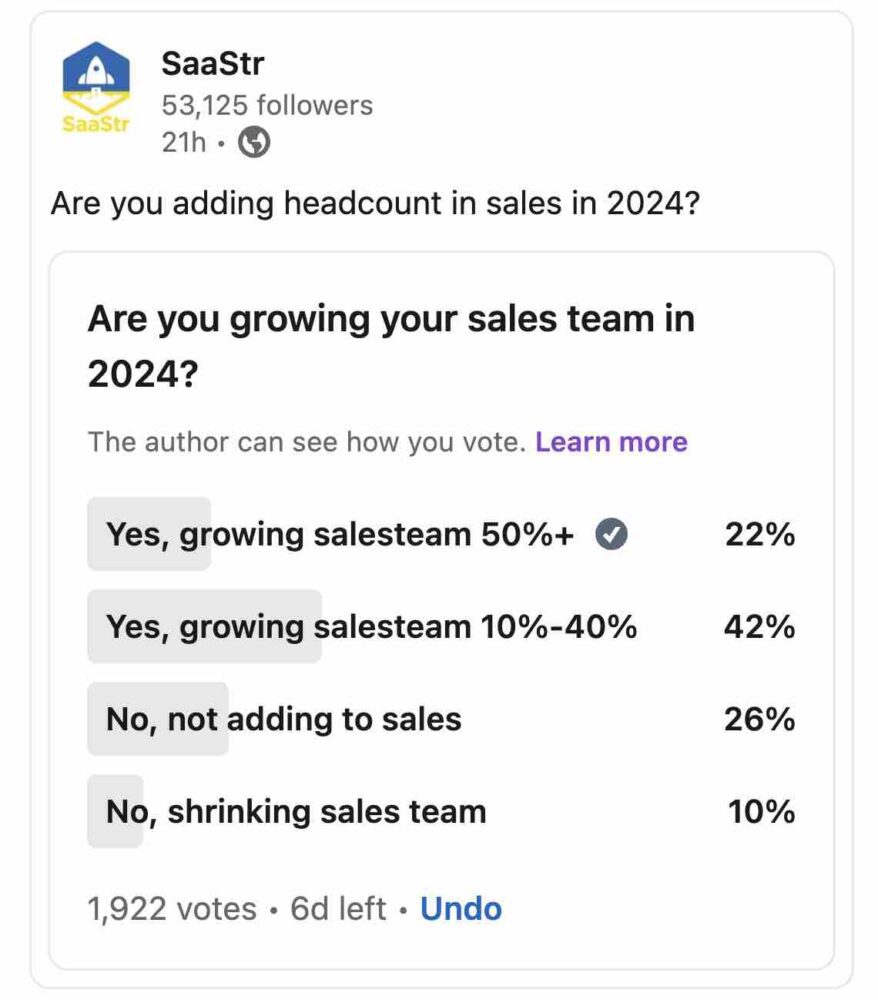
For a year that supposedly arrived wearing a gray hoodie labeled “cautious growth,” 2024 has delivered a surprise: many companies are not slamming the brakes on sales hiring. They are pressing the acceleratorcarefully, sure, but still pressing it. In a SaaStr survey of more than 2,000 SaaS executives, 64% said they were growing their sales teams in 2024, and 22% said they were growing those teams by 50% or more.
That is not a tiny footnote. It is a signal. After years of layoffs, budget scrutiny, longer sales cycles, and “please justify every software subscription like it’s applying for citizenship,” companies still know one thing: revenue does not magically wander into the building carrying a signed contract. Someone has to create pipeline, qualify demand, build trust, guide buying groups, negotiate value, and close deals.
The real story is not simply that sales teams are growing. The better story is how they are growing. The 2024 sales team is not just bigger. It is more data-driven, more AI-assisted, more specialized, and under more pressure to prove productivity fast. Hiring more reps without improving systems is like buying more frying pans when the kitchen is on fire. Helpful? Maybe. Strategic? Not exactly.
Why Sales Teams Are Growing Again
The biggest reason sales teams are expanding in 2024 is simple: companies still need growth, but the easy-growth era is over. During the low-interest, high-spending years, many organizations could rely on broad demand, aggressive outbound, and generous budgets. In 2024, buyers are more informed, finance teams are more involved, and every deal has to survive a committee meeting that feels like a courtroom drama.
That does not mean sales is less important. It means sales has to be better. B2B buyers often research heavily before speaking with a rep. Many compare products, read reviews, check pricing pages, watch demos, and ask peers long before they book a call. By the time a prospect arrives in the pipeline, they may already have opinions, objections, internal politics, and a spreadsheet with five vendors color-coded like a holiday decoration.
Growing a sales team in this environment is not about throwing more people at a quota. It is about building a revenue engine that can meet buyers where they are. That includes account executives who can run consultative conversations, sales development representatives who can prioritize the right signals, customer success teams that protect expansion revenue, and revenue operations teams that keep the machine from turning into a haunted CRM mansion.
The New Sales Hiring Math: More People, More Precision
In 2024, headcount growth comes with sharper expectations. Leadership teams are asking harder questions before approving new sales roles: What segment will this hire cover? How quickly can they ramp? What pipeline source will support them? What tools will they use? What quota is realistic? What coaching system exists? What happens if the territory is weak?
This is healthy. Sales hiring used to be treated by some companies as a blunt growth lever: add reps, add revenue. But experienced operators know the formula is more complicated. A new account executive without enough qualified pipeline may spend months chasing poor-fit leads. An SDR team without strong messaging may generate meetings that never convert. A manager without clean data may coach from vibes, and vibes do not belong in a forecast review.
The best companies are expanding sales teams with a clearer operating model. They define ideal customer profiles, strengthen enablement, improve handoffs between marketing and sales, and use technology to remove low-value work. Growth is happening, but it is more disciplined than the “hire everyone with a LinkedIn profile and a pulse” days.
AI Is Not Replacing the Sales TeamIt Is Changing the Job Description
Artificial intelligence is one of the biggest reasons sales leaders are rethinking headcount. Salesforce reported that 81% of sales teams are either experimenting with or fully implementing AI, and HubSpot found that AI adoption among salespeople rose sharply from 2023 to 2024. The reason is obvious: salespeople spend too much time not selling.
Modern reps often lose hours to CRM updates, call summaries, account research, email drafting, meeting preparation, follow-up notes, forecasting inputs, and internal reporting. Some of this work matters. Much of it is administrative oatmeal: technically useful, emotionally bland, and nobody wakes up excited to eat three bowls of it.
AI tools can help reps summarize calls, identify buying signals, draft personalized outreach, surface relevant customer data, recommend next steps, and prioritize accounts. This does not eliminate the need for human sellers. It raises the bar for them. If AI handles the repetitive work, reps have fewer excuses for shallow discovery, generic messaging, or forgetting what the buyer said two calls ago.
What AI Means for Sales Hiring
AI changes the type of sales talent companies want. Leaders are looking for reps who can combine human judgment with technology. The best sellers in 2024 are not afraid of AI; they use it like a research assistant, writing partner, and productivity booster. But they still bring the human skills AI cannot fully replicate: empathy, commercial curiosity, negotiation, timing, trust-building, and the ability to read a room when the room is a Zoom grid of twelve silent rectangles.
This is why sales hiring remains active even as automation expands. Companies do not only need more bodies. They need better-equipped people. They need reps who understand business problems, not just product features. They need managers who coach behavior, not just inspect dashboards. They need RevOps professionals who can turn messy data into practical decisions.
Why Buyers Are Harder to Win in 2024
Sales teams are growing because selling has become more complex. Buyers are doing more research independently, involving more stakeholders, and taking longer to reach decisions. Forrester’s business buying research pointed to stalled purchasing processes and buyer dissatisfaction as major challenges. McKinsey’s B2B research continues to emphasize omnichannel selling, where buyers expect a blend of digital convenience and human expertise.
This creates a strange paradox. Buyers want self-service, but they also want guidance. They want to research alone, but they also want a rep who understands their business. They want fast answers, but they also need confidence before committing budget. In other words, buyers want both the vending machine and the trusted advisor. Sales teams have to provide both without sounding like a chatbot in a blazer.
The winning sales team in 2024 is built around buyer enablement. That means giving prospects useful content, transparent information, practical demos, ROI support, stakeholder-specific messaging, and clear implementation guidance. The rep’s job is not to “push” the buyer through a funnel. The rep’s job is to help the buyer make a confident decision in a messy internal environment.
Sales Enablement Is No Longer Optional
If companies are growing sales teams, they must also grow their enablement muscles. Hiring reps without training them is expensive optimism. Sales enablement helps teams ramp faster, deliver consistent messaging, handle objections, understand competitors, and run better discovery.
Enablement in 2024 should be practical, not theatrical. A 90-slide onboarding deck is not enablement; it is a sleep aid with bullet points. Good enablement includes call reviews, role plays, deal strategy sessions, product training, buyer-persona education, messaging frameworks, and easy access to content reps can actually use.
High-performing teams also connect enablement to measurable outcomes. Are new hires reaching productivity faster? Are discovery calls improving? Are win rates rising in target segments? Are managers coaching consistently? Are reps using the right talk tracks? If enablement cannot answer those questions, it may be busybut not necessarily effective.
The Role of Sales Managers Is Getting Bigger
Growing a sales team puts pressure on frontline managers. They are responsible for hiring, onboarding, forecasting, coaching, performance management, territory planning, and occasionally serving as emotional support humans during end-of-quarter chaos. The U.S. Bureau of Labor Statistics projects sales manager employment to grow faster than the average for all occupations from 2024 to 2034, which makes sense: as sales organizations become more complex, strong management becomes more valuable.
But the manager role has to evolve. A manager who only asks, “What’s closing this month?” is not managing; they are narrating anxiety. Great sales managers inspect pipeline quality, coach specific skills, remove blockers, align with marketing and customer success, and help reps make better decisions.
In 2024, sales managers also need to understand data. They do not have to become data scientists, but they should know how to interpret conversion rates, deal velocity, activity quality, pipeline coverage, sales cycle length, average contract value, and churn signals. The best managers blend numbers with context. They know when the dashboard tells the truth and when it is wearing a fake mustache.
What Kind of Sales Roles Are Companies Adding?
Sales team growth does not look the same everywhere. Some companies are adding account executives to capture more demand. Others are rebuilding SDR teams after overcorrecting during layoffs. Some are investing in customer success and account management because expansion revenue is more efficient than constantly hunting new logos. Many are hiring revenue operations, enablement, and sales engineering roles because complex deals require better infrastructure.
In SaaS and B2B technology, a common pattern is a more specialized revenue team. SDRs focus on prospecting and early qualification. Account executives lead discovery, demos, business cases, and negotiation. Sales engineers handle technical depth. Customer success managers drive adoption and renewal. RevOps improves systems, data, territories, compensation, and forecasting. Marketing creates demand and supports self-serve education. When this works, it feels like an orchestra. When it does not, it feels like five bands playing different songs in the same elevator.
How to Grow a Sales Team Without Creating Expensive Chaos
Sales hiring should follow strategy, not panic. Before adding headcount, leaders should answer a few uncomfortable but useful questions. Is the market large enough to support the new team? Is there enough pipeline? Are conversion rates healthy? Is churn under control? Is the product ready? Is pricing clear? Are managers capable of coaching more people? Is the CRM trustworthy?
Companies that skip these questions may grow headcount and still miss revenue goals. The problem is not always the reps. Sometimes the issue is weak positioning, poor lead quality, unclear territories, unrealistic quotas, slow onboarding, or a product that requires a heroic sales effort to explain. Hiring can amplify a good system, but it can also amplify confusion.
A smart growth plan starts with segmentation. Decide which customers are worth pursuing and which are distractions wearing a fake mustache. Then build coverage around that strategy. Enterprise accounts may need experienced AEs, sales engineers, executive sponsorship, and long-cycle deal support. SMB accounts may need speed, automation, self-service tools, and efficient inside sales. Mid-market may require a hybrid model with strong qualification and repeatable playbooks.
Metrics That Matter When Expanding Sales Teams
When a company grows its sales team, leaders should watch more than bookings. Bookings matter, of course. Revenue keeps the lights on and prevents awkward all-hands meetings. But early indicators reveal whether the team is healthy before the quarter ends.
Important metrics include ramp time, quota attainment, pipeline coverage, opportunity creation, win rate, average sales cycle, deal slippage, stage conversion, customer acquisition cost, payback period, and retention. For SDR teams, useful metrics include quality meetings booked, conversion to opportunity, account engagement, connect rates, and sourced pipeline. For managers, coaching frequency and forecast accuracy can reveal whether leadership is improving performance or just reporting it.
The key is to avoid worshiping activity alone. More calls, more emails, and more LinkedIn messages do not automatically mean better selling. A thousand bad emails are not a strategy; they are a digital leaf blower. Sales teams need activity, but they also need relevance, timing, personalization, and follow-through.
The Bottom Line: Growth Is Back, but Discipline Wins
The fact that 64% of surveyed SaaS executives are growing sales teams in 2024 is encouraging. It suggests that companies still believe in human-led revenue growth, even in an AI-powered, buyer-controlled, budget-conscious market. But the winners will not be the companies that simply hire the most reps. They will be the companies that build the best systems around those reps.
Sales growth in 2024 requires a smarter mix of people, process, data, technology, and leadership. AI can reduce busywork. Enablement can improve execution. Managers can coach better decisions. Marketing can educate buyers earlier. RevOps can clean the machinery. But humans still matter because trust still matters. A buyer may use AI to compare vendors, but when the decision is expensive, risky, and politically visible, they want someone credible on the other side of the table.
So yes, sales teams are growing. But the old playbook needs an upgrade. The modern sales organization is leaner in its thinking, sharper in its targeting, and more serious about productivity. Growth is not about adding chairs to the sales floor. It is about making sure every chair has a purpose.
Experience Notes: What Growing Sales Teams in 2024 Feels Like in the Real World
In practical terms, growing a sales team in 2024 feels very different from growing one in 2019 or 2021. Back then, many companies hired ahead of demand because the market rewarded speed. The thinking was: capture territory now, clean up the mess later. In 2024, the mess is no longer invited to the meeting. Finance, operations, and leadership teams want cleaner assumptions before they approve headcount.
One common experience is that sales leaders are being asked to justify every role with sharper math. A VP of Sales may want five new account executives, but the CEO and CFO will ask: Where will the pipeline come from? What is the expected ramp period? What is the quota capacity? What happens if only 60% of reps hit target? How does this affect cash burn? The conversation is not anti-sales. It is anti-fantasy.
Another real-world lesson is that onboarding has become a competitive advantage. Companies growing quickly often discover that hiring is the easy part. Getting reps productive is the hard part. A new seller needs product knowledge, buyer context, objection handling, CRM discipline, messaging confidence, and access to examples of what “good” looks like. Teams that record strong calls, document playbooks, and pair new hires with experienced reps usually ramp faster than teams relying on inspirational chaos.
Managers also feel the strain. A sales manager with six reps may be effective. Give that same manager twelve reps, three new territories, two underperformers, and a new AI tool rollout, and suddenly their calendar looks like it lost a fight. When companies grow sales teams, they must also grow management capacity. Otherwise, reps receive less coaching exactly when they need more.
There is also a cultural challenge. New hires change team dynamics. Top performers may worry about territory dilution. Existing reps may wonder whether quotas will rise. New reps may struggle to understand unwritten rules. Leadership has to communicate clearly: why the team is growing, how territories will be handled, what support is coming, and what success looks like.
The best experience-backed advice is to grow in waves, not stampedes. Hire a focused group, onboard them well, measure the results, fix the gaps, then expand again. Keep the feedback loop short. If new reps are struggling with the same objection, update the messaging. If demos are too technical, improve sales engineering support. If leads are weak, revisit targeting. If CRM data is messy, do not ignore it and hope the forecast fairy arrives.
Finally, remember that sales hiring is not just a numbers game. Great sellers want clarity, strong leadership, useful tools, fair compensation, and a product they can believe in. If your company offers those things, growing a sales team in 2024 can be a powerful move. If not, you may still hire peoplebut you will mostly be renting their frustration until they find a better-run team.
The companies that win are treating sales growth as a system-building exercise. They are not asking, “How many reps can we add?” They are asking, “How do we help the right reps succeed faster with the right buyers?” That is the difference between headcount growth and revenue growth. One fills seats. The other builds momentum.














