
Sir Isaac Newton is usually remembered as the gravity guy: apple falls, genius thinks, science textbooks cheer. But Newton’s notebooks reveal a far stranger and more fascinating picture. The man who helped explain planetary motion also spent years studying biblical prophecy, ancient chronology, alchemy, sacred architecture, and the Great Pyramid of Giza. Yes, the same Newton who gave the world calculus also looked at pyramids and wondered whether their measurements could unlock divine history. History, apparently, enjoys plot twists.
The phrase “Isaac Newton pyramid notes” sounds like the title of a dusty academic paper or a very ambitious adventure movie. In reality, it refers to Newton’s handwritten studies of the Great Pyramid, ancient units of measurement, Solomon’s Temple, and biblical prophecy. Some of these notes, badly damaged by fire, were sold at auction in 2020 for hundreds of thousands of pounds. Their popularity came from one irresistible question: did Newton believe the pyramids held secrets about the apocalypse?
The answer is both yes and no. Newton did not treat the Great Pyramid as a magical doomsday machine. He was not looking for glowing buttons, alien batteries, or a calendar hidden behind a secret door. Instead, he believed ancient measurements might preserve knowledge about the original “sacred cubit,” a unit connected to biblical architecture, especially the Temple of Solomon. If he could recover that unit, he thought he might better understand ancient history, scripture, and prophetic timelines.
Why Isaac Newton Studied the Great Pyramid
To modern readers, Newton’s pyramid research may sound eccentric. But in the 17th century, the boundaries between science, theology, history, mathematics, and mysticism were much less rigid than they are today. Newton lived in a world where nature was often viewed as a book written by God, and scripture was treated as another book filled with patterns waiting to be decoded. For Newton, studying the heavens, light, metals, temples, and pyramids were not separate hobbies. They were different routes toward one grand truth.
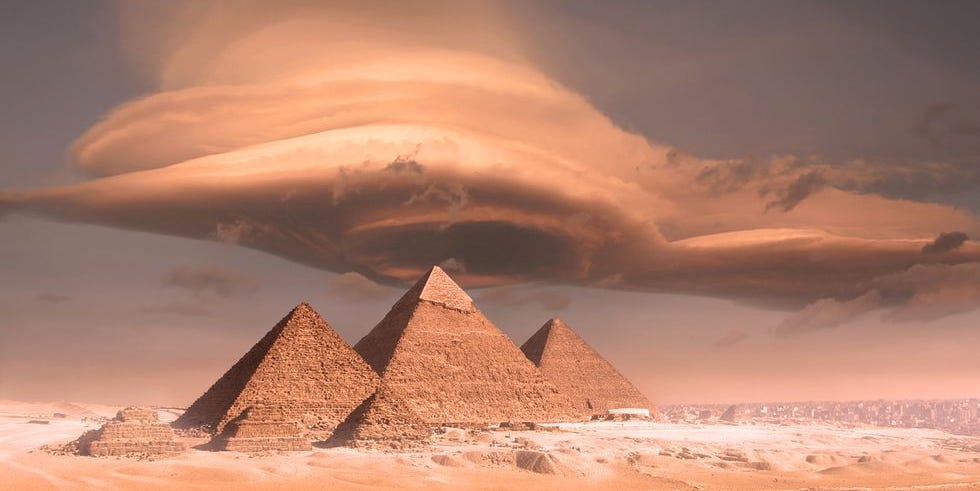
The Great Pyramid of Giza was especially tempting to scholars because of its age, precision, and enormous scale. Built for Pharaoh Khufu around the middle of the third millennium BCE, the Great Pyramid originally stood about 481 feet tall. Its base covered more than 13 acres, and its sides were aligned with striking accuracy. Long before modern archaeology explained much of its construction and purpose, early modern scholars looked at the pyramid and asked: what did the ancient Egyptians know that we have forgotten?
Newton was interested in that question because he believed ancient civilizations may have preserved accurate knowledge of the Earth’s size and sacred measurement systems. He studied the pyramid not simply as a monument, but as a measuring instrument from antiquity. The key idea was the cubit, an ancient unit used in Egypt and the Bible. If Newton could determine the exact length of the cubit used in the Great Pyramid, he hoped to compare it with biblical measurements and reconstruct the dimensions of Solomon’s Temple.
The Sacred Cubit: Newton’s Mathematical Treasure Hunt
Newton’s pyramid notes focused heavily on ancient metrology, which is a fancy word for the study of measurement. Metrology may not sound thrilling, but in Newton’s hands it became a detective story. Imagine Sherlock Holmes, but instead of footprints and cigar ash, he is examining cubits, temple walls, and prophetic numbers.
The Bible describes Solomon’s Temple using measurements that depend on the cubit. The problem is that ancient cubits varied. Egyptian cubits, Hebrew cubits, Greek measures, and Roman measures were not identical. Newton wanted to determine which cubit was used in sacred architecture. He believed that the Great Pyramid might preserve the original or most accurate form of this unit.
That mattered because Newton did not see Solomon’s Temple as merely an ancient religious building. He saw it as a divinely significant structure whose proportions could reveal deeper truths about creation, worship, and prophecy. His study of the Temple lasted for decades. He compared biblical passages, ancient historians, architectural ratios, and Jewish sources. The pyramid entered this research because it seemed to offer a surviving stone reference point from a very ancient world.
Did Newton Think the Pyramid Predicted the Apocalypse?
Newton did connect his pyramid studies to biblical prophecy, but not in the clickbait sense of “secret pyramid countdown clock discovered.” His goal was not to stand in front of the Great Pyramid with a dramatic cape and announce the date of the end of the world. In fact, Newton disliked reckless end-times predictions. He thought careless prophecy hunters made serious religious study look ridiculous, which is impressive because even in Newton’s day, people were already tired of sensational doomsday math.
Newton’s famous “2060” calculation came from his interpretation of biblical books such as Daniel and Revelation, not directly from the pyramid itself. He explored prophetic periods such as 1,260 years and tried to connect them with historical events. In some manuscripts, he suggested that major prophetic fulfillment would not occur before 2060. That is very different from saying, “The world ends in 2060.” Newton was cautious. His wording suggests a “not before” date rather than a guaranteed cosmic deadline.
So where do the pyramids fit? Newton believed the measurements of the Great Pyramid could help him understand ancient sacred units. Those units could then help reconstruct biblical architecture. That architecture, in turn, belonged to his larger system of scriptural history and prophecy. The pyramid was not the apocalypse itself. It was one piece in Newton’s enormous puzzle.
The Burnt Notes That Sparked Modern Curiosity
The Newton pyramid notes that made headlines in 2020 were especially dramatic because they had been damaged by fire. According to auction descriptions, the pages dated probably to the 1680s and contained Newton’s handwritten observations about the Great Pyramid, ancient units of measurement, and biblical prophecy. The fire damage created a cinematic image: fragile, scorched pages from one of history’s greatest minds, filled with calculations about pyramids and the end times. If a museum exhibit had a “please whisper mysteriously here” sign, this would be the place.
These notes sold for a high price not because they proved a hidden apocalypse code, but because they opened a window into Newton’s lesser-known intellectual world. Many people know Newton from physics class. Fewer know that he wrote extensively on theology, church history, prophecy, chronology, and alchemy. His surviving manuscripts show a thinker who was not content with one category. Newton wanted the blueprint of reality, and he searched for it everywhere.
Newton Was Not “Anti-Science”He Was Pre-Modern
One common mistake is to judge Newton as if he were a modern scientist secretly betraying science by studying prophecy. That misses the historical context. Newton lived before today’s sharp separation between scientific research and religious interpretation. Natural philosophy, the ancestor of modern science, was often deeply connected to theology. Many scholars believed that studying nature revealed the wisdom of the Creator.
Newton’s work on gravity, optics, and mathematics was rigorous and revolutionary. His work on prophecy was also systematic, though based on assumptions most modern scholars would not share. He applied patterns, timelines, textual comparison, and mathematical reasoning to scripture. The result feels strange to us because the subject matter is different, not because Newton suddenly stopped being Newton.
In other words, the same mental engine was running. It was just driving down a much weirder road.
The Great Pyramid: Monument, Tomb, and Magnet for Theories
The Great Pyramid has always attracted big ideas. Archaeology identifies it as the tomb of Khufu, part of a royal funerary complex on the Giza Plateau. Its construction required vast organization, skilled labor, engineering, quarrying, transport, and long-term planning. Modern research continues to discover new details about its structure. In recent years, scanning technologies have revealed hidden spaces and corridors, reminding us that ancient monuments can still surprise us without needing supernatural explanations.
Yet the pyramid’s precision and age have made it a magnet for speculation. Some theories claim it encodes astronomical constants, world history, lost technology, or prophetic messages. Most of these claims go far beyond evidence. Newton’s interest is often dragged into modern pyramid mysticism, but his approach was different. He was not claiming the pyramid was built by aliens or designed as a mystical billboard for the 21st century. He was investigating ancient measurement and sacred history through the tools available to him.
What Newton Actually Teaches Us About “Hidden Secrets”
The most useful lesson from Newton’s pyramid notes is not that pyramids secretly predict the apocalypse. It is that great minds are complicated. Newton was not a cardboard cutout labeled “rational scientist.” He was a brilliant, intense, religious, private, sometimes obsessive scholar who believed knowledge had been scattered across nature, scripture, and antiquity.
His pyramid notes reveal a man trying to rebuild lost knowledge from fragments. A cubit here. A temple measurement there. A prophecy in Daniel. A passage in Revelation. A historical date from late antiquity. A pyramid dimension from Egypt. To Newton, these were not random facts. They were clues in a cosmic archive.
Modern readers do not have to accept Newton’s prophetic framework to appreciate the seriousness of his search. His notes show intellectual ambition at full volume. They also warn us about the danger of forcing patterns onto evidence. Newton was careful by the standards of his time, but later interpreters have often simplified his work into dramatic headlines. “Newton studied ancient measurements” becomes “Newton cracked the pyramid apocalypse code.” That is a fun headline, but history deserves better table manners.
Why the Apocalypse Angle Still Fascinates Us
People are drawn to apocalypse stories because they promise hidden order in chaos. The world feels unpredictable, and a secret timeline can feel strangely comforting. If someone as brilliant as Newton searched for prophetic patterns, the idea becomes even more tempting. Maybe the universe has a schedule. Maybe ancient stones know something we do not. Maybe the Great Pyramid is less tomb and more time capsule.
But fascination should not replace evidence. Newton’s pyramid notes are historically real. His interest in prophecy is real. His studies of the Great Pyramid, ancient cubits, and Solomon’s Temple are real. What is not proven is the claim that the pyramids contain a reliable apocalypse countdown. The better story is subtler and more human: Newton wanted to understand history as a meaningful design, and the Great Pyramid seemed to him like one of the oldest measuring sticks left behind.
Experience Section: Reading Newton’s Pyramid Notes in the Age of Internet Mysteries
Encountering the story of Isaac Newton’s pyramid notes today feels a little like opening a hidden drawer in a very respectable professor’s desk and finding maps, temple sketches, prophecy charts, and maybe a snack he forgot in 1687. At first, the discovery is surprising. Then it becomes oddly relatable. Newton was doing what curious people still do: chasing connections across subjects that most people keep separate.
Anyone who has ever fallen into a late-night research rabbit hole can understand the mood. You begin with one simple question: “Why did Newton study the pyramids?” Three hours later, you are reading about Egyptian cubits, Solomon’s Temple, the Book of Daniel, auction catalogs, and the history of manuscript collections. Your coffee is cold. Your browser tabs are multiplying like ancient dynasties. You are no longer fully in control.
The experience also changes how we think about intelligence. Newton’s greatness did not come from having tidy interests. It came from intensity. He pushed questions further than most people would. Sometimes that led to physics that reshaped civilization. Sometimes it led to burnt notes about pyramid measurements and prophetic chronology. The important point is that curiosity does not always travel in straight lines. Sometimes it zigzags through Egypt, Jerusalem, Cambridge, and Revelation before breakfast.
There is also a useful lesson for modern readers who love mysteries. The internet often rewards the biggest claim, not the best evidence. “Newton studied ancient measurement systems” sounds educational. “Newton discovered pyramid apocalypse secrets” sounds clickable. The second headline wins attention, but the first one is closer to the truth. Learning to enjoy the real story without inflating it is a skill. Reality is already strange enough. It does not need a fake underground laser chamber to be interesting.
Newton’s pyramid notes are fascinating because they sit at the crossroads of science, religion, architecture, mathematics, and imagination. They remind us that the past was not simple. The same person could calculate planetary motion and study biblical prophecy. The same mind could demand mathematical precision and pursue sacred symbolism. Instead of flattening Newton into either “pure scientist” or “mystic prophet,” we get a richer picture: a human being trying, with astonishing energy, to understand everything.
For writers, students, and curious readers, this topic is a gift. It invites skepticism without cynicism. It allows wonder without gullibility. It lets us ask why ancient monuments still feel powerful and why brilliant people sometimes pursue ideas that later generations find unusual. The Great Pyramid does not need to predict the apocalypse to matter. Newton does not need to be right about every prophetic calculation to remain fascinating. The real secret is not hidden in the stones. It is hidden in the way humans search for meaning.
Conclusion: Do Pyramids Hold Apocalypse Secrets?
So, do pyramids hold apocalypse secrets? Based on real historical evidence, the safest answer is nonot in the dramatic sense. The Great Pyramid is not a proven doomsday clock. Isaac Newton did not leave behind a clean, confirmed pyramid code that predicts the end of the world. What he did leave behind is far more interesting: a record of how one of history’s greatest thinkers tried to connect ancient measurement, sacred architecture, biblical prophecy, and the history of civilization.
The Isaac Newton pyramid notes matter because they reveal the full range of Newton’s mind. He was not only the scientist of gravity and light. He was also a historian of ancient kingdoms, a student of scripture, a decoder of prophecy, and a man convinced that the universe had been designed with mathematical order. His pyramid studies were part of that enormous search.
The real mystery is not whether the pyramid predicts the apocalypse. The real mystery is how far human curiosity can go when it refuses to stay in one box. Newton looked at falling apples, moving planets, biblical numbers, temple walls, and Egyptian stonework, and he asked the same basic question again and again: what pattern lies beneath this? That question still keeps history alive.













