
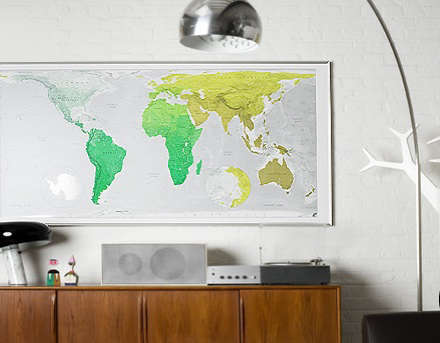
Future Maps from the UK are what happens when geography decides to dress better. Instead of treating a world map like something that belongs only in a classroom, a shipping office, or the back wall of a dentist’s waiting room, The Future Mapping Company turns cartography into a stylish home accessory. Think accurate reference tool, modern wall art, conversation starter, and subtle travel flex all rolled into one handsome sheet of paper, magnetic panel, or framed design piece.
Founded by designer Marcus Kirby, The Future Mapping Company built its reputation on maps that combine serious geographic thinking with bold color, lithographic printing, metallic inks, and a distinctly British sense of graphic discipline. These are not “random map posters” bought because the sofa looked lonely. They are designed objects. They belong in living rooms, offices, classrooms, studios, kids’ rooms, hallways, and anywhere a blank wall is begging not to be boring.
The phrase “Accessories: Future Maps from the UK” points to a larger idea: maps are no longer just tools for finding places. They are accessories for identity, curiosity, design taste, and the quiet belief that your wall should do more than hold paint. A good map says, “I know where Madagascar is,” without shouting it during dinner.
What Are Future Maps from the UK?
Future Maps are contemporary wall maps created by The Future Mapping Company, a British brand known for combining cartographic information with strong visual design. The company produces world maps, country and continent maps, city maps, star maps, personalized maps, wallpaper, framed maps, magnetic maps, and map accessories such as hanging rails, magnet packs, and replacement strips.
The company’s most recognizable product is the Future Map world wall map, which uses an equal-area projection. In simple terms, this projection aims to show countries and continents in their correct proportional size. That makes it different from many familiar world maps that enlarge areas closer to the poles. So yes, Greenland finally has to stop pretending it is roughly the size of Africa. Cartographic justice has entered the room.
Future Maps are sold in several formats, including paper prints, magnetic versions, framed editions, and larger statement pieces. Their appeal comes from three ingredients working together: geographic accuracy, modern color palettes, and premium print finishes. The result is a map that works as both information and decoration.
Why Future Maps Became a Design Accessory
Maps have always carried emotional weight. They remind people of where they came from, where they have been, and where they would go if PTO days grew on trees. A wall map can make a room feel worldly, curious, educated, and personal. Future Maps take that natural appeal and polish it for modern interiors.
Unlike vintage school maps, which often bring a nostalgic, slightly dusty charm, Future Maps lean contemporary. Their colors can be bright, graphic, and playful, or refined and metallic. They fit into minimalist spaces, creative studios, family rooms, classrooms, and home offices. A Future Map can sit above a desk like a productivity coach with coastlines, or stretch across a living room wall as a large-scale design statement.
They Are Decorative, But Not Empty Decoration
Some accessories merely sit there looking pretty. Future Maps do that, but they also invite repeated looking. You notice a coastline, a border, a sea, a cluster of islands, or a route from one place to another. Guests drift toward them. Children point at countries. Adults pretend they already knew exactly where the Faroe Islands were. Everyone wins.
This is one reason maps remain such durable wall decor. They offer visual texture, pattern, color, and educational value. A framed print may look beautiful, but a map also gives the eye a reason to wander. It rewards attention. In a home full of screens, a large physical map can feel refreshingly analog.
The Equal-Area Projection: The Brainy Part That Still Looks Good
One of the most important features of many Future Maps is the equal-area projection. A flat map can never show the round Earth perfectly. Something must be distorted: shape, direction, distance, or area. Equal-area projections prioritize the relative size of landmasses, even if some shapes stretch or compress.
For a wall map, this matters because it changes how viewers understand the world. Traditional projections can make northern countries look much larger than they really are. Equal-area maps correct that imbalance by giving viewers a more proportional sense of global scale. Africa, South America, and other large landmasses appear with more honest visual weight.
That does not mean an equal-area map is “perfect.” No flat map gets that trophy. But it is thoughtful. It asks the viewer to question familiar images of the world. For design lovers, that makes the map more interesting. For educators, it makes the map more useful. For dinner guests, it provides a safe debate topic that does not involve politics, cryptocurrency, or why someone put raisins in the salad.
Materials, Printing, and Finish
Future Maps stand out because of how they are made. The company emphasizes lithographic printing, careful color selection, metallic effects, and gloss varnish. These details matter because maps are dense visual objects. Tiny labels, coastlines, borders, and color fields need clarity. A fuzzy map is not charming. It is a geography-themed headache.
The lithographic approach gives the maps a richer, more tactile presence than ordinary digital posters. Metallic seas, gloss-varnished landmasses, and high-contrast colors create movement as light shifts across the surface. In a bright room, the map can look different in the morning than it does at night. That is a lot of personality for something that does not need charging.
Paper Maps
Paper Future Maps are ideal for buyers who want flexibility. They can be framed, clipped, hung with rails, or displayed more casually. Paper maps are lighter and often easier to ship, store, and rotate. They also suit renters who want a strong visual feature without drilling enough holes to make the landlord sigh in another zip code.
Magnetic Maps
Magnetic Future Maps add interaction. With magnets, users can mark places visited, future trips, family origins, business locations, or dream destinations. In homes with children, magnetic maps can become an informal geography game. In offices, they can track clients, projects, markets, or team locations. In travel-loving households, they become a beautiful record of memories and ambitions.
Framed Maps
Framed Future Maps are the most polished option. They work well in living rooms, offices, hotel interiors, meeting rooms, and gallery-style walls. A frame turns the map from poster to permanent design feature. It also protects the print and gives it a finished architectural presence.
Future Maps Accessories: Small Details, Big Difference
The accessories category is where Future Maps become easier to live with. The Future Mapping Company offers items such as oak hanging rails, white hanging rails, magnet packs, and hanging strips for different magnetic map sizes and map types. These are not glamorous accessories in the jewelry sense. Nobody is walking into a party whispering, “Is that an oak hanging rail?” But they matter.
Good hanging hardware can make the difference between a map that looks intentionally styled and one that looks like it lost an argument with gravity. Wooden rails create a clean, gallery-inspired look. White rails blend into light walls and modern interiors. Magnet packs and replacement strips keep magnetic maps useful over time.
Oak Hanging Rails
Oak hanging rails add warmth and a handcrafted feel. They are especially effective in Scandinavian, mid-century, rustic-modern, and minimalist spaces. The wood softens the precision of the map and helps it feel like part of the room rather than a classroom escapee.
White Hanging Rails
White hanging rails are quieter. They work well when the map itself should be the star. In bright rooms, kids’ rooms, studios, and contemporary apartments, white rails keep the display crisp and uncluttered.
Magnet Packs and Hanging Strips
Magnet packs and hanging strips are practical upgrades. If the map is used often, extra magnets are helpful for marking destinations, planning trips, or turning geography into a low-key family competition. Hanging strips keep magnetic maps properly mounted, which is useful for larger versions that need even support.
Where Future Maps Work Best in the Home
A Future Map can work almost anywhere, but placement changes the mood. In a living room, it becomes a focal point. In a home office, it suggests ambition and global thinking. In a child’s bedroom, it becomes educational decor that does not feel like homework wearing pajamas. In a hallway, it turns a pass-through space into a small gallery moment.
Living Room
A large Future Map above a sofa can anchor the room the way a painting would. Choose a colorway that connects with existing textiles, rugs, or accent pieces. If the room is neutral, a bright map can add energy. If the room already has strong color, a more restrained map may keep things balanced.
Home Office
In a home office, a Future Map adds structure and imagination. It makes the workspace feel bigger than the laptop screen. For remote workers, freelancers, educators, designers, and travel planners, a map can serve as visual inspiration. It says, “There is a whole world out there,” which is helpful when your calendar says, “There are six video calls in here.”
Kids’ Room or Study Area
Maps are classic children’s room accessories because they teach without nagging. A Future Map can introduce scale, continents, oceans, countries, and travel dreams. Magnetic versions are especially useful because children can interact with them. A map that invites touch often teaches more than one that only demands admiration from a safe distance.
Entryway or Hallway
A map in an entryway creates instant personality. It can tell visitors that the household values travel, curiosity, culture, or at least very attractive wall accessories. Hallways also work well for large maps because they offer viewing distance. A big map needs breathing room. It is a wall feature, not a postage stamp with ambition.
How to Choose the Right Future Map
Choosing a Future Map depends on size, format, color, purpose, and room style. Start with the wall. Measure it. Then measure it again, because walls are sneaky and online product photos are dangerously persuasive. A huge map can be stunning, but only if the space can handle it.
Pick the Size First
If the map will hang above a sofa, bed, desk, or console table, choose a size that feels proportional. A small map on a large wall can look timid. A massive map in a tiny nook can look like it is trying to annex the room. The goal is confidence, not conquest.
Choose the Format Based on Use
Choose paper if you want flexibility and affordability. Choose magnetic if you want interaction. Choose framed if you want a refined, finished look. Choose wallpaper if you want full commitment and have reached the “my wall is now a continent” stage of interior confidence.
Match the Colorway to the Room
Future Maps often use bold color combinations, metallic finishes, and high contrast. That is part of their charm. For calm rooms, use a softer palette. For creative rooms, go brighter. For offices, consider colors that feel energetic without becoming distracting. Remember: the map should invite exploration, not visually tackle people when they enter.
Future Maps as Gifts
Future Maps make excellent gifts because they feel personal without requiring you to guess someone’s sweater size. They work for travelers, students, teachers, designers, new homeowners, remote workers, geography fans, and people who say “I love maps” with the same seriousness other people reserve for coffee.
A world map suits broad curiosity. A city map can celebrate a meaningful place. A British Isles map may appeal to someone with UK roots or travel memories. A star map can feel romantic, reflective, or cosmic, depending on the occasion. Add hanging rails or extra magnets, and the gift becomes ready to use rather than another beautiful thing waiting in a closet for “someday.”
Design Analysis: Why These Maps Feel Modern
Future Maps feel modern because they refuse to separate function from beauty. Many decorative maps lean heavily into nostalgia: sepia tones, antique borders, fake aging, and fonts that look like they know where treasure is buried. Future Maps go the other direction. They use clean design, fresh color, and contemporary production techniques.
That modernity makes them flexible. They can sit beside modern furniture, industrial shelving, minimalist lighting, children’s storage, or creative studio materials. They do not require a nautical theme, a globe collection, or a suspiciously large brass telescope. They simply need a wall and a viewer willing to look closer.
Practical Care and Styling Tips
To keep a Future Map looking sharp, avoid placing it in harsh direct sunlight for long periods. Like many printed objects, color can fade with excessive UV exposure. Frame paper maps when possible if they are intended as long-term decor. Keep magnetic maps clean and use the correct hanging strips or rails so the map stays flat and secure.
Style the area around the map with restraint. Let the map breathe. If it hangs above a desk, keep the desktop simple. If it sits in a gallery wall, pair it with quieter pieces: black-and-white photography, small abstract prints, or simple typography. If it is in a child’s room, add a globe, travel books, or animal illustrations for a layered learning corner.
Common Mistakes to Avoid
The first mistake is buying too small. Maps contain detail, and detail needs space. The second mistake is choosing a colorway that clashes with everything else in the room. The third mistake is mounting the map too high, which forces viewers into a neck-craning geography workout. Hang it at a comfortable viewing height, especially if children will use it.
Another mistake is treating the map like ordinary filler art. A good map deserves thoughtful placement. Put it where people can approach it, read it, and interact with it. The closer a map is to daily life, the more valuable it becomes.
Experience Notes: Living with Future Maps from the UK
Spending time with a Future Map changes how a room behaves. At first, it is simply a beautiful object: color, scale, print finish, clean typography, and that satisfying sense of order maps always bring. Then, slowly, it becomes part of everyday conversation. Someone points at Iceland. Someone else asks why Africa looks larger than expected. A child asks where penguins live. A guest mentions a trip to Lisbon. Suddenly the wall is doing social work.
In a home office, a Future Map can make work feel less boxed in. It is easy to spend hours staring at spreadsheets, tabs, messages, and dashboards until the world shrinks to the size of a browser window. A physical map reverses that. It reminds you that places are real, distances matter, and ideas travel. For designers, writers, teachers, and entrepreneurs, that reminder can be quietly motivating.
In a family room, magnetic maps are especially satisfying. They turn memory into a visible pattern. Add a magnet for where grandparents live, where a vacation happened, where a favorite animal comes from, or where a book is set. Over time, the map becomes less like decor and more like a family archive. It collects stories without needing a password reset.
In children’s spaces, Future Maps work because they do not feel childish. Many kids’ room accessories are quickly outgrown, but a well-designed map can stay relevant for years. Younger children may enjoy colors and magnets. Older children may use it for homework, travel dreaming, or simply as cool wall art. Parents get the bonus of educational value without turning the bedroom into a full-time classroom. Nobody wants bedtime to come with a pop quiz on the Caspian Sea.
The most rewarding experience is how often a map invites curiosity. Unlike a static poster, a map keeps offering new details. You can glance at it for months and still notice something new: an island chain, a border shape, a sea name, a place you have heard in the news, or a country you suddenly want to learn about. That repeat value is why Future Maps make sense as accessories. They are decorative, yes, but they are also durable companions for curiosity.
There is also pleasure in the physical finish. The metallics, gloss, and print quality give the map a presence that digital screens cannot imitate. A phone map is useful when you are lost. A Future Map is useful when you want to feel oriented. That is a different kind of navigation. One gets you to the coffee shop. The other reminds you that the world is enormous, fascinating, and still worth looking at slowly.
Conclusion
Accessories: Future Maps from the UK is more than a product idea. It is a reminder that practical objects can be beautiful, and beautiful objects can still teach us something. Future Maps combine accurate cartographic thinking, equal-area perspective, modern British design, and thoughtful accessories such as hanging rails, magnets, frames, and strips. They bring geography into the home in a way that feels stylish, useful, and surprisingly personal.
For anyone decorating a home, office, classroom, or creative studio, Future Maps offer a rare balance: they are smart without being stiff, decorative without being empty, and playful without looking disposable. They are proof that a wall accessory can do more than match the cushions. It can make people pause, point, talk, remember, learn, and dream about where to go next.














