
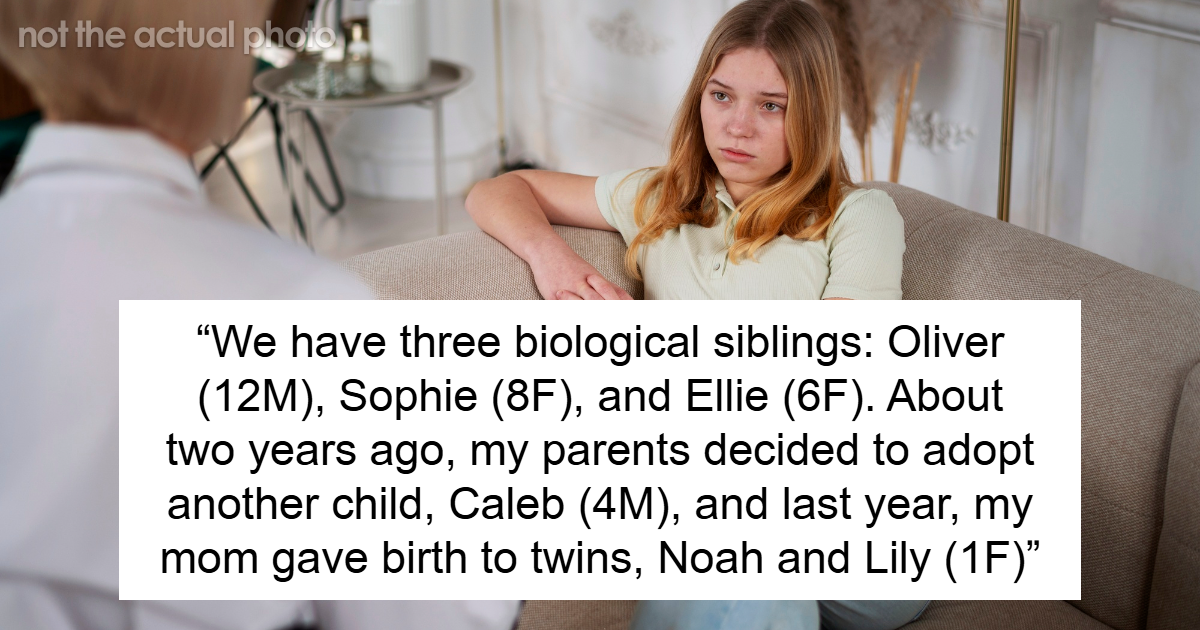
There are normal family chores, and then there is being drafted into what feels like a permanent unpaid daycare shift. That is the difference at the heart of stories like this one: two 16-year-old twins who are supposed to be figuring out homework, friendships, sports, crushes, college dreams, and whether their haircut was a bold choice or a cry for help, but instead keep getting handed six younger siblings and a mountain of responsibility.
On the surface, some adults shrug and say, “It’s just babysitting.” But when babysitting stops being occasional help and starts becoming the default setting of a teenager’s life, the situation changes. It becomes something much heavier. Experts often describe that kind of role reversal as parentification, a family pattern in which a child or teen is pushed into duties that are too constant, too adult, or too emotionally loaded for their stage of life.
And that is exactly why this story hits a nerve. It is not really about one missed Saturday night. It is about what happens when teenagers become backup parents before they have even gotten a fair shot at being teenagers.
When “Helping Out” Stops Being Reasonable
Let’s be fair: helping around the house is not a tragedy. Most teens babysit once in a while, wash dishes, fold laundry, or keep an eye on a younger sibling for an hour. That is called being part of a family. No violin solo required.
The problem begins when the expectation becomes constant, automatic, and nonnegotiable. If the twins are the first names called every time the parents want to work late, run errands, attend events, sleep in, or simply disappear into adult life while the teens handle the chaos, then the arrangement is no longer ordinary. It is a system.
And systems shape people.
In families with too much pressure on older children, teens often become the planners, entertainers, snack distributors, diaper deputies, homework monitors, referee squad, and emotional shock absorbers of the home. One of them is microwaving nuggets while the other is stopping a toddler from licking a window. Again. Meanwhile, their own needs get bumped to the bottom of the list like an email nobody wants to answer.
That imbalance matters because adolescence is not a waiting room before adulthood. It is a crucial period of development. Teens need time to build identity, friendships, social confidence, independence, and coping skills. They also need downtime, sleep, privacy, and a chance to fail at low-stakes teenage things rather than being expected to perform as miniature adults.
Why Missing the Teen Years Comes at a Cost
Social life is not “extra”
Adults sometimes talk about teen activities as if they are optional fluff. As if hanging out with friends is just decorative. But being with peers is a major part of how teenagers learn communication, boundaries, trust, conflict management, and self-esteem. Friday night plans, club meetings, part-time jobs, football games, drama rehearsals, and aimless conversations over fries are not meaningless distractions. They are part of growing up.
If these twins are always stuck at home with six kids, they are not just missing parties. They are missing practice at being people their own age. Over time, that can create resentment, social isolation, and the awkward feeling that everyone else got the instruction manual for adolescence while they were busy finding somebody’s missing shoe.
School and future plans can quietly suffer
Heavy family caregiving does not always explode in dramatic fashion. Sometimes it chips away at life slowly. A late homework assignment here. A skipped club meeting there. A missed sports practice. A canceled study group. A lost scholarship opportunity because there was no time to build the résumé everyone keeps talking about.
Teenagers who carry too much at home can look “mature” from the outside while feeling stretched paper-thin on the inside. People praise them for being responsible, but responsibility without support can become exhaustion wearing a gold star.
Rest and identity matter too
Teens need real rest, not just the kind where they are technically sitting down but still listening for a crash in the other room. They need mental space to think about who they are beyond what the family needs from them. Are they artistic? Athletic? Quiet? Ambitious? Funny? Burned out? All of the above?
When a teen is always in caretaker mode, identity can shrink around usefulness. They stop asking, “What do I want?” and start asking, “What does everyone need from me now?” That is a rough script to carry into adulthood.
The Hidden Emotional Fallout
One reason stories like this spread so quickly online is because so many people recognize the pattern. Maybe not with six siblings, maybe not with twins, but with the same emotional math: the oldest kids become dependable because they have to be, and then they keep getting more piled on because they are dependable.
It is a brutal family paradox. The more capable the teen becomes, the easier it is for adults to forget that they are still a teen.
That often creates a mix of emotions that do not fit neatly into a caption. The twins may love their younger siblings and still be furious. They may feel proud of being trusted and deeply trapped at the same time. They may feel guilty for wanting freedom. They may even worry that saying no makes them selfish, when in reality it may be the healthiest sentence in the house.
Over time, chronic over-responsibility can fuel anxiety, irritability, emotional numbness, and constant guilt. Some teens become hyper-competent and struggle to relax. Others become withdrawn because they are too drained to fight anymore. Some carry the pattern into adulthood and feel responsible for everyone’s feelings forever, which is exhausting and a terrible hobby.
Why Parents Sometimes Do This
Not every parent who relies too much on an older child is cruel. Some are overwhelmed. Some are financially stressed. Some lack support. Some come from family cultures where older siblings are expected to step in without question. Some convince themselves that this is “teaching responsibility” when it is actually handing over part of the parenting load.
Intent matters, but impact matters more.
If parents regularly depend on two 16-year-olds to manage six younger children, then the family has crossed into an unsustainable setup whether the adults mean well or not. The twins did not choose to have six kids. The parents did. That is the plainest truth in the whole story.
So What Would Fairness Actually Look Like?
Babysitting should be occasional, not assumed
A reasonable family arrangement would include asking, not ordering. It would include advance notice, clear start and end times, and the freedom to say no sometimes. It would not treat the twins’ free time as a public utility.
Teen plans should count as real plans
If one twin has practice, a school event, or just wants to leave the house and be 16, that should matter. A teen’s social life is not automatically less important than a parent’s convenience. If adults want responsible teens, they also have to respect teen responsibilities and commitments.
Compensation and appreciation matter
When older kids provide substantial childcare, parents should not act like gratitude is optional. Money helps. So does genuine acknowledgment. So does making sure the teen is not losing every weekend in the bargain. Nothing worsens resentment faster than being overused and then told to be thankful for the opportunity.
Parents need backup plans that are not just “the twins”
That could mean paid childcare, help from other adults, swapping support with relatives, reducing optional obligations, or reworking schedules. If the family can only function because two teenagers are constantly filling the gaps, the real issue is not the twins’ attitude. The system is broken.
What the Twins Could Learn From This, For Better or Worse
Hard seasons can make teenagers strong, but strength built under unfair pressure often comes with a bill attached. These twins may become organized, resourceful, and calm under chaos. They may know how to soothe a crying child, prepare a quick meal, and locate missing socks with military precision. Impressive? Sure. Ideal for 16? Not exactly.
The danger is that adults around them may confuse survival skills with healthy development. A teen who can manage six kids for an evening may look incredibly mature, but maturity gained through chronic burden is not the same thing as growing up with proper support.
Healthy responsibility leaves room for joy. Unhealthy responsibility swallows it.
What Parents Should Do Instead
If parents see themselves in this story, the fix is not complicated, even if it is inconvenient.
- Ask before assigning childcare.
- Limit how often teens are expected to babysit.
- Protect school, sleep, and extracurricular time.
- Do not dump emotional adult problems onto teens.
- Rotate household tasks fairly across the family.
- Create dependable routines so the house is not run by emergency mode.
- Thank teens for helping without turning that help into a permanent job description.
Most importantly, parents should remember that older children are not replacement adults. They are still in the middle of becoming themselves.
The Bigger Message Behind the Story
What makes this headline powerful is not just the number of siblings. It is the grief tucked inside the situation. Teen years are supposed to include awkward freedom, loud opinions, messy self-discovery, and moments that feel tiny at the time but become huge in memory later. The twins may not fully realize what they are missing until they are older and suddenly notice how often they were needed, but how rarely they were considered.
And that is the real heartbreak.
Because no teenager should have to earn the right to be young.
Yes, family members should support each other. Yes, older siblings can help. But there is a line between contribution and sacrifice, and once teenagers are consistently giving up their social lives, school opportunities, rest, and emotional breathing room to cover for their parents’ choices, that line has already been crossed.
So if these 16-year-old twins feel angry, tired, or cheated, they are not spoiled. They are reacting to an arrangement that asks them to behave like adults while denying them the freedom that usually comes with adulthood. That would frustrate anybody.
In other words, the problem is not that they do not love their siblings. The problem is that love is being treated like limitless labor.
Experiences Related to This Topic: What Life Often Looks Like for Teens in This Situation
In real life, experiences like this rarely begin with a dramatic speech from the parents announcing that childhood has been canceled. It usually starts small. “Watch them for twenty minutes.” “Just help after school.” “We really need you this weekend.” Then, little by little, the arrangement hardens into expectation. The twins stop being asked and start being informed. Their calendar becomes everybody else’s safety net.
One common experience is social plans disappearing in slow motion. A teen gets invited to a birthday dinner, a school dance, or a movie night, says yes, gets excited, and then hears the familiar line: “We need you to stay home tonight.” After enough repeats, many teens stop making plans at all. It hurts less to expect nothing than to keep watching your life get canceled by someone else’s convenience.
Another experience is feeling older than your friends but not in a fun, mysterious, cool-jacket way. More in a “Why am I discussing snack schedules while everybody else is arguing about playlists?” way. Teens in caregiving roles often feel out of sync with people their own age. They may care deeply about their siblings, yet still feel lonely because their daily life does not look anything like a normal teenage routine.
School can become a strange battleground too. Some teens stay high-achieving because they feel pressure to be perfect everywhere. Others fall behind because they are exhausted. Both experiences are real. A twin might finish homework late at night after bedtime chaos, wake up tired, sit through class in a fog, and still hear adults praise their “maturity” while ignoring the toll it takes.
There is also the emotional whiplash. Teens in these situations often love the younger kids fiercely. They read bedtime stories, break up fights, make snacks, and become the reliable person everyone runs to. But love does not erase burnout. In fact, it can make things messier. A teen may resent the responsibility and then feel guilty for resenting children they adore. That guilt can sit heavy for years.
Some twins in this position also become a team in a way that is both beautiful and sad. They cover for each other, trade tasks, vent in whispers, and develop the kind of shorthand that only people in the same trench understand. One says, “I’ll get the little ones bathed,” and the other says, “I’ll finish the lunches,” and suddenly two teenagers are operating like underpaid managers of a chaotic startup called Survive the Evening.
When they finally get a little freedom, the experience can feel unfamiliar. They may struggle to relax, panic when they are not being useful, or feel responsible for problems that are not theirs. That is why stories like this matter. They are not gossip candy. They are windows into what happens when responsibility grows faster than childhood does.
The good news is that patterns can change. Families can reset expectations. Teens can learn boundaries. Parents can step back into the roles they should have been carrying all along. But the first step is naming the problem honestly: this is not just babysitting when it is stealing the entire shape of a teenager’s life.
Conclusion
The story of these 16-year-old twins lands so hard because it reveals a truth many families avoid: older children are often praised for sacrifices they should never have been asked to make in the first place. Occasional babysitting is part of family life. Constant childcare at the expense of school, friendships, rest, and identity is not.
When teens are always expected to babysit younger siblings, they do not simply lose free time. They lose parts of adolescence that are essential to growth. They lose chances to belong, explore, make mistakes, and discover who they are outside the home. Families work best when responsibility is shared fairly and adulthood stays with the adults.
If there is one lesson in this headline-worthy situation, it is this: teenagers can be helpful without becoming substitute parents. And when parents forget that difference, everyone in the house pays for it, especially the kids who were supposed to still be kids.










