
Santa’s sleigh is already one of the most successful delivery vehicles in fictional logistics. It runs once a year, covers the planet overnight, operates with zero visible fuel costs, and somehow avoids every airport security line. But what if the North Pole decided it was time for a design refresh? What if Santa invited five world-famous brandsCarlsberg, Ikea, Apple, Ferrari, and Red Bullto redesign his ride?
The result would not be one sleigh. It would be five wildly different interpretations of Christmas transportation, each shaped by a distinct brand personality. Carlsberg would turn the sleigh into a cozy, good-humored social machine. Ikea would make it flat-packed, affordable, and suspiciously dependent on an Allen key. Apple would remove every visible button, add a glowing interface, and call it magical. Ferrari would build a red aerodynamic missile with leather seats and unnecessary emotional drama. Red Bull would strap wings to it and launch it off a mountain for content.
This fictional brand design exercise is more than holiday comedy. It is a fun way to explore how branding, product design, customer experience, materials, engineering, and visual identity shape the things we use. Santa’s sleigh becomes a blank canvas, and each brand reveals what it values most: comfort, function, simplicity, speed, or pure adrenaline.
Why Santa’s Sleigh Is the Perfect Design Challenge
Santa’s traditional sleigh is iconic because it is simple. It has runners, room for gifts, a red-and-gold holiday look, and enough mystery to make engineers politely look away. Its purpose is clear: carry Santa, deliver presents, and look festive while doing it.
But from a modern product design perspective, the sleigh has room for improvement. There is no obvious weather protection, no visible navigation system, no ergonomic seating, no gift-sorting interface, and absolutely no cup holder. The reindeer do most of the work, while Santa sits in what appears to be a wooden open-top vehicle traveling through freezing air at impossible speed. Charming? Yes. Practical? Only if you are powered by Christmas magic and cookies.
That is exactly why the sleigh makes such a great imaginary redesign project. A strong brand does not simply change how something looks. It changes how something feels, works, and communicates. If Carlsberg, Ikea, Apple, Ferrari, and Red Bull redesigned Santa’s sleigh, each version would tell a different story about modern design culture.
The Carlsberg Sleigh: Probably the Coziest Ride in the World
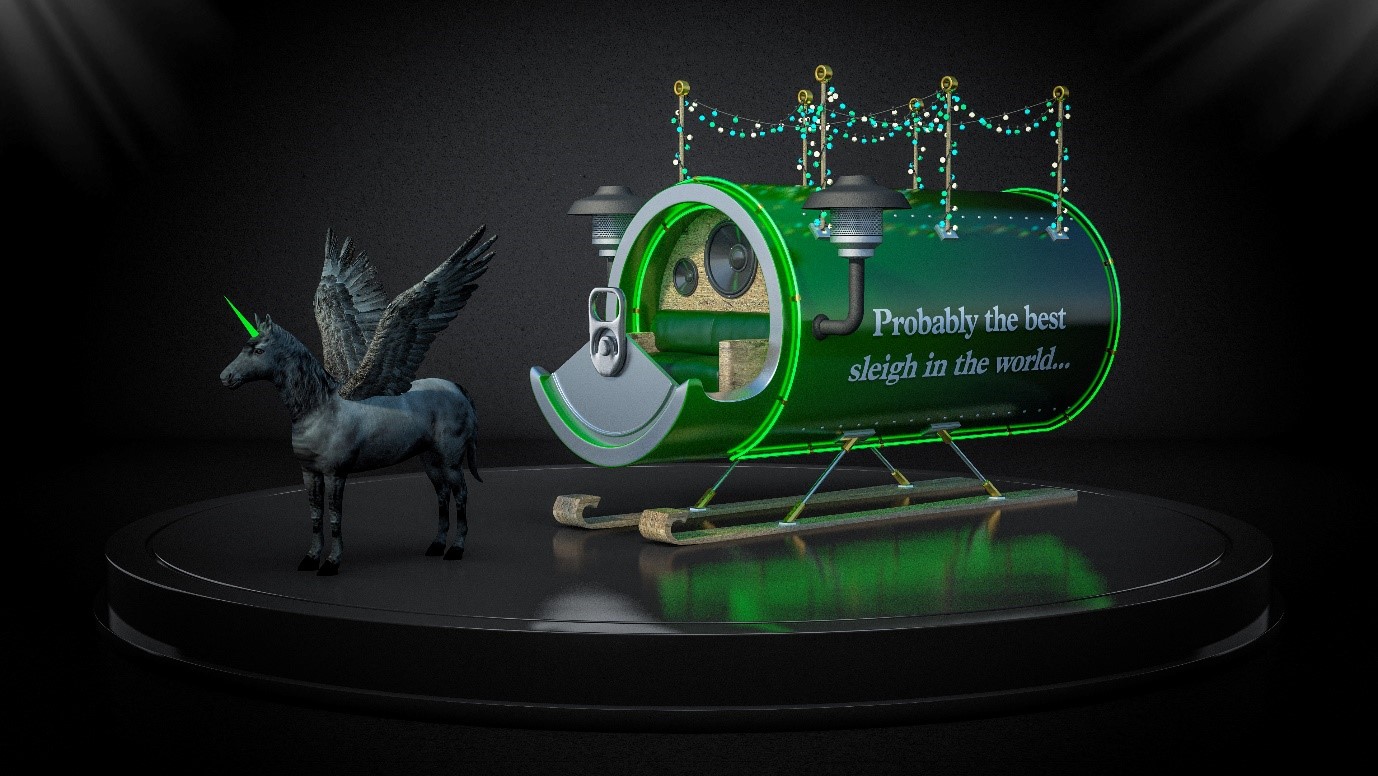
If Carlsberg redesigned Santa’s sleigh, it would feel less like a vehicle and more like a friendly holiday gathering on runners. The Carlsberg-inspired sleigh would be built around warmth, hospitality, good humor, and relaxed Scandinavian confidence. It would not scream for attention. It would wink at you from across the snowbank.
Design Style
The sleigh would likely feature deep green panels, polished brass details, soft amber lighting, and a cabin that looks like a tiny festive lounge. Instead of a standard cargo bay, the back would have modular gift barrelspurely decorative, of coursestacked with the precision of a well-organized delivery operation. The side might read: “Probably the best sleigh in the world,” because subtlety has never been a requirement for Christmas.
The seating would be plush and slightly pub-like, with warm wood finishes and stitched upholstery. There would be a built-in refreshment nook, but this article is not here to encourage drinking; the design idea simply borrows the brand’s social, celebratory identity. Think cozy gathering energy, not beverage promotion.
Special Features
The Carlsberg sleigh would include a “cheer mode” that gently lights up neighborhoods as Santa passes overhead. It would also have a laughter-optimized sound system playing soft bells, crackling fireplace audio, and possibly one elf telling acceptable dad jokes. The gift compartments would open smoothly like a well-designed serving station, allowing Santa to dispatch presents with relaxed efficiency.
This sleigh would not be the fastest or the most futuristic, but it might be the one Santa enjoys driving most. After all, delivering billions of gifts is stressful. A little comfort and good cheer can go a long way.
The Ikea Sleigh: Flat-Packed, Functional, and Named “SNÖFLYG”
If Ikea redesigned Santa’s sleigh, the North Pole workshop would immediately receive 47 cardboard boxes, one tiny Allen key, and a manual with cheerful line drawings but no words. The sleigh would be called something like SNÖFLYG, GÅVORIDER, or ELFBRÖD. Nobody would pronounce it correctly, but everyone would agree it looks clean and practical.
Design Style
The Ikea sleigh would follow the logic of democratic design: useful form, smart function, reasonable quality, sustainability, and value. It would be minimal, modular, and surprisingly efficient. The structure might combine pale wood, recyclable metal, and weather-resistant textile panels. The cargo area would be divided into labeled compartments so Santa could separate toys, books, socks, gadgets, and “mysterious boxes that parents refuse to explain.”
The runners would fold inward for easy storage during the off-season. The seat would double as a storage bench. The gift sack would clip into a rail system. Even the reindeer harnesses would be adjustable, washable, and available in three neutral colors.
Special Features
The Ikea version would win on practicality. It would have stackable gift bins, replaceable parts, a collapsible roof, and a family-friendly price tag. If a runner broke over Nebraska, Santa could replace it with part 14B from aisle 7. The sleigh would also be designed for easy repair, which is helpful when your annual commute involves chimneys, blizzards, rooftops, and one very opinionated reindeer named Rudolph.
Of course, assembly would be the biggest challenge. The elves would spend three nights arguing over whether panel A faces inward or outward. Santa would pretend to understand the diagram. Mrs. Claus would quietly fix it in 20 minutes.
The Apple Sleigh: Minimal, Seamless, and Definitely Missing a Charging Port
If Apple redesigned Santa’s sleigh, it would be called Sleigh Pro, Sleigh Air, or simply Sleigh. The launch presentation would describe it as “the most personal sleigh we’ve ever made,” and every elf in the audience would applaud before knowing the price.
Design Style
The Apple sleigh would be impossibly smooth, with a unibody aluminum frame, rounded edges, frosted glass panels, and no visible seams. The traditional reins would be replaced by gesture control. Santa would guide the reindeer with a subtle hand movement, voice command, or possibly a look. The dashboard would be a clean glowing interface showing delivery routes, weather patterns, chimney dimensions, cookie density, and naughty-or-nice analytics.
There would be no physical buttons because buttons are apparently too emotionally complicated. The sleigh would unlock with Face ID, although Santa’s beard would trigger several “try again” moments in early testing.
Special Features
The Apple sleigh would integrate beautifully with every part of the Christmas ecosystem. Santa’s watch would track his heart rate while climbing chimneys. The gift sack would sync with the delivery list. The sleigh would automatically suggest optimized routes and remind Santa to stand, breathe, and stop eating cookies at house number 4,006,221.
Privacy would be a major part of the concept. Instead of loudly announcing who is naughty or nice, the sleigh would process behavior scores securely on-device. Parents would not receive push notifications reading, “Your child has been questionable since Tuesday.” That would be efficient, but emotionally devastating.
The downside? Accessories. The Apple sleigh would come with the sleigh, one polishing cloth, and a cable that works with nothing else at the North Pole. Reindeer adapters sold separately.
The Ferrari Sleigh: Rosso Corsa, Carbon Fiber, and Emotionally Loud
If Ferrari redesigned Santa’s sleigh, it would stop being transportation and become theater. This would be a low, sculpted, breathtaking machine painted in rich red, shaped by airflow, and engineered to make Santa say “ho ho ho” at 9,000 rpm.
Design Style
The Ferrari sleigh would be all curves, vents, carbon fiber, and drama. Every line would have a purpose, even if that purpose is making people stare. The runners would be aerodynamically profiled. The front nose would cut through icy air. The rear diffuser would manage magical turbulence from the gift sack. The cabin would feature hand-stitched leather, racing harnesses, and a steering yoke that looks incredible but makes parking at the North Pole slightly tense.
Unlike the Ikea sleigh, this one would not fold flat. It would sit under a spotlight in Santa’s garage while elves whisper, “Don’t touch it.”
Special Features
The Ferrari version would be built for speed, control, and emotional impact. It might include launch control for takeoff, adaptive aerodynamics for changing weather, ceramic brakes for rooftop landings, and a performance mode called “Buon Natale.” Santa’s gift delivery time would improve dramatically, although the sound of the sleigh passing overhead might wake every child in a three-state radius.
Would it be practical? Not entirely. Would it be expensive? Absolutely. Would Santa look magnificent arriving in it? Without question. The Ferrari sleigh is the version you choose when Christmas Eve is not just a delivery route; it is a grand prix across the stars.
The Red Bull Sleigh: It Literally Gives Santa Wings
If Red Bull redesigned Santa’s sleigh, the first question would not be “Is it safe?” The first question would be “Can we livestream it from six camera angles?” The Red Bull sleigh would treat Christmas Eve as an extreme sports event, complete with aerial stunts, branded helmets, cliff launches, and a soundtrack that makes wrapping paper feel dangerous.
Design Style
This sleigh would be lightweight, aggressive, and built for motion. It might combine carbon fiber, bright graphics, exposed suspension, and wing-like stabilizers. The traditional sleigh runners would remain, but only because they look cool in slow-motion snow landings. The reindeer team would wear aerodynamic gear, and Rudolph’s nose would be upgraded into a high-visibility navigation beacon.
The sleigh would probably have detachable wings, booster-assisted takeoff, and a cockpit that looks halfway between a rally car and a snowboarding helmet. There would be sponsor decals everywhere. Even the candy canes would look ready for motocross.
Special Features
The Red Bull sleigh would dominate in spectacle. It would launch from glaciers, skim over mountain peaks, barrel-roll over major cities, and land on rooftops with the confidence of someone who definitely signed a waiver. Santa would wear a flight suit. The elves would operate drones. Every delivery would become a highlight reel.
But this version might terrify the reindeer union. Dasher would love it. Prancer would file paperwork. Blitzen would ask whether the stunt coordinator has insurance. Still, as a brand expression, the Red Bull sleigh is perfect: high-energy, bold, risky, unforgettable, and built for people who think “quiet Christmas Eve” sounds like a missed opportunity.
Which Brand Would Build the Best Santa Sleigh?
The answer depends on what Santa values most. If he wants comfort and holiday warmth, Carlsberg wins. If he wants practical storage and easy repairs, Ikea takes the crown. If he wants seamless technology and a premium experience, Apple has the strongest pitch. If he wants speed and beauty, Ferrari is impossible to ignore. If he wants to turn Christmas Eve into a global action-sports broadcast, Red Bull is already halfway down the ramp.
From an SEO and brand analysis perspective, this imaginary sleigh redesign works because each brand has a recognizable identity. Great brands are not just logos. They are systems of expectation. When people hear “Ikea,” they think practical, affordable, modular design. When they hear “Apple,” they expect simplicity, polish, and ecosystem thinking. Ferrari suggests speed, craftsmanship, and passion. Red Bull means action, energy, and extreme experiences. Carlsberg brings a social, witty, celebratory mood.
That is the lesson hidden inside the holiday joke. Strong branding makes imagination easy. You do not need to see the finished sleigh to guess how each company might approach it. The brand already gives your mind a blueprint.
What This Funny Sleigh Concept Teaches About Design
Behind the comedy, there is a serious design principle: the same object can become completely different when filtered through different values. A sleigh is just a sleigh until someone asks what it should do, who it should serve, how it should feel, and what story it should tell.
Carlsberg would ask, “Does it bring people together?” Ikea would ask, “Can everyone use it?” Apple would ask, “Can we make it feel effortless?” Ferrari would ask, “Can we make it thrilling?” Red Bull would ask, “Can it jump over a canyon?” These questions shape the final product as much as materials or engineering.
That is why brand-inspired product concepts are so useful for marketers, designers, and content creators. They reveal the emotional DNA of a company. They show how visual language, user experience, and storytelling combine to create meaning. Even a fictional Santa sleigh can become a case study in brand positioning.
Experience Section: Imagining the Ride from Santa’s Seat
Imagine being Santa and stepping into each redesigned sleigh on Christmas Eve. The experience would change completely from one brand to the next. In the Carlsberg sleigh, the night would begin with warmth. The cabin lights would glow softly against the snow. The seat would feel comfortable enough for a very long route, and the whole vehicle would seem to say, “Relax, big guy, we’ve got this.” The experience would be friendly, familiar, and charming. Santa would feel less like a logistics executive and more like the host of the world’s largest holiday party.
Now picture the Ikea sleigh. Santa would appreciate the order immediately. Every gift would have a place. Every compartment would be labeled. Replacement parts would be stored under the seat, and the whole vehicle would be refreshingly sensible. The only stressful part would happen before takeoff, when three elves realize there are two extra wooden pegs left over. Still, once assembled, the Ikea sleigh would offer the calm satisfaction of a perfectly organized closet. For a man who delivers presents to millions of homes, that kind of structure is priceless.
The Apple sleigh would create a very different experience. Santa would climb in and feel as if the future had quietly arrived. The route would appear in the air like a soft ribbon of light. The sleigh would respond before he finished speaking. Chimney sizes, rooftop angles, and cookie locations would appear in an elegant interface. Everything would feel smooth, quiet, and premium. The only awkward moment would come when Santa tries to connect an old North Pole printer and discovers that the sleigh has moved on emotionally.
The Ferrari sleigh would be pure excitement. Santa would not simply depart; he would launch. The reindeer would tense, the runners would grip the snow, and the red machine would surge forward like Christmas had entered a racing championship. Every turn would feel precise. Every rooftop landing would feel heroic. Santa’s beard would stream behind him like a victory flag. The experience would be less “silent night” and more “symphony of speed.” It might not be the calmest way to deliver a teddy bear, but it would certainly be memorable.
Then comes the Red Bull sleigh. This experience would begin with someone handing Santa a helmet and saying, “Trust us.” The sleigh would roll toward a snowy ramp while drones buzz overhead. The reindeer would look both excited and concerned. Then, suddenly, the whole team would shoot into the sky, wings extended, lights flashing, cameras recording every impossible move. Santa would not just deliver gifts; he would become the main event. It would be thrilling, chaotic, and slightly too much before breakfast.
Experiencing these five sleighs makes one thing clear: design is never just about appearance. It affects mood, confidence, behavior, and memory. The Carlsberg sleigh feels social. The Ikea sleigh feels useful. The Apple sleigh feels intelligent. The Ferrari sleigh feels passionate. The Red Bull sleigh feels fearless. In real life, the products we love often work the same way. We remember not only what they do, but how they make us feel while using them.
Conclusion
If Carlsberg, Ikea, Apple, Ferrari, and Red Bull redesigned Santa’s sleigh, Christmas Eve would become the funniest design competition in history. Each brand would bring its own personality to the same magical problem. Carlsberg would make it cozy. Ikea would make it practical. Apple would make it seamless. Ferrari would make it fast. Red Bull would make it fly sideways over a mountain.
The best version depends on the mission. For real-world delivery, Ikea and Apple might offer the smartest systems. For pure beauty and performance, Ferrari would dominate. For holiday spirit, Carlsberg would feel wonderfully on-brand. For unforgettable spectacle, Red Bull would win every viral video before Santa reached the second chimney.
In the end, Santa probably keeps the original sleigh. It may lack carbon fiber, gesture controls, modular storage, and livestream sponsorships, but it has something no redesign can fully replace: magic. Still, if the North Pole ever opens a design studio, these five concepts prove one thingbranding can turn even a sleigh into a story.
Note: This article is a fictional, brand-inspired design analysis created for entertainment and SEO content purposes. It is not affiliated with, endorsed by, or sponsored by Carlsberg, Ikea, Apple, Ferrari, Red Bull, Santa Claus, or the North Pole workshop.













