
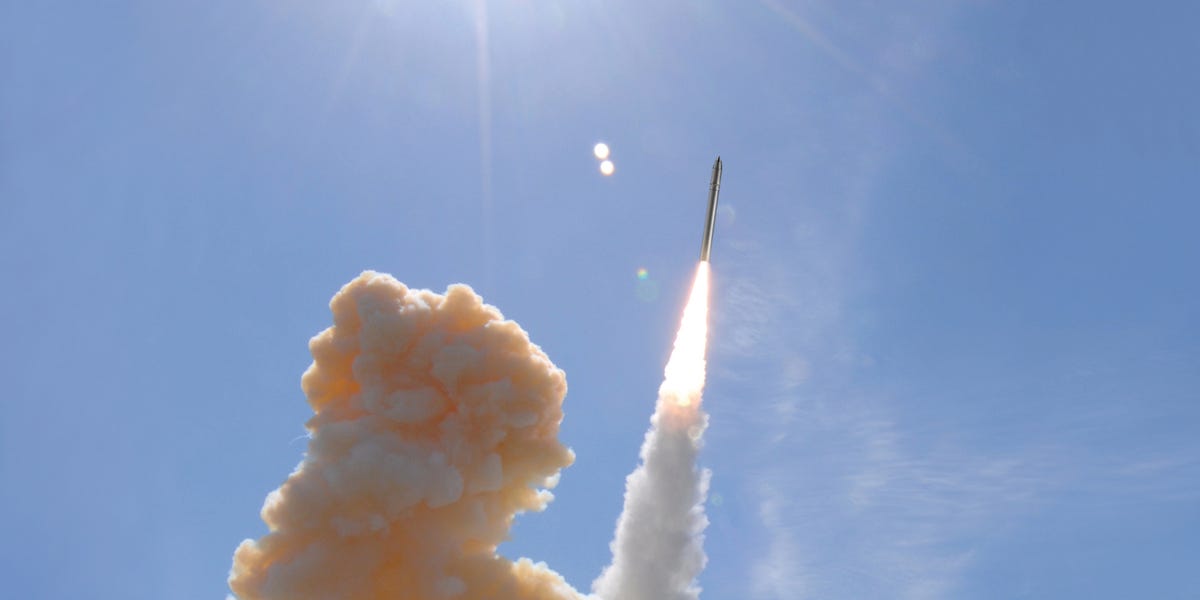
Every now and then, the defense world gets a plot twist that feels less like a press briefing and more like someone left a classified-looking sticky note on the office copier. That was the mood when public reporting in 2020 revealed that the U.S. Air Force had briefly posted a request for industry ideas tied to future intercontinental ballistic missile upgrades, including language about supporting a hypersonic glide vehicle at ICBM ranges. In plain English: the Air Force appeared to be thinking about how a future nuclear missile system might one day support a hypersonic delivery option.
The phrase “hypersonic nuke” sounds like it escaped from a summer blockbuster, probably right after a scientist says, “There’s no way this could go wrong.” But behind the dramatic headline is a serious debate about nuclear modernization, emerging weapons technology, deterrence, strategic stability, and the terrifyingly important question of what happens when speed meets ambiguity.
This article breaks down what was revealed, why it mattered, what the Air Force likely meant, and why experts immediately raised eyebrows high enough to require clearance from air traffic control.
What Did the Air Force Accidentally Reveal?
The controversy began with a request for information connected to possible future upgrades for the Ground-Based Strategic Deterrent, now known as the LGM-35A Sentinel. Sentinel is the Air Force’s planned replacement for the aging Minuteman III intercontinental ballistic missile system, which has been a core part of America’s land-based nuclear force for decades.
The eyebrow-raising part was a reference to a “thermal protection system” capable of supporting “hypersonic glide” over intercontinental ranges. That may sound like a phrase engineered in a lab to cure insomnia, but in missile technology it is a big deal. Hypersonic glide vehicles travel at extreme speeds and maneuver through the atmosphere after being boosted to altitude. A thermal protection system is essential because flying that fast through the atmosphere creates intense heat.
The Air Force later removed the request, and officials emphasized that there was no announced change in U.S. policy to field nuclear-armed hypersonic weapons. Still, the public language was enough to spark discussion. Why would a nuclear weapons organization ask industry about hypersonic glide technology for an ICBM-range system? Was this routine research? A long-term hedge? A bureaucratic oopsie? Or a glimpse of a future weapons path that had not yet been publicly debated?
The honest answer is: probably a little of the first three, and possibly a warning sign about the fourth.
Hypersonic Weapons: Fast, Maneuverable, and Politically Complicated
Hypersonic weapons are usually defined as systems that travel at Mach 5 or faster, meaning at least five times the speed of sound. Speed alone is not the whole story. Traditional ballistic missiles already reach extreme speeds. What makes many hypersonic glide vehicles and hypersonic cruise missiles especially interesting to militaries is their combination of speed, maneuverability, and unusual flight paths.
A ballistic missile typically follows a more predictable arc. A hypersonic glide vehicle, by contrast, can maneuver after launch, which may make it harder to track and complicate missile defense planning. That does not make hypersonic weapons magical. Physics is still physics, budgets are still budgets, and engineers still have to convince extremely hot metal not to become extremely expensive confetti. But the military appeal is obvious: a weapon that can arrive quickly, fly in less predictable ways, and challenge existing defenses gets attention fast.
The United States, China, and Russia have all pursued hypersonic weapons. U.S. programs have included the Air-Launched Rapid Response Weapon, known as ARRW, and the Hypersonic Attack Cruise Missile, known as HACM. The Army and Navy have also worked on boost-glide systems, including the Long-Range Hypersonic Weapon, often called Dark Eagle. These programs have had mixed progress, with tests, delays, cost questions, and shifting priorities. In other words, hypersonics are not just “future weapons.” They are also future invoices.
Why a Hypersonic Nuclear Weapon Is Different
Conventional hypersonic weapons are already controversial. Nuclear-armed hypersonic systems raise the stakes dramatically. The main concern is not simply that such a weapon could be fast. The bigger issue is that it could compress decision-making time during a crisis.
Nuclear deterrence depends partly on communication, predictability, and the ability of national leaders to understand what is happening before making irreversible decisions. A hypersonic nuclear system could create uncertainty. Is the incoming weapon conventional or nuclear? What is its target? Is this a limited strike, a warning, or the start of something larger? When warning time shrinks, the risk of miscalculation grows.
That is why many arms control analysts worry about mixing hypersonic delivery systems with nuclear missions. A weapon that is fast, maneuverable, and difficult to interpret in real time may make deterrence less stable rather than more stable. The point of deterrence is to prevent war, not to create a national security version of “guess what’s in the box,” except the box is moving at several times the speed of sound.
The Sentinel Connection
The Sentinel ICBM program is the modern center of gravity for America’s land-based nuclear modernization effort. It is intended to replace Minuteman III and remain in service for decades. Because Sentinel is being designed as a long-term system, the Air Force has emphasized modularity and future upgrade potential. That makes sense from a program-management perspective. If a missile system is expected to last into the 2070s, planners naturally want room for future changes.
However, that same future-proofing can make people nervous. A modular nuclear missile architecture sounds efficient to acquisition officials, but to arms control experts it can sound like a blank check for future capability expansion. When a public request mentions hypersonic glide technology in connection with ICBM-range systems, people notice.
Sentinel has also become controversial for another reason: cost. The program has faced major cost growth and a formal Nunn-McCurdy breach, a statutory warning sign used when major defense acquisition programs exceed cost thresholds. The Pentagon has continued the program, arguing that there is no practical alternative to modernizing the land-based leg of the nuclear triad. Critics argue that the rising cost should force a deeper rethink of whether land-based ICBMs are still worth the investment.
So when hypersonic language appears near Sentinel discussions, the reaction is not merely about technology. It is about trust, transparency, spending, and the direction of U.S. nuclear strategy.
Was This Really an “Accidental Reveal”?
The word “accidental” is doing a lot of work here. Defense procurement documents are often public by design because the government needs to communicate with industry. Requests for information do not necessarily mean a program is being built. They can be exploratory. Agencies ask questions all the time about technologies they may never buy.
Still, the fact that the document was reportedly removed after being noticed made the situation look more sensitive. That does not prove a secret program existed. It does suggest that the language may have gone farther than officials intended to publicly discuss.
The careful interpretation is this: the Air Force’s nuclear weapons community was at least interested in understanding technologies that could support hypersonic glide at intercontinental ranges. That is not the same as announcing a deployed hypersonic nuclear missile. But it is also not nothing. In defense policy, “just asking questions” can be the first breadcrumb on a very expensive trail.
Why Would the Air Force Want This Capability?
From a military planning perspective, the argument for advanced delivery systems usually centers on deterrence. The United States wants to ensure that no adversary believes it can neutralize America’s nuclear forces or escape retaliation. Supporters of modernization argue that future missile defenses, hardened targets, and rapidly changing technologies require the U.S. to keep its deterrent credible.
A hypersonic delivery option could theoretically be viewed as a way to complicate an adversary’s defense planning. It might also be seen as a hedge against future breakthroughs by rivals. If China and Russia continue developing advanced missile systems, some U.S. planners may feel pressure to explore similar or superior options.
That logic is familiar. It is also exactly how arms races learn to jog, then sprint, then ask Congress for a supplemental appropriation.
The danger is that every country can describe its own buildup as “defensive” or “stabilizing” while viewing everyone else’s buildup as aggressive. This is how strategic competition becomes self-feeding. One side builds because the other side built. The other side builds because the first side responded. Soon everyone insists they are merely reacting, while the planet quietly wonders whether anyone has considered a hobby.
The Conventional-Only Hypersonic Policy Debate
For years, U.S. officials have generally described American hypersonic weapons as conventional systems rather than nuclear ones. Conventional hypersonics are often framed as tools for striking high-value, time-sensitive targets without crossing the nuclear threshold.
That distinction matters. A conventional hypersonic weapon may still be destabilizing in certain scenarios, but it is not the same as a nuclear weapon. The problem is that an adversary observing a launch may not immediately know what kind of warhead is involved. Ambiguity can be dangerous. If a country fears a nuclear strike is incoming, it might respond before confirmation.
This is one reason nuclear-armed hypersonics are so controversial. They could blur lines that nuclear strategy has spent decades trying to keep clear. During a crisis, ambiguity is not a quirky personality trait. It is a risk multiplier.
How China and Russia Shape the Conversation
U.S. interest in hypersonic weapons cannot be separated from competition with China and Russia. Both countries have invested in advanced missile systems, and Russia has used missiles it describes as hypersonic in the war against Ukraine. China has tested and displayed systems that U.S. defense officials view as part of a broader effort to challenge American military power in the Pacific.
For U.S. officials, these developments create pressure to respond. Nobody in Washington wants to be accused of “falling behind” in a technology race, especially one with national security branding and dramatic animations. Yet speed is not strategy. Building a weapon because a rival has one does not automatically make the United States safer.
The strategic question is not “Can we build it?” The better question is “What problem does it solve, and what new problems does it create?” With nuclear hypersonics, that second half of the question is enormous.
Cost, Oversight, and the Great Pentagon Wallet Workout
Hypersonic weapons are expensive. Nuclear modernization is expensive. Combining the two is not the kind of idea that makes budget analysts whistle cheerfully while sharpening pencils.
The Congressional Budget Office has projected very high costs for U.S. nuclear forces over the coming decade, while oversight bodies such as the Government Accountability Office have raised concerns about acquisition approaches, schedules, testing infrastructure, and cost control for advanced weapons programs. Sentinel itself has faced major scrutiny because of rising costs and program complexity.
This matters because defense dollars are not infinite, despite what some PowerPoint slides seem to believe. Money spent on one program is money not spent elsewhere: conventional readiness, cyber defense, shipbuilding, aircraft modernization, service member housing, or even more missile defense sensors. A hypersonic nuclear concept would have to compete in a crowded and expensive modernization portfolio.
That is why public debate is essential. If the United States is going to explore nuclear hypersonic options, the discussion should not happen by accident through a procurement posting. It should happen openly through Congress, policy review, expert testimony, and democratic oversight.
Strategic Stability: The Boring Phrase That Might Save Everyone
Strategic stability is one of those phrases that sounds like it belongs in a graduate seminar where the coffee is cold and the chairs are hostile. But the concept is simple: nuclear-armed states should not feel pressure to strike first in a crisis.
Weapons that compress decision time, increase ambiguity, or threaten an adversary’s nuclear forces can weaken strategic stability. Hypersonic nuclear systems could do all three, depending on how they are deployed and perceived. Even if U.S. leaders view such weapons as deterrent tools, adversaries may see them as first-strike tools.
This perception gap matters. Deterrence is not just about what a weapon can do. It is about what others believe it can do, and what they fear it might be used for. A system designed to reassure one country can terrify another. That is the awkward emotional life of nuclear strategy.
What the Public Should Watch Next
The most important thing to watch is not whether the phrase “hypersonic nuke” appears in a headline again. It is whether future budget documents, congressional testimony, or official strategy papers begin to normalize nuclear roles for hypersonic systems.
Watch for language about non-ballistic nuclear delivery, advanced reentry vehicles, intercontinental hypersonic glide, nuclear payload flexibility, or future Sentinel upgrade pathways. None of those phrases automatically proves a new weapon is coming. But together, they can reveal the direction of travel.
Also watch the arms control debate. The New START treaty framework has been under strain, and future U.S.-Russia and U.S.-China arms control discussions are uncertain. Hypersonic systems are difficult to fit into older treaty categories, especially when they blur lines between ballistic and non-ballistic delivery. If nuclear hypersonics become part of future arsenals, arms control will need new vocabulary and new verification ideas.
Experience-Based Reflections: What This Story Teaches About Defense Transparency
There is an everyday lesson hidden inside this very high-stakes topic: institutions reveal themselves through paperwork. Not speeches. Not slogans. Paperwork. Budgets, requests for information, acquisition notices, environmental documents, oversight reports, and congressional testimony often tell the public where policy is quietly heading long before leaders make a clean announcement.
Anyone who follows defense policy learns to read these documents the way weather watchers read cloud patterns. A single phrase may not mean a storm is coming, but it can tell you the air pressure is changing. The Air Force’s hypersonic glide language was one of those pressure changes. It did not announce a deployed weapon, but it pointed toward a possible future interest that deserved public scrutiny.
The second lesson is that “modernization” is never just modernization. The word sounds harmless, like updating a kitchen backsplash or replacing a phone with one that has three cameras and a mysterious fourth circle. In nuclear policy, modernization can mean sustaining old capabilities, replacing aging systems, adding flexibility, or opening pathways to new missions. Those are very different things. The public deserves to know which version is being discussed.
The third lesson is that speed can be seductive. Hypersonic technology has a futuristic glow. It sounds decisive, advanced, and unstoppable. But in nuclear strategy, faster is not automatically better. Faster can mean less time to verify, less time to communicate, less time to de-escalate, and less time for leaders to avoid catastrophe. The most dangerous feature of a weapon may not be what it can destroy, but how quickly it forces people to make decisions.
The fourth lesson is that ambiguity is not always clever. Military planners sometimes value ambiguity because it complicates an adversary’s calculations. But nuclear ambiguity can also complicate everyone’s calculations, including one’s own. If an adversary cannot tell whether an incoming hypersonic system is conventional or nuclear, the risk of overreaction rises. In a crisis, confusion is not a strategy. It is a trapdoor.
The fifth lesson is that public oversight still matters. A technical phrase in a removed document became a national security discussion because journalists, analysts, and watchdogs noticed it. That is how democratic accountability works at its best. Not perfectly, not elegantly, and often with too many acronyms, but it works when people pay attention.
Finally, this story reminds us that nuclear weapons policy should never drift quietly into the future on autopilot. If the United States decides it needs new nuclear delivery options, officials should explain the rationale, costs, risks, and alternatives. If it does not intend to pursue nuclear hypersonics, it should make that clear and avoid procurement language that suggests otherwise. The stakes are too high for accidental messaging.
Conclusion: A Small Document, a Big Warning
The Air Force’s apparent accidental reveal did not prove that a hypersonic nuclear weapon is sitting in a hangar waiting for a dramatic soundtrack. It did, however, expose a serious strategic question: should the United States even explore nuclear-armed hypersonic delivery systems?
Supporters may argue that future threats require future options. Critics will counter that nuclear hypersonics could make crises more unstable, arms control harder, and nuclear decision-making more dangerous. Both sides agree on one thing, even if they phrase it differently: the technology matters.
The public should not have to learn about possible nuclear futures through a briefly posted acquisition request. The conversation belongs in open policy debate, congressional oversight, and serious strategic review. When a weapon combines nuclear stakes with hypersonic speed, “oops” is not a communications strategy.














