
Investing can feel like checking the weather with three apps and still getting rained on. One year, stocks are soaring. The next, bonds forget they are supposed to be boring. Inflation shows up like an uninvited guest, commodities start acting like rock stars, and cash suddenly looks less lazy than usual. This is exactly why the All Weather Strategy has become such an interesting topic for long-term investors.
The phrase “All Weather” is often associated with Bridgewater Associates and Ray Dalio’s approach to building a portfolio that can survive different economic seasons. The idea is not to predict tomorrow’s market mood. It is to own a balanced mix of assets that can respond differently when growth rises, growth falls, inflation rises, or inflation falls. In other words, instead of trying to be the genius who knows when the storm is coming, the strategy tries to build a financial umbrella, raincoat, sunscreen, and snow boots into one portfolio.
In the spirit of “Talk Your Book,” this article explains why investors are paying attention to All Weather investing, how the strategy works, what makes it different from a traditional 60/40 portfolio, and where it can fit in a real investor’s financial plan.
What Is the All Weather Strategy?
The All Weather Strategy is a diversified investment approach designed to perform reasonably across many market environments. It does not depend entirely on a single economic outcome, such as strong growth or falling interest rates. Instead, it spreads exposure across several asset classes, usually including stocks, government bonds, inflation-linked bonds, commodities, and sometimes gold or other real assets.
The central idea is simple: different assets tend to thrive in different environments. Stocks often do well when economic growth is strong. Long-term bonds may help when growth slows and interest rates fall. Inflation-linked bonds and commodities can be useful when inflation rises. Gold may act as a store of value during periods of stress or currency uncertainty. No asset is magical, but together they can create a portfolio that is less dependent on one prediction.
That is the key difference between All Weather investing and market timing. Market timing asks, “What will happen next?” All Weather investing asks, “What if I am wrong?” That second question may be less glamorous, but it is often more useful.
Why Investors Care About All Weather Investing
The classic balanced portfolio, often described as 60% stocks and 40% bonds, has helped many investors for decades. But it is not perfect. In many cases, the majority of its risk still comes from stocks because equities are usually much more volatile than high-quality bonds. So while the portfolio may look balanced by dollars, it may not be balanced by risk.
This became especially clear during periods when stocks and bonds fell together. When inflation is high and interest rates rise quickly, bonds may not provide the same cushion investors expect. That does not mean the 60/40 portfolio is dead. It simply means investors need to understand what kind of economic weather their portfolio is actually prepared for.
The All Weather Strategy gained attention because it aims to diversify across economic drivers, not just asset labels. It is less about owning “some stocks and some bonds” and more about asking what actually makes those assets move. Growth, inflation, interest rates, central bank policy, earnings expectations, and risk appetite all matter.
How the All Weather Strategy Works
1. It Balances Economic Environments
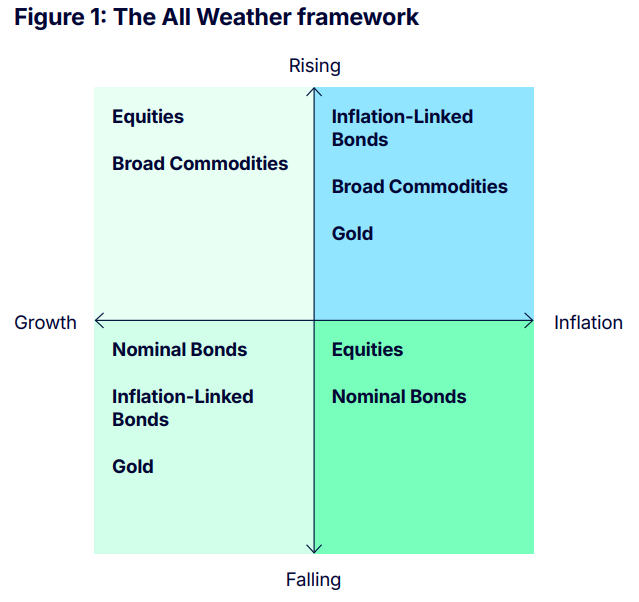
A simplified All Weather framework looks at four major environments:
- Rising growth: Stocks and credit-sensitive assets may benefit.
- Falling growth: High-quality government bonds may help stabilize returns.
- Rising inflation: Commodities, inflation-linked bonds, and real assets may perform better.
- Falling inflation: Nominal bonds and growth-oriented assets may benefit.
The strategy does not assume one environment will dominate forever. That matters because markets love embarrassing confident forecasts. A portfolio built for only one outcome can look brilliant until the world changes its mind.
2. It Uses Risk Parity Thinking
Risk parity is one of the most important ideas behind many All Weather portfolios. Traditional portfolios usually allocate by dollars. For example, putting $60 into stocks and $40 into bonds. Risk parity asks a different question: how much risk does each asset contribute?
Because stocks are generally more volatile than bonds, a dollar-weighted portfolio can still be stock-risk-heavy. Risk parity attempts to spread risk more evenly across asset classes. This can lead to larger allocations to lower-volatility assets, such as bonds, and smaller allocations to higher-volatility assets, such as equities or commodities.
Some institutional versions use leverage to increase exposure to lower-volatility assets, aiming for a higher return while keeping the portfolio balanced by risk. This is where investors need to pay attention. Leverage can improve capital efficiency, but it also increases complexity and potential downside if markets move sharply against the strategy.
3. It Diversifies Beyond the Usual Suspects
A basic investor may own U.S. stocks and U.S. bonds and call it diversified. That is a good start, but an All Weather approach usually goes further. It may include international equities, long-term Treasuries, Treasury Inflation-Protected Securities, commodities, gold, and global bonds.
The reason is not to collect asset classes like trading cards. The reason is to own assets with different return drivers. If everything in a portfolio depends on the same economic force, diversification may vanish when it is needed most.
Example of an All Weather Portfolio
A commonly discussed simplified version of an All Weather-style portfolio includes allocations such as stocks, long-term bonds, intermediate bonds, commodities, and gold. The exact percentages can vary depending on the manager, the investment vehicle, and the investor’s goals.
For example, a simplified educational model might include:
- U.S. and global equities for growth exposure
- Long-term government bonds for deflationary or recessionary environments
- Intermediate bonds for stability and income
- Commodities for inflation sensitivity
- Gold or similar assets for stress protection and currency concerns
This is not a recommendation to copy those allocations blindly. Portfolio construction depends on time horizon, risk tolerance, tax situation, available products, and personal goals. But the structure shows the broader philosophy: do not let one economic bet control the entire portfolio.
All Weather Strategy vs. 60/40 Portfolio
The 60/40 portfolio is easy to understand, easy to implement, and historically useful for many long-term investors. Its main advantage is simplicity. You can build it with low-cost index funds, rebalance occasionally, and avoid turning your account into a financial science project.
The All Weather Strategy is more sophisticated. It looks beyond dollar allocation and focuses on economic balance and risk contribution. It may hold more bonds, commodities, inflation-sensitive assets, and global exposures than a standard 60/40 portfolio.
The trade-off is complexity. All Weather portfolios can underperform stocks during strong bull markets. They can also struggle when correlations move unexpectedly, especially if bonds and stocks fall at the same time. Investors who expect it to win every year are misunderstanding the word “weather.” Even the best raincoat does not make you enjoy a hurricane.
Benefits of Investing in the All Weather Strategy
More Balanced Risk
The biggest appeal of the All Weather Strategy is balanced risk exposure. Instead of relying heavily on stocks, it attempts to create a smoother ride by spreading risk across different assets and economic scenarios.
Better Behavioral Support
A portfolio that falls less dramatically may help investors stay invested. This is important because the best strategy on paper is useless if an investor abandons it at the worst possible moment. All Weather investing can be attractive for people who want growth but cannot emotionally tolerate extreme volatility.
Inflation Awareness
Traditional stock-and-bond portfolios may be vulnerable when inflation rises sharply. All Weather portfolios often include commodities or inflation-linked bonds to address that risk. These assets will not always work perfectly, but they add tools that a plain vanilla portfolio may lack.
Long-Term Resilience
The strategy is built around resilience, not excitement. That may sound boring, but boring can be beautiful in investing. A portfolio that survives multiple cycles gives compounding more time to do its job.
Risks and Limitations Investors Should Understand
It Can Lag in Stock Bull Markets
When stocks are roaring, an All Weather portfolio may look dull. Investors comparing it to the S&P 500 during a technology-led rally may feel like they brought a bicycle to a Formula 1 race. But that comparison misses the point. The strategy is not designed to maximize returns in one environment. It is designed to reduce dependence on any single environment.
Commodities Can Be Volatile
Commodities can help during inflationary periods, but they can also be unpredictable. Oil, metals, and agricultural commodities respond to supply shocks, geopolitics, weather, demand cycles, and speculative flows. They are useful ingredients, but spicy ones.
Bond Exposure Has Interest Rate Risk
Long-term bonds can be powerful diversifiers when rates fall, but they can suffer when rates rise quickly. Investors learned this lesson the hard way during periods of inflation and aggressive central bank tightening. An All Weather portfolio is not immune to rate shocks.
Leverage Adds Complexity
Some risk parity strategies use leverage to scale lower-volatility assets. This can make sense in institutional portfolio design, but it also adds borrowing costs, tracking issues, and risk management challenges. Individual investors should understand the product structure before investing.
Who Might Consider an All Weather Approach?
An All Weather Strategy may appeal to investors who want a diversified core portfolio, are concerned about inflation, dislike heavy stock-market dependence, and prefer smoother long-term returns over chasing the hottest asset class. It may also fit retirees or near-retirees who care about drawdown control, although income needs and tax issues must be considered carefully.
It may be less appropriate for young investors with high risk tolerance who are comfortable with stock volatility and have decades to recover from market declines. For those investors, a higher equity allocation may offer stronger long-term growth potential, though with a bumpier ride.
The best use case may be as a core stabilizer or a sleeve within a broader portfolio. For example, an investor might combine a global stock portfolio with an All Weather allocation to reduce overall volatility. Another investor might use it as a replacement for part of a bond allocation if they want broader diversification.
How ETFs Changed Access to All Weather Investing
For many years, institutional All Weather and risk parity strategies were mainly available to large investors. Pension funds, endowments, and wealthy clients had access to sophisticated products and managers that ordinary investors could not easily use.
ETF innovation has changed that. Actively managed multi-asset ETFs can now package complex allocation strategies into a vehicle that trades like a stock. This gives everyday investors easier access, but it also creates a responsibility to read the fund documents. Investors should understand fees, holdings, leverage, turnover, tax treatment, and the manager’s process.
Convenience is not the same as simplicity. Buying a ticker is easy. Understanding what lives inside that ticker takes more work.
Practical Tips Before Investing
Know the Role It Plays
Before buying an All Weather fund or building your own version, decide what job it has in your portfolio. Is it your main portfolio? A defensive sleeve? An inflation hedge? A diversifier? A strategy without a clear role can quickly become another random holding.
Check the Costs
Multi-asset and actively managed funds may cost more than basic index funds. Fees matter because they reduce returns every year, whether the strategy performs well or not.
Expect Imperfection
The All Weather Strategy is not a crystal ball. It can lose money. It can disappoint. It can underperform simpler portfolios for long stretches. The goal is not perfection; the goal is durability.
Rebalance With Discipline
If you build your own version, rebalancing is essential. Without it, the portfolio can drift away from its intended risk profile. Rebalancing also forces investors to trim assets that have done well and add to assets that may be temporarily out of favor. This feels uncomfortable, which is usually why it works.
Experiences and Real-World Lessons From All Weather Investing
One of the most useful experiences investors can have with an All Weather Strategy is learning that “diversified” does not always mean “exciting.” In fact, a properly diversified portfolio can feel mildly annoying most of the time. Something in it is almost always underperforming. When stocks are up, bonds may look sleepy. When commodities are hot, equities may be wobbling. When gold is doing its job, the headlines are probably not cheerful. This is normal. Diversification means always having to apologize for part of your portfolio at dinner.
Another real-world lesson is that All Weather investing helps investors think in scenarios instead of predictions. Many people begin investing by asking, “What asset will go up next?” A more mature question is, “What happens if my favorite assumption is wrong?” If you believe inflation will fall, what if it does not? If you think stocks will keep leading, what if earnings slow? If you expect bonds to protect you, what if inflation pushes yields higher? The All Weather mindset encourages humility, and humility is an underrated financial asset.
Investors who use this strategy often discover that patience is the actual product. The portfolio may not deliver thrilling short-term results, especially during strong equity bull markets. Friends bragging about concentrated tech gains may make an All Weather investor feel like they ordered oatmeal at a steakhouse. But when markets become chaotic, the value of preparation becomes easier to appreciate. The goal is not to win every conversation. The goal is to stay solvent, calm, and invested.
A practical experience is the emotional benefit of smoother drawdowns. Large losses can cause investors to panic-sell, pause contributions, or abandon a plan. A more balanced portfolio may reduce the chance of those harmful decisions. This does not mean losses disappear. It means the ride may be easier to tolerate, which can be just as important as the math.
Another lesson is that implementation matters. A homemade All Weather portfolio using low-cost ETFs may behave differently from an institutional risk parity fund or an actively managed ETF. Differences in leverage, duration, commodity exposure, international allocation, rebalancing frequency, and fees can create very different outcomes. Two portfolios can both wear the “All Weather” label and still behave like cousins who only see each other at weddings.
Finally, All Weather investing teaches investors to respect uncertainty. Markets are complex because they reflect millions of decisions, emotions, policies, and surprises. A resilient strategy accepts that the future will not politely follow your spreadsheet. That is the deeper value of the All Weather approach: it turns uncertainty from an enemy into a design requirement.
Conclusion
The All Weather Strategy is not about predicting the next market season. It is about building a portfolio that can handle more than one forecast. By combining assets that respond differently to growth, inflation, interest rates, and stress, the strategy aims to create long-term resilience.
For investors who want a smoother path, better diversification, and less dependence on a single market outcome, All Weather investing deserves serious attention. It is not perfect, and it is not guaranteed to outperform. But as a framework for thinking about risk, balance, and uncertainty, it is one of the most useful portfolio concepts available.
The smartest investors do not pretend to know the weather. They pack for several seasons.
SEO Metadata
Note: This article is for educational and informational purposes only and should not be considered personalized financial advice. Investors should review their own goals, risk tolerance, time horizon, and professional guidance before making investment decisions.










