
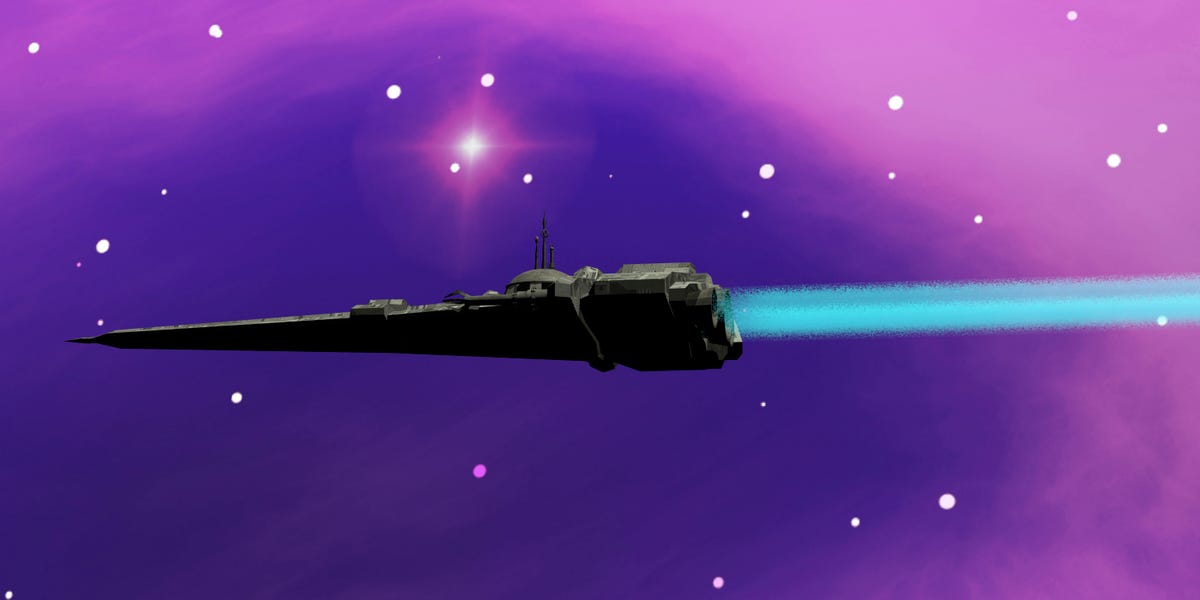
Space travel has always had a flair for drama. Chemical rockets roar, launchpads tremble, livestream chats explode with emojis, and somewhere a coffee cup in mission control quietly vibrates like it has seen things. But the next big step in interplanetary travel may not come from a louder rocket. It may come from a quieter, smarter, more patient kind of engine: an advanced electric thruster designed to give small spacecraft the kind of deep-space mobility they have never truly had before.
At the center of this story is NASA’s H71M sub-kilowatt Hall-effect thruster, a compact electric propulsion system developed to help small spacecraft perform high-delta-v maneuvers. In plain English, that means a spacecraft could change its speed enough to do hard things: leave low Earth orbit, head toward the Moon, reach Mars from a higher transfer orbit, or slow down enough to enter orbit around a distant world instead of merely waving goodbye during a flyby.
This is not a “warp drive,” a gravity-defying miracle, or a shiny sci-fi toaster bolted to a satellite. It is real engineering, rooted in decades of ion propulsion research, Hall thruster testing, and solar electric propulsion experience. And while it will not launch astronauts from Earth’s surface, it could make interplanetary missions cheaper, more flexible, and more frequentespecially for small spacecraft that currently hitch rides like budget travelers with one backpack and no legroom.
Why Escape Velocity Is Such a Big Deal
Escape velocity is the speed needed to break free from the gravitational pull of a planet or other body without falling back. From Earth’s surface, the commonly cited escape velocity is about 11.2 kilometers per second. However, spacecraft rarely try to do everything from the ground in one elegant leap. A launch vehicle usually places a spacecraft into orbit first. From there, the spacecraft needs additional velocity change, called delta-v, to raise its orbit, escape Earth’s gravity, travel to another destination, and sometimes slow down for orbital capture.
For decades, the classic approach has been simple in concept and brutal in execution: burn chemical propellant, get a big push, coast through space, correct your trajectory, and hope your math and hardware keep getting along. Chemical propulsion is powerful, fast, and necessary for launch. But it is also fuel-hungry. Once a spacecraft is already in space, especially beyond the thick atmosphere and the tyranny of launchpad physics, efficiency becomes king.
That is where electric propulsion shines. Instead of throwing large volumes of hot gas out the back in a quick burst, electric thrusters accelerate ionscharged atomsusing electromagnetic fields. The thrust is gentle, often tiny compared with a chemical rocket, but it can continue for thousands of hours. In space, where there is almost no drag, a small continuous push can gradually build enormous speed. It is the tortoise in the old fable, except the tortoise glows blue and runs on xenon.
What Makes the H71M Thruster Different?
The NASA-H71M is a Hall-effect thruster, a type of electric propulsion system that ionizes propellant and accelerates it through an electric field. Hall thrusters are already widely used for satellite stationkeeping, orbit raising, collision avoidance, and end-of-life deorbiting. They are common in commercial space because they are efficient, reliable, and far less dramatic than a rocket enginewhich is exactly what satellite operators want. Nobody wants their billion-dollar satellite to have a flair for theatrics.
The problem is that many low-power commercial Hall thrusters were built for near-Earth jobs, not ambitious planetary missions. They may work beautifully for keeping a satellite in the right orbital slot, but they are not usually designed to process large amounts of propellant over very long lifetimes. Deep-space missions ask for more: more total impulse, more operating hours, more durability, and more ability to change trajectory after launch.
The H71M was developed to push beyond those limits. NASA’s work focused on a low-power system with unusually high propellant throughput. That means the thruster can process a larger fraction of a spacecraft’s total mass as propellant over its lifetime. NASA has described the technology as enabling small spacecraft science missions requiring up to about 8 kilometers per second of delta-v. For a small spacecraft, that is not a small upgrade. That is the difference between “I can adjust my orbit” and “I can go places.”
Small Spacecraft, Big Ambitions
Small spacecraft have become a major force in modern spaceflight. CubeSats and small satellites can be built faster and cheaper than traditional flagship missions. They can ride as secondary payloads on larger launches, share costs, test new instruments, and take risks that would be harder to justify on a multibillion-dollar mission. But rideshare launches come with a catch: you usually go where the primary mission is going.
Imagine buying a cheap airline ticket, only to discover the plane is going to Denver when you wanted to visit New Orleans. You can still learn something in Denver, sure, but it is not the same trip. Small spacecraft face a similar limitation. They often begin from low Earth orbit, geosynchronous transfer orbit, or a trajectory selected for someone else’s mission. Without strong onboard propulsion, they cannot easily depart, redirect, or slow down at a distant target.
A high-throughput electric propulsion system changes that equation. A small spacecraft with enough delta-v could launch as a secondary payload, then gradually spiral away from its initial orbit and head toward a scientific destination of its own. Instead of being stuck with whatever route the primary payload provides, the spacecraft gains independence. That independence could open doors for lower-cost missions to the Moon, Mars, asteroids, and small bodies that are scientifically fascinating but rarely convenient.
Why Hall Thrusters Are So Efficient
Efficiency in spacecraft propulsion is often measured through specific impulse, a way of describing how effectively an engine uses propellant. Chemical rockets provide high thrust but generally lower specific impulse than electric propulsion. Electric thrusters provide very low thrust, but their propellant efficiency is excellent. They squeeze more velocity change out of each kilogram of propellant.
Hall thrusters typically use noble gases such as xenon because these gases are easy to ionize, heavy enough to produce useful thrust, and chemically stable. The thruster strips electrons from the gas atoms, creating ions. Electric fields accelerate those ions out of the thruster at high speed, producing thrust in the opposite direction. The visible blue plume often associated with ion propulsion comes from excited xenon plasma, which is basically space engineering’s version of mood lighting.
The key is persistence. A Hall thruster may produce a push that feels laughably small on Earth, but in space there is no road friction, no wind resistance, and no potholes lurking in the asteroid belt. Given enough time, a gentle push can reshape an orbit, raise a spacecraft’s energy, and set up transfers that would otherwise require far more propellant.
From Deep Space 1 to Dawn to Psyche
The H71M does not appear out of nowhere. It stands on a long ladder of electric propulsion progress. NASA’s Deep Space 1, launched in 1998, was a major demonstration of ion propulsion for long-duration spaceflight. It tested advanced technologies, flew by asteroid Braille, and later visited comet Borrelly. Its ion engine proved that electric propulsion could do real deep-space work, not just look cool in a lab.
Then came Dawn, one of the great success stories of solar electric propulsion. Dawn used ion propulsion to travel to Vesta and Ceres, becoming the first spacecraft to orbit two extraterrestrial bodies. Chemical propulsion would have made that kind of multi-target orbital mission extremely difficult and expensive. Dawn showed that patient thrusting could accomplish elegant mission design: arrive, orbit, study, depart, and arrive again.
NASA’s Psyche mission extends the story with Hall thrusters. Psyche uses solar electric propulsion to travel to a metal-rich asteroid in the main asteroid belt. Its thrusters accelerate xenon ions using electromagnetic fields, and the spacecraft can thrust for long periods while gradually building speed. The mission illustrates why electric propulsion is so attractive for deep-space exploration: it reduces propellant needs, enables complex trajectories, and makes long missions more practical.
What “Interplanetary Travel” Really Means Here
When people hear “interplanetary travel,” they may picture crewed ships zipping from Earth to Mars like commuter trains with better window views. The H71M is not that. It is not a single engine that suddenly makes Mars a weekend getaway. Instead, it is a practical propulsion technology that could help smaller robotic spacecraft perform missions once reserved for larger, more expensive platforms.
For example, a small spacecraft could start in low Earth orbit and slowly raise its orbit until it escapes Earth’s gravitational influence. Another could begin in geosynchronous transfer orbit and build enough energy to head toward Mars. A mission to an asteroid could use electric propulsion not only to arrive but also to slow down and enter orbit, turning a quick flyby into months or years of close-up science.
That last point matters. Flybys are valuable, but they are brief. A spacecraft may spend years traveling to a target and then have only hours to collect its most important data. Orbital insertion changes the game. It lets scientists map surfaces, measure gravity fields, study composition, observe changes over time, and select follow-up targets. In science terms, that is the difference between glancing at a book cover and actually reading the chapters.
The Low-Thrust Lifestyle
Electric propulsion demands a different mindset. Chemical rockets are sprinters. Hall thrusters are marathon runners. Mission designers must plan long arcs of thrusting, carefully timed coast phases, power availability, thermal conditions, propellant margins, and navigation updates. The spacecraft does not simply blast off toward Mars and call it a day. It follows a carefully optimized path, slowly adding or subtracting velocity over weeks, months, or years.
This can make electric propulsion missions slower in some cases, but slower is not always worse. If the mission is robotic, time can be traded for mass savings, lower cost, and more scientific flexibility. A spacecraft does not complain about a longer cruise phase. It does not ask whether the in-flight meal includes pretzels. It simply follows commands, points its solar arrays, and keeps nudging itself through space.
For small spacecraft, that trade can be revolutionary. A lower-cost probe that takes longer to arrive but can enter orbit around a target may deliver more value than a faster probe that only gets one brief encounter. The H71M’s promise lies in giving mission planners more options.
Commercial Space Could Benefit, Too
Although the H71M is especially exciting for planetary science, similar high-throughput electric propulsion technology also matters for commercial space. Satellite servicing is one example. A spacecraft equipped with efficient propulsion can travel to valuable satellites in geosynchronous orbit and help extend their lives. Instead of abandoning a functioning satellite simply because it is running low on stationkeeping propellant, operators may attach a propulsion module that gives it several more years of useful service.
This “space tug” concept is not just clever; it is economically powerful. Satellites are expensive, launch slots are valuable, and orbital infrastructure is becoming more important every year. Propulsion systems based on the same design philosophy as the H71M could help make space assets more maintainable. The future of space may involve fewer throwaway machines and more repair, reuse, repositioning, and life extension.
Why This Matters for the Moon and Mars
The Moon is becoming a busy destination again. Scientific orbiters, commercial landers, communications relays, and future infrastructure all need mobility. Mars remains even more demanding. Getting there is hard; arriving usefully is harder. A spacecraft that can independently depart from a convenient near-Earth orbit and then perform meaningful maneuvers near its destination gives mission planners a larger toolbox.
For Mars science, small spacecraft with strong electric propulsion could support weather monitoring, communications, mapping, atmospheric studies, or reconnaissance for future landers. Around the Moon, they could inspect polar regions, test navigation networks, or serve as flexible communications relays. Around asteroids, they could scout resources, study early solar system materials, or investigate potentially hazardous objects.
The exciting part is not just one mission. It is cadence. If electric propulsion makes ambitious small missions more affordable, agencies and companies can fly more often. More missions mean more data, more chances to test new instruments, and more opportunities for universities and smaller teams to participate in deep-space exploration.
The Challenges Still Ahead
No thruster gets a free pass from physics. Hall thrusters must survive harsh plasma environments, thermal cycling, vibration during launch, and long operating periods. Engineers must manage erosion, power processing, propellant flow, plume interactions, and spacecraft charging. A compact thruster that works beautifully for a short lab test still needs years of validation before mission designers trust it with a once-in-a-lifetime spacecraft.
Power is another constraint. Solar electric propulsion depends on sunlight, so missions farther from the Sun receive less available energy unless they carry larger solar arrays or use another power source. This is why electric propulsion for the outer solar system may eventually pair with nuclear electric power. For inner solar system missionsEarth, Moon, Mars, Venus, and many asteroidssolar power can be enough, but spacecraft design still has to balance array size, mass, cost, and distance from the Sun.
There is also the public perception problem. Headlines can make electric propulsion sound like a magic engine that “achieves escape velocity” by itself. In reality, propulsion is a system-level story. The thruster, spacecraft mass, propellant load, power system, trajectory, launch orbit, and mission timeline all work together. The H71M is remarkable not because it ignores these constraints, but because it helps small spacecraft work within them more effectively.
Specific Example: From Rideshare Passenger to Independent Explorer
Consider a small spacecraft launched as a rideshare payload into low Earth orbit. Without a powerful onboard propulsion system, it may only be able to perform modest maneuvers. Its mission might involve Earth observation, technology testing, or communications. Useful, yesbut not exactly a grand tour of the solar system.
Now give that spacecraft a durable, high-throughput Hall thruster and enough propellant. It can gradually raise its orbit, move beyond Earth’s immediate neighborhood, and target the Moon or another destination. It may take months of careful thrusting, but the spacecraft gains a level of freedom that small satellites historically lacked. Instead of relying entirely on the launch vehicle to provide the right trajectory, the spacecraft can create much of its own path.
That is the real breakthrough. The thruster does not replace big rockets; it complements them. Rockets get spacecraft off Earth. Electric propulsion helps them do more after separation. Together, they make a more layered and flexible transportation system.
Experience Notes: What This Technology Feels Like From a Mission-Planning Perspective
Working with a concept like the H71M is less like planning a dramatic cannon shot and more like planning a long ocean voyage with an extremely efficient sail. The first experience is humility. Low-thrust propulsion reminds mission teams that space travel is not only about speed; it is about patience, timing, and energy management. A chemical burn may last minutes, while an electric propulsion arc can stretch across weeks. That changes how engineers think about navigation, operations, and risk.
The second experience is creative freedom. A mission designer looking at a small spacecraft with meaningful delta-v suddenly has more choices. Instead of asking, “Where can the launch vehicle drop us?” the team can ask, “Where can we go after drop-off?” That shift is enormous. It turns secondary payloads into potential independent explorers. It also makes unusual targets more realistic, including asteroids that do not line up neatly with a primary mission’s trajectory.
The third experience is operational discipline. Electric propulsion missions require careful monitoring of power, thermal conditions, pointing, propellant use, and trajectory accuracy. The spacecraft may need to keep its solar arrays aimed at the Sun while its antenna communicates with Earth and its thruster points in the correct direction. That sounds simple until you remember the spacecraft is moving through a constantly changing gravitational environment millions of miles away. Space is not empty so much as quietly complicated.
The fourth experience is a new appreciation for small forces. On Earth, a Hall thruster’s push can seem almost comically weak. You would not use it to move a grocery cart, unless you had a very patient afternoon and no frozen food. In space, however, that tiny push accumulates. Day after day, the spacecraft’s orbit changes. The effect is subtle, then significant, then mission-defining. It is one of the best examples in engineering of persistence beating brute force.
The fifth experience is realism. The H71M is exciting, but it is not magic. It still needs a well-designed spacecraft, a reliable power system, a suitable propellant load, and a mission profile that matches low-thrust dynamics. It will not make every mission cheap or easy. But it gives engineers a stronger lever. And in spaceflight, a stronger lever can open entire categories of missions that previously sat on the shelf labeled “great idea, too expensive.”
The final experience is optimism. Electric propulsion has already proved itself on missions such as Deep Space 1, Dawn, and Psyche. The H71M represents the next step: bringing deep-space-class maneuverability to smaller spacecraft. If the technology matures as expected, future missions may not need to be giant flagships to reach meaningful destinations. Some may be compact, focused, affordable explorers that quietly spiral away from Earth and write new chapters of planetary science.
Conclusion: A Small Thruster With a Big Future
The remarkable new thruster behind this conversation is not remarkable because it breaks physics. It is remarkable because it respects physics with unusual elegance. The NASA-H71M Hall-effect thruster points toward a future where small spacecraft can do more than orbit Earth or tag along on someone else’s mission. They may be able to escape near-Earth starting points, travel toward the Moon or Mars, and perform the kind of orbital capture maneuvers that turn quick visits into serious exploration.
That could reshape interplanetary travel in practical ways. More small spacecraft could visit more places, collect better data, and do so at lower cost. Space agencies could test ideas faster. Commercial companies could extend satellite lifetimes and support new orbital services. Universities and research groups could dream bigger without needing a flagship-sized budget.
Chemical rockets will still provide the thunder. They will still lift spacecraft from Earth, shake launch towers, and make spectators cheer. But once the spacecraft is in space, the future may belong increasingly to quiet blue plumes, efficient ions, and patient thrust. Sometimes the engine that changes everything does not roar. Sometimes it whispers for 15,000 hours and ends up on another world.










