
When most of us think about the Sun, we picture a friendly yellow ball that helps tomatoes ripen, powers beach vacations, and occasionally reminds us that sunscreen is not optional. But the Sun is not just a glowing lamp in the sky. It is a magnetic, plasma-powered star with moods, cycles, storms, and the occasional cosmic tantrum. Some scientists now think that, long before Earth had forests, fish, or anyone arguing about daylight saving time, a much younger and stormier Sun may have helped spark the chemistry that led to life.
The idea sounds dramatic, and honestly, it deserves the drama: early Earth may have been showered by powerful solar eruptions called superflares. These ancient blasts may have fired energetic particles into Earth’s primitive atmosphere, helping create molecules such as amino acids and carboxylic acidsthe building blocks of proteins and organic chemistry. In other words, the Sun may not have merely warmed the cradle of life. It may have shaken the cradle, plugged in the chemistry set, and said, “Let’s see what happens.”
So, what are superflares? How are they different from ordinary solar flares? Could they really have helped life begin on Earth? And should we be worried about them today? Let’s unpack the science without needing a PhD, a lab coat, or a telescope the size of a small country.
What Are Superflares?
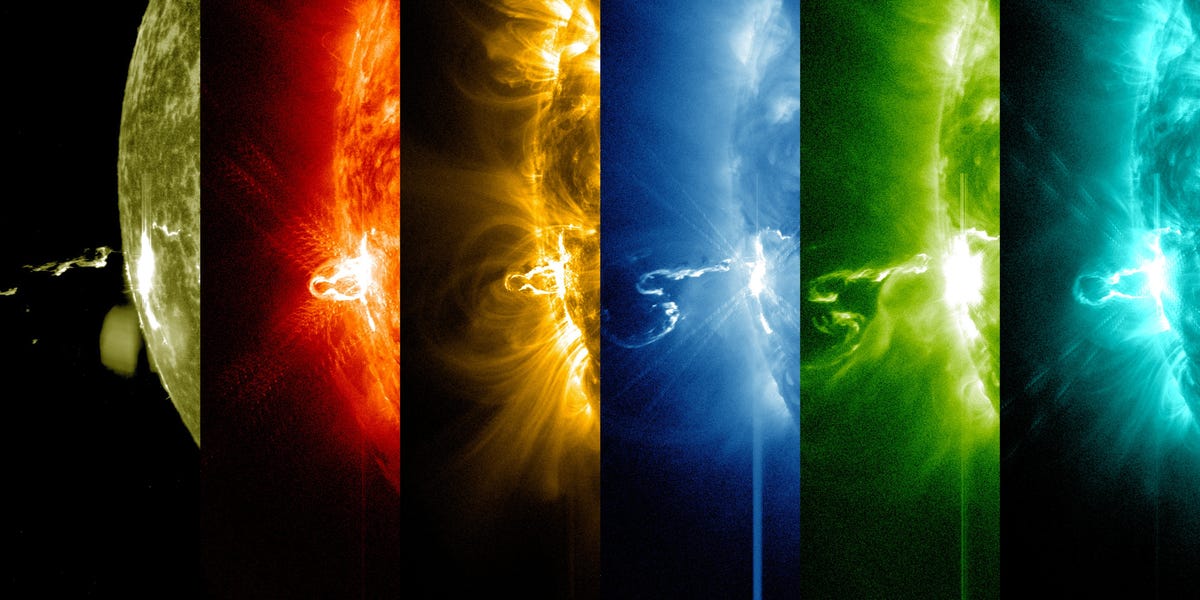
Superflares are enormous eruptions of energy from stars. They are similar to solar flares, but much more powerful. A regular solar flare is already impressive: it is a sudden explosion caused by twisted magnetic fields near sunspots. These explosions release light, X-rays, ultraviolet radiation, and high-speed particles into space. A superflare turns that volume knob way past “loud” and into “please check the structural integrity of reality.”
A typical strong solar flare from today’s Sun can disrupt radio communications, affect satellites, and create beautiful auroras when paired with a coronal mass ejection. A superflare can release tens, hundreds, or even thousands of times more energy than the largest solar flares observed in modern history. Astronomers have detected superflares on many Sun-like stars using space telescopes such as Kepler and TESS, which measure tiny changes in starlight. When a star suddenly brightens, then fades, that spike may reveal a flare.
The key point is that superflares are not magical space explosions. They are extreme versions of a familiar process: magnetic energy building up in a star’s atmosphere and then snapping into a new configuration. Imagine twisting a rubber band until it breaks. Now imagine the rubber band is made of magnetic fields, the snapping happens on a star, and the released energy could power human civilization for a very, very long time. That is the general neighborhood we are talking about.
Solar Flares vs. Superflares: What Is the Difference?
Solar Flares Are the Sun’s Magnetic Fireworks
Solar flares occur when magnetic fields near the Sun’s surface become tangled and suddenly reconnect. This releases energy across the electromagnetic spectrum. Scientists classify solar flares by intensity: A, B, C, M, and X classes. X-class flares are the most powerful category measured regularly from the Sun today. They can cause radio blackouts on Earth’s sunlit side and may be associated with coronal mass ejections, or CMEs.
Superflares Are the “Boss Level” Version
Superflares are usually defined as stellar flares that release far more energy than ordinary solar flares. They have been observed on young, active stars and even on some stars that resemble the Sun. The younger a star is, the faster it often rotates, and faster rotation can drive stronger magnetic activity. That matters because the early Sun, about 4 billion years ago, was not the calm middle-aged star we see today. It was a rowdy adolescent with a magnetic attitude problem.
CMEs Are Related, but Not the Same
A solar flare is a burst of radiation. A coronal mass ejection is a huge cloud of plasma and magnetic field launched from the Sun’s outer atmosphere. They often occur together, but not always. Think of a flare as the flash and a CME as the cannonball. If a CME is aimed at Earth, it can slam into our magnetosphere and trigger geomagnetic storms, auroras, satellite issues, power-grid stress, and communication problems.
The Young Sun Was Much More Active
Today’s Sun follows an approximately 11-year solar cycle, moving between quieter periods and more active phases filled with sunspots, flares, and CMEs. But early in its life, the Sun likely rotated faster and produced far more frequent eruptions. Research on young Sun-like stars suggests that powerful flares may have happened often during Earth’s first billion years.
This creates a fascinating paradox. The young Sun was dimmer than it is today, perhaps only about 70% as bright as the modern Sun. That raises a famous problem called the faint young Sun paradox: if the Sun was weaker, why was early Earth not a frozen snowball? Geological evidence suggests liquid water existed on early Earth. Something helped keep the planet warm enough.
Greenhouse gases such as carbon dioxide, methane, and nitrous oxide may have played major roles. Superflares may have helped by driving chemical reactions in the atmosphere that produced warming compounds. They may also have helped fix nitrogen, transforming atmospheric nitrogen into forms useful for prebiotic chemistry. Basically, early Earth needed both warmth and chemical ingredients. A stormy Sun may have helped deliver both.
How Could Superflares Help Spark Life?
Life requires chemistry that is organized, energetic, and persistent. You need carbon-based molecules. You need nitrogen. You need energy sources capable of pushing simple molecules into more complex arrangements. On early Earth, possible energy sources included lightning, volcanic heat, ultraviolet light, asteroid impacts, hydrothermal vents, and solar energetic particles.
For decades, lightning was a star player in origin-of-life discussions, partly because of the famous Miller-Urey experiment in the 1950s. That experiment showed that electrical sparks passing through a simulated early atmosphere could produce amino acids. The challenge is that scientists now think Earth’s early atmosphere may have been less methane-rich than the Miller-Urey setup assumed. With less methane, lightning may have been less efficient at making organic molecules.
That is where solar energetic particles enter the story. When superflares erupt, they can accelerate protons and other charged particles to high speeds. If those particles strike a planet’s atmosphere, they can break apart stable molecules such as nitrogen, carbon dioxide, methane, and water vapor. The broken pieces can recombine into new molecules, including hydrogen cyanide, nitrous oxide, amino acids, and carboxylic acids. Some of these compounds are important stepping stones toward proteins, nucleic acids, and metabolism.
Recent laboratory work has tested this idea by exposing gas mixtures resembling early planetary atmospheres to energetic particles. The experiments found that proton irradiation could produce biologically relevant organic compounds, even under weakly reducing atmospheric conditions. That matters because it suggests solar particles may have been an efficient prebiotic energy source, especially when methane was present at lower levels than older models required.
The Recipe: Atmosphere, Energy, and Patience
To understand the superflare hypothesis, imagine early Earth as a kitchen. The atmosphere supplied ingredients: carbon dioxide, nitrogen, methane, water vapor, and other gases. The young Sun supplied heat and energetic particles. Volcanoes, impacts, and lightning added extra chaos because apparently early Earth did not believe in minimalist design.
Now add time. Lots of time. Not “wait for bread dough to rise” time. We are talking millions of years of repeated reactions, changing environments, oceans, mineral surfaces, ponds, tides, and atmospheric cycles. A single superflare did not create a fish, a fern, or your neighbor’s golden retriever. Instead, repeated solar storms may have helped generate useful chemical building blocks that later participated in longer chains of prebiotic chemistry.
This distinction is important for accuracy. Scientists are not saying, “A solar flare hit Earth and life instantly appeared.” That would be a comic book origin story, and even comic books would ask for a better mechanism. The more careful claim is that energetic solar activity may have increased the supply of molecules needed for life’s emergence.
Did Superflares Warm Early Earth?
Superflares may also have influenced early climate. When energetic particles hit the atmosphere, they can trigger chemical pathways that produce nitrous oxide, a greenhouse gas. They may also influence methane chemistry. These processes could have contributed to warming at a time when the Sun was dimmer.
However, this is not a simple “more flares equals more life” equation. Too much stellar activity can be destructive. High-energy radiation can erode atmospheres, damage organic molecules, strip away ozone, and make planetary surfaces hostile. The same kind of stellar activity that may help create prebiotic ingredients can also destroy habitability if it is too intense or too frequent.
Earth had important advantages. It had gravity strong enough to hold an atmosphere, a magnetic field that likely helped shield the surface from charged particles, oceans that could absorb and protect chemistry, and geological cycling that refreshed environments. In other words, Earth was not merely lucky because the Sun was active. It was lucky because the activity occurred in a planetary setting that could turn danger into chemistry.
What Does This Mean for Alien Life?
The superflare story reaches far beyond Earth. Astronomers searching for life on exoplanets often focus on the habitable zone, the region around a star where liquid water could exist on a planet’s surface. But water is only one part of habitability. Stellar behavior matters too.
Many rocky exoplanets have been found around red dwarf stars. These stars are smaller and cooler than the Sun, but they can be magnetically active for a long time. Their habitable zones are close in, meaning planets there may be exposed to frequent flares and particle storms. In some cases, flares could help drive prebiotic chemistry. In others, they could strip atmospheres or bathe the surface in harmful radiation.
This is why scientists now study “space weather” as part of astrobiology. A planet’s star is not just a light bulb. It is an environmental engine. To judge whether a planet could support life, researchers need to know the star’s flare rate, ultraviolet output, particle storms, age, rotation, and magnetic behavior. A calm star may provide stability. A mildly active young star may provide chemistry. A wildly active star may behave like a landlord who keeps removing the roof.
Should We Worry About Superflares Today?
The modern Sun is calmer than it was in its youth, but it is not asleep. Solar flares and CMEs still happen, especially near solar maximum. In recent years, strong solar activity has produced impressive auroras and temporary radio disruptions. Space-weather agencies monitor the Sun constantly because modern technology is vulnerable to geomagnetic storms.
A major solar storm today could affect satellites, GPS, high-frequency radio, aviation routes, spacecraft operations, and electrical grids. The famous Carrington Event of 1859 caused telegraph systems to malfunction and auroras to appear at unusually low latitudes. If a comparable event occurred now, the consequences could be much larger because our civilization is wrapped in electronics like a burrito wrapped in foil.
Does that mean a civilization-ending superflare is around the corner? No. Scientists continue to debate how often truly extreme events occur on Sun-like stars and whether the Sun can produce the largest kinds of superflares seen elsewhere. The risk is not zero, but it is also not a reason to panic. It is a reason to improve forecasting, harden infrastructure, protect satellites, and support solar research.
How Scientists Study Superflares
Space Telescopes Watch Other Stars
Because we have not observed a true superflare from the modern Sun, scientists study other stars. Missions like Kepler and TESS look for brightness changes in thousands of stars. A sudden spike in brightness may indicate a flare. By studying many stars over time, researchers estimate how often superflares occur on stars similar to the Sun.
Solar Observatories Watch Our Own Star
NASA, NOAA, and other space agencies use satellites to monitor the Sun in visible light, ultraviolet light, X-rays, and charged particles. These observations help forecast solar storms and reveal how magnetic fields twist, reconnect, and release energy.
Laboratories Recreate Early-Earth Chemistry
Researchers also simulate early atmospheres in the lab. They expose gas mixtures to sparks, ultraviolet light, or energetic particles, then analyze the products. This approach does not recreate early Earth perfectly, but it helps test which energy sources are most effective at forming prebiotic molecules.
Superflares and the Origin of Life: A Balanced View
The idea that the Sun may have helped spark life is exciting, but science is rarely a single-cause story. Life probably did not arise because of one ingredient, one storm, one pond, or one miracle lightning bolt. It likely emerged through a network of processes: atmospheric chemistry, ocean chemistry, mineral surfaces, wet-dry cycles, hydrothermal systems, impacts, and solar energy.
Superflares may have been one important source of energy in that network. They could have helped produce organic molecules, influenced climate, and changed atmospheric chemistry. But they were not alone. The origin of life was probably less like flipping a switch and more like slowly assembling a recipe in a kitchen where the stove, refrigerator, and ceiling were all volcanoes.
That is what makes the story beautiful. The Sun, which can burn, blind, and disrupt, may also have helped prepare Earth for biology. The same star that now powers photosynthesis may once have powered prebiotic chemistry. Our existence may be tied not only to sunlight, but to solar storms.
Specific Example: From Particles to Amino Acids
Imagine a young Earth with a nitrogen-rich atmosphere containing carbon dioxide, methane, and water vapor. A superflare erupts from the young Sun. Along with radiation, it accelerates protons into space. Some of those particles reach Earth’s upper atmosphere. They collide with atmospheric gases, breaking chemical bonds. Nitrogen molecules, which are normally difficult to split, become chemically available. Carbon-bearing molecules fragment and recombine. Over time, reactions produce compounds that can rain out or dissolve into surface water.
In protected environments such as ponds, shorelines, or mineral-rich basins, these molecules could concentrate. Wet-dry cycles might help link small molecules into longer chains. Minerals could act as surfaces that organize reactions. Heat, ultraviolet light, and additional particle events could keep the chemistry moving. None of this guarantees life, but it increases the odds that early Earth had a steady supply of useful molecular parts.
Why This Topic Matters
The superflare hypothesis matters because it changes how we think about habitability. We often imagine life needing peace and quiet, but early Earth was anything but peaceful. It was volcanic, stormy, impact-scarred, and chemically restless. Instead of preventing life, some of that chaos may have helped create the conditions for life.
This idea also reminds us that danger and possibility can come from the same source. Solar storms can threaten modern technology, but ancient solar storms may have helped build life’s molecular foundation. The Sun is both hazard and helper, destroyer and gardener, cosmic dragon and neighborhood lamp. It is complicated, which is exactly what makes it interesting.
Experience Notes: Thinking About Superflares Under the Modern Sun
One of the best ways to appreciate this topic is to step outside on a clear morning and feel ordinary sunlight on your face. Nothing about that moment seems violent. The light feels soft. The sky looks calm. Birds are doing bird things. Someone nearby is probably holding an iced coffee with the seriousness of a sacred object. Yet that gentle warmth comes from a star that is constantly moving, boiling, twisting magnetic fields, and sending particles through space.
That contrast makes the superflare story feel personal. We experience the Sun as daily comfort, but science reveals it as a force that shaped the entire planet. Every garden, every ocean breeze, every meal grown by photosynthesis depends on solar energy. Now add the possibility that ancient solar eruptions helped make amino acids and other organic molecules, and the Sun becomes more than a background object. It becomes part of life’s origin story.
If you have ever watched an aurora, even in photos, you have seen a small modern echo of this relationship. Auroras happen when charged particles interact with Earth’s magnetic field and atmosphere. They are beautiful because Earth has defenses. The planet takes an incoming stream of solar energy and turns it into curtains of green, red, and purple light. Early Earth may have performed a chemical version of that trick: taking solar particles and turning them into useful molecular ingredients.
There is also a humbling lesson here for anyone interested in space, science, or the search for alien life. We often want clean categories: good radiation, bad radiation; safe planets, unsafe planets; friendly stars, dangerous stars. But nature refuses to be that tidy. A flare that is harmful in one context may be helpful in another. A quiet planet may lack the energy needed for complex chemistry. A violent environment may become creative if it has the right protections and ingredients.
For students, writers, educators, and curious readers, superflares offer a perfect doorway into big science. They connect astronomy, chemistry, climate, biology, and technology. They explain why space weather matters today and why ancient space weather may have mattered even more. They also make the Sun feel new again. Not just the thing we complain about in July. Not just the reason plants lean toward windows. The Sun may be one of the original authors of Earth’s biological story.
So the next time sunlight spills across your desk, think about the younger Sun: louder, stormier, and far less polite. Its superflares may have blasted particles into Earth’s early atmosphere, stirring chemical reactions that helped set the stage for life. That does not mean the Sun single-handedly created life. But it may have provided some of the sparks. And considering we are here to wonder about it, that is one spectacular solar legacy.
Conclusion
Superflares are extreme stellar eruptions powered by magnetic energy. On the young Sun, they may have been far more frequent than the flares we see today. Instead of being only destructive, these ancient solar storms may have helped warm early Earth and drive chemical reactions that produced life-related molecules such as amino acids and carboxylic acids.
The theory does not solve the entire mystery of life’s origin, but it adds an important piece to the puzzle. Life may have needed water, minerals, atmosphere, time, and energy. The young Sun may have supplied some of that energy in dramatic bursts. In that sense, our star was not just shining on early Earth. It may have been actively helping Earth become a living world.













