
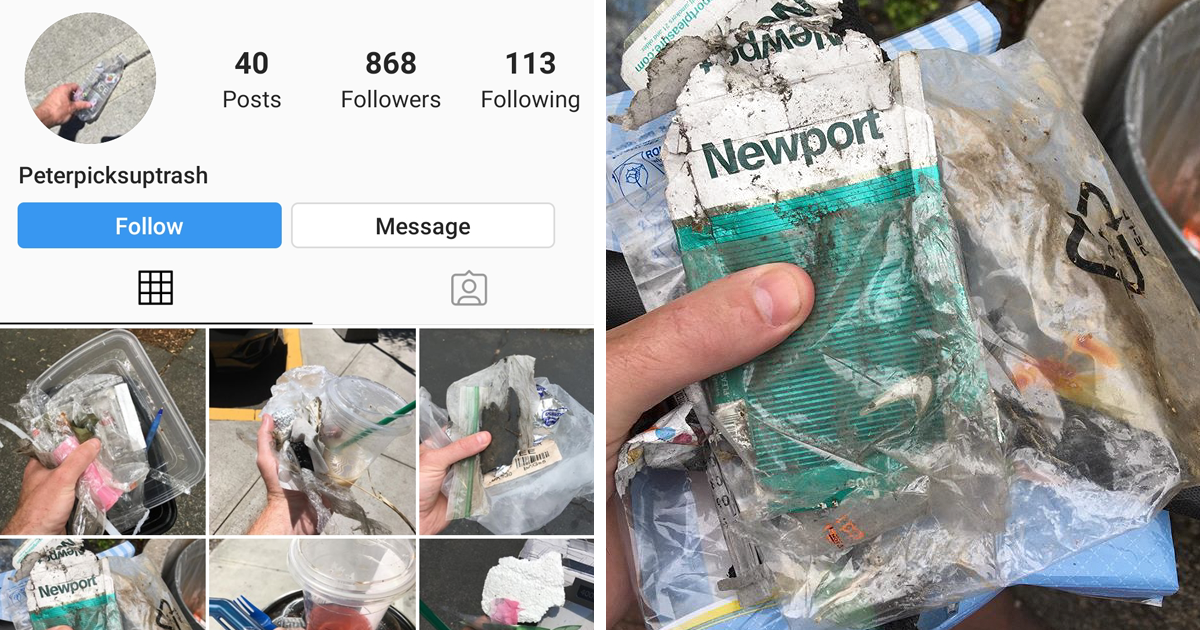
Instagram has given us many things: vacation photos from people who “needed a reset,” latte art that looks suspiciously like a beige cloud, and gym mirror selfies taken with the emotional intensity of a Renaissance painting. But every now and then, the internet coughs up something genuinely useful. Enter @peterpicksuptrash, an account built around one radically simple idea: when Peter sees trash on the ground, he picks it up, throws it away, takes a photo, and reminds everyone that helping the planet does not always require a committee, a brand partnership, or a 47-slide sustainability deck.
The account is almost aggressively unglamorous. No cinematic drone shots. No influencer voiceover whispering, “I didn’t choose this journey; the journey chose me.” Just a hand holding wrappers, cups, cigarette boxes, masks, plastic scraps, and whatever other little urban leftovers people decided the sidewalk should inherit. The repeated message is beautifully boring: this was very easy to do. And that is exactly why it works.
At a time when environmental problems can feel enormous, complicated, and wrapped in enough policy language to sedate a raccoon, Peter’s posts cut through the fog. He is not claiming that one coffee cup will save the world. He is showing that one coffee cup is still one less coffee cup rolling toward a storm drain, blowing into a park, or becoming somebody else’s problem.
Who Is the Guy Behind the Trash?
The person behind the account is Peter Hoherd, a Portland-area resident known online for turning litter pickup into a small, repeatable public habit. His Instagram account, @peterpicksuptrash, became noticed because of its almost comical consistency. He walks, sees trash, picks it up, documents it, and moves on with his day. That is the entire plot. Somehow, it is more satisfying than half the streaming shows people keep recommending.
Peter’s approach is not about posing as a superhero. In fact, the charm of the account is how normal it is. He has explained in past interviews that the habit began when he noticed trash during ordinary lunch walks. Like many of us, he saw people step around litter as if it were protected by an invisible force field. Eventually, he simply picked some up. Then he did it again. Then it became a habit. Then it became content with a purpose.
The genius is in the framing. Most environmental messaging starts with doom: oceans choking, landfills swelling, wildlife suffering, and humanity sprinting toward catastrophe while holding a disposable fork. Peter starts with something much smaller: “This was on the ground. I picked it up. You could too.” That kind of message lands because it does not ask people to become perfect. It asks them to become slightly less passive.
Why a Trash Instagram Is Strangely Addictive
On paper, an Instagram feed full of litter should be depressing. In practice, it is oddly wholesome. Each post has the rhythm of a tiny completed mission. There is a problem. There is an action. There is a result. No cliffhanger. No outrage bait. No caption ending with “thoughts?” like the comments section is about to solve civilization.
That simplicity is powerful because most social media rewards spectacle. The louder, shinier, angrier, or more luxurious a post is, the more it screams for attention. Peter’s trash photos do the opposite. They are quiet, repetitive, and almost stubbornly practical. They remind followers that public spaces are not maintained only by city workers, volunteers, or some mythical department called “Someone Else.” They are maintained by people who decide not to walk past the obvious.
There is also a tiny psychological trick at work. When you see someone repeatedly doing an easy good thing, the excuse machine in your brain starts to sputter. “I’m too busy” sounds less convincing when the task takes ten seconds. “It’s not my trash” begins to feel like a technicality. “Someone should clean that up” becomes awkward when you realize you are currently someone.
The Bigger Problem: America Has a Lot of Little Trash
Peter’s handfuls of litter may look small, but they represent a very real national issue. The United States produces hundreds of millions of tons of municipal solid waste each year, and single-use packaging remains a major part of the stream. Keep America Beautiful has reported tens of billions of pieces of litter along U.S. roads and waterways, while marine debris experts continue to warn that trash from streets, parks, and parking lots can travel through storm drains and waterways before reaching rivers, lakes, or the ocean.
That is the uncomfortable part of litter: it rarely stays where it was dropped. A plastic wrapper on a sidewalk can become a plastic wrapper in a gutter. A bottle cap in a parking lot can become a bottle cap in a creek. A cigarette butt flicked onto a curb can move with rainwater toward places where fish, birds, and other wildlife did not request a nicotine-flavored buffet.
The most common litter items are not mysterious alien artifacts. They are everyday things: food wrappers, beverage containers, cups, straws, cigarette butts, plastic bags, bottle caps, takeout packaging, and the occasional object so weird it deserves its own detective series. Peter’s account captures exactly that ordinary ugliness. The trash is not dramatic. It is familiar. That familiarity is the point.
Why “This Was Very Easy to Do” Is Better Than a Lecture
Environmental communication often struggles because it accidentally makes people feel either guilty or powerless. Too much guilt, and people tune out. Too much complexity, and people assume the solution belongs to governments, corporations, or people with clipboards. Peter’s message avoids both traps. He does not say, “You personally ruined the planet with that burrito wrapper.” He says, in effect, “Here is a small thing that helps, and it took almost no effort.”
That tone matters. People are more likely to copy behavior when it feels socially normal and achievable. A person picking up one piece of trash creates a visible example. A feed full of those moments creates repetition. Repetition creates a norm. Suddenly, picking up litter is not a grand moral performance. It is just something decent people do when they can.
There is humor in it, too. The deadpan nature of the posts makes the whole thing feel like anti-influencing. Instead of “Use my discount code,” the message is “Use your hand.” Instead of “Here is my morning routine,” it is “Here is a cup someone abandoned like it owed them money.” The account is funny because it refuses to decorate the obvious. Trash is bad. Picking it up is good. Roll credits.
What Peter’s Account Teaches About Real Environmental Action
1. Start where you already are
You do not need to drive to a beach cleanup, buy matching T-shirts, or announce a campaign with a dramatic logo. Start on your block, near your office, at the park, by the bus stop, or on the walk from lunch. Most litter pickup opportunities are not hidden. They are sitting next to a curb like tiny accusations.
2. Make it repeatable
A heroic cleanup once a year is great. A small habit repeated often may be even better. Peter’s account works because it turns action into routine. The goal is not to exhaust yourself. It is to lower the mental barrier until picking up one safe piece of trash feels as normal as holding a door open.
3. Keep it safe
Not all trash should be handled casually. Gloves, grabbers, and common sense are your friends. Avoid needles, broken glass, chemicals, sharp metal, suspicious containers, animal waste, or anything that makes your inner alarm system start playing circus music. When in doubt, report hazardous items to local authorities or property managers instead of trying to become Captain Tetanus.
4. Share without preaching
Posting cleanup photos can inspire others, but the tone matters. The best posts say, “This is doable,” not “I am morally superior because I touched a potato chip bag.” Peter’s account succeeds because the message is humble and practical. It invites people in rather than shaming them from a throne made of recycled cardboard.
From One Handful to a Movement
Peter is part of a broader culture of everyday cleanup action. Some people join neighborhood litter walks. Some participate in Adopt-a-Highway programs. Others use cleanup apps to track what they collect. Runners have popularized “plogging,” a Swedish-inspired trend that combines jogging with picking up litter. It is fitness, community service, and surprise squats all in one. Your hamstrings may complain, but the sidewalk will look better.
What these efforts share is a refusal to treat trash as invisible. That refusal matters. Littered spaces can send a message that nobody cares. Clean spaces send the opposite message: people are paying attention here. People live here. People use this trail, this sidewalk, this bus stop, this beach, this little patch of grass next to the parking lot where someone apparently performed a ritual involving energy drink cans.
One person cannot remove every piece of litter in America. But one person can change the small zone around them. One person can influence a friend, a neighbor, a coworker, or a stranger scrolling Instagram while pretending not to avoid laundry. And when enough people adopt the same small behavior, the result stops being small.
How to Start Your Own Mini Trash-Picking Habit
If Peter’s feed makes you want to do more than double-tap a photo of a discarded straw, start simple. Carry a reusable glove or a compact litter grabber when you walk. Keep a small trash bag in your car or backpack. Pick up only what is safe. Wash your hands afterward. Separate recyclables when local rules make that practical. Most importantly, do not turn the habit into a guilt marathon. You are not required to clean the whole city before dinner.
A useful rule is the “one-piece minimum.” On any walk, pick up at least one safe piece of litter and dispose of it properly. That is it. One wrapper. One cup. One plastic lid. It is almost laughably small, which is why it is sustainable. The trick is that once you pick up one thing, you often notice the next one. Soon your brain starts scanning the ground like a low-budget environmental Roomba.
Families can make it a game. Friends can turn it into a walk-and-talk ritual. Offices can organize ten-minute cleanup breaks around the building. Runners can turn easy miles into plogging routes. Schools can use cleanups to teach students that environmental responsibility is not only a chapter in a textbook; it is also bending down, picking up a snack wrapper, and realizing the world improves through unglamorous actions.
Experience Section: What Picking Up Trash Actually Feels Like
The first experience most people have with picking up public trash is awkwardness. Not danger, not difficulty, not heroic sacrificejust awkwardness. You see the cup. You see the bin twenty feet away. You look around as if a panel of judges may appear from behind a shrub. Then you pick it up, walk it over, toss it in, and discover that absolutely nothing dramatic happens. No applause. No parade. No bald eagle landing on your shoulder. Just a cleaner patch of ground.
That quietness is part of the lesson. A lot of good actions do not feel cinematic. They feel ordinary. They feel like holding an elevator, returning a cart, or telling someone they dropped their keys. Picking up litter belongs in that same category. It is civic housekeeping. It is tiny maintenance for the shared world.
After doing it a few times, people often notice two things. First, there is more litter than they used to see. The trash was always there, but the brain filters it out to avoid daily despair. Once you become the kind of person who removes it, the filter changes. A gum wrapper becomes visible. A bottle cap flashes near a curb. A plastic bag trembles in a bush like a ghost with poor life choices.
Second, the act becomes easier socially. The first time, you may feel strange. The tenth time, you feel efficient. The fiftieth time, you may become mildly annoyed at how simple it is and how many people still walk by. That irritation can be useful if it turns into action rather than scolding. Nobody enjoys being lectured by a person holding a damp napkin. But many people are influenced by seeing a neighbor calmly do the right thing.
There is also an unexpected satisfaction in completing a visible task. Many modern problems are abstract. Emails reproduce overnight. News cycles mutate by lunch. Bills, deadlines, and notifications arrive in formation. Litter pickup is refreshingly direct. There was trash. Now there is not. The before-and-after happens in seconds. It gives the brain a little click of completion, like closing a tab you actually meant to close.
On a neighborhood walk, the experience can become almost meditative. You slow down. You notice storm drains, tree wells, sidewalk cracks, and the strange migration patterns of fast-food packaging. You learn where litter gathers after windy days. You become aware of which corners need better bins, which businesses might need outdoor ashtrays, and which public spaces are loved but under-maintained. Picking up trash is not just cleaning; it is paying attention.
And yes, sometimes the experience is gross. There will be sticky cups. There will be mystery fluids. There will be objects that make you whisper, “Absolutely not,” and keep walking. That is fine. The goal is not reckless bravery. The goal is responsible care. Use gloves. Use a grabber. Skip hazardous items. Take the safe wins.
In the end, the best part of the experience is how quickly it changes your relationship with public space. A sidewalk stops being “the city’s problem.” A park stops being “someone else’s responsibility.” You begin to feel a small ownership of the places you pass through every day. That feeling is contagious. It is exactly what makes Peter’s trash-posting Instagram worth following: it turns a boring act into a visible reminder that the world gets better when ordinary people stop waiting for extraordinary permission.
Conclusion: The Internet Needs More Useful Weirdness
@peterpicksuptrash is not the flashiest Instagram account. It will not teach you how to style a bookshelf by color, cook pasta in a wheel of cheese, or look mysteriously windswept in a parking garage. But it might make you a better neighbor. It might make you notice the wrapper you would have ignored yesterday. It might remind you that environmental action can be humble, funny, repetitive, and still meaningful.
That is why this account feels so refreshing. It takes a global problem and reduces the first step to something almost anyone can do: pick it up, throw it away, move on. No cape required. No speech required. No influencer lighting required. Just a hand, a bin, and the tiny rebellious belief that public spaces deserve better.
If the internet must keep feeding us endless content, more of it should be like this: practical, oddly charming, and useful in real life. Because sometimes the only Instagram worth following is not the one showing a perfect life. It is the one showing a dirty sidewalk becoming a little cleaner, one very easy act at a time.
SEO Tags
Note: This article is based on publicly available reporting and reputable environmental information, rewritten in original language for web publication.














