
The 2019 Formula E season was not just another lap around the sustainability marketing track. It was the moment electric car racing stopped feeling like a clever science project and started looking like a serious motorsport category with sharp elbows, bold technology, and enough street-circuit drama to make a race engineer develop a permanent eye twitch.
Officially known as the 2018–19 ABB FIA Formula E Championship, Season 5 was the year Formula E grew up. The championship introduced the dramatic Gen2 car, removed the awkward mid-race car swap, added Attack Mode, expanded to 11 teams and 22 drivers, and delivered a title fight that ended with Jean-Éric Vergne becoming the series’ first two-time champion. In short, the 2019 Formula E season was when electric racing got faster, smarter, more strategic, and much harder to dismiss.
For years, critics treated Formula E like the quiet cousin at the motorsport dinner table. Interesting? Sure. The future? Maybe. Loud enough to scare birds out of trees like Formula 1? Absolutely not. But by 2019, the conversation had changed. Automakers were paying attention, fans were learning the rhythms of energy management, and the cars finally looked like something from the future instead of a committee-approved compromise.
Why the 2019 Formula E Season Mattered
The big story of the 2019 Formula E season was credibility. Formula E had already proved that electric single-seater racing could exist. Season 5 proved it could evolve into a proper racing product. The championship no longer had to explain why drivers were jumping into a second car halfway through the race. The new Gen2 machine had enough battery range to complete a full E-Prix, which instantly made the racing easier to understand and more professional to watch.
That change may sound technical, but for fans it was huge. Imagine watching a basketball game where every player has to change shoes at halftime because the first pair runs out of bounce. That was essentially the old Formula E car-swap era. It was charming in a “we are building the airplane while flying it” kind of way, but it also reminded viewers that the technology was still catching up. In 2019, the technology caught up enough to let the sport breathe.
The season also arrived at the perfect cultural moment. Electric vehicles were moving from niche curiosity to mainstream conversation. Tesla had already shaken the car industry awake. Traditional manufacturers such as Audi, BMW, Jaguar, Nissan, DS, Mahindra, and others were using Formula E as a public laboratory for electric performance. Suddenly, Formula E was not only about racing. It was about the future of mobility, software, batteries, efficiency, and the slightly terrifying realization that race cars might someday sound like angry spaceships rather than thunder trapped in a metal tube.
The Gen2 Car Changed Everything
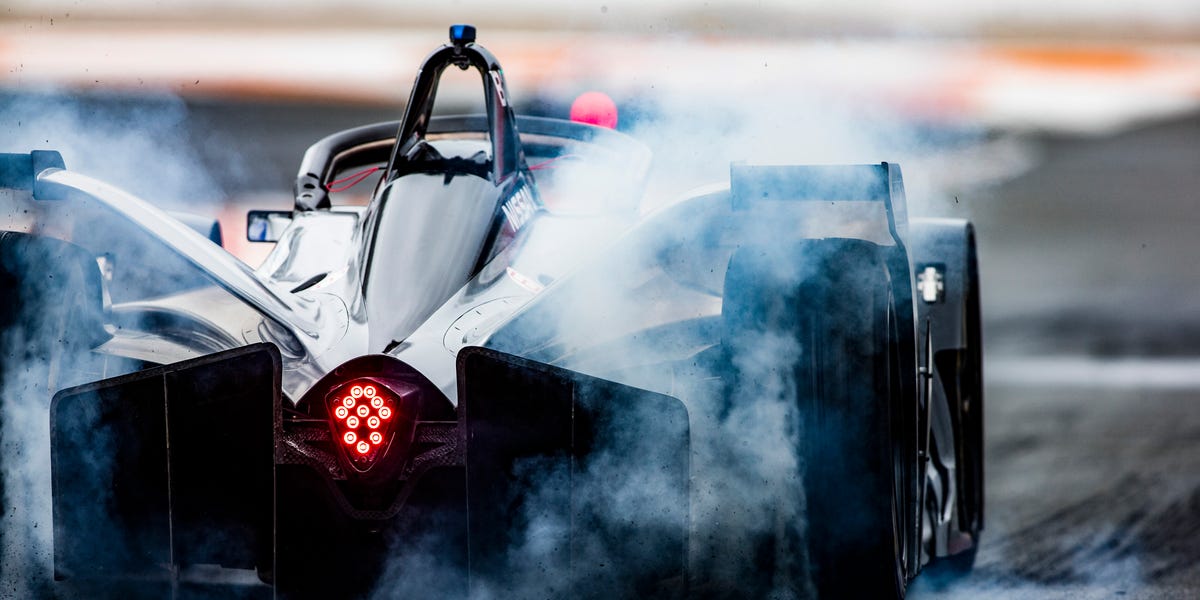
The Gen2 Formula E car was the star of the 2019 season. Officially called the Spark SRT05e, it looked sharper, lower, wider, and more futuristic than the first-generation car. With its covered wheels, angular bodywork, and LED-lit halo, it had the visual confidence of a vehicle that knew people were going to photograph it from every possible angle.
More importantly, the Gen2 car delivered real performance gains. Its maximum power output rose to 250 kW, roughly 335 horsepower, while race power was typically capped lower to preserve energy. The car could accelerate from 0 to 100 km/h in about 2.8 seconds and had a potential top speed around 280 km/h, or 174 mph. Those numbers did not make it a Formula 1 killer, but that was never the point. Formula E races on tight city streets, where acceleration, braking, traction, software mapping, and driver confidence matter more than simply chasing enormous top speed.
No More Mid-Race Car Swaps
The biggest Gen2 breakthrough was range. The battery capacity and energy efficiency improved enough that drivers could complete an entire 45-minute-plus-one-lap race in one car. That single change made Formula E easier to explain to new fans. It also made the championship feel less like a prototype demonstration and more like a mature racing series.
Instead of watching drivers dive into the pits and sprint between two cars, fans could focus on racing strategy, overtakes, tire management, and energy conservation. The car swap had been unique, but unique does not always mean good. Eating cereal with a fork is unique too; that does not make it the future of breakfast.
Energy Management Became the Real Battleground
Formula E has always rewarded drivers who can think while driving at ridiculous speed between concrete walls. In 2019, that mental workload became even more important. Drivers had to manage battery energy, regenerative braking, track position, tire grip, Attack Mode timing, and race pace all at once. It was part motorsport, part chess match, part high-voltage accounting exam.
The best drivers were not simply the fastest over one lap. They were the ones who knew when to attack, when to save energy, when to defend, and when to avoid turning the car into an expensive carbon-fiber confetti cannon. That combination gave Formula E its own identity. It was not Formula 1 with a plug. It was something different.
Attack Mode Made Strategy Visible
One of the most talked-about innovations of the 2019 Formula E season was Attack Mode. The idea sounded like it came from a racing video game, but it worked surprisingly well in real life. Drivers could temporarily unlock extra power by driving through an activation zone placed off the racing line. The catch was simple: to gain power, they first had to lose time.
This created delicious strategic chaos. A driver might surrender a position to activate Attack Mode, then use the extra power to fight back. Teams had to decide when to deploy it based on traffic, safety cars, battery state, and rival behavior. Fans could also follow the action more easily thanks to halo lighting that indicated different power modes.
Attack Mode gave Formula E something many racing series struggle to produce: a built-in reason for the running order to change. It did not replace genuine overtaking, but it helped generate opportunities. It also made every race feel slightly unpredictable, like someone had shaken the strategy box before opening it.
A Bigger Grid and Bigger Names
The 2019 Formula E season featured an expanded 11-team grid with 22 cars. That mattered because manufacturer interest was one of Formula E’s strongest signs of legitimacy. Audi returned as a major player. BMW joined with Andretti. Nissan entered after Renault’s departure. DS partnered with Techeetah. Jaguar continued developing its electric racing program. HWA Racelab arrived as a preview of Mercedes’ deeper involvement to come.
The driver lineup also mixed Formula E specialists with familiar names from Formula 1, DTM, endurance racing, and junior categories. Jean-Éric Vergne, Lucas di Grassi, Sébastien Buemi, Sam Bird, António Félix da Costa, André Lotterer, Felipe Massa, Stoffel Vandoorne, Pascal Wehrlein, Mitch Evans, and Robin Frijns helped give the season depth. This was no longer a grid of drivers politely experimenting with electric racing. It was a competitive field full of people who very much disliked being overtaken.
The Calendar Turned Cities Into Race Tracks
Formula E’s identity has always been tied to cities. The 2019 season took the championship across the Middle East, Africa, South America, Asia, Europe, and North America. Races were held in places such as Ad Diriyah, Marrakesh, Santiago, Mexico City, Hong Kong, Sanya, Rome, Paris, Monaco, Berlin, Bern, and New York City.
This urban approach gave Formula E a distinct flavor. Instead of racing only at traditional circuits far from city centers, the championship brought electric motorsport closer to where people live. That was smart branding, but it also created a unique racing challenge. Street circuits are narrow, bumpy, dusty, and unforgiving. There is very little room for error. If a driver misjudges a braking point, the wall does not gently offer feedback. It replies immediately, usually with carbon fiber.
The Racing Was Wildly Unpredictable
The 2019 Formula E season was famous for its unpredictability. The early races produced a rotating cast of winners, giving the championship a wonderfully chaotic feeling. António Félix da Costa won the opener in Ad Diriyah for BMW i Andretti. Jérôme d’Ambrosio won in Marrakesh for Mahindra. Sam Bird won in Santiago for Envision Virgin Racing. Lucas di Grassi snatched a dramatic victory in Mexico City for Audi after Pascal Wehrlein ran out of energy near the line. Edoardo Mortara won in Hong Kong for Venturi. Jean-Éric Vergne responded in Sanya for DS Techeetah. Mitch Evans gave Jaguar its first Formula E win in Rome. Robin Frijns took victory in a wet and messy Paris race.
That run of varied winners made Formula E feel refreshingly open. In many racing championships, fans can predict the podium before the race starts and then spend the next two hours pretending to be surprised. Formula E in 2019 was not like that. Form swung from track to track. Qualifying groups mattered. Energy strategy mattered. Weather mattered. Safety cars mattered. Sometimes, simply staying out of trouble felt like a podium-worthy achievement.
Jean-Éric Vergne Became Formula E’s First Double Champion
Despite all the unpredictability, Jean-Éric Vergne and DS Techeetah found a way to rise above the noise. Vergne entered the season as the reigning champion and ended it by becoming the first driver in Formula E history to win back-to-back titles. He did not dominate every race, but he showed the consistency, racecraft, and competitive stubbornness that champions tend to carry around like luggage.
His season was not smooth. Formula E rarely offers smooth seasons. Vergne had difficult qualifying sessions, pressure from rivals, and races where survival mattered as much as speed. But he won key rounds, collected important points, and controlled the championship fight when it mattered most. At the New York City finale, a seventh-place finish in the final race was enough to secure the title.
DS Techeetah also captured the teams’ championship, confirming that the partnership between Techeetah’s racing operation and DS Automobiles’ powertrain expertise had become one of the strongest packages on the grid. In a season full of new cars and new variables, DS Techeetah adapted faster than most.
Why Automakers Took Formula E Seriously
The 2019 Formula E season mattered beyond the racetrack because it gave automakers a competitive environment for electric technology. Motorsport has always been a development laboratory, but Formula E’s laboratory was focused on the problems road-car companies cared about: battery efficiency, thermal management, regenerative braking, power delivery, software control, lightweight packaging, and durability.
Unlike racing categories built around combustion engines, Formula E spoke directly to the direction of the consumer car market. Every improvement in efficiency or energy recovery had a road-car echo. That made participation attractive to brands trying to prove they were serious about electric mobility. Winning was nice. Learning was even better. Winning while learning was the corporate dream, preferably followed by a tasteful press release.
Formula E Versus Formula 1: The Wrong Question
Many people compared Formula E with Formula 1 in 2019, usually in ways that missed the point. Formula E was not trying to replace Formula 1 overnight. It was building a different kind of racing. Formula 1 remained the pinnacle of speed, aerodynamics, global glamour, and engine-era heritage. Formula E offered close urban racing, electric powertrains, software-heavy strategy, and a direct link to the future of road cars.
The better question was not “Can Formula E beat Formula 1?” The better question was “Can Formula E become important on its own terms?” In 2019, the answer started to look like yes. The Gen2 car gave the series technical credibility. The manufacturer grid gave it industry relevance. The unpredictable racing gave it entertainment value. And the title fight gave it sporting legitimacy.
The Fan Experience: Different, But Not Lesser
Formula E sounded different, looked different, and behaved differently from traditional racing. That made some motorsport fans skeptical. The cars did not roar in the old-school way. Instead, they produced a high-pitched electric whine, tire noise, gearbox sounds, and the slap of rubber against city streets. For fans raised on V8s, V10s, and V12s, that required adjustment.
But quieter racing came with advantages. City races became more practical. Fans could hear tire scrub, lockups, impacts, and crowd reactions. The atmosphere felt more immediate and less like standing inside a thunderstorm made of gasoline. Formula E was not trying to imitate combustion racing. It was creating a new sensory language for motorsport.
Specific Examples That Defined the 2019 Season
Mexico City: The Energy Drama Everyone Remembered
The Mexico City E-Prix offered one of the season’s most dramatic finishes. Pascal Wehrlein looked set for victory, but Lucas di Grassi chased him down as energy became critical. Wehrlein ran out of usable energy at the end, allowing di Grassi to snatch the win at the line. It was peak Formula E: strategy, battery management, pressure, and heartbreak packed into one finish.
Rome: Jaguar Gets Its Breakthrough
Mitch Evans’ win in Rome was a major milestone for Jaguar. The victory showed that the British manufacturer’s electric racing program was becoming genuinely competitive. It also reinforced Formula E’s value to legacy automakers: success in the championship could support a broader electric vehicle story.
Paris: Rain, Chaos, and Robin Frijns
The Paris E-Prix delivered the kind of messy street-race drama that Formula E fans either love or watch through their fingers. Rain added another layer of difficulty, and Robin Frijns came through to win for Envision Virgin Racing. It was not a polished procession. It was racing with elbows, umbrellas, and consequences.
What the 2019 Formula E Season Proved
The 2019 Formula E season proved that electric racing could be more than an environmental statement. It could be competitive, technical, emotional, and commercially relevant. The championship still had challenges. Some fans wanted more speed. Some wanted better broadcasting. Some wanted fewer gimmicks. Some simply missed the sound of internal combustion engines and were not emotionally ready to cheer for a battery percentage.
Those criticisms were real, but Season 5 answered the biggest doubts. The cars could complete races. The racing could be unpredictable. Manufacturers cared. Drivers cared. Fans had storylines to follow. And the championship had a champion worthy of the history books.
Experiences Related to the 2019 Formula E Season
Watching the 2019 Formula E season felt like watching a sport discover its own confidence in real time. Earlier Formula E seasons had charm, but they also required a little explanation. You had to tell new viewers why the cars sounded different, why the races were shorter, why the tracks were squeezed into city streets, and, most importantly, why drivers were changing cars halfway through the event. By 2019, that last explanation disappeared, and the whole product became easier to enjoy.
The Gen2 car made the biggest emotional difference. It looked serious. It had presence. It did not appear as if it had been designed apologetically. The styling was aggressive enough to catch attention even from casual viewers, and the LED halo added a useful visual clue during Attack Mode and Fanboost moments. For a fan trying to understand the race quickly, those signals mattered. Motorsport can be complicated; anything that makes strategy visible is helpful.
The city-track experience also gave Formula E a personality that traditional circuits could not copy. Watching cars thread through streets in Rome, Paris, Monaco, or New York made the series feel connected to real places rather than isolated racing facilities. The walls were close, the braking zones were busy, and the racing often looked slightly too tight for comfort. That tension became part of the appeal. Every overtake felt earned because there was rarely enough room to do anything casually.
Another memorable experience from the 2019 Formula E season was learning to appreciate energy management as a form of racing skill. At first, saving energy can sound boring. Nobody buys a ticket to watch a driver conserve electricity with the emotional intensity of someone lowering their phone brightness at 3 percent battery. But Formula E made conservation competitive. The fastest driver was not always the smartest driver. The smartest driver was not always safe. The best drivers balanced aggression and restraint, and that balance created suspense.
The Mexico City finish captured that feeling perfectly. A driver could lead most of the race and still be vulnerable if the energy calculation went wrong. That is cruel, but racing has never been famous for emotional generosity. Formula E simply found a new way to create pressure. Instead of only worrying about tires, fuel, or engine temperature, teams had to manage software, battery state, regeneration, and power deployment. The drama came from invisible numbers becoming very visible at the worst possible moment.
For new fans, the 2019 season was also a useful entry point because the championship fight had personality. Jean-Éric Vergne was not a faceless points machine. He was intense, experienced, occasionally fiery, and clearly aware of what a second title would mean. DS Techeetah looked like a team that had found the sweet spot between speed and resilience. Their championship win felt earned, not accidental.
By the end of the season, Formula E no longer felt like a promise. It felt like a platform. The cars were better, the racing was sharper, and the manufacturers were taking notes. The 2019 Formula E season was not perfect, but it was the year the series stopped asking for patience and started demanding attention. That is a much better place for any sport to be.
Conclusion: The Year Electric Racing Got Real
The 2019 Formula E season was a turning point because it combined technology, competition, and identity. The Gen2 car solved the most obvious weakness of the early era by eliminating mid-race car swaps. Attack Mode added strategic theater. The expanded grid brought more manufacturers and more recognizable drivers. The calendar turned city streets into electric battlegrounds. And Jean-Éric Vergne’s second title gave the season a strong sporting headline.
Most importantly, Season 5 made Formula E feel believable. Not as a novelty. Not as a side quest for retired racing drivers. Not as a green brochure with wheels. It became a championship where the technology mattered, the racing mattered, and the future of the car industry was quietly hiding in the paddock with a laptop and a very serious battery engineer.
If the question before 2019 was whether electric car racing could grow into something real, the answer after the season was obvious: yes, and it was already happening.










