
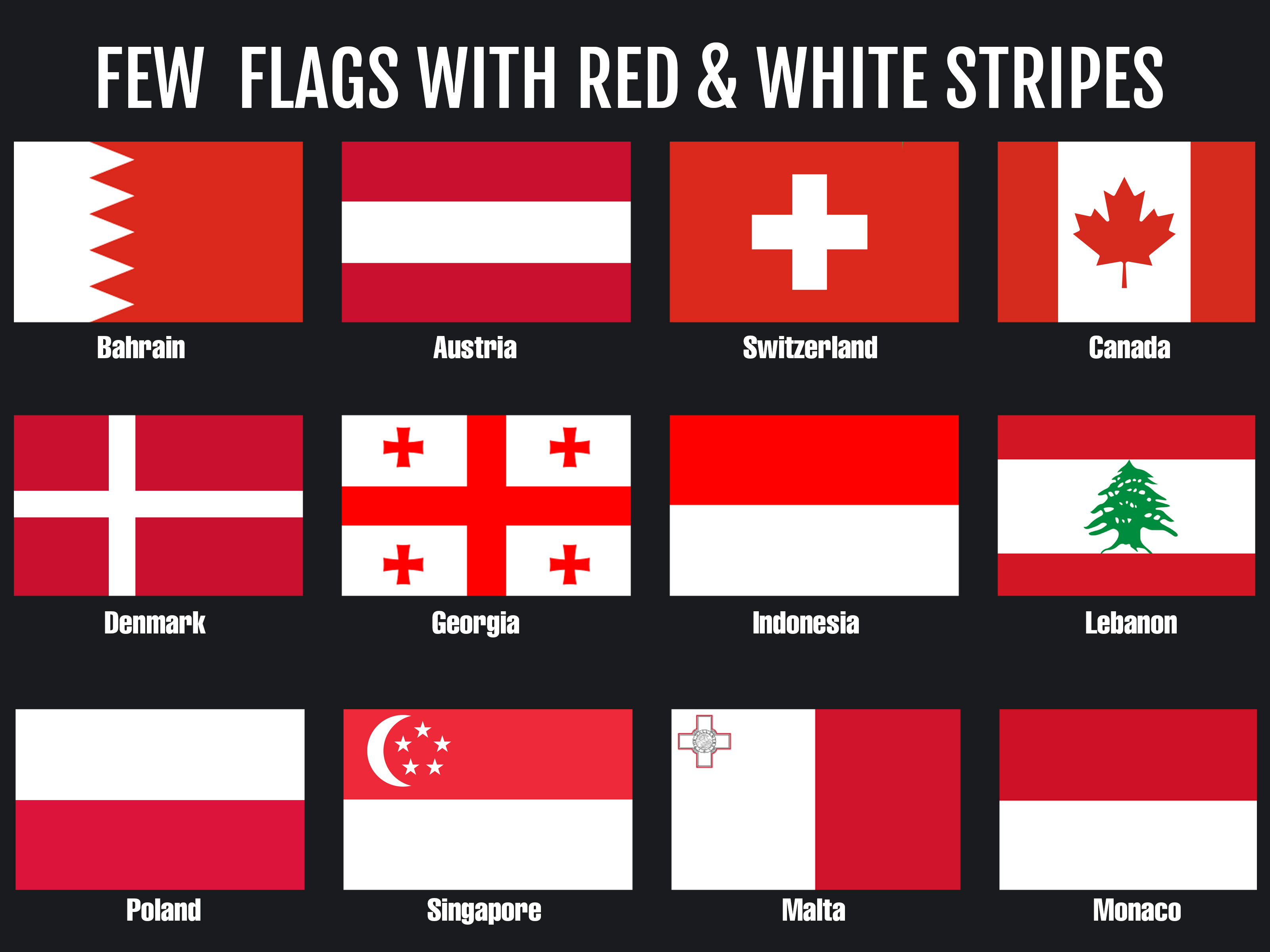
Red and white flags have a funny way of looking simple until you start comparing them. One country uses a clean red-white-red stripe pattern. Another adds a cedar tree, a maple leaf, a crescent, a cross, or a zigzag edge sharp enough to make a graphic designer reach for coffee. Suddenly, what looked like “just red and white” becomes a world tour through independence movements, old kingdoms, maritime traditions, religious symbolism, geography, and national pride.
This guide looks at 21 red, white, and red stripe flags from around the world, including classic red-white-red tribands and other red-and-white flags where stripes, bands, crosses, fields, or strong graphic divisions do the heavy visual lifting. Some are national flags. Some belong to territories. All of them prove one thing: with only two colors, a flag can still have plenty to say.
Why Are Red and White So Common in Flags?
Red and white are among the most popular flag colors because they are bold, visible, and easy to reproduce. Red often represents courage, sacrifice, struggle, vitality, or historical bloodshed. White commonly points to peace, honesty, purity, unity, or snow-covered landscapes. Of course, symbolism changes from place to place, so it is risky to assume every red stripe means the same thing. Flags are not universal emojis; they are national stories stitched into geometry.
The red-white-red arrangement is especially powerful because it creates balance. The outer red fields frame the white center, making the design easy to recognize from a distance. That is why Austria, Latvia, Lebanon, Peru, Canada, and French Polynesia all use red and white in striking central layouts, even though their histories could not be more different.
21 Red, White, & Red Stripe Flags from Around the World
1. Austria
Austria’s flag is one of the cleanest examples of a red-white-red stripe flag. It has three horizontal bands: red on top, white in the middle, and red on the bottom. No stars, no animals, no tiny coat of arms on the civil flagjust pure visual confidence. The Austrian design is also considered one of the oldest national flag designs still in use, which gives it serious “classic but not trying too hard” energy.
2. Latvia
Latvia’s flag is often compared to Austria’s, but the details matter. Instead of bright red, Latvia uses a deep carmine shade sometimes called Latvian red. The central white stripe is narrower than the red bands, giving the flag a more dramatic, elegant look. Its proportions create a strong horizontal rhythm, and the darker red helps distinguish it from similar red-white-red flags at international events.
3. Lebanon
Lebanon takes the red-white-red horizontal structure and adds one of the most recognizable natural symbols in flag design: the green cedar tree. The flag has red stripes at the top and bottom, a wider white stripe in the center, and the cedar standing proudly in the middle. The cedar has long been associated with Lebanon’s landscape, endurance, and cultural identity. Without it, the flag would be simple. With it, the flag becomes unforgettable.
4. Peru
Peru flips the red-white-red idea vertically. Its national flag has red bands on the hoist and fly sides with a white stripe in the center. The civil flag is plain, while official state versions may include the national coat of arms. The red and white colors are widely associated with sacrifice, peace, and national independence. It is a sharp design that works well because it is symmetrical, bold, and easy to recognize even when fluttering in the wind.
5. Canada
Canada’s flag is technically a red-white-red vertical design, but the maple leaf turns it into something much more iconic. The flag has red vertical bands on both sides, a white center panel, and a stylized red maple leaf in the middle. Adopted in 1965, it replaced older flag traditions tied more closely to British colonial symbols. Today, the Maple Leaf is one of the most instantly recognizable national flags in the world.
6. French Polynesia
The flag of French Polynesia uses a horizontal red-white-red design with a wide central white band. In the middle sits an emblem featuring a Polynesian canoe, sun, and waves. This makes the flag feel deeply connected to the Pacific: ocean travel, island identity, and local culture all appear in one compact image. It is a great example of how a classic stripe pattern can become regionally specific through a central emblem.
7. Bahrain
Bahrain’s flag is red and white, but instead of simple stripes, it uses a serrated division. A white band sits at the hoist, separated from the red field by five white triangles. Those five points are commonly linked to the five pillars of Islam. The result is a flag that looks clean from far away and meaningful up close. It also helps separate Bahrain visually from Qatar, a neighbor with a similar but darker design.
8. Qatar
Qatar’s flag features a white serrated band on the hoist and a large maroon field on the fly side. While many people casually call the color red, Qatar officially uses a distinctive maroon tone. The nine white points are associated with Qatar’s historical position among the Gulf’s reconciled emirates. The flag’s long proportions make it unusual, elegant, and very hard to confuse once you know what you are looking at.
9. Denmark
Denmark’s flag, known as the Dannebrog, is red with a white Scandinavian cross. It is not a red-white-red triband, but it is one of the world’s most important red-and-white stripe-based designs. The cross is shifted toward the hoist, a layout that influenced the flags of several Nordic countries. Denmark’s flag feels simple, but it carries centuries of national tradition and has become a template for an entire regional flag family.
10. Switzerland
Switzerland uses a red field with a bold white cross in the center. Its square shape makes it stand out immediately because most national flags are rectangular. The white cross has deep historical roots and is strongly tied to Swiss identity, neutrality, and federal tradition. It is one of those flags that proves a design does not need many elements to be powerful. Sometimes one cross and one red background are enough.
11. Poland
Poland’s flag is a horizontal bicolor: white on top and red on the bottom. It may look minimal, but the colors are connected to Polish heraldic tradition, especially the white eagle and red shield. Because it has only two bands, the flag is easy to reproduce and instantly recognizable. It is also frequently confused with Monaco or Indonesia by people who are moving too fast through a flag quiz and living dangerously.
12. Indonesia
Indonesia’s flag has two horizontal bands: red on top and white on the bottom. Known as the Merah Putih, meaning “Red White,” it is tied to national identity and independence. Its design is almost identical to Monaco’s flag, but the proportions differ. The red-over-white arrangement is simple, strong, and memorable, making Indonesia’s flag one of the clearest red-and-white designs in Asia.
13. Monaco
Monaco’s flag also uses a red-over-white horizontal bicolor. At first glance, it looks like Indonesia’s flag, which has created plenty of trivia-night drama. Monaco’s flag is tied to the heraldic colors of the House of Grimaldi, the ruling family. It is small-state elegance in flag form: no extra symbols, no clutter, just two clean bands with historical roots.
14. Singapore
Singapore’s flag has a red upper half and a white lower half, with a white crescent and five white stars in the red field. The crescent represents a young nation on the rise, while the stars stand for ideals such as democracy, peace, progress, justice, and equality. The design balances simplicity with symbolism, which is why it works well on everything from official buildings to tiny lapel pins.
15. Japan
Japan’s flag, the Nisshoki or Hinomaru, is white with a red disc in the center. It is one of the most minimalist national flags in the world, yet it carries enormous symbolic weight. The red circle represents the sun, a central image in Japanese cultural and historical identity. Although it is not striped, its red-and-white geometry is so iconic that no serious list of red-and-white flags feels complete without it.
16. Turkey
Turkey’s flag features a red field with a white crescent and star. The design is closely associated with Turkish identity and has roots in Ottoman symbolism. Its red background makes it visually intense, while the white crescent and star create a crisp focal point. Many flags use red and white, but Turkey’s design has a distinctive silhouette that is recognizable even without reading the country name.
17. Tunisia
Tunisia’s flag has a red field with a white circle containing a red crescent and red star. The red background, white disc, and central symbols make the flag feel layered without becoming busy. The crescent and star connect to Islamic and regional symbolism, while the circular white center helps the design stand apart from other red flags in the region.
18. Tonga
Tonga’s flag is red with a white canton containing a red cross. The cross reflects the country’s Christian heritage, while the red field gives the design a bold and dignified appearance. Tonga’s flag is protected by law from being altered casually, which makes sense: when a design is this clean and meaningful, you do not start adding gradients and clip art like it is a school newsletter.
19. Malta
Malta’s flag is split vertically into white and red fields, with the George Cross outlined in red in the upper hoist corner. The George Cross was awarded to Malta for bravery during World War II, and its presence gives the flag a strong historical dimension. The red and white colors are traditionally linked to Malta’s long civic and heraldic history.
20. Greenland
Greenland’s flag uses red and white in a highly original way. It has two horizontal fields, white above red, with a large circle split into opposite colors. The design is modern, clean, and full of visual motion. The colors connect Greenland to Denmark, but the layout is distinctly Greenlandic. It suggests ice, sun, sea, and landscape without drawing any of them literally.
21. Georgia
Georgia’s national flag is white with one large red cross and four smaller red crosses. Known as the Five Cross Flag, it is one of the most striking red-and-white flags in Europe and the Caucasus region. The design is rooted in medieval Christian symbolism and was restored as Georgia’s national flag in the 21st century. It is bold, historic, and surprisingly modern-looking for a design with such old roots.
What These Flags Have in Common
The most obvious connection is color, but the deeper link is clarity. Red and white flags tend to work because they contrast strongly. They are readable from a distance, easy to remember, and flexible across different settings, from government buildings to sports uniforms. A red-white-red stripe flag like Austria’s communicates order and balance. A symbolic red-and-white flag like Canada’s or Japan’s uses the same limited palette to create a national icon.
Another shared feature is emotional intensity. Red is visually loud. White gives it space to breathe. Together, they create a design language that can feel brave, peaceful, sacred, royal, revolutionary, or modern depending on the country. That flexibility explains why so many cultures have chosen the same colors but produced flags that look completely different.
How to Tell Similar Red and White Flags Apart
The easiest way to identify red and white flags is to look at layout first. Are the colors arranged horizontally, vertically, as a cross, as a disk, or as a serrated edge? Austria and Latvia are both horizontal red-white-red flags, but Latvia’s red is darker and its white stripe is narrower. Peru and Canada both use vertical red-white-red arrangements, but Canada has a maple leaf and a wider white center panel.
For bicolor flags, order matters. Poland is white over red. Indonesia and Monaco are red over white. If you confuse them, do not panic; even flag fans double-check proportions sometimes. For Bahrain and Qatar, count the points and observe the color: Bahrain is brighter red with five serrations, while Qatar is maroon with nine. Small details are the secret sauce of vexillology, which is the fancy word for flag study and a great way to sound mysterious at dinner.
Experiences and Practical Lessons from Red, White, & Red Stripe Flags
Anyone who has ever traveled, watched an international sports event, decorated a classroom, or helped organize a cultural festival knows that flags are not just pieces of fabric. They are instant identity markers. Red, white, and red stripe flags are especially noticeable because their contrast works in crowded spaces. At a parade, a red-white-red flag cuts through visual noise. At an airport arrival hall, a maple leaf or red-white-red triband can make someone feel instantly welcomed. At a school project table, these flags are often the first ones students recognize because the color scheme is clean and memorable.
One useful experience with these flags is learning not to judge them too quickly. At first, Austria and Latvia may look almost identical to a beginner. After a closer look, the differences become obvious: shade, stripe width, proportion, and historical background. The same thing happens with Indonesia and Monaco. A casual observer sees “red on top, white below.” A careful observer notices the proportions and context. That small act of noticing is what makes flag study surprisingly addictive. It trains the eye to respect details.
Red and white flags also teach a good design lesson: simplicity is not emptiness. Canada’s flag has only two colors and one symbol, yet it is one of the strongest national brands on Earth. Japan’s flag is even simpler, but the red sun on white has enormous cultural power. Bahrain and Qatar use a serrated edge instead of a complicated emblem, and that one design choice gives each flag movement and identity. For bloggers, designers, students, and travelers, these flags are reminders that strong visuals do not need to shout. They need to be clear.
Another real-world lesson is cultural sensitivity. A flag may look decorative to an outsider, but to the people it represents, it can hold memories of independence, sacrifice, faith, unity, and national survival. The Lebanese cedar is not just a tree. The Maltese George Cross is not just a small corner detail. The Georgian crosses are not random decoration. When using flags in articles, graphics, or events, it is worth checking the correct version, proportion, and orientation. Upside-down flags, stretched images, or wrong shades may seem minor, but they can feel careless.
Finally, these flags make global learning more fun. They are perfect for quizzes, travel content, geography lessons, and cultural explainers because they create instant “wait, I know that one” moments. Red and white may be a limited palette, but the world has used it with impressive creativity. From Austria’s ancient triband to Greenland’s modern circle, from Peru’s vertical stripes to Qatar’s serrated maroon field, these flags show that two colors can carry centuries of meaning. Not bad for designs that, at first glance, look like they were made with a very strict box of crayons.
Conclusion
Red, white, and red stripe flags prove that simple colors can tell complex stories. Austria and Latvia show how a classic triband can carry centuries of identity. Lebanon and French Polynesia demonstrate how a central emblem can transform a familiar stripe pattern into something deeply local. Peru and Canada use vertical red-white-red layouts to create symmetry and national recognition. Meanwhile, Bahrain, Qatar, Denmark, Switzerland, Japan, and others show that red and white can work through crosses, disks, serrations, and bicolor fields.
For readers, travelers, students, and flag lovers, the lesson is clear: look closer. The difference between one red-and-white flag and another may be a stripe width, a shade of red, a historical emblem, or one tiny star. That is what makes flags fascinating. They are small designs carrying big identities, and red and white may be the most energetic color duo in the flag world.
Note: This article is based on real flag information from official national descriptions, encyclopedic flag references, and established vexillology resources. Source links are intentionally omitted to keep the article clean for web publishing.













