
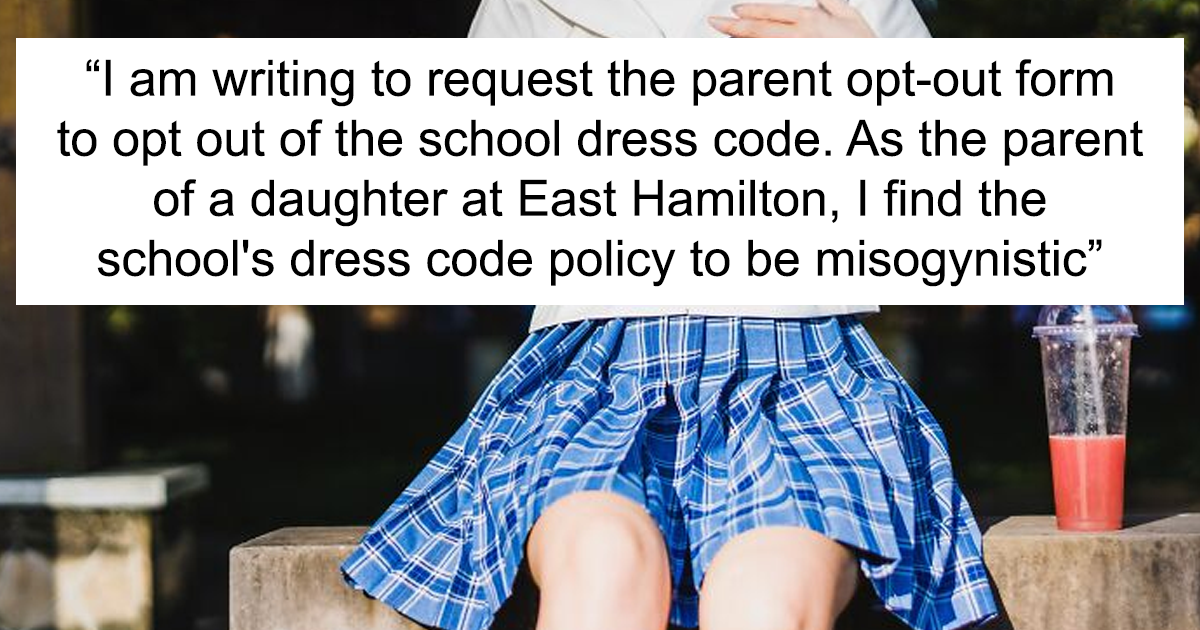
A Tennessee mom went viral for asking a question that landed with the force of a school bell in a quiet hallway: if families could opt out of masks, why couldn’t her daughter opt out of a dress code she considered sexist?
The now-famous message was simple, sharp, and more effective than a thousand committee meetings. The mother reportedly wrote to Hamilton County Schools after learning that parents could exclude their children from the district’s face-covering requirement. Her response was to request the same kind of opt-out form for the school dress code, arguing that the policy was “misogynistic” and harmful to girls’ confidence.
That line hit a nerve because it exposed a contradiction many students and parents already felt: schools often claim strict dress codes are necessary for order, safety, and learning, yet they sometimes treat public-health rules as flexible personal preferences. When a girl’s leggings are an emergency but a mask is a “family choice,” people notice. And yes, they screenshot.
Why This Mom’s Message Went Viral
The mother’s point was not only about spaghetti straps, leggings, shorts, or school hallways full of fashion police. It was about consistency. Schools are allowed to have rules, but rules gain legitimacy when they are clear, fair, and connected to a real educational purpose. The viral email questioned why one rule could be enforced firmly while another, related to community health, was treated as optional.
Her argument also landed because it used the school’s own logic. If parents could choose which policies aligned with their beliefs, she suggested, then she could choose to reject a dress code that she believed taught her daughter the wrong lesson about her body. It was satire, protest, and parental advocacy rolled into one very tidy email. Somewhere, an English teacher probably gave it an A for persuasive writing.
But behind the humor was a serious issue. Dress codes in U.S. schools have long been criticized for disproportionately targeting girls, students of color, LGBTQ+ students, and students whose bodies or cultural expression do not fit narrow ideas of what is “appropriate.” The mother’s viral moment became a larger conversation about whose comfort schools protect and whose education gets interrupted.
The Problem With “Girls Are a Distraction” Dress Codes
Many school dress codes are written in neutral language, but the enforcement often feels anything but neutral. Rules about “modesty,” “distraction,” “revealing clothing,” skirt length, leggings, tank tops, bra straps, and midriffs tend to fall hardest on girls. Even when boys also have dress requirements, girls are more often pulled aside, sent to the office, told to change, or made to feel embarrassed in front of classmates.
The deeper problem is the message. When a girl is told that her shoulders, knees, or clothing choices distract boys, the school is not just regulating fabric. It is teaching a social lesson: boys’ focus matters more than girls’ comfort, and girls are responsible for managing how others react to them. That is a heavy backpack to carry, especially when students already have algebra, social pressure, and cafeteria pizza to survive.
A fair dress code should focus on practical standards: clothing should be safe, not hateful, not disruptive in a genuine educational sense, and suitable for school activities. It should not turn ordinary clothing into a morality test. A student wearing leggings should not lose instructional time because an adult has decided the leggings are a philosophical crisis.
Mask Rules Versus Dress Codes: Why the Double Standard Felt So Loud
The viral comparison between mask policies and dress codes became powerful because masks and dress codes both involve what students wear on their bodies. Yet schools often framed them differently. Masks were debated as personal freedom, parental choice, and community responsibility. Dress codes, meanwhile, were frequently treated as nonnegotiable rules that students had to obey immediately.
During the pandemic, face coverings were discussed as a way to reduce the spread of illness in crowded indoor environments. Whether individual families supported or opposed mandates, the issue was clearly connected to shared spaces and public health. Dress codes, on the other hand, are often justified with vague claims about distraction or professionalism. That difference matters.
The mother’s point was not that every policy should be optional. It was that schools should be honest about why some rules are treated as urgent and others are softened for convenience. If a school can carefully enforce the length of a girl’s shorts, parents may reasonably ask why it cannot carefully enforce policies meant to protect students and staff during a health crisis.
How Dress Codes Can Interrupt Learning
Schools often say dress codes exist to protect learning. But when enforcement removes students from class, calls them out publicly, or makes them wait for replacement clothing, the dress code itself becomes the disruption. A student may miss a quiz, lose class participation time, or spend the rest of the day feeling embarrassed instead of engaged.
That is not a small issue. Instructional minutes matter. Confidence matters. Belonging matters. When students believe teachers are watching their clothing more closely than their ideas, the school climate suffers. The lesson becomes less “come ready to learn” and more “come ready to be inspected.” Not exactly the inspirational poster version of education.
Dress code enforcement can also be subjective. One adult’s “inappropriate” is another adult’s “normal summer outfit.” One student may pass without comment while another is disciplined for the same clothing because of body type, race, gender expression, or reputation. Subjective rules invite inconsistent enforcement, and inconsistent enforcement quickly becomes unfair enforcement.
Gender, Race, and Body Bias in School Policies
Dress code debates are not only about gender. They are also about race, culture, class, and body type. Rules about hair, head coverings, “professional” appearance, or fitted clothing can affect students differently depending on their background. Policies that ban certain hairstyles or coverings without clear religious, cultural, or medical exceptions can create unnecessary barriers for students who are simply showing up as themselves.
Girls of color are often placed at the center of these debates because they can face overlapping forms of bias. A rule may appear neutral on paper, but if it is enforced more harshly against Black girls, curvier girls, or students who do not match a narrow standard of “acceptable,” the impact is discriminatory even if the wording sounds polite.
That is why many civil-rights advocates push schools to review not only the text of dress codes but also the data behind enforcement. Who is being dress coded? Who is missing class? Who is being sent home? Who is being warned privately, and who is being publicly embarrassed? A policy is not fair just because it uses the same font for everyone.
What a Fair School Dress Code Should Look Like
A better dress code does not have to mean “wear anything, chaos forever, principals fainting into their coffee.” Schools can set reasonable expectations without policing students’ bodies. The best policies are simple, gender-neutral, culturally inclusive, and focused on actual safety or learning concerns.
1. Use the Same Rules for Every Student
A dress code should not have separate standards for boys and girls. If a rule applies to shoulders, shorts, hats, or hairstyles, it should be written in a way that applies to all students equally. Clothing expectations should not force students into traditional gender roles or punish students for gender expression.
2. Avoid Vague Words Like “Distracting”
Words such as “distracting,” “immodest,” or “inappropriate” can become a playground for bias. Clear rules are easier to follow and harder to enforce unfairly. If a policy cannot explain the actual problem, it probably needs rewriting.
3. Keep Students in Class
Unless clothing creates a genuine safety issue or contains hateful or explicit messaging, the response should not remove students from learning. A private reminder, a neutral conversation, or a practical solution is usually better than public discipline.
4. Include Students and Families in the Process
Students are the people living under these rules every day. They know which policies feel fair and which ones feel humiliating. Schools should invite students, parents, teachers, and civil-rights experts into the policy review process instead of treating dress codes like sacred tablets discovered in the supply closet.
Why Parents Connected With This Mom’s Protest
The viral mother’s email resonated because it said what many parents were already thinking: selective rule enforcement damages trust. Parents may not agree on every school policy, but they usually recognize a double standard when they see one.
Many families have watched girls stress over whether shorts are long enough, whether a shirt strap passes the “three-finger rule,” or whether leggings will trigger a lecture. At the same time, students have lived through real safety concerns, from illness to bullying to classroom disruptions. When schools pour energy into policing clothing but struggle to address bigger issues, parents naturally question priorities.
That does not mean dress codes are always malicious. Many administrators are trying to manage large schools with limited time and intense pressure from every direction. But good intentions do not erase harmful effects. Policies should be judged by how they work in real life, not by how tidy they look in a handbook.
The Bigger Lesson: Schools Should Teach Respect, Not Shame
The heart of the debate is not whether students should follow rules. They should. The real question is whether the rules teach respect or shame. A respectful policy says, “Everyone deserves a safe, focused learning environment.” A shame-based policy says, “Your body is a problem, and other people’s reactions are your responsibility.”
Schools have an opportunity to model something better. They can teach boys and girls that respect is not dependent on clothing. They can teach students that bodies are not distractions by default. They can teach that personal expression and academic seriousness are not enemies. A student can wear comfortable clothes and still understand the quadratic formula. Miracles happen every semester.
When a mother calls out a school for enforcing dress codes while making masks optional, she is really asking for coherence. If schools want families to trust policies, those policies must be consistent, evidence-based, and fair. If a rule exists mainly because adults are uncomfortable with students’ bodies, it deserves a hard second look.
Experiences and Reflections: What Families Can Learn From This Moment
For many parents, this story feels familiar even if they have never written a viral email to a school board. Picture the morning routine: a student comes downstairs ready for school, backpack half-zipped, breakfast negotiated, shoes somehow missing even though they were “literally right there.” Then a parent pauses and asks, “Will that pass dress code?” Suddenly, the day begins not with curiosity or confidence, but with inspection.
That small moment can shape how a child feels walking into school. A daughter may wonder whether teachers will notice her work or her waistband first. She may keep a sweatshirt in her locker, not because she is cold, but because she has learned that covering up is safer than being questioned. Over time, that can teach students to shrink themselves before anyone even says a word.
Some parents describe feeling trapped between supporting school rules and protecting their child’s self-esteem. They do not want to raise a student who ignores every policy. At the same time, they do not want their child absorbing the message that her body is automatically inappropriate. That tension is exactly why this viral mom’s response felt so satisfying. She did not simply complain; she exposed the logic gap with humor and precision.
Students also notice when rules are inconsistent. They notice when one classmate wears the same outfit without consequence while another is pulled aside. They notice when boys are told to “settle down” but girls are told to “cover up.” They notice when adults use the language of respect while making students feel embarrassed. Young people may be young, but they are not confused about fairness. In fact, teenagers often have a built-in hypocrisy detector, and it has excellent battery life.
Parents can take a practical lesson from this story: advocacy does not always require shouting. Sometimes it starts with asking a clear question. What educational purpose does this rule serve? Is it enforced equally? Does it remove students from class? Does it respect gender identity, cultural expression, religious practice, and body diversity? Are students part of the conversation?
Families can also document patterns. If a child is repeatedly dress coded, parents can write down dates, what happened, who enforced the rule, whether class time was missed, and whether similar clothing was treated differently on other students. Calm records are powerful. They move the conversation from “my child feels targeted” to “here is a pattern worth reviewing.”
Finally, this moment reminds schools that trust is built through fairness. Students are more likely to respect rules when they understand them, see them applied consistently, and feel those rules protect everyone’s dignity. A dress code should not be a daily referendum on a girl’s body. It should be a simple, fair policy that lets students get back to the real business of school: learning, growing, making friends, and occasionally wondering why the cafeteria insists that square pizza counts as geometry.
Conclusion
The viral Tennessee mom did more than complain about a dress code. She highlighted a contradiction that many families recognized immediately: schools often police girls’ clothing with strict confidence while treating other safety-related rules as optional. Her message worked because it was funny, direct, and rooted in a serious concern about fairness.
Misogynistic dress codes do not prepare students for the real world. Respect does. Consistency does. Policies that protect learning without shaming students do. If schools want students to take rules seriously, they must create rules worthy of respect. That means writing dress codes that are gender-neutral, bias-aware, culturally inclusive, and focused on keeping students in classnot making them feel like their bodies are the day’s biggest disciplinary problem.










