
Human beings are excellent at building things. We carve roads through mountains, raise cities in deserts, turn islands into mining colonies, and occasionally create entire towns for industries that later pack up and leave faster than a teenager asked to clean the garage. But nature is patient. It does not need a permit, a crane, or a five-year redevelopment plan. Give it a cracked wall, an empty street, or a roof with one suspicious leak, and it will politely move in with moss, vines, roots, birds, sand, trees, and the occasional “this is my house now” raccoon energy.
That is why abandoned places reclaimed by nature fascinate travelers, photographers, historians, and anyone who has ever forgotten a sandwich in the back of the fridge. These sites are not simply spooky ruins. They are living examples of ecological succession, natural decay, urban abandonment, and the strange beauty that appears when human ambition takes a coffee break and never returns.
Below are ten real abandoned places where nature has become the new landlord. Some are open to visitors, some require guided access, and some are strictly off-limits for safety or conservation. Either way, each one proves the same point: concrete may be tough, but a determined tree root has the patience of a tax auditor.
1. Pripyat and the Chernobyl Exclusion Zone, Ukraine
Few abandoned cities are as haunting as Pripyat, the Soviet-era city evacuated after the 1986 Chernobyl nuclear disaster. Built to house workers from the nearby nuclear power plant and their families, Pripyat once had schools, apartment blocks, cafés, sports facilities, and an amusement park that became one of the world’s most recognizable symbols of sudden abandonment.
After the disaster, the surrounding exclusion zone became unsafe for regular human settlement. Yet the absence of people created an unexpected ecological story. Forests expanded, vegetation pushed through roads, and wildlife returned to landscapes once shaped by industry and agriculture. Wolves, deer, boar, foxes, birds, and other animals have been documented in the broader zone, turning it into one of the most unusual examples of accidental rewilding on Earth.
This does not mean the area is “safe” or magically healed. Radiation remains a serious issue, and scientists continue to study its effects on plants and animals. But Pripyat shows a complicated truth: remove constant human pressure, and nature often rushes back, even in places marked by catastrophe.
2. Houtouwan, Shengshan Island, China
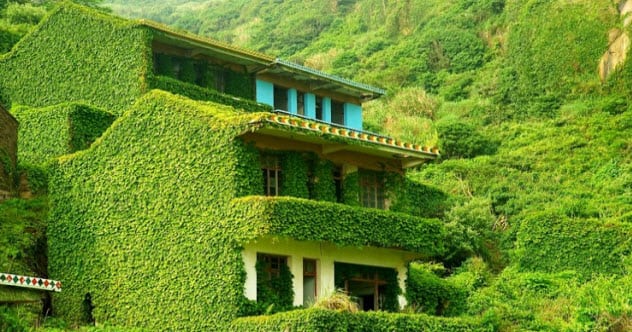
Houtouwan looks like a village designed by a fairy tale artist who had a very serious ivy budget. Located on Shengshan Island in China’s Shengsi Archipelago, this former fishing village was once home to a thriving community. As transportation became difficult and economic opportunities shifted, residents gradually moved away. By the early 2000s, much of the village had emptied.
Then the plants clocked in for work.
Today, abandoned homes are wrapped in thick green vines. Roofs, walls, stairs, windows, and terraces disappear beneath vegetation, giving Houtouwan its famous “green ghost village” appearance. Unlike many abandoned places that feel dry and brittle, Houtouwan feels strangely alive. It is not a town fading into dust; it is a town being swallowed by leaves.
The site has become popular with photographers and curious travelers, which has brought both tourism opportunities and safety concerns. The best way to experience it is from designated paths and viewpoints rather than treating crumbling buildings like a personal jungle gym. Nature may be beautiful, but gravity remains undefeated.
3. Kolmanskop, Namibia
Kolmanskop is what happens when a diamond boom ends and the desert quietly says, “My turn.” Founded in the early 20th century after diamonds were discovered in the Namib Desert, Kolmanskop quickly became a wealthy mining settlement with German-style architecture, a hospital, a ballroom, homes, and other signs of surprising luxury in a harsh landscape.
But diamond fortunes moved elsewhere. As richer deposits were found farther south, the town declined. By the mid-20th century, Kolmanskop was abandoned, leaving the desert to reclaim its prize.
Today, sand pours through broken windows, fills hallways, rises in bedrooms, and drifts across old floors in smooth golden waves. The result is surreal: elegant rooms half-buried under dunes, peeling paint glowing in desert light, and doorways opening into silence. Unlike forests that reclaim ruins with roots and branches, Kolmanskop is being reclaimed grain by grain.
It is one of the most photogenic abandoned places in the world because it captures both wealth and impermanence in a single frame. Yesterday’s luxury becomes today’s sandbox. The desert is apparently not impressed by your ballroom.
4. Ta Prohm, Angkor, Cambodia
Ta Prohm is not abandoned in the same modern sense as a deserted factory or empty town. It is part of the Angkor archaeological complex and is actively managed as a heritage site. Still, it remains one of the most famous examples of nature and architecture locked in a dramatic embrace.
Built in the late 12th century during the Khmer Empire, Ta Prohm was later neglected for centuries as the forest advanced. Massive silk-cotton trees and strangler figs grew over walls, around doorways, and across stone blocks. Their roots are now so intertwined with the temple that removing them carelessly could damage the very structures they appear to be destroying.
This is what makes Ta Prohm so powerful. It is not simply a ruin covered by plants. It is a living negotiation between preservation and natural force. The trees are invaders, protectors, sculptors, and slow-motion demolition crews all at once.
Visitors often describe the temple as cinematic, and for good reason. It looks like the setting for an adventure film because, well, it has been one. But its real magic is quieter: stone built for eternity meeting roots that never got the memo.
5. Hashima Island, Japan
Hashima Island, also known as Gunkanjima or Battleship Island, sits off the coast of Nagasaki. Once a densely populated coal-mining community, the island was developed with apartment blocks, schools, shops, and industrial facilities packed into a small sea-walled space. At its peak, it was one of the most crowded places on the planet.
When Japan’s energy economy shifted and the coal mine closed in 1974, residents left quickly. What remained was a compact city of concrete exposed to salt air, typhoons, waves, and time. Nature’s role here is less leafy and more elemental. Wind, sea spray, moisture, and storms have cracked walls, rusted metal, and worn down the island’s once-imposing structures.
Hashima is also historically complex. It represents Japan’s industrial modernization, but it is also connected to painful wartime labor history. Any serious discussion of the island should acknowledge both the engineering achievement and the human suffering tied to its past.
Today, guided tours allow visitors to view parts of the island, though access is limited for safety. It is a reminder that nature does not always reclaim with flowers. Sometimes it uses salt, wind, and a very long grudge.
6. North Brother Island, New York City
North Brother Island sits in New York City’s East River, close to one of the busiest urban regions in the United States. Yet it feels like a secret swallowed by trees. The island once housed Riverside Hospital, which treated contagious diseases, and it is famously associated with Mary Mallon, better known as “Typhoid Mary.” Later, the island served other institutional uses, including housing and a rehabilitation center, before being abandoned in the 1960s.
Since then, nature has taken over with remarkable enthusiasm. Trees grow through buildings, vines cover brick walls, and birds nest where people once worked, recovered, suffered, or waited. The island is now managed with strong restrictions and is important as wildlife habitat, especially for birds.
North Brother Island is fascinating because it is not hidden in some faraway wilderness. It is surrounded by one of the world’s most famous cities. Skyscrapers, airports, bridges, and traffic are nearby, yet the island has become a dense, forbidden pocket of urban rewilding.
For most people, it is best admired through photographs, authorized research, or boat views. Trespassing is dangerous and harmful to the habitat. Besides, poison ivy has been preparing for unauthorized visitors for decades.
7. Bodie, California, USA
Bodie is one of America’s most famous ghost towns, preserved as Bodie State Historic Park in California. Once a booming gold-mining town, Bodie had thousands of residents, saloons, businesses, homes, and all the frontier drama one could want without having to personally wear uncomfortable boots.
When mining declined, people left. Unlike restored tourist towns polished into theme-park versions of the past, Bodie is preserved in a state of “arrested decay.” That means buildings are stabilized but not fully rebuilt. Interiors still show traces of former lives, while wind, snow, sun, and sagebrush continue to shape the landscape.
Nature’s reclamation in Bodie is subtle compared with vine-covered villages or jungle temples. It appears in weathered wood, leaning structures, grasses moving through empty streets, and the harsh high-desert climate slowly sanding down human certainty. The town does not scream “nature took over.” It whispers, “People left, and the weather kept the keys.”
Bodie is also a model for responsible heritage tourism. Visitors can walk through the site, but removing artifacts is prohibited. The rule is simple: take photos, not objects. The ghosts already have enough paperwork.
8. SS Ayrfield, Homebush Bay, Australia
The SS Ayrfield proves that even a steel ship can accidentally become a planter. Built in the early 20th century and later used as a cargo vessel, the ship eventually ended up in Homebush Bay near Sydney, where several old vessels were left after their working lives ended.
Over time, mangroves and other vegetation took root in the rusting hull. The result is now widely known as Sydney’s “floating forest.” From a distance, the ship looks like a small island with trees bursting out of its metal frame. It is part shipwreck, part garden, part reminder that nature will use absolutely anything as real estate if conditions are right.
Unlike many abandoned places that require risky exploration, the SS Ayrfield is best viewed from shore. The decaying structure itself is unsafe, but the view across the water is enough. At sunset, the contrast between the dark hull, green growth, and glowing sky makes it one of the most unusual reclaimed places in the world.
It is also a perfect metaphor: industry ends, rust begins, seeds arrive, and suddenly your old cargo ship is hosting a tree committee.
9. Ross Island, Andaman Islands, India
Ross Island, officially known today as Netaji Subhas Chandra Bose Island, was once an administrative center for the British in the Andaman Islands. During the colonial period, it had buildings, churches, offices, residences, and other infrastructure connected to British rule in the region.
Earthquakes, wartime occupation, shifting administration, and abandonment changed the island’s fate. Over time, tropical vegetation advanced through the ruins. Banyan roots wrapped around walls, trees rose through old rooms, and the forest transformed colonial architecture into something half historical record, half living sculpture.
Ross Island is especially striking because the natural beauty sits beside a difficult human story. The Andamans were tied to colonial punishment, isolation, and control. The ruins should not be treated merely as pretty backdrops. They are reminders of power, hardship, and history being slowly overwritten by roots.
Visitors can reach the island by boat from Port Blair, but the most meaningful experience comes from seeing it as more than a photo stop. The trees are not just decoration. They are time made visible.
10. Kayaköy, Turkey
Kayaköy, near Fethiye in southwestern Turkey, is a hillside village of roofless stone houses, churches, paths, and empty rooms. Once home to a Greek Orthodox community, the village was largely abandoned after the population exchange between Greece and Turkey in the 1920s. Later earthquake damage and neglect deepened its ghost-town atmosphere.
Today, grasses, shrubs, and small trees grow between stones and through former homes. The village is not hidden by jungle like Houtouwan or Ta Prohm, but it is being softened by Mediterranean vegetation and weather. The effect is quiet and deeply emotional. Instead of one dramatic “wow” moment, Kayaköy offers hundreds of smaller moments: a doorway opening to sky, a wall warmed by sun, a path leading nowhere and everywhere.
Kayaköy is often called a ghost village, but that phrase can feel too simple. It is not just abandoned; it is a landscape shaped by forced migration, memory, politics, and loss. Nature’s return does not erase that history. It frames it.
For travelers, Kayaköy is a place to walk slowly, read the landscape carefully, and remember that abandoned places were once full of ordinary routines: meals, arguments, laundry, laughter, and someone probably yelling, “Who left the door open?”
Why Abandoned Places Reclaimed By Nature Captivate Us
The popularity of abandoned places is not just about spooky photos. These landscapes speak to big questions: What happens when people leave? How long do buildings last without maintenance? Can ecosystems recover after industrial damage? Why do ruins make us feel both tiny and weirdly peaceful?
Nature reclaiming abandoned places also challenges our assumptions about permanence. Cities feel solid when we live in them. Roads, schools, hospitals, factories, and houses seem like permanent features of the world. But without maintenance, drainage, cleaning, repairs, heating, cooling, pest control, and human attention, the built environment begins to fail quickly. Paint peels. Roofs leak. Seeds enter cracks. Water freezes and expands. Roots push. Birds nest. Mold celebrates like it won the lottery.
These sites are beautiful because they reveal a partnership between decay and renewal. A broken window is not just damage; it is an opening for weather and seeds. A collapsed roof is not only loss; it is sunlight reaching a floor for the first time in decades. Ruins remind us that nature is not outside civilization waiting politely at the border. It is always present, always testing the edges.
Responsible Travel Tips for Visiting Reclaimed Abandoned Places
Respect access rules
Some abandoned places are open to visitors, some require permits, and some are closed completely. “But I saw it on Instagram” is not a legal strategy. Respect barriers, signs, guides, and conservation rules.
Do not take souvenirs
Artifacts belong to the site, not your bookshelf. Removing objects damages historical integrity and encourages more destruction. Take photographs, notes, and memories. Leave the rusty spoon alone.
Stay on safe paths
Abandoned buildings can hide unstable floors, exposed nails, broken glass, wildlife, toxic materials, and surprise holes that would love to ruin your vacation. Designated paths exist for a reason.
Understand the human story
Many abandoned places are tied to tragedy, displacement, labor exploitation, disaster, or disease. Enjoy the scenery, but do not reduce painful history to a spooky aesthetic. A little empathy goes a long way.
Experiences Inspired by 10 Abandoned Places Being Reclaimed By Nature
Exploring abandoned places reclaimed by nature is less about chasing fear and more about learning how to look. The best experience starts before you arrive. Read the history, understand why the place was abandoned, and learn whether it is safe and legal to visit. A ruin without context is just a broken building. A ruin with context becomes a layered story about economics, climate, migration, disaster, ambition, and time.
When you stand near a reclaimed site, slow down. The first impression is usually visual: vines over walls, trees in windows, sand in rooms, or rust under leaves. But the deeper experience comes from noticing small details. A stairway may show where hundreds of people once walked. A cracked tile may reveal a former kitchen. A schoolroom, hospital ward, chapel, or apartment block can feel strangely intimate because abandonment freezes ordinary life in unusual ways.
Photography is one of the most popular ways to experience these places, but the best photos are not always the most dramatic. Look for contrast: soft moss against hard concrete, bright leaves against dark doorways, sunlight crossing a dusty floor, or a tree root bending around carved stone. These images work because they show tension between human design and natural growth.
Sound also matters. Many abandoned places are quieter than expected. In a city, silence can feel impossible, but on a deserted island, inside a roofless village, or beside an old shipwreck, you may hear wind, insects, birds, water, and your own footsteps. That quiet is part of the experience. It reminds you that humans are noisy tenants, and nature is perfectly comfortable working without a soundtrack.
The emotional experience can be complicated. Some sites feel peaceful; others feel heavy. Pripyat and North Brother Island, for example, carry histories of disaster, illness, and isolation. Kayaköy holds memories of forced migration. Hashima Island raises difficult questions about industrial progress and labor. Visiting responsibly means accepting that beauty and sadness can occupy the same space.
For writers, artists, and content creators, abandoned places offer powerful metaphors. They can represent resilience, impermanence, ecological recovery, or the consequences of human decisions. However, it is important to avoid turning real places into empty “creepy content.” The most meaningful storytelling balances atmosphere with accuracy.
For travelers, the best practical advice is simple: go prepared, stay respectful, and resist the urge to perform. Wear appropriate shoes, bring water, follow local rules, and avoid entering unstable structures. A good abandoned-place visit should end with insight, not a tetanus shot.
Ultimately, these experiences teach humility. We like to imagine that our buildings define the landscape forever. But abandoned places reclaimed by nature show that the world is always in motion. Roots widen cracks. Sand enters rooms. Birds turn ledges into nests. Forests return to hospital islands. Mangroves grow from ships. Nature does not need to defeat us dramatically. It simply waits until we leave the door open.
Conclusion
Abandoned places being reclaimed by nature are more than eerie travel curiosities. They are outdoor classrooms where ecology, history, architecture, and human ambition meet. From the radioactive forests around Pripyat to the vine-covered homes of Houtouwan, the sand-filled rooms of Kolmanskop, and the floating forest of the SS Ayrfield, each site tells a different version of the same story: nothing humans build is truly separate from the natural world.
Some of these places are beautiful. Some are tragic. Many are both. They remind us that progress can be temporary, that communities can vanish, and that landscapes remember even when people move on. Most of all, they show that nature is not passive. It is patient, persistent, and occasionally a little dramatic with the vines.













