
Note: This article is written as an opinion-style cultural analysis based on current public reporting, official show information, and long-running critical discussion about South Park, satire, streaming, politics, and audience fatigue.
There are few sentences in American pop culture more dangerous than “South Park has something to say.” For nearly three decades, those words have meant a lot of things: a brilliant half-hour of television, a crude cartoon grenade, a cultural reset, a fight at Thanksgiving, or a reminder that somewhere in Colorado, a fourth grader is about to explain geopolitics with the moral sophistication of a broken vending machine.
But in the current media climate, maybe the question is not whether South Park is still capable of saying something. It obviously is. The better question is whether we need to hear from South Park every time the world catches fire, trips over a cable-news chyron, and lands face-first in a pile of algorithmic outrage.
The show, created by Trey Parker and Matt Stone, premiered on Comedy Central in August 1997 and quickly became famous for profanity, shock humor, and topical satire. Its fast production model has long allowed it to respond to current events with unusual speed, sometimes producing episodes in less than a week. That nimbleness helped make the series feel less like a cartoon and more like a smoke alarm with fart jokes.
In 2025, South Park returned to the center of the conversation with a politically charged season premiere, a massive Paramount streaming deal, and renewed debate over whether the show remains a necessary satirical voice or just another megaphone in a room already full of screaming. Paramount’s new agreement covered 50 new episodes over five seasons, with new episodes airing on Comedy Central before streaming on Paramount+.
That is impressive. It is also exhausting. Because after years of political chaos, media consolidation, culture-war branding, and social platforms that turn every joke into a congressional hearing, even good satire can start to feel like another notification we forgot to mute.
Why ‘South Park’ Became the Cartoon That Couldn’t Be Ignored
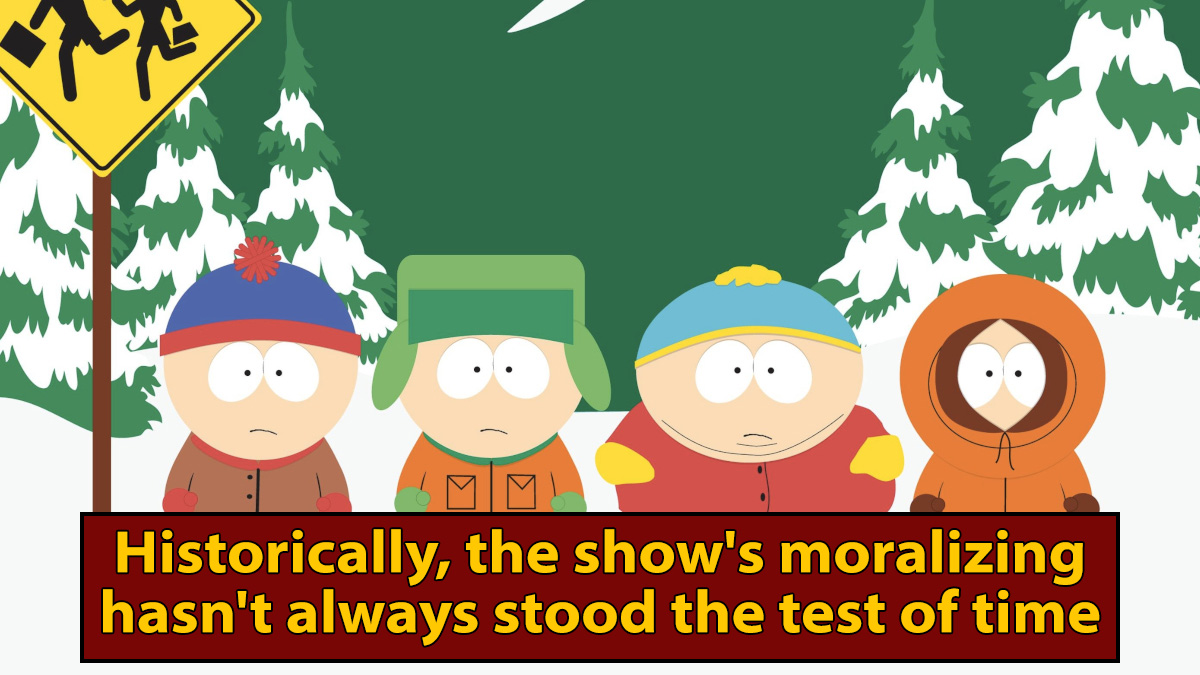
At its best, South Park is not just offensive. Offense is easy. Any toddler denied a cookie can produce scandal. The show’s sharper trick has been turning childish behavior into adult diagnosis. Cartman is not simply a rude kid; he is entitlement in a winter hat. Randy Marsh is not simply a buffoon; he is every suburban adult who discovers a trend six months late and immediately ruins it for everyone.
This is why the show lasted. It understood that America often behaves less like a serious republic and more like a school cafeteria where everyone has a microphone. The town of South Park works because it shrinks massive issueswar, religion, celebrity worship, corporate greed, moral panic, internet hysteriainto something ridiculous enough to recognize.
The show also benefited from speed. Where other scripted comedies needed long production cycles, South Park could attack a headline while the headline was still limping across cable news. That gave it a special role in American satire. It could react before the public had finished arguing, which made it feel dangerous, immediate, and occasionally like it had swallowed a live wire.
For years, that urgency was refreshing. When institutions sounded fake, South Park sounded rude enough to be honest. When celebrities took themselves too seriously, the show reminded everyone that fame is often just insecurity with better lighting. When political tribes demanded loyalty, Parker and Stone frequently refused to join the group photo.
The Problem With Being “Relevant” Forever
Relevance is a strange prize. Everybody wants it until they get it, and then they have to keep tap dancing on a volcano. South Park has spent much of its life being praised for staying relevant, but the cost of constant relevance is that the show must keep running toward the loudest thing in the room.
That worked better when the loudest thing in the room changed every week. Now, American politics and pop culture often feel fused into one endless spectacle. Elections become fandoms. Court cases become content arcs. Billionaires become characters. Streaming platforms behave like feudal kingdoms with worse passwords. Even artificial intelligence now has the comic timing of a haunted printer.
In that environment, a show built to satirize absurdity faces a brutal challenge: what happens when the real world is already writing jokes at maximum volume?
Recent seasons leaned heavily into politics, including storylines tied to Donald Trump, media power, artificial intelligence, religion, and corporate control. Some critics argued that the show met the moment with force; others saw the moment itself as so overheated that even South Park risked becoming part of the noise. A 2026 review in Reason framed the show as still funny in an age when politics has become pop culture, while other responses to recent episodes emphasized how deliberately provocative the series had become again.
The Trump Episode, Paramount, and the Satire Feedback Loop
The 2025 season premiere, “Sermon on the ’Mount,” arrived with the subtlety of a piano falling through a church roof. Official episode information described a story in which the residents of South Park face possible doom and Jesus returns with an important message. In practice, the episode became a high-profile political and corporate satire that drew intense attention.
Part of the reason the episode landed so loudly was timing. Paramount had recently agreed to pay $16 million to settle President Donald Trump’s lawsuit over a 60 Minutes interview with Kamala Harris; Paramount said the money would go to Trump’s future presidential library and that the settlement did not include an apology.
At roughly the same moment, CBS announced that The Late Show with Stephen Colbert would end in May 2026, calling it a financial decision unrelated to content or other Paramount matters. Reuters reported that the cancellation came as Paramount was seeking approval for an $8.4 billion merger with Skydance, while Colbert had often criticized Trump and had criticized the Paramount settlement.
That is the kind of media stew South Park was born to mock: lawsuits, executives, censorship anxiety, presidential ego, late-night TV, streaming economics, and enough corporate awkwardness to make a boardroom smell like cold panic. The show did what it does. It threw gasoline on the news cycle, then lit the match with a grin.
And yet, the reaction proved the larger problem. The episode became not merely a satire of the outrage machine, but fuel for it. Viewers debated whether it was brave, desperate, hilarious, crude, necessary, or proof that civilization should be returned to the manufacturer. The White House reportedly criticized the show after the episode, and entertainment outlets treated the backlash as part of the story.
This is the modern satire trap: the joke critiques the spectacle, the spectacle absorbs the joke, and then everyone argues about the argument. By Friday, the parody has become content, the content has become discourse, and the discourse has become someone’s podcast thumbnail.
Maybe Silence Would Be More Shocking
For a show famous for never shutting up, silence might now be the most radical move. Not permanent silence. Not retirement. Not a tasteful bronze statue of Cartman in a public square, though honestly, some city would approve it by accident. The point is selective silence: choosing not to respond to every outrage simply because the brand is good at outrage.
The old internet rewarded speed. The current internet rewards escalation. The next joke must be harsher, faster, uglier, stranger, more screenshot-ready. South Park helped invent a language of “nothing is sacred” comedy that once felt liberating. Now that same language is everywhere, often stripped of wit and used as a permission slip for lazy cruelty.
This is not the show’s fault alone. Culture copied the easy parts. People learned the sneer but not always the structure. They copied Cartman’s volume without understanding that Cartman is usually the warning label, not the role model.
Still, when a series has as much influence as South Park, it is fair to ask what its voice does in 2026. Does it clarify? Does it puncture hypocrisy? Does it reveal a hidden truth? Or does it simply add another layer of irony to a public conversation already buried under irony like a lasagna made by nihilists?
The Case for Still Listening
To be fair, dismissing South Park would be too easy. The show has earned its place because it has repeatedly done what safer comedy avoids. It attacks institutions that expect protection. It mocks pieties on the left and right. It treats corporations, celebrities, politicians, parents, activists, influencers, and children as equally capable of becoming ridiculous.
That broad suspicion can be useful. In an era when audiences often want satire that flatters their side and humiliates the other side, South Park remains annoyingly unwilling to become a team mascot. That is one reason people still get angry at it. It refuses to behave. It will not sit. It will not stay. It is the comedy equivalent of a raccoon in a courtroom.
The show also understands that public virtue can become performance. It has been sharp on corporate branding, moral panic, celebrity activism, tech hype, and the strange way adults outsource their thinking to slogans. When it is working, South Park does not merely say, “Everyone is dumb.” It says, “Here is the specific way everyone is being dumb, and here is the emotional payoff they are getting from it.”
That matters. Satire should make people uncomfortable, especially when comfort has become a business model. A culture that cannot laugh at its own sacred cows eventually ends up worshiping a whole barn.
The Case for Taking a Break
But needing satire does not mean needing the same satirical rhythm forever. South Park emerged in a media world with fewer channels, slower responses, and clearer targets. Today, every platform is packed with instant commentary. TikTok has teenagers doing media criticism between skincare steps. YouTube has four-hour essays on a cereal mascot’s political implications. X can turn a typo into a constitutional crisis by lunch.
So when South Park arrives to explain that everything is absurd, the audience may respond, “Yes, thank you, we noticed.” The fire alarm is less useful when the entire neighborhood has been on fire for nine years and someone is selling commemorative smoke.
The show’s greatest strengthits refusal to treat anything with reverencecan also become a limitation. Some moments require ridicule. Others require precision. Others require empathy, patience, or enough quiet to hear people who are not already famous, powerful, or trending.
That is where South Park can feel mismatched to the moment. Not because it is too offensive, but because offense is no longer rare. The culture is already offensive. The harder task now is not saying the unsayable. It is saying something useful after everyone has finished yelling the unsayable into a ring light.
What the Show Could Do Instead
The answer is not for South Park to become polite. A polite South Park would be like a decaf chainsaw. But the show could benefit from aiming less at the most obvious target and more at the systems that make obvious targets unavoidable.
Rather than simply satirizing a politician, it can satirize the economy of attention that turns politicians into 24-hour entertainment. Rather than only mocking AI deepfakes, it can explore why people are emotionally ready to believe fake images when those images confirm what they already want to hate. Rather than treating every culture-war fight as another food fight, it can ask who profits from keeping the cafeteria slippery.
That is where the show still has room to evolve. The best South Park episodes are not just topical; they are diagnostic. They reveal the machine behind the madness. They show how ordinary people become ridiculous when fear, greed, status, and groupthink take the wheel.
Experience: Watching ‘South Park’ When the Joke Starts Watching You Back
Anyone who grew up with South Park probably has a strange relationship with it. At first, it felt like contraband. You did not simply watch the show; you survived being caught watching it. The animation looked harmless enough to fool exactly one adult for exactly seven seconds. Then Cartman opened his mouth, and suddenly the living room had the temperature of a courtroom.
For many viewers, the early appeal was freedom. South Park seemed to say the thing nobody was supposed to say, then immediately say something worse, then somehow end up making a point. It trained a generation to be suspicious of moral panic and allergic to sanctimony. That was useful. Some of us needed a cartoon to teach us that the loudest adult in the room was not automatically the smartest.
But watching the show now can feel different. The world caught up with the chaos. The old shock has become everyday background noise. Public life is full of Cartmans: shameless, loud, tribal, allergic to accountability, and somehow always holding snacks. Randy Marsh no longer feels like an exaggeration of the American dad; he feels like a documentary subject with a podcast sponsorship.
That changes the viewing experience. A new South Park episode can still be funny, but it may also leave a viewer feeling tired. Not offended. Not scandalized. Just tired in the bones, like after reading comments under a local news post about bike lanes. The show points at absurdity, and the viewer thinks, “Yes, that is absurd. Also, I saw three worse things before breakfast.”
There is also the matter of emotional bandwidth. People do not consume satire in a vacuum. They watch it after bills, work, school shootings, climate anxiety, layoffs, elections, medical debt, broken friendships, and the daily psychological circus of being online. Sometimes the appetite for another “brutal takedown” is gone. Sometimes what sounds brave in a headline feels like more noise in the body.
That does not make South Park bad. It may mean the audience has changed. Or matured. Or just developed the cultural equivalent of lactose intolerance. The same joke that once felt like rebellion can later feel like another plate of nachos at 1 a.m.: tempting, familiar, and possibly a decision your future self will question.
The best personal way to watch South Park now may be with boundaries. Not every episode needs to be a civic event. Not every controversy needs a take. Not every joke needs to become evidence in the trial of whether satire is alive or dead. Sometimes a viewer can laugh, shrug, and move on. Sometimes a viewer can skip it completely and still remain a functioning citizen, unless Cartman has already been elected county treasurer.
In that sense, “Maybe we don’t need to hear from South Park right now” is less a demand and more a permission slip. We can respect the show’s history without treating every new episode as mandatory national homework. We can appreciate Parker and Stone’s skill without pretending that crude clarity is the only kind of clarity. We can admit that satire matters while also admitting that silence, rest, and attention to real people matter too.
Conclusion: The Question Is Not Whether ‘South Park’ Still Matters
South Park still matters. That is not really in doubt. A show does not generate this much attention after nearly 30 years by accident. It remains fast, fearless, funny, and capable of making powerful people uncomfortable. Its new streaming deal and continuing seasons prove that the business still sees enormous value in four badly behaved children wandering through America’s psychic landfill.
But cultural value is not the same as cultural necessity. Sometimes the smartest thing a loud show can do is decide when not to shout. Sometimes the sharpest satire is not the biggest swing, but the most carefully chosen one. And sometimes the audience is allowed to say, with affection and mild concern, “We get it, South Park. The world is insane. Please pass the remote.”
Maybe we do not need to hear from South Park right now. Or maybe we dobut only if it has something better to offer than another reminder that everything is broken. The show has always been best when it does more than mock the fire. It should show us who keeps selling matches.














