
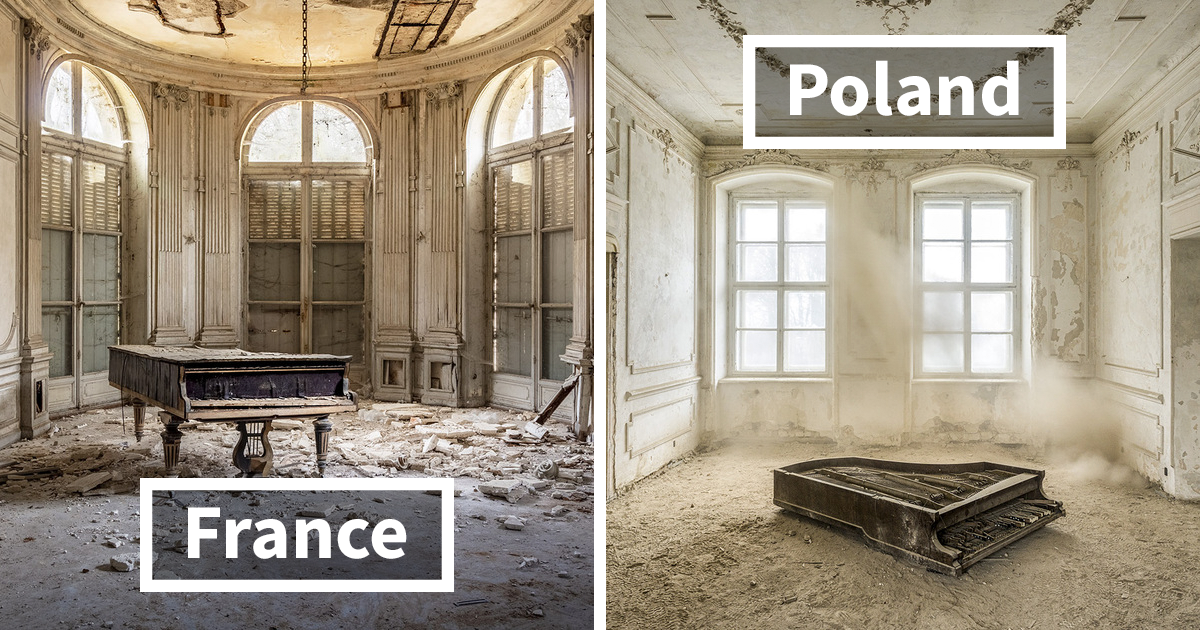
Some people collect stamps. Others collect refrigerator magnets, vintage postcards, or hotel shampoos they swear they will use someday. I collect something a little less practical: abandoned pianos sleeping inside forgotten European mansions, castles, schools, theaters, villas, and palaces.
As both a pianist and a photographer, I have spent more than a decade searching for these quiet instruments. Not shiny concert grands under stage lights. Not perfectly tuned uprights in polite living rooms. I mean the pianos left behind when families moved away, hotels closed, schools emptied, and ballrooms forgot how to echo. These are instruments with cracked keys, dusty strings, warped soundboards, and, somehow, more personality than half the people at a cocktail party.
This journey became a long visual love letter to abandoned pianos in Europe: a project about music, memory, architecture, decay, and the strange emotional power of an instrument that no longer plays. Each piano I found seemed to hold a room together. Even when the roof leaked, wallpaper peeled, and vines pushed through the windows, the piano remained like a stubborn host waiting for guests who were extremely late.
Why Abandoned Pianos Feel So Powerful
A piano is never just furniture. Technically, it is a complex percussion instrument: press a key, a hammer strikes strings, dampers rise and fall, and the whole wooden body vibrates with sound. Emotionally, though, it is a time machine with pedals.
In European homes, schools, salons, theaters, and hotels, pianos once marked the center of social life. People gathered around them to sing, rehearse, impress guests, avoid awkward silence, and occasionally murder Chopin with enthusiasm. When I find one abandoned, I do not see an object that failed. I see the final witness of a room that used to have a pulse.
The irony is beautiful and cruel. Pianos are built for sensitivity. Wood, felt, metal, glue, leather, and tension must work together precisely. They dislike humidity swings, cold drafts, direct sunlight, and neglect. Abandoned buildings specialize in exactly those things. That is why many forgotten pianos lean, split, rust, and fall out of tune until silence becomes their last performance.
The Search: More Detective Work Than Romance
People imagine I wander through Europe dramatically, wearing a scarf, following moonlight until a piano appears. I wish. In reality, finding abandoned pianos requires research, patience, contacts, maps, local history, permissions, and the ability to explain to strangers that yes, I really do travel to photograph old pianos and no, I am not starting the world’s saddest moving company.
Over the years, I built a network across music circles, heritage groups, real estate contacts, photographers, historians, and local associations. Every tip mattered. A closed hotel in Belgium. A villa in France. A palace in Poland. A theater in Germany. A school where the music room still smelled faintly of chalk and damp wood. Some leads were magical. Others led to locked gates, demolished buildings, or rooms containing exactly zero pianos and one very judgmental pigeon.
Urban exploration also requires respect. The best rule is simple: take photographs, leave nothing, move nothing, damage nothing. Many of these places are fragile, privately owned, dangerous, or under renovation. The goal is not to conquer a ruin. The goal is to listen to it visually.
My 31 Favorite Abandoned Piano Photos
Each of these favorite images represents a different kind of silence. Some are grand and cinematic. Others are small, intimate, and almost shy. Together, they form a visual concert where every instrument plays the same note: remember.
1. The Castle Piano in France
This piano sat inside an abandoned castle where ivy had begun acting like an interior designer. The room felt theatrical, as if the instrument had just finished a final recital for ghosts, dust, and one extremely nervous photographer.
2. The Polish Palace Upright
In a forgotten palace in Poland, an upright piano stood against a fading wall. The elegance of the room had not disappeared; it had simply changed clothes, trading velvet and candlelight for plaster dust and winter air.
3. The French Villa Piano
This villa was quiet in the way only abandoned homes can be quiet. The piano looked domestic, almost modest, as if someone might return after lunch and ask why I was photographing their parlor.
4. The Grand Piano Beneath a Broken Ceiling
A grand piano under a damaged ceiling is a lesson in vulnerability. The instrument was built to project sound upward. Instead, rain and time had come down to meet it.
5. The School Music Room
Few abandoned pianos feel as emotional as those left in schools. This one seemed to carry the echo of scales, nervous recitals, and children pretending they practiced more than they actually did.
6. The Theater Piano Backstage
Backstage pianos are working instruments. They rehearse, accompany, wait, and support. Finding one behind a decaying curtain felt like discovering the understudy who never left.
7. The Piano With Missing Keys
Missing keys give a piano the look of a broken smile. This one was impossible to play, but incredibly expressive. Its silence had rhythm.
8. The Sunlit Salon
In one salon, afternoon light crossed the keyboard with ridiculous perfection. Photographers live for this kind of moment. Pianists, meanwhile, immediately wonder whether the action still works. My brain is a duet.
9. The Piano Covered in Leaves
Nature does not ask permission. Leaves had drifted through broken windows and gathered around the pedals. The room looked less abandoned than slowly being returned to the forest.
10. The Blue Room Piano
A blue-painted room gave this image a dreamlike calm. The piano’s dark frame cut through the color like a bass note. It was melancholy, but not hopeless.
11. The Molded Wallpaper Piano
Wallpaper can decay with surprising drama. Behind this piano, the walls peeled like old theater posters. The room felt like a stage set designed by time itself.
12. The Mansion Staircase Piano
Placed near a sweeping staircase, this piano became part of the architecture. It suggested arrivals, parties, footsteps, and the moment when someone says, “Play something!” which is the sentence every pianist both loves and fears.
13. The Hotel Lobby Piano
Hotel pianos are social survivors. They hear proposals, arguments, champagne laughter, and tired travelers. This abandoned lobby piano looked as if it still expected someone to request a song at midnight.
14. The Dusty Grand in Germany
This grand piano carried a heavy, dignified silence. German interiors often bring a certain architectural discipline to decay, and the piano sat in the frame like punctuation at the end of a long sentence.
15. The Piano Near the Window
A window is both a gift and a threat. It gives light to the photograph and weather to the instrument. This piano seemed to be watching the outside world reclaim the inside one season at a time.
16. The Piano in a Former Chapel
In a chapel-like space, the piano felt almost sacred. Not because it was perfect, but because it had endured. Music and prayer have always understood each other.
17. The Upright With a Collapsed Front Panel
Some pianos reveal their inner mechanics when they decay. Hammers, strings, dampers, and wooden parts become visible. It is sad, yes, but also intimate, like seeing the instrument think.
18. The Ballroom Piano
The ballroom had lost its dancers, but not its drama. The piano anchored the composition, reminding me that every empty room is more powerful when it once had music.
19. The Piano Surrounded by Greenery
Plants had entered with confidence. They climbed, spread, and softened the ruin. The piano did not look defeated. It looked like it had gained a very slow backup band.
20. The French Castle Corridor
A piano at the end of a corridor creates instant mystery. Why was it there? Who moved it? Did someone practice in the hallway? The best photographs keep a few questions politely unanswered.
21. The Broken Bench
A piano bench can be as emotional as the instrument. A broken bench suggests absence directly: someone used to sit here. Someone leaned forward. Someone listened.
22. The Piano With Sheet Music Nearby
Finding old sheet music near an abandoned piano is almost too perfect, like the building hired a set decorator. But there it was: paper, dust, notes, and silence.
23. The Red Room Piano
This room had color that refused to fade politely. The red walls made the piano feel dramatic and slightly dangerous, like it might start playing by itself if I turned my back.
24. The Attic Piano
Attic pianos feel especially lonely. They are hard to move, easy to forget, and usually surrounded by boxes, beams, and rumors. This one seemed exiled rather than abandoned.
25. The Palace Music Corner
In one palace, the piano occupied a corner with quiet authority. The grandeur around it had faded, but the instrument still gave the room a center.
26. The Piano With Rusted Strings
Rusted strings are the visible sound of neglect. They show what humidity, time, and temperature can do to tension. The image was painful for the pianist in me and irresistible for the photographer.
27. The Room With No Roof
A piano under open sky is both absurd and poetic. Instruments are made for interiors; this one had become part of the weather. I photographed it quickly, partly from respect and partly because the clouds looked suspicious.
28. The Children’s Practice Piano
Small uprights in schools and homes often carry the most human stories. They are not glamorous, but they are where fingers learn discipline, frustration, and the thrilling discovery that two hands can argue beautifully.
29. The Mirror Room
Mirrors in abandoned spaces multiply the silence. This piano appeared twice: once in the room and once in reflection, as if memory itself had made a copy.
30. The Last Light Photo
This image was captured near the end of the day, when light became narrow and gold. The piano looked less like a ruin and more like an old performer taking a final bow.
31. The Favorite I Cannot Fully Explain
Every long project has one image that resists explanation. This piano was not the rarest, grandest, or most dramatic. But the balance of light, room, silence, and memory felt exactly right. Sometimes the best photograph is the one that stops asking to be understood.
What These Abandoned Pianos Teach Us
After years of searching, I no longer think of abandoned pianos as ruined objects. I think of them as archives. They record climate in warped wood, history in dust, architecture in their placement, and human presence in their absence.
They also remind us how quickly culture can become fragile. A piano may take months to build and generations to love, yet one leaking roof can begin its undoing. Historic preservation often focuses on walls, windows, facades, and structural systems, but interiors matter too. Objects inside a building can reveal how people lived, gathered, celebrated, studied, and dreamed.
Photography cannot save every piano. It cannot restore every palace or reopen every theater. But it can slow forgetting. A photograph says: this existed, this mattered, someone noticed.
The Photographer’s Challenge: Light, Safety, and Respect
Photographing abandoned places is not simply a matter of walking in and pressing a button. Light is often scarce. Floors may be unstable. Glass, mold, rust, animals, and hidden holes all have opinions about your ankles. A flashlight is essential, not only for safety but also as a precise tool for long exposures and controlled highlights.
Composition is another challenge. The piano must remain the emotional center, but the room must tell the larger story. Too close, and the image becomes a product shot of decay. Too wide, and the piano disappears. The best frame lets the viewer feel both the instrument and the space that abandoned it.
I try not to move anything. A chair where it fell, a curtain where it hangs, a broken panel where it landed: these details are part of the truth of the room. The temptation to “improve” a scene is strong, especially when a perfect photograph seems one small adjustment away. But abandoned-place photography depends on trust. The place gives you what it gives you. Your job is to receive it well.
Why Europe Holds So Many Forgotten Music Rooms
Europe is layered with history. Castles became hotels. Villas became schools. Palaces became offices. Industrial fortunes rose and fell. Borders shifted. Families left. Institutions closed. In that long cycle, pianos were often too heavy, too damaged, too expensive, or too emotionally complicated to remove.
That is one reason abandoned pianos appear in such varied settings. You may find one in a rural manor, another in an urban theater, another in a spa resort, another inside a school where the blackboard still carries faint chalk marks. Each location changes the meaning of the instrument.
A piano in a mansion speaks of private life. A piano in a theater speaks of performance. A piano in a school speaks of learning. A piano in a hotel speaks of strangers passing through. The object is similar, but the memory is different every time.
Extra Field Notes: 10 Years of Chasing Silent Keys
After more than ten years of searching for abandoned pianos in Europe, I have learned that the journey is never only about the photograph. It is about the walk before the photograph, the uncertainty at the gate, the local rumor that may or may not be true, the nervous silence before entering a room, and the moment when a keyboard appears through the dust like a familiar face in a crowd.
Some days were frustrating. I traveled hours to reach a building only to find fresh locks, security cameras, renovation crews, or a cheerful sign explaining that the site had been turned into luxury apartments. Good for the building, terrible for my dramatic artistic mood. Other times, the piano was gone. That absence was strangely powerful. A rectangular mark on the floor, a music stand left behind, a bench without its partner: even the missing instruments told stories.
There were also moments of pure comedy. I have crawled through vegetation with camera gear while trying to look professional, which is impossible when your tripod gets tangled in brambles. I have mistaken birds for footsteps, loose shutters for human voices, and my own backpack strap for a snake. I have whispered apologies to staircases before testing them, as if politeness might improve structural integrity. It does not, but it makes the fear more elegant.
As a pianist, the hardest part is resisting the urge to play. Sometimes a few keys still move. Sometimes one note groans out, wildly out of tune, but alive. That sound can fill an entire abandoned room with emotion. It is not music in the traditional sense. It is more like the building clearing its throat. Still, I avoid forcing anything. These instruments have already survived enough enthusiastic human behavior.
As a photographer, I became more patient. Early on, I wanted dramatic wide shots, grand decay, cinematic symmetry. Over time, I learned to love smaller details: ivory-colored keys yellowed by age, a pedal half-buried in plaster, the curve of a grand piano reflecting broken windows, felt hammers frozen mid-thought. The photographs became less about showing ruins and more about listening visually.
The most memorable locations were not always the most beautiful. Some were plain rooms with ordinary upright pianos. But they felt honest. They reminded me that music does not belong only to concert halls and aristocratic salons. It belongs to practice rooms, family gatherings, local schools, and imperfect homes where someone once played the same measure twenty-seven times while everyone else silently reconsidered their life choices.
In the end, abandoned pianos taught me that silence is not empty. It can be dense, textured, funny, sad, and full of evidence. A silent piano still has posture. It still occupies space with dignity. It still asks us to imagine the hands that touched it, the songs that passed through it, and the people who left before the final note had fully disappeared.
Conclusion
My favorite abandoned piano photos are not just images of decay. They are portraits of memory. Across Europe, these forgotten instruments sit inside rooms where music once made walls feel alive. They are fragile, impractical, heavy, and silent which, inconveniently, makes them perfect subjects.
To a pianist, an abandoned piano is heartbreaking. To a photographer, it is visually irresistible. To me, it is both. Each one is a reminder that beauty does not always arrive polished, tuned, and ready for applause. Sometimes beauty waits in a damp room, under a cracked ceiling, covered in dust, still holding the shape of a song.














