
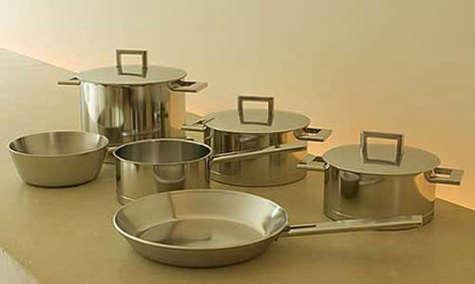
The John Pawson for Demeyere Six-Piece Cookware Set is what happens when a minimalist architect walks into a kitchen and politely removes everything unnecessaryexcept performance. This is not cookware that shouts from the stovetop. It does not arrive wearing rainbow silicone handles or a celebrity chef’s signature in letters the size of a lasagna pan. Instead, it whispers: “I can sear a steak, simmer a sauce, and look like I belong in a design museum while doing it.”
Designed by British architect and designer John Pawson for Belgian cookware specialist Demeyere, this stainless steel cookware collection blends architectural restraint with serious culinary engineering. The six-piece set has become something of a design-kitchen cult object, especially because archived product pages now identify it as discontinued. That makes it interesting not only to cooks, but also to design collectors, stainless steel cookware fans, and anyone who believes a saucepan should not look like it escaped from a hotel breakfast buffet.
This article takes a close look at the set’s design, construction, cooking performance, care requirements, and everyday value. We will also explore who should buy it, who should admire it from a safe distance, and why this sleek cookware still matters years after its original retail moment.
What Is the John Pawson for Demeyere Six-Piece Cookware Set?
The John Pawson for Demeyere Six-Piece Cookware Set is a premium stainless steel cookware set created as part of Demeyere’s John Pawson 7 collection. Demeyere, founded in Belgium in 1908, is known for high-performance stainless steel cookware, especially induction-friendly pans with layered construction, advanced bases, and durable finishes.
John Pawson’s role was not to reinvent cooking from scratch. Thankfully, nobody needed a square soup pot just for philosophical reasons. Instead, he refined the shapes, handles, lids, and visual language of the cookware into something calm, precise, and architectural. The result is cookware that looks almost monolithic: clean lines, squared handles, polished stainless steel, and a quiet confidence that says, “Yes, I know what mise en place means.”
Archived listings and product references describe the six-piece set as a stainless steel kit typically built around essential everyday pieces: covered saucepots or casseroles, a sauté-style pan, and a fry pan. Related John Pawson cookware pieces include saucepans, cooking pans, sauté pans, frying pans, and stockpots in multiple sizes, available with or without lids. In other words, the six-piece set was intended to cover the core jobs of a serious home kitchen without burying you under 14 matching lids you will later use as cabinet percussion instruments.
Design: Minimalism That Actually Works
John Pawson is widely associated with minimalist architecture, but “minimal” does not mean empty, cold, or impractical. In good design, minimalism means removing what does not help so that what remains performs better. This cookware follows that philosophy.
Clean Lines and Sculptural Form
The John Pawson Demeyere cookware set has a sharper, more architectural look than many rounded traditional cookware lines. The handles are flat and squared. The lids sit with a tight, controlled profile. The body of each piece feels less like a kitchen gadget and more like a tool designed for a carefully edited space.
That matters because cookware lives visually in the kitchen. Many home cooks leave a favorite pan on the stove, hang pieces from a rail, or serve directly from the pan at the table. The John Pawson collection understands this. It transitions from stovetop to dining table without looking like it forgot to change clothes.
Stove-to-Table Appeal
One of the strongest selling points of the John Pawson for Demeyere Six-Piece Cookware Set is its ability to function as both cookware and servingware. A stainless steel saucepan full of risotto or a sauté pan holding glazed vegetables can go straight to the table and still look intentional. That is useful for small dinner parties, open kitchens, and people who want fewer dishes to wash because they have already emotionally negotiated with the dishwasher.
Materials and Construction
The set is made from stainless steel, but not all stainless steel cookware is created equal. Entry-level stainless steel pans often have thin walls, uneven heating, or a base that behaves like it has personal issues with electric burners. Demeyere’s premium lines are engineered for heat control, induction performance, and durability.
7-Ply Stainless Steel Performance
The John Pawson 7 line is commonly compared with Demeyere Atlantis because both occupy the brand’s high-performance category. Related product listings and cookware references describe the John Pawson collection as using impressive 7-layer construction. That type of build is designed to improve heat distribution, heat retention, and responsiveness.
For home cooks, this means better browning, more stable simmering, and fewer hot spots. When making a pan sauce, you want fondthe flavorful browned bitsnot random black scorch marks shaped like a tiny map of Florida. A well-built stainless steel pan helps you develop color evenly and then deglaze with wine, stock, vinegar, or citrus.
Silvinox Surface Treatment
Demeyere is known for its Silvinox treatment, a surface technology designed to help stainless steel keep a silvery finish and resist discoloration. This does not mean the pans clean themselves. We are still waiting for cookware that apologizes and scrubs its own corners. But Silvinox does make maintenance easier and helps preserve the refined appearance that makes this set so attractive.
Induction-Friendly Engineering
Demeyere has long emphasized induction performance. Technologies such as TriplInduc are designed to improve efficiency on induction cooktops. That is an important detail because induction cooking rewards cookware with stable, magnetic, well-engineered bases. A cheap pan on induction can buzz, warp, or heat unevenly. A premium Demeyere pan is built to behave more like a precision instrument.
The set is also compatible with other common cooking surfaces, making it versatile for gas, electric, ceramic, and induction kitchens. For buyers upgrading their kitchen in the future, induction compatibility is a major advantage. Nobody wants to buy heirloom cookware and then discover it refuses to cooperate with the new cooktop like a diva with a rider.
Cooking Performance: Where Beauty Meets Heat
A beautiful pan that cannot cook well is just a shiny bowl with ambition. Fortunately, the John Pawson for Demeyere cookware set is built around performance. Its stainless steel surface is especially good for searing, browning, sautéing, boiling, simmering, reducing sauces, and oven finishing.
Searing and Browning
Stainless steel is excellent for browning proteins because it allows food to develop a crust. This is where the fry pan and sauté-style pieces shine. With proper preheating, a small amount of oil, and patience, you can get golden chicken thighs, crisp-edged mushrooms, or a steak crust that makes you briefly consider opening a restaurant called “My Apartment.”
The trick is temperature control. Stainless steel rewards cooks who let the pan heat properly before adding food. If food sticks aggressively, the pan may be too cold, too hot, or the food may need more time before it naturally releases. Once you learn the rhythm, stainless steel becomes much less intimidating.
Sauce Work and Simmering
The covered saucepot or casserole pieces are ideal for grains, soups, pasta sauces, custards, and reductions. Because stainless steel is nonreactive, acidic ingredients such as tomatoes, wine, and lemon juice will not pick up metallic flavors. That makes these pans practical for classic tomato sauce, beurre blanc, pan gravies, and slow-simmered dishes.
Oven and Broiler Use
Related John Pawson cookware listings describe pieces as oven and broiler safe up to high temperatures, often around 500 degrees Fahrenheit. This makes the cookware useful for recipes that start on the stove and finish in the oven, such as thick pork chops, skillet chicken, baked pasta, or roasted vegetables.
Always confirm the exact temperature rating of your specific piece, especially if buying secondhand. Older sets, missing documentation, or replacement lids can complicate things. When in doubt, choose caution over turning dinner into a metallurgy experiment.
What Comes in the Six-Piece Set?
Because the John Pawson six-piece set is discontinued and surviving listings vary, exact contents should be verified before purchase. However, archived descriptions commonly refer to a compact but capable assortment, including covered saucepot or casserole pieces, a conic sauté pan, and a frying pan. In practical terms, that combination gives a home cook four essential cooking shapes across six total pieces when lids are counted.
Why Six Pieces Can Be Enough
A six-piece cookware set is not trying to outfit a catering company. It is meant to cover the daily rhythm of home cooking: boiling, simmering, frying, sautéing, reheating, and serving. For many kitchens, that is enough. The advantage is focus. Instead of owning many mediocre pans, you own fewer excellent ones.
This approach fits Pawson’s design philosophy perfectly. The set does not chase abundance. It offers restraint. And in a world where some cookware sets include a tiny “bonus” pan useful only for melting three chocolate chips, restraint feels refreshing.
Pros and Cons of the John Pawson Demeyere Set
Pros
- Exceptional minimalist design: The cookware looks refined, architectural, and timeless.
- Premium stainless steel construction: The 7-ply build supports even heating and strong heat retention.
- Induction compatibility: A major benefit for modern kitchens.
- Stove-to-table presentation: The pieces look elegant enough for serving.
- Durable finish: Silvinox helps maintain the clean stainless steel appearance.
- Rivetless-style appeal: Many Demeyere pieces are appreciated for easier cleaning and hygienic interiors.
Cons
- Limited availability: The six-piece set is discontinued, so buyers may need to search resale markets or specialty retailers.
- Premium price: Even used or archived pieces can be expensive.
- Weight: High-performance stainless steel cookware can feel heavy, especially when full.
- Learning curve: Stainless steel requires heat control and proper technique.
- Not nonstick: Eggs and delicate fish require practice, fat, and patience.
Who Should Buy This Cookware Set?
The John Pawson for Demeyere Six-Piece Cookware Set is best for people who care about both cooking performance and design integrity. It suits serious home cooks, design enthusiasts, collectors of modern kitchen objects, and anyone building a high-end kitchen around fewer, better tools.
It is especially appealing if you cook often and enjoy stainless steel techniques. If you regularly sear, deglaze, simmer, reduce, and finish dishes in the oven, this set makes sense. If your cooking style is mostly microwave oatmeal and occasional toast, the set may be overqualified. It would be like hiring a concert pianist to play the doorbell.
Who Should Skip It?
This set is not ideal for everyone. If you want lightweight cookware, budget cookware, colorful cookware, or nonstick convenience for eggs every morning, there are easier options. Stainless steel requires attention. It also asks you to clean properly and avoid panic-scrubbing with whatever metal object is closest.
Buyers who want a large matching set with many sizes may also find the six-piece format limiting. Since the set is discontinued, replacing individual pieces may be more difficult than with current mainstream cookware lines.
How to Use Stainless Steel Without Losing Your Mind
The most common complaint about stainless steel cookware is sticking. Usually, the pan is not the villain. The villain is impatience, high heat, or cold food tossed into a pan before the surface is ready.
Preheat First
Warm the pan before adding oil. A properly preheated stainless steel surface helps reduce sticking and improves browning. Many cooks use the water-drop test: a few drops of water should bead and glide across the surface before oil is added.
Use Enough Fat
Stainless steel is not nonstick. A thin layer of oil, butter, or another cooking fat helps food release and promotes even browning. This does not mean you need to deep-fry dinner unless dinner is fries, in which case please invite us.
Let Food Release Naturally
Protein often sticks at first and releases once a crust forms. If chicken or steak clings to the pan, give it time. Tugging too early tears the crust and your confidence.
Cleaning and Care Tips
One reason people invest in Demeyere cookware is longevity. With proper care, stainless steel pans can last for decades. The John Pawson collection deserves thoughtful cleaning, not because it is fragile, but because its polished design is part of the pleasure.
Daily Cleaning
For everyday cleaning, use warm water, dish soap, and a non-scratch sponge. Let the pan cool before washing to reduce the risk of warping. Avoid shocking a hot pan with cold water, even if the dramatic steam cloud makes you feel like a kitchen wizard.
Removing Stuck Food
For browned bits or stubborn residue, add water to the pan and simmer briefly to loosen the food. This is basically deglazing for cleanup. A paste of baking soda and water or a stainless steel cleaner can help with tougher stains.
Maintaining Shine
Mineral marks, rainbow discoloration, and cloudy spots can appear on stainless steel over time. These are usually cosmetic and can often be removed with vinegar, stainless steel cleaner, or gentle scrubbing. The key is regular maintenance, not waiting until the pan looks like it survived a campfire festival.
How It Compares With Other Premium Cookware
The John Pawson for Demeyere Six-Piece Cookware Set sits in the premium stainless steel category alongside brands and lines such as Demeyere Atlantis, All-Clad D3 or D5, Hestan, Fissler, and Made In. Its standout quality is the combination of top-tier performance and distinctive minimalist design.
Compared with many American-style stainless steel pans, Demeyere pieces often emphasize welded or rivetless interiors, advanced induction bases, and heavy construction. Compared with visually louder cookware, the Pawson set is quieter and more architectural. It does not look trendy. It looks permanent.
That said, buyers should consider weight and availability. A current cookware line may be easier to replace, expand, or buy on sale. The Pawson set, by contrast, appeals partly because it is less common. Scarcity adds charm, but it also adds shopping homework.
Buying Advice: New, Used, or Alternative?
Because the six-piece set is discontinued, shoppers should be careful. Check condition, exact contents, lid fit, heat warping, interior pitting, and return policies. If purchasing used, ask for clear photos of the cooking surface, base, handle connections, and lids.
If you cannot find the six-piece set, consider related John Pawson open-stock pieces or Demeyere Atlantis alternatives. Atlantis offers similar performance language and may be easier to source. If your priority is design, the Pawson pieces are worth hunting. If your priority is pure cooking performance with easier availability, Atlantis or other Demeyere lines may be more practical.
Real-Life Experience: Cooking With a Set Like This
Living with the John Pawson for Demeyere Six-Piece Cookware Set is less like owning a random box of pans and more like learning the personality of a finely made tool. The first thing most people notice is the weight. These pieces feel substantial. When you lift the fry pan, it does not flutter around like a bargain pan from a starter apartment. It has presence. That weight can be comforting because it signals stability, but it also means you will use two hands when the pan is full. Your wrists will thank you, and so will the soup.
The second experience is visual. On a clean stovetop, the set looks unusually calm. The squared handles, polished surfaces, and controlled proportions create a sense of order. This may sound dramatic for cookware, but kitchens are emotional spaces. A beautiful pan can make ordinary cooking feel more intentional. Even reheating leftovers feels slightly upgraded, as if last night’s pasta has been invited to a gallery opening.
Performance-wise, the set rewards patience. The fry pan is excellent for browning when properly preheated. Mushrooms release moisture, then begin to caramelize. Chicken skin goes from pale to golden. A splash of wine or stock lifts the fond into a sauce with real depth. The saucepots feel steady during simmering, especially for grains, oatmeal, custards, and reductions. The cookware does not require high heat to perform well; in fact, medium heat often works better because the construction holds and distributes heat efficiently.
The learning curve is real, especially for cooks moving from nonstick. Eggs can stick if the pan is not heated correctly or if too little fat is used. Delicate fish requires confidence. But after a few sessions, the set teaches better habits: preheat, add oil, wait, listen, adjust. It turns cooking into a conversation instead of a wrestling match.
Cleaning is also part of the experience. Most messes come off with soaking, soap, and a non-scratch sponge. For darker residue, a little water simmered in the pan loosens the fond. Stainless steel cleaner restores shine when needed. The Silvinox finish helps, but it does not eliminate care. Think of it like owning a white shirt: easier if it is high quality, but you still cannot eat barbecue ribs in a wind tunnel and expect miracles.
The best everyday use of this set is a simple dinner rhythm. Start rice or farro in a covered pot. Sear chicken or tofu in the fry pan. Use the sauté pan for greens with garlic and lemon. Deglaze the fry pan for a quick sauce. Serve directly from one of the pieces if the table is casual but polished. That is where the Pawson design shines: it reduces the gap between cooking and presenting.
Over time, the set feels less like a luxury object and more like a reliable kitchen partner. It is not the easiest cookware, nor the cheapest, nor the lightest. But it offers something rare: performance with restraint. For cooks who appreciate quiet design and serious engineering, the John Pawson for Demeyere Six-Piece Cookware Set can make the daily act of cooking feel cleaner, calmer, and just a little more elegant.
Final Verdict
The John Pawson for Demeyere Six-Piece Cookware Set is a rare blend of minimalist design and high-performance stainless steel engineering. It is beautiful without being decorative, practical without being ordinary, and durable enough to serve serious cooks for years. Its discontinued status makes it harder to find, but also more desirable for collectors and design-minded home chefs.
If you want lightweight, inexpensive, nonstick cookware, this is not your set. If you want a refined, induction-compatible, stainless steel cookware collection with architectural presence and professional-level cooking ability, the John Pawson Demeyere set remains one of the most compelling cookware designs in the premium kitchen world.
Note: Availability, exact piece count, and temperature ratings can vary across archived and resale listings. Before buying, confirm the included pieces, condition, and specifications with the seller.














