
Sea mines sound like something from a dusty World War II briefing room: grainy photos, cigarette smoke, and an admiral pointing at a map with a stick. But the Pentagon is pulling this old-school weapon back into the spotlight, and not because anyone is feeling nostalgic. Air-dropped sea mines are becoming relevant again because modern naval warfare is returning to a basic truth: you do not always have to sink a fleet to stop it. Sometimes, you only have to make the water look suspicious.
The new focus is not on the cartoonish floating ball with spikes that everyone imagines when they hear “mine.” Today’s U.S. air-dropped naval mines are smarter, more precise, and designed to be delivered from safer distances by aircraft such as the B-52. The key name to know is Quickstrike Extended Range, often shortened to QS-ER. Think of it as a conventional underwater mine given wings, guidance, and a much better résumé.
For readers searching for “Pentagon air-dropped sea mines,” “Quickstrike-ER mines,” or “U.S. Navy mine warfare,” the story is bigger than one weapon. It is about the Indo-Pacific, China’s naval growth, contested shipping lanes, military logistics, and the uncomfortable fact that cheap weapons can create expensive problems. Sea mines are not glamorous. They do not trend on defense Twitter like stealth fighters. But in naval strategy, they are the equivalent of a locked door with a handwritten sign that says, “Are you sure you want to try this?”
Why Sea Mines Are Back in the Pentagon’s Conversation
The United States has used naval mines for centuries, but interest in them faded after the Cold War. For decades, mine warfare sat in the defense attic next to old maps, forgotten doctrines, and probably a box labeled “things we should not ignore but keep ignoring anyway.” That is changing because the strategic environment has changed.
Modern naval competition is increasingly centered on chokepoints, island chains, ports, undersea infrastructure, and commercial shipping routes. In the Indo-Pacific, the movement of fuel, food, electronics, military supplies, and raw materials depends heavily on sea lanes. If those routes are disrupted, the effects ripple through economies faster than a group chat during breaking news.
Air-dropped sea mines give military planners a way to deny access without permanently occupying an area. A minefield can complicate an adversary’s plan, slow a fleet, close a harbor, or force ships to spend time and resources on mine countermeasures. That last point matters. Clearing mines is slow, dangerous, and psychologically exhausting. Nobody wants to be the first ship through suspicious water.
What Are Air-Dropped Sea Mines?
An air-dropped sea mine is a mine delivered by aircraft into a maritime area. Older systems required aircraft to fly relatively low and close to the intended minefield. That worked in less contested environments, but in a modern fight filled with radar, surface-to-air missiles, fighter aircraft, and electronic warfare, “fly low and slow near the enemy” is not exactly a comforting mission briefing.
The newer U.S. approach is to combine existing bomb bodies with mine components and guidance kits. In plain English: take hardware the military already understands, add the ability to guide it, and turn it into a mine that can land much closer to where planners want it. This is the logic behind the Quickstrike family and the Quickstrike Extended Range program.
The Quickstrike Family
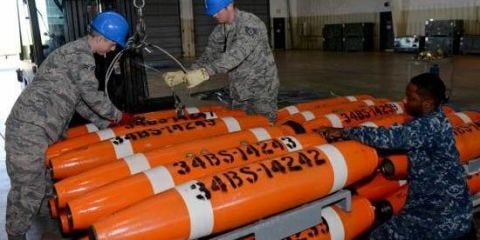
The U.S. Navy’s Quickstrike mines include variants based on 500-pound, 1,000-pound, and 2,000-pound classes. Some are converted general-purpose bombs, while others use dedicated mine cases. Once in the water, these weapons are designed to rest on or near the seabed and detect passing ships or submarines through influence signatures such as acoustic, magnetic, seismic, or pressure changes.
This is why mines are so unnerving. A missile announces itself. A mine waits. It is the introvert of naval warfare: quiet, patient, and surprisingly disruptive when it finally participates.
What Makes Quickstrike-ER Different?
Quickstrike Extended Range adds a wing kit and precision guidance concept to the mine. Instead of simply falling from an aircraft like a very expensive rock with paperwork, the mine can glide toward a designated area. That standoff range gives the aircraft more room to survive and allows a minefield to be placed with greater precision.
The U.S. Air Force has publicly described B-52 testing of inert Quickstrike Extended Range mines from a standoff distance of more than 40 miles. That matters because range changes the risk equation. A bomber does not need to fly directly over the target waterway, and the minefield can be placed more efficiently than older gravity-dropped systems.
The Strategic Logic: Denial, Delay, and Deterrence
The Pentagon’s renewed interest in air-dropped sea mines is not simply about blowing holes in ships. The deeper value is sea denial. Sea control means you can use the ocean freely. Sea denial means your opponent cannot. Mines are excellent denial tools because they create uncertainty.
A minefield does not need to destroy every ship to be effective. It only needs to convince commanders, insurers, captains, and logistics planners that moving through a certain area might be a terrible idea. That uncertainty can delay military timelines, reroute commercial traffic, and force an adversary to commit specialized mine-clearing assets.
In a crisis, delay can be decisive. If an adversary needs to move ships quickly through a strait, support an amphibious operation, or keep a port open for military logistics, a mine threat becomes more than a nuisance. It becomes a strategic speed bump made of explosives and anxiety.
Why the Indo-Pacific Makes Mines More Important
The Indo-Pacific is full of maritime geography that makes planners stare at maps until their coffee gets cold. Narrow passages, island chains, port approaches, shallow seas, and busy commercial routes all shape military options. Air-dropped sea mines are relevant because they can influence those waters without requiring the United States to place ships directly in harm’s way.
China’s naval modernization has also pushed the U.S. military to think harder about ways to complicate operations in contested environments. A large surface fleet is powerful, but it still needs predictable routes, logistics, ports, and safe operating areas. Mines threaten all of those things.
For the United States and its allies, the goal is not necessarily to use mines casually. Naval mines are politically sensitive and governed by international law. But having a credible mine-laying capability can strengthen deterrence. If an adversary knows that key waterways could become dangerous quickly, it may think twice before making aggressive moves. Deterrence, after all, is often the art of making someone else’s bad idea look even worse.
History Shows Why Mines Matter
Sea mines have repeatedly punched above their weight. During World War II, U.S. aircraft dropped thousands of mines in Japanese shipping routes and harbor approaches. The campaign damaged shipping, disrupted logistics, and showed how mines could produce outsized strategic effects for relatively low cost.
In Vietnam, aerial mining was used to pressure North Vietnam’s ports and maritime supply routes. During the Persian Gulf War, mines damaged U.S. warships, reminding everyone that even advanced navies are vulnerable to hidden underwater threats. This is one reason modern mine warfare is both attractive and frightening: it works, but it creates operational, legal, and humanitarian complications that serious planners cannot ignore.
The Pentagon’s renewed mine focus is therefore not a strange new obsession. It is a return to a tool that history has already proven effective. The difference is that today’s mines can be paired with precision guidance, better sensors, improved planning tools, and delivery platforms that can operate from farther away.
Air-Dropped Mines vs. Missiles: Why Use Something That Waits?
Missiles are fast, dramatic, and easy to understand. A missile hits a target. A mine changes behavior. That is the key difference.
A missile strike may destroy a ship, radar site, or port facility. A minefield can make an entire area questionable for days, weeks, or longer depending on the situation and rules governing activation and clearance. Mines are persistent. They can tie down mine countermeasure ships, drones, divers, helicopters, and command attention. In a conflict where time and logistics matter, persistence is powerful.
There is also a cost-imposition angle. Mine countermeasures are expensive and slow. If a relatively inexpensive mine forces an adversary to spend large amounts of time and money clearing a route, the mine has already done part of its job. It has turned the ocean into a scheduling problem, and military planners hate scheduling problems almost as much as sailors hate surprise maintenance.
What About Hammerhead and Other New Mine Programs?
Quickstrike-ER is not the only mine-related program attracting attention. The Navy has also been developing Hammerhead, an encapsulated effector designed to sit on the seafloor and launch a torpedo against submarine threats. Hammerhead is different from shallow-water Quickstrike mines because it is aimed at undersea targets and broader anti-submarine warfare missions.
The Navy has also discussed clandestine delivery concepts and unmanned systems that could place or help counter mines. This reflects a larger shift: mines are no longer just passive explosives. The future of mine warfare points toward smarter sensors, better target discrimination, remote control concepts, unmanned delivery, and integration with broader maritime surveillance networks.
In other words, the mine is evolving from “underwater boom box” into a networked denial tool. That does not make it simple, but it does make it strategically interesting.
The Legal and Ethical Weight of Mine Warfare
Any serious article about naval mines has to address the uncomfortable part: mines can be dangerous long after they are placed. Poorly controlled or poorly marked minefields can threaten civilian shipping and postwar recovery. International law places limits on how mines may be used, especially in peacetime, international straits, and waters used by neutral shipping.
This is why modern U.S. mine programs emphasize control, precision, planning, and target discrimination. The military value of a minefield depends partly on where it is placed, how it is activated, how long it remains dangerous, and how it can be cleared or neutralized. A mine that cannot be controlled creates more than a military problem. It creates a diplomatic headache wearing a helmet.
That legal and ethical dimension is one reason sea mines were neglected for years. They are powerful but politically sensitive. The Pentagon’s current challenge is to regain mine warfare capability while building systems that fit modern rules, modern targeting expectations, and modern coalition operations.
Why This Matters to Ordinary Readers
At first glance, air-dropped sea mines may seem like a niche defense topic best left to naval officers, budget analysts, and people who voluntarily read procurement documents. But the implications reach much farther.
Global trade depends on ships. Energy markets depend on chokepoints. Consumer goods depend on predictable maritime movement. If mines can close, delay, or threaten shipping lanes, they can affect fuel prices, supply chains, insurance costs, military planning, and diplomatic negotiations.
That is why the Pentagon’s renewed interest in air-dropped sea mines is not just a weapons story. It is a supply-chain story, a deterrence story, and a geography story. The ocean may look open, but modern strategy is often about controlling the narrow places.
Experience-Based Perspective: What This Topic Feels Like Beyond the Briefing Room
To understand why air-dropped sea mines matter, imagine the experience from several different viewpoints. Start with a bomber crew. Their mission is not a Hollywood dogfight or a dramatic missile launch shown in slow motion. It is a precision delivery task where navigation, timing, weather, communications, and rules of engagement all matter. The crew may never see the ships they are trying to deter. Their job is to place risk into the water, then leave before the enemy can turn the aircraft into a very expensive headline.
Now shift to the sailor on a mine countermeasures team. For that person, a minefield is not an abstract symbol on a map. It is a slow, tense, technical problem. Every sonar return might be harmless debris, a rock, an old anchor, or a weapon waiting patiently on the seabed. The work is repetitive until suddenly it is not. Mine warfare rewards caution, discipline, and people who can stay focused while the ocean does its best impression of a cluttered garage.
For a commercial ship captain, the experience is different again. A warning about mines near a strait or port approach can upend schedules, contracts, fuel planning, crew rotations, and insurance. The ship may be perfectly seaworthy, the cargo may be ready, and the buyer may be impatient, but none of that matters if the water ahead is considered unsafe. A mine threat turns business into risk management with waves.
For policymakers, mines create both opportunity and danger. They can deter aggression without immediately escalating to direct ship-to-ship combat. But they also require careful messaging, legal review, and coordination with allies. A minefield that is tactically clever but diplomatically reckless can backfire. In that sense, mine warfare is not just about explosives; it is about credibility, restraint, and control.
For ordinary citizens, the experience may arrive indirectly. A regional maritime crisis can show up as higher shipping costs, delayed electronics, fuel-price spikes, or nervous financial markets. Most people will never think, “A naval mine affected my grocery bill.” But in a globalized economy, maritime disruption has a sneaky way of walking from the harbor to the checkout line.
That is the strange reality of the Pentagon’s return to air-dropped sea mines. The weapon is hidden, but the consequences are visible. It does not need to appear on television to shape behavior. Its power comes from uncertainty. Ships slow down. Commanders hesitate. Insurers raise eyebrows. Diplomats start making phone calls. Somewhere, a logistics officer opens a spreadsheet and sighs deeply.
The best way to think about modern air-dropped mines is not as relics, but as strategic punctuation marks. They can put a comma in an adversary’s timeline, a question mark in a shipping route, and, if used poorly, an exclamation point in international politics. That is why the Pentagon is bringing them back carefully, technologically, and with far more precision than the mine campaigns of the past.
Conclusion
The Pentagon’s renewed investment in air-dropped sea mines signals a broader shift in U.S. naval strategy. In an era of great-power competition, contested chokepoints, and fragile supply chains, weapons that deny access may be just as important as weapons that destroy targets outright. Quickstrike-ER, Hammerhead, and related mine programs show that the United States is modernizing an old concept for a new maritime age.
Sea mines are not flashy. They do not have the public-relations sparkle of hypersonic missiles or stealth aircraft. But they are effective, affordable, persistent, and deeply inconvenient to anyone who has to sail through them. In naval warfare, inconvenience can be a weapon. And when that inconvenience is delivered from the air with precision guidance, it becomes a serious strategic tool.
The return of air-dropped sea mines is not about nostalgia. It is about deterrence, survivability, and the hard geography of modern conflict. The ocean is still vast, but the places that matter most are often narrow. The Pentagon knows it. U.S. rivals know it. And now, once again, the mine is waiting.













