
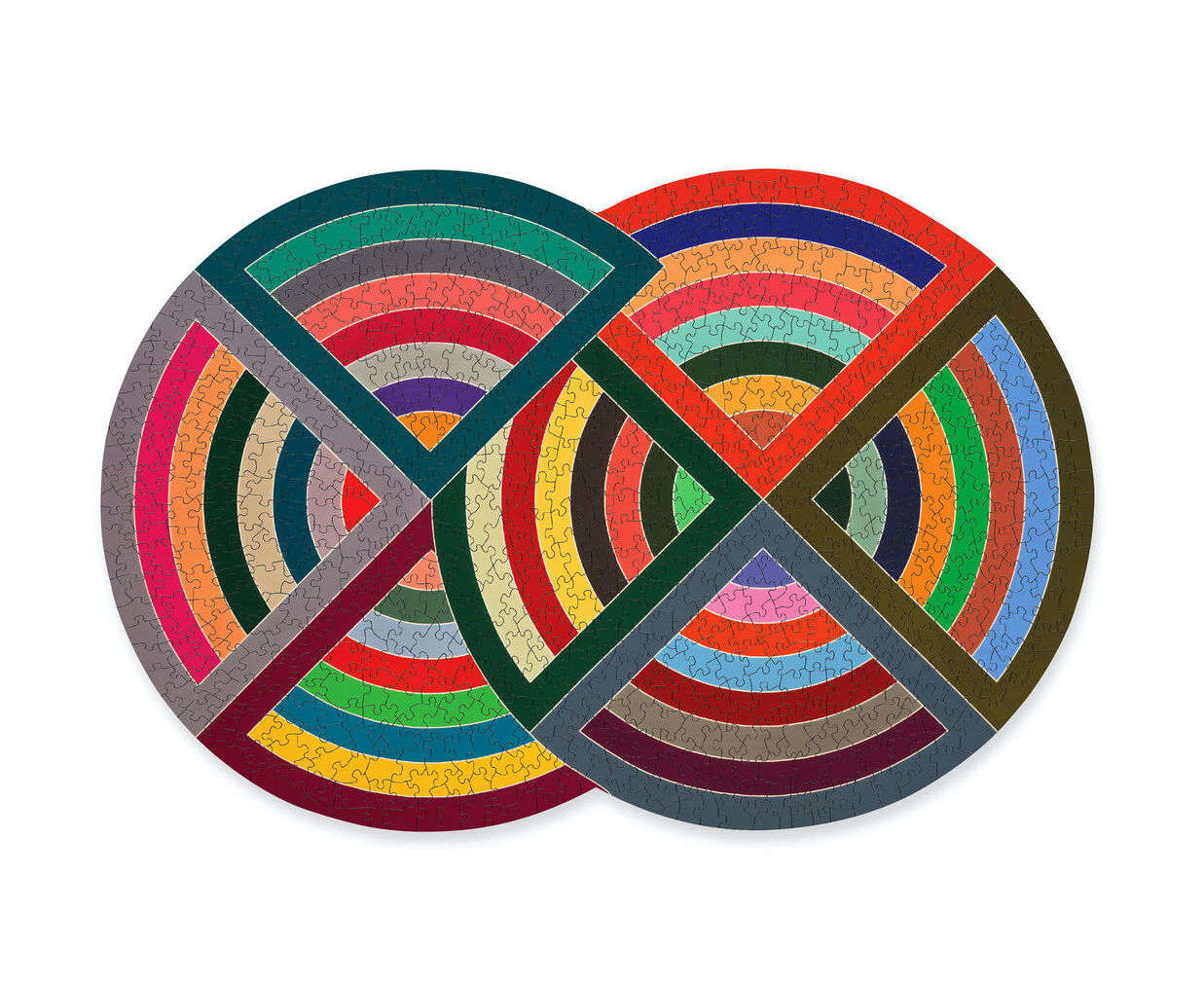
The Frank Stella Jigsaw Puzzle – 750 Pieces is not your average rainy-day table project. This is a puzzle with opinions. It has curves, color, abstract energy, and enough geometric confidence to make your coffee table look like it enrolled in art school. Based on Frank Stella’s vibrant 1970 painting Firuzabad, this shaped jigsaw puzzle turns a landmark of modern abstraction into a hands-on experiencepart art appreciation, part visual workout, and part “where on earth does this orange arc go?” adventure.
Created by Galison in collaboration with MoMA, the puzzle features a die-cut silhouette that follows the contours of Stella’s artwork rather than forcing it into the usual rectangle. That single design choice makes a big difference. Instead of building a polite square with corners that behave themselves, you assemble a sculptural-looking burst of bands, arcs, and overlapping color fields. It is a puzzle for people who love modern art, thoughtful gifts, clever design, and the satisfying little click of a piece finally finding its home.
What Is the Frank Stella 750-Piece Shaped Puzzle?
The Frank Stella 750-piece puzzle is a shaped art puzzle featuring Firuzabad, a work associated with Stella’s famous Protractor series. Most listings describe it as a 750-piece shaped jigsaw puzzle with a finished size of roughly 24.5 inches by 16.25 inches, though some retailers list slightly different measurements. The puzzle is packaged in a sturdy matte-finish box, making it suitable for gifting, storing, or displaying on a shelf where it can quietly announce, “Yes, I have taste.”
Unlike traditional rectangular puzzles, this design is cut to echo the edge of the artwork. That means the finished puzzle has a custom outline with curves and contours that match the visual rhythm of Stella’s composition. The result feels closer to assembling a small art object than completing a standard puzzle. It also means the border will not save you immediately. Corner-piece people, take a deep breath. Your beloved corners are mostly off duty today.
Why Frank Stella Makes Such a Good Puzzle Subject
Frank Stella was one of the most influential American artists of the postwar era. Born in Malden, Massachusetts, in 1936, Stella studied at Phillips Academy and Princeton University before moving to New York, where his early Black Paintings helped shift the conversation around abstraction, minimalism, and the physical presence of painting. His famous attitude toward artoften summarized by the line “what you see is what you see”fits puzzle-making beautifully. With Stella, you are not hunting for a hidden cottage, a secret cat, or a tiny lighthouse pretending to be important. You are looking directly at color, line, shape, edge, and structure.
That directness makes Firuzabad especially rewarding as a jigsaw puzzle. Stella’s Protractor works from the late 1960s and early 1970s used arcs, bands, semicircles, and interlocking geometries inspired in part by architectural patterns and circular city plans he encountered in Western Asia and Iran. In puzzle form, those ideas become wonderfully physical. You are not just viewing the composition; you are rebuilding its logic one curved stripe at a time.
The Art Behind the Puzzle: Firuzabad
Firuzabad is a bold, colorful abstract painting from 1970. In the original work, Stella used sweeping arcs and layered bands of color to create a composition that feels engineered, musical, and slightly mischievous. The title refers to Firuzabad, a city in Iran, and belongs to Stella’s broader interest in forms connected to Middle Eastern architecture, circular planning, and decorative geometry.
As a painting, Firuzabad is huge, immersive, and architectural. As a puzzle, it becomes intimate. You notice details that might escape a museum glance: the way a peach band meets a yellow curve, the way a blue segment interrupts a darker sweep, the way repeated shapes create rhythm without becoming predictable. It is the kind of puzzle that teaches you to look slowly. And in a world where most of us scroll faster than we chew, slow looking is practically a luxury spa treatment for the brain.
Key Features of the Frank Stella Jigsaw Puzzle – 750 Pieces
1. A shaped puzzle with a custom silhouette
The biggest selling point is the shape. The finished puzzle is die-cut and contoured to follow the artwork’s edge, creating a final object that feels visually dynamic. This is ideal for puzzle lovers who want something more interesting than a basic rectangle and art lovers who enjoy design-forward objects.
2. 750 pieces: challenging, but not punishing
A 750-piece puzzle lands in a sweet spot. It is more substantial than a casual 300-piece activity but less intimidating than a 1,500-piece monster that takes over the dining table and begins receiving mail. For many adults and older kids, 750 pieces offer a satisfying weekend project. It asks for focus without demanding that you cancel your social life.
3. Bright geometric artwork
Stella’s vivid color bands make the puzzle easier to sort than many fine-art puzzles based on painterly scenes or muted landscapes. You can group pieces by color family, curve direction, and line pattern. That said, the repeating arcs add a clever challenge. Several pieces will look like cousins, siblings, and possibly identical twins until you study them closely.
4. Gift-ready packaging
Galison puzzles are known for polished packaging, and this one is commonly listed with a sturdy matte-finish box. It looks good enough to wrap without needing a dramatic bow, although a dramatic bow never hurt anybody. The art-forward presentation makes it a strong gift for museum fans, design lovers, artists, teachers, collectors, and puzzle people who already own every cottage-core puzzle known to humankind.
Who Will Enjoy This Puzzle Most?
The Frank Stella 750-piece shaped jigsaw puzzle is a smart choice for several types of puzzlers. First, it suits modern art fans who want something connected to a major American artist. Second, it works for experienced puzzle solvers who want a new shape challenge without jumping into extreme difficulty. Third, it is excellent for gift buyers who want something thoughtful, stylish, and not destined to be hidden in a junk drawer next to expired batteries.
It is also a strong pick for families with older children, classroom art activities, creative studios, and anyone who enjoys color theory. Because the image is abstract, there is no “sky section” or “grass section” to slog through. Instead, the challenge comes from shape, pattern, and visual rhythm. That makes it especially appealing to people who like solving by logic and design rather than by recognizable objects.
Difficulty Level: Is It Hard?
On a difficulty scale, the Frank Stella puzzle sits somewhere between “pleasantly challenging” and “why did I think all red curves were the same?” The 750-piece count is manageable, but the shaped edge changes the normal strategy. Many puzzlers begin with edge pieces, but here the border is irregular and less predictable. You can still start with the outline, but it will require more patience than a standard rectangle.
The good news is that the strong colors help. Sort pieces by dominant color, then by line direction. Curved stripes become your map. Because Stella’s image relies on repeated arcs and geometric relationships, the puzzle gradually teaches you how it wants to be solved. At first it may feel chaotic. Then the structure appears. Then you become emotionally attached to a small lavender piece. This is normal. Puzzling does things to people.
Tips for Solving the Frank Stella Jigsaw Puzzle
Start with color families
Separate pieces into broad color groups: blues, yellows, oranges, reds, purples, creams, and dark outlines. Because Stella’s composition is based on bold bands, color sorting gives you a strong foundation.
Look for curve direction
After sorting by color, study the direction of the arcs. Some pieces curve inward, others outward. Placing them according to movement can be more helpful than relying on color alone.
Build small islands
Instead of forcing the entire border first, assemble recognizable clusters. A section of repeated yellow, a blue arc, or a striped orange passage can become a mini-island. Later, those islands connect into the larger composition.
Use the box image often
This is not cheating. This is scholarship. Stella’s puzzle rewards close comparison with the reference image, especially when two pieces look almost correct but one is clearly lying to your face.
Give it space
Because the finished shape is irregular, use a board or table larger than the final dimensions. A little extra room keeps the puzzle from feeling cramped and protects your progress from cats, elbows, and overly enthusiastic snack plates.
Why This Puzzle Works as Home Decor
Once completed, the puzzle has real display potential. The shaped silhouette and bright abstract design make it look more like a graphic art object than a typical jigsaw. Some puzzlers may choose to frame it, mount it, or photograph it before taking it apart. If your room needs color, Stella arrives like a marching band with excellent geometry.
For modern interiors, the puzzle pairs especially well with clean furniture, white walls, colorful bookshelves, and creative office spaces. It can add energy to a studio, reading nook, or game room. Even if you do not frame it, the completed puzzle is fun to leave out for a day or two. It invites conversation, and unlike most home decor, it comes with the humble brag that you built it yourself.
A Great Gift for Art Lovers and Puzzle Fans
The Frank Stella Jigsaw Puzzle – 750 Pieces makes a particularly good gift because it feels specific. It is not just “a puzzle.” It is a museum-quality art puzzle connected to a major American artist and a celebrated abstract work. That gives it more personality than generic landscapes or novelty images.
It is suitable for birthdays, holidays, host gifts, teacher gifts, graduation presents, or a thoughtful surprise for someone who needs a screen-free evening. It also works as a gift for people who say they “do not need anything.” They may not need anything, but they probably do need a Frank Stella puzzle and a quiet Saturday afternoon. That is practically wellness.
How It Compares With Traditional Art Puzzles
Many museum puzzles reproduce famous paintings in standard rectangular formats. Those can be beautiful, but they often turn the artwork into a flat image inside a predictable grid. The Frank Stella shaped puzzle is different because the objecthood of the puzzle echoes the objecthood of Stella’s own art. His shaped canvases challenged the idea that paintings had to behave like windows or rectangles. This puzzle extends that idea in a playful, accessible way.
In other words, the format is not a gimmick. It makes sense. A shaped Stella puzzle feels true to Stella’s artistic concerns: edge, structure, surface, color, and form. The puzzle becomes a miniature lesson in modern art, but without the intimidating museum wall label that makes everyone suddenly whisper.
Is the Frank Stella Puzzle Worth Buying?
Yes, especially if you enjoy puzzles that combine visual beauty with thoughtful design. The 750-piece count offers a satisfying challenge, the shaped format adds novelty, and the artwork gives the puzzle lasting appeal. It is also a strong choice for collectors of art puzzles, fans of MoMA-related products, and anyone who appreciates abstract art but does not currently have the wall space for a 15-foot painting.
The only caution is that shaped puzzles are not ideal for everyone. If you prefer traditional edge-first solving or highly representational images, this may require a small adjustment. But that adjustment is part of the fun. The puzzle asks you to think differently, which is exactly what great modern art tends to do. It nudges you out of habit and into observation.
Experience: Spending Time With the Frank Stella Jigsaw Puzzle – 750 Pieces
Working on the Frank Stella Jigsaw Puzzle – 750 Pieces feels less like assembling a picture and more like entering a colorful argument between geometry and joy. The first experience is visual: you open the box and immediately get hit with arcs, stripes, and bold blocks of color. There is no cozy cottage, no sleepy harbor, no basket of puppies wearing scarves. Instead, Stella gives you pure abstraction, and the puzzle politely says, “Good luck, champion.”
The early stage is all sorting. You start making piles by color, then realize that “orange” is not a single category but a whole emotional spectrum. There is yellow-orange, peach-orange, reddish-orange, and the orange that looks innocent until it joins the wrong arc and ruins your confidence. This is where the puzzle becomes strangely absorbing. You begin noticing tiny differences in line weight, curve angle, and edge shape. The more you look, the more the design opens up.
The middle stage is the most satisfying. Small sections begin forming like islands in a bright abstract sea. A blue curve connects to a cream band. A yellow segment finally stops wandering around the table like a lost tourist. The shaped border slowly appears, and with it comes the pleasure of seeing the puzzle become an object rather than a rectangle. That moment is important. It changes how you relate to the piece. You are not filling a frame; you are building the frame and the image at the same time.
There is also a meditative quality to the process. Because the image is abstract, your brain cannot rely on story clues. You have to slow down and notice relationships. Which stripe continues this line? Which curve matches this angle? Does this piece belong here, or is it merely flirting with the idea? That kind of attention is calming. It pulls you away from notifications, tabs, errands, and the dramatic inner monologue about whether you replied to that email. For a while, the only task is color meeting color.
The final stage brings a small burst of triumph. A shaped puzzle has a special finish because the completed outline feels unexpected. It does not sit there like a polite rectangle. It has movement. It almost seems to lean, spin, and hum. When the last piece clicks into place, the result looks lively enough to keep on the table for admiration. You may even find yourself explaining Frank Stella to someone who only came into the room looking for snacks. That is the magic of this puzzle: it turns puzzling into art appreciation without making either activity feel like homework.
Overall, the experience is colorful, clever, and pleasantly different. It rewards patience, close looking, and a willingness to let go of traditional puzzle habits. It is challenging enough to feel meaningful but not so brutal that it becomes a grudge match. Best of all, it leaves you with the feeling that you have spent time with a major artwork in a hands-on way. A museum visit is wonderful, but a museum visit where you get to rebuild the artwork piece by piece? That is a pretty excellent way to spend an afternoon.
Conclusion
The Frank Stella Jigsaw Puzzle – 750 Pieces is more than a puzzle with a famous name on the box. It is a smart, colorful, design-rich activity that brings modern American art into everyday life. Based on Stella’s Firuzabad, the puzzle captures the energy of the artist’s Protractor series through bold color, curved geometry, and a custom shaped silhouette. It offers a balanced challenge for adult puzzlers, an elegant gift for art lovers, and a memorable alternative to ordinary jigsaw designs.
If you enjoy puzzles that ask you to look closely, think visually, and occasionally negotiate with a stubborn orange curve, this one deserves a spot on your table. It is playful, sophisticated, and just difficult enough to make the final piece feel like a tiny personal victory. Frank Stella once helped change the shape of painting; this puzzle lets you change the shape of your weekend.














