
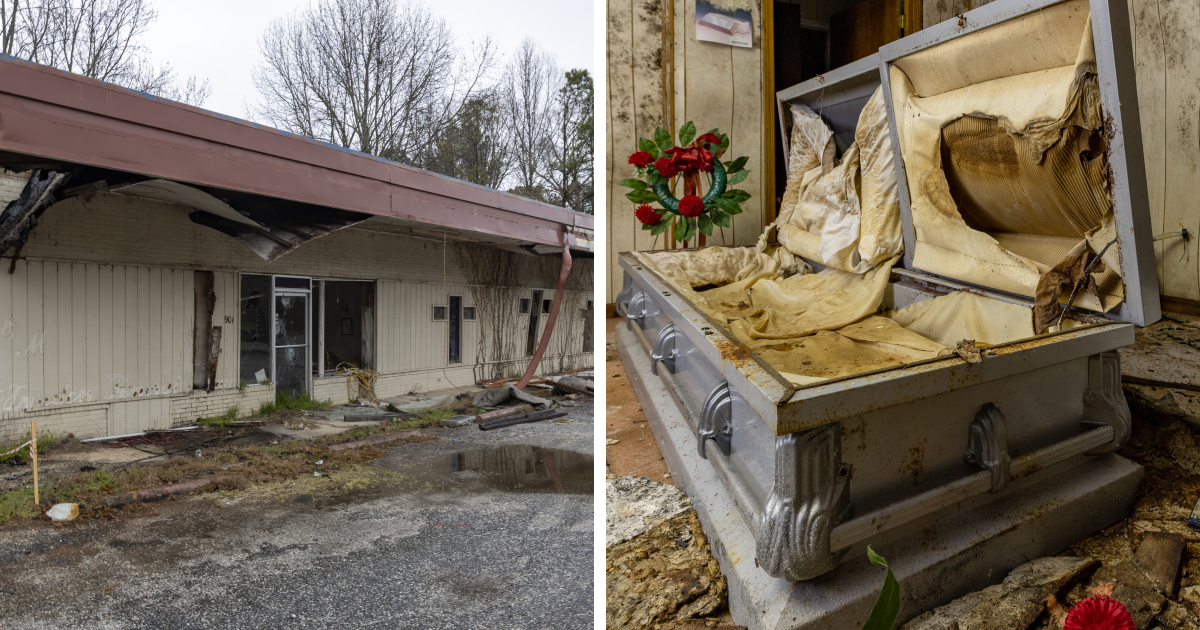
Some abandoned buildings whisper. This abandoned funeral home practically cleared its throat, adjusted its dusty tie, and said, “Welcome, traveler. Please do not touch the embalming equipment.”
My 9 photos of Little Shop of Horrors Abandoned Funeral Home are not just a spooky gallery of peeling paint, sagging ceilings, and rooms that look like they were abandoned mid-breath. They are a strange little tour through American death-care history, small-town decline, urban exploration photography, and the uneasy feeling that some buildings remember more than we do.
The name “Little Shop of Horrors” fits almost too well. This place had the theatrical gloom of an old horror set: cracked tiles, forgotten tools, warped wood, and that heavy funeral-home stillness that makes even your camera shutter sound disrespectfully loud. But behind the eerie atmosphere is something more human than horror. Funeral homes were once pillars of community life. Families gathered there to mourn, say goodbye, and try to make sense of the one appointment nobody gets to cancel.
When a funeral home is abandoned, it feels different from an empty store or shuttered office. A closed grocery store says, “People stopped shopping here.” A closed funeral home says, “People stopped trusting this place with their grief.” That is a much colder sentence.
The Story Behind the Abandoned Funeral Home
The real-life story connected to this site is unsettling. Reports about the building describe sheriff’s deputies arriving in 2010 to serve an eviction notice and discovering human remains left inside the funeral home. That detail alone changes the way every hallway, preparation room, and basement corner feels. It turns the building from creepy scenery into a failed responsibility.
This is why abandoned funeral home photography demands a careful tone. It is tempting to lean into the Halloween mood, especially when the location looks like it auditioned for a horror movie and got the part. But places like this are not just “creepy abandoned buildings.” They were workplaces, family businesses, neighborhood institutions, and, in some cases, sites of real negligence. The best urban exploration photography finds that balance: atmospheric without being cruel, curious without being invasive, and dramatic without forgetting the people behind the story.
Why Abandoned Funeral Homes Feel So Haunting
There is a reason abandoned hospitals, schools, churches, and funeral homes fascinate people. These are emotional buildings. They were built for big human moments: birth, learning, worship, sickness, grief, and farewell. When they decay, they do not feel empty. They feel interrupted.
A funeral home is especially powerful because it combines domestic comfort with clinical purpose. Many American funeral homes were designed to feel like houses: carpeted rooms, lamps, floral wallpaper, framed landscapes, soft chairs, and a front door that says “come in” instead of “facility entrance.” But behind that parlor-like warmth were embalming rooms, prep tables, casket displays, hearses, refrigeration, paperwork, and procedures. That strange mix creates visual tension. One room says casserole and condolences. The next says stainless steel and formaldehyde.
In these nine photos, that contrast becomes the main character. The building seems to hold two moods at once: the polite quiet of a receiving room and the sharp, metallic unease of a place where death was handled professionally.
Photo 1: The Entrance That Forgot How to Welcome People
The first photo begins where every funeral home visit once began: the entrance. In its active years, this doorway probably received grieving families, flower deliveries, clergy members, funeral directors in dark suits, and guests trying to remember whether they signed the condolence book.
Now the entrance feels like a mouth with missing teeth. Paint curls from the trim. The door frame looks tired. Dust softens every surface. It is the kind of doorway that makes you pause before stepping through, partly because of safety and partly because your brain politely asks, “Are we making wise choices today?”
As an image, the entrance sets the emotional contract for the whole gallery. This is not a jump-scare tour. It is a slow walk into a building that has lost its public face. The welcome is gone, but the architecture still remembers how it used to behave.
Photo 2: The Viewing Room and the Theater of Goodbye
The viewing room is where funeral homes do their most delicate work. It is not only a room; it is a stage for farewell. Chairs are arranged with intention. Lighting is softened. Flowers are placed to comfort the eye. The casket becomes the still center of the room.
In an abandoned funeral home, the viewing room becomes deeply strange. Without people, flowers, music, or ceremony, the space looks like a theater after the audience has vanished. The carpet may be stained, the ceiling may sag, and the walls may show water damage, but the layout still suggests ritual.
This photo works because it lets absence do the talking. There is no need to exaggerate the horror. A quiet room where people once cried is haunting enough. The emptiness is not blank; it is loaded.
Photo 3: The Preparation Room Where the Mood Changes Fast
Every abandoned funeral home gallery has a moment when curiosity becomes caution. The preparation room is usually that moment.
Unlike the viewing room, the prep room was not designed to comfort families. It was built for work: practical surfaces, drains, equipment, storage, chemicals, and tools. In photographs, these rooms often look more medical than memorial. They remind viewers that funeral service is both emotional care and technical labor.
This image likely carries the strongest “Little Shop of Horrors” energy. A forgotten sink, a stained counter, a metal table, or a piece of old equipment can look like a prop from a creature feature. But the real story is not monster-movie nonsense. It is the behind-the-scenes labor that made public mourning possible. Funeral directors prepared bodies, arranged services, answered calls at impossible hours, and guided families through decisions nobody wants to make.
That is what makes the decay unsettling. This was once a room of duty. Now it feels like a room abandoned by duty.
Photo 4: The Basement That Nobody Wants to Explore Alone
Basements in abandoned buildings are already suspicious. Basements in abandoned funeral homes should come with their own soundtrack: one cello note, held forever.
The basement photo is probably the darkest chapter of the set. Basements collect moisture, mold, rust, fallen debris, and the kind of shadows that make flashlights feel underqualified. If reports connected to the property mention remains found below the main floor, the basement becomes more than architectural space. It becomes the location where neglect crossed a moral line.
From an SEO perspective, this is why searches for abandoned funeral home photos, creepy abandoned places, and haunted funeral home continue to attract readers. People are not only looking for fear. They are looking for story. They want to know what happened, what was left behind, and why a place built around dignity fell into disgrace.
Photo 5: The Embalming Equipment and the Tools of a Hidden Trade
One of the most fascinating parts of funeral home photography is the equipment. To outsiders, embalming machines, pumps, porcelain sinks, drainage systems, and prep-room tools can look mysterious or frightening. To funeral professionals, they were simply part of the job.
Modern American funeral customs changed significantly after embalming became more common in the 19th century, especially as families wanted bodies transported over long distances and preserved for viewing. Over time, the work moved from family homes into the hands of professional undertakers and funeral directors.
That history gives this photo depth. The equipment is not just creepy hardware. It represents a major shift in how Americans handled death. Families once washed and cared for loved ones at home. Later, professionals took on that role, creating a specialized industry with its own tools, training, rules, and rituals.
In the photo, the equipment may be rusted, dusty, or half-hidden, but it still points to a serious craft. Spooky? Absolutely. Historically important? Also yes. Like a haunted museum exhibit with worse ventilation.
Photo 6: The Casket Area and the Business Side of Mourning
If the funeral home still contains a casket display area, the photo may feel less like a horror scene and more like an abandoned showroom. That is its own kind of strange.
Caskets are emotional objects, but they are also products. Funeral homes have always operated at the intersection of grief, service, tradition, and commerce. Families make financial decisions while under stress. They choose between burial, cremation, memorial services, flowers, transportation, printed programs, and other details while trying to hold themselves together.
An abandoned casket room exposes that tension. The sales setting remains, but the customers are gone. Brochures may be scattered. Display stands may lean. The room can feel frozen in a moment after the last transaction, as if business simply evaporated.
That image invites a bigger question: what happens when community institutions can no longer survive? Changing consumer preferences, rising costs, cremation growth, family mobility, and consolidation in the funeral industry have all reshaped death care in America. The empty casket room is not just eerie. It is economic evidence.
Photo 7: The Office Where Paperwork Outlived People
Offices in abandoned buildings are underrated. They are rarely the scariest rooms, but they are often the most revealing. A desk, a calendar, a phone, a file cabinet, or a stack of forms can tell you how quickly a business unraveled.
In a funeral home, paperwork is not boring. It is identity, permission, transport, death certificates, contracts, family contacts, cemetery arrangements, insurance information, and regulatory responsibility. The office was where grief became logistics.
This photo may show ordinary clutter, but ordinary clutter becomes powerful in the right context. A dusty chair behind a desk suggests the funeral director who once sat there. A wall calendar suggests the last month anyone bothered to turn the page. A file cabinet suggests private lives reduced to folders.
It is not the most cinematic room. It will not make anyone scream, unless they are afraid of paperwork, in which case welcome to adulthood. But it may be one of the saddest rooms in the set.
Photo 8: The Hallway That Connects Public Grief and Private Work
Hallways are the veins of abandoned buildings. They move the eye from one mood to another. In a funeral home, a hallway might connect the chapel to the office, the family room to the prep area, or the public entrance to staff-only spaces.
This hallway photo is important because it shows the building as a system. Funeral homes rely on separation. Families see comfort, order, and ceremony. Staff manage the difficult work behind closed doors. A hallway is where those worlds nearly touch.
Visually, abandoned hallways are irresistible. They create depth, mystery, and that deliciously bad idea of wondering what is around the corner. A good hallway photograph lets viewers feel like they are standing there with you, breathing dust, listening too hard, and pretending the sound upstairs was “probably the wind.”
In this gallery, the hallway becomes a reminder that architecture shapes emotion. The building was designed to control movement, privacy, and mood. Even in decay, it still directs the story.
Photo 9: The Final Room and the Feeling That the Building Is Done Talking
The last photo should not try to top the others with a bigger scare. The strongest ending is usually quieter: a broken window, a chair in the wrong place, a light leak across the floor, or a room where the wallpaper is giving up one strip at a time.
This final image feels like the exhale after the tour. By now, the viewer has seen the entrance, the viewing room, the prep space, the basement, the equipment, the office, and the connecting corridors. The building is no longer just creepy. It is understood.
The best abandoned place photography does this. It begins with curiosity and ends with reflection. You click for the chills, then stay for the questions. Who worked here? Who trusted this place? Who failed it? Who will clean it up? Should it be demolished, preserved, documented, or left alone?
That is why this abandoned funeral home lingers in the mind. It is not simply a “scary place.” It is a collapsed promise.
Urban Exploration Ethics: Take Photos, Not Souvenirs
Abandoned places attract photographers because decay is visually generous. Rust, dust, broken glass, sunlight through roof holes, peeling wallpaper, and forgotten objects can make even a simple room look cinematic. But urban exploration comes with ethical rules, and those rules matter even more in a former funeral home.
The basic principle is simple: take nothing, break nothing, stage nothing, reveal sensitive locations cautiously, and respect the dead as well as the living. Do not move objects just to create a better shot. Do not steal documents, tools, signs, or religious items. Do not force entry. Do not vandalize. Do not treat tragedy like a theme park.
There are also serious safety risks. Abandoned buildings may contain asbestos, lead paint, mold, unstable floors, exposed wiring, sharp metal, animal waste, biohazards, and structural damage. A dramatic photo is not worth a hospital visit, a criminal trespass charge, or becoming the reason firefighters have to enter an unsafe building.
The strongest urbex photographers understand that restraint improves the work. A respectful image lasts longer than a reckless stunt.
Why These Photos Matter Beyond the Creep Factor
It would be easy to package the Little Shop of Horrors Abandoned Funeral Home as pure spooky content: “Look at this nightmare room! Look at this creepy sink! Look at this basement where your common sense goes to die!” And yes, the building is undeniably eerie. It has all the ingredients: death-care setting, decayed rooms, disturbing history, and enough atmosphere to fog up your glasses.
But the photos matter because they preserve a moment in the life cycle of a building. America is full of vacant structures that sit between memory and demolition. Some are eventually restored. Some are repurposed. Some collapse. Some burn. Some become neighborhood hazards. Others become local legends whispered about by teenagers with flashlights and questionable footwear.
Photography gives these places a second record. Not a full rescue, but a witness. It says: this existed, this happened here, this is what was left behind.
My Experience Photographing a Place Like This
Walking into a place like the Little Shop of Horrors Abandoned Funeral Home is not like walking into an abandoned mall or an old factory. Those places can feel huge, industrial, and impersonal. A funeral home feels intimate from the first step. The rooms are smaller. The details are softer. The silence seems more intentional. You do not feel like you are exploring a business as much as entering a house where everyone left after receiving terrible news.
The first thing I noticed was the smell. Abandoned buildings have their own vocabulary: damp wood, old carpet, rust, mildew, sun-baked dust, and sometimes the sharp chemical scent of materials breaking down. In a former funeral home, every odor feels suspicious, even when it is probably just moldy drywall. Your imagination starts writing horror scripts without being asked. Very rude of it, honestly.
Photographing the rooms required patience. The light was uneven, pouring through broken windows in bright slices while corners stayed dark and stubborn. I had to move slowly, not only for composition but for safety. Every step became a small negotiation with the floor. Is that board solid? Is that glass? Is that hole deeper than it looks? Is that noise a raccoon, a loose shutter, or the building expressing an opinion?
The hardest part was deciding what not to photograph. In a location connected to real death-care failure, the camera can become too hungry. It is easy to chase the most shocking object in the room. But shock is cheap. Mood is better. Context is better. Respect is best. I found myself focusing on doorways, surfaces, light, and the way objects sat in space rather than trying to turn every image into a horror poster.
One photo that stayed with me was not the creepiest one. It was a quiet corner with a chair, peeling paint, and a patch of sunlight on the floor. Nothing dramatic. No scary object. No obvious funeral equipment. But it felt like the whole building was present in that corner: the service it once offered, the neglect that followed, and the strange dignity that remained despite everything.
That is the unexpected lesson of photographing abandoned funeral homes. You arrive expecting fear and leave thinking about responsibility. These buildings remind us that death care is built on trust. Families hand over their loved ones and expect competence, compassion, and order. When a funeral home fails, the damage is not only legal or financial. It is emotional. It violates one of the most vulnerable moments in a family’s life.
At the same time, there is beauty in documenting what remains. Not pretty beauty, exactly. More like honest beauty. The kind found in cracked plaster, dusty glass, and rooms still trying to hold their shape. Abandoned funeral home photography is powerful because it combines the visual pleasure of decay with the moral weight of memory. It asks viewers to look longer than they planned.
By the time I left, the place felt less like a haunted attraction and more like a warning. Buildings do not become abandoned overnight. They decline through neglect, debt, changing industries, poor decisions, and sometimes outright wrongdoing. The camera catches the final stage, but the real story began much earlier.
So yes, my nine photos are creepy. They deserve the title. The place has enough horror atmosphere to make a flashlight feel like a tiny emotional-support animal. But the real chill is not in the shadows. It is in the reminder that every abandoned building was once useful, trusted, and full of human activity. Even a Little Shop of Horrors was once somebody’s place of business, somebody’s place of mourning, and somebody’s last stop before goodbye.
Conclusion
My 9 Photos Of Little Shop Of Horrors Abandoned Funeral Home captures more than decay. It captures the uneasy overlap between horror aesthetics, American funeral history, urban exploration ethics, and the fragile trust families place in death-care professionals. The building is creepy, no doubt. But the deeper story is not about ghosts hiding in corners. It is about abandonment, memory, responsibility, and what happens when a place designed for dignity loses its own.
These photos remind us why abandoned places fascinate us. They are visual mysteries. They are time capsules. They are warnings with broken windows. And sometimes, like this funeral home, they are dark little museums of promises that were not kept.










